Continuing the ‘avian’ theme this Pelican at Healesville seemed more than content to pose for what was probably the easiest animal portrait I have yet taken in this series.

- Content at Rest
Continuing the ‘avian’ theme this Pelican at Healesville seemed more than content to pose for what was probably the easiest animal portrait I have yet taken in this series.
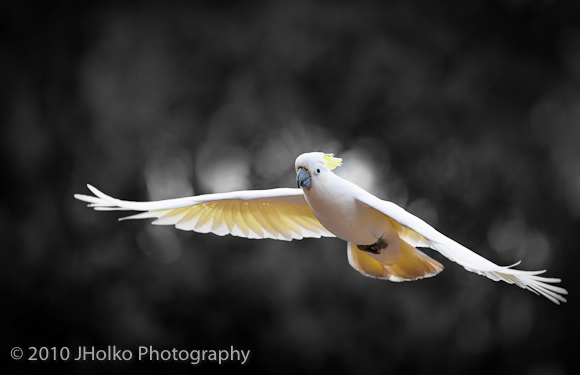
Another from the same photo shoot as the Emu photograph ‘Eye-to-Eye‘. This time of the Australian Cockatoo in flight at Healesville. I shot this with the Canon 300mm F2.8L IS wide open at F2.8 ISO400 1/2000th of a second to freeze the action. Tracking birds in flight is not easy – this was one of only a few good sharp frames where I was also very happy with the pose. In order to make the Cockatoo better stand out from the background I created a second layer in Photoshop, converted it to Black and White and then masked off the Cockatoo. This effect dramatically helps in isolating the bird and creating a clear point of focus.
I am starting to wind down my Wildlife Portraits project as its only a week now until I leave for Iceland and I have a seemingly never ending list of things I need to complete before I can leave. The plan was to run the project up until I left for Iceland. However, I have subsequently shot a lot more frames than I initially thought I would have and still have images to sort through and process. So, rather than finalise a project that feels somewhat incomplete I am simply going to put it on hold until I get back and have a chance to pick up where I am leaving off. I will then see the project through until the end of the year. The additional time should give me greater opportunity to expand the portfolio into a more complete form. I hope to still post a couple more images (including this photograph) before next week when the project will officially go on hold.

The definite highlight from my trip to the South Island of New Zealand just on a year ago was the helicopter flights over Fox Glacier and the Southern Alps. A helicopter ride is far and away the best way to see, experience and photograph both Fox Glacier and the Southern Alps. Whilst you can walk up to the Glacier (and even climb on sections) most of the glaciers slowly moving mass is generally just to unstable, too difficult to traverse and too dangerous to access in any other way except by helicopter. Not to mention its otherwise impossible to get these kind of shots from ground level. This photograph was taken over Fox Glacier leaning out (but well strapped in!) with the door off for better visibility during one of the many passes we did over the seracs and crevasses. Although quite hard to tell in this small jpeg the scale of the ice wall running through the frame is immense and that crevasse seemingly bottomless. A higher resolution version of this photograph is on my portfolio website at www.jholko.com in the New Zealand section. At this stage I am likely heading back to the South Island of New Zealand early next year and will definitely be returning to Fox Glacier for more aerial photography.
Barring any major volcanic event this will most likely be my last Katla update before I leave for Iceland in two and a bit weeks. I did ‘touch wood’ before my last update a week or so ago when all was quiet as it kind of felt like the calm before the storm with very minimal seismic activity. However, there have subsequently been more than seven earthquakes at the Katla Caldera in the last 48 hours. Since 17-May-2010 there have been approximately 96 earthquakes at the Katla volcano site within the region of the Myrdalsjokull glacier. Of the 96 earthquakes, 27 have been within the Katla caldera. It is interesting to note that of the approximate 96 Katla earthquakes since 17-May, the majority have occurred just off of the northwest rim of the caldera. Katla has been fickle during the past number of weeks in that there have been days when hardly an earthquake has appeared, while there have been other days that have been fairly active. There was one stretch of several weeks that was very quiet, while during the past several days there has been quite a lot of activity, much more than average since I’ve been watching this. What does this mean?
Who knows… or rather no one knows. There are no reports of imminent eruptions from the Icelandic MET office to date for Katla. But, (and it is a big but), I am reminded that Katla historically does erupt following the Eyjafjallajokull volcano; which erupted back on the 14th of April this year. I am also reminded that Katla is around ten times more powerful than Eyjafjallajokull and that an eruption would have world wide consequences. Not the least of which would be greatly affected air travel. Its only a couple of weeks until I leave for Iceland now so my fingers are crossed Katla can hold its ‘magma’ for at least this long.
 www.WILDNATUREPHOTOTRAVEL.com