In May of 2023, I ran what has become an annual ground-level wildlife masterclass workshop in Zululand, South Africa. African Safaris and even African Photographic Safaris are nothing new, but the ability to work at ground level with wildlife in Africa is unique and incredibly special. Working at ground level provides opportunities for emotive and powerful photographs simply not possible from traditional safari vehicles. Whilst we have all seen endless pictures of Cheetah high up from safari vehicles, how many have seen or experienced Cheetahs while walking on the ground? How many have walked with and photographed wild Cheetah on the hunt?

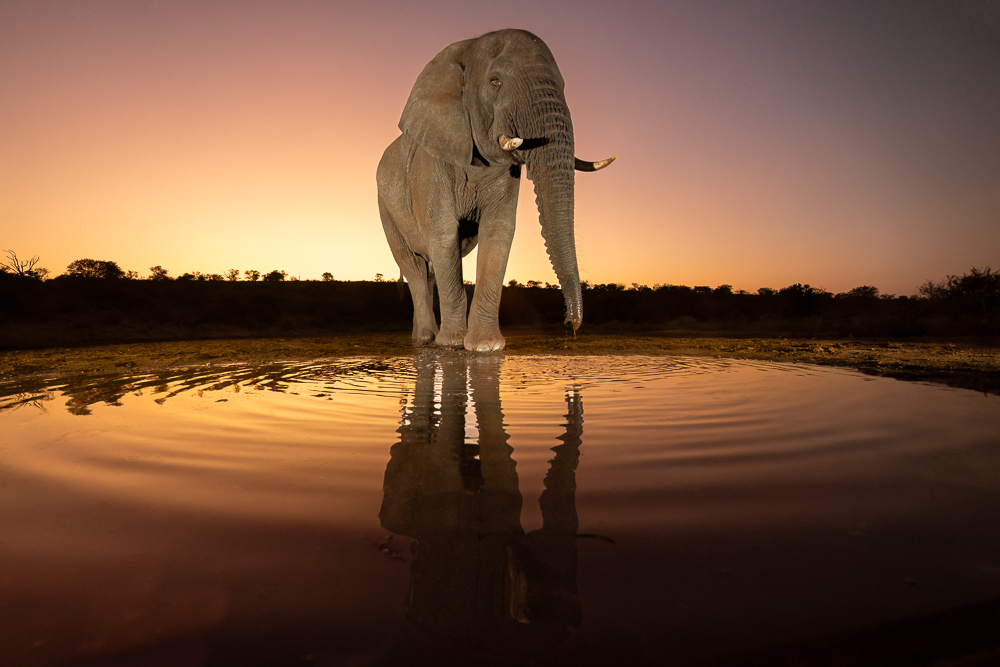
Located in Zululand, the private game reserve for this workshop spans more than 70 square kilometres and includes many species above the African big five. Additionally, the game reserve consists of several dedicated state-of-the-art hides offering the ability to photograph wildlife at ground level and at night, when many of the species come to drink at the water holes. The overnight hides provide opportunities for dramatic and unique photographs simply not possible in any other way.
This workshop was a complete camp takeover, meaning there was no one else in the game reserve for the entire workshop. The whole camp takeover meant we had many more opportunities in the overnight hides than would typically be possible. It also meant a great degree of flexibility in terms of daily activities. Overnight hide sessions, day hide sessions, game drives, and walk with Cheetahs were all available on demand. This flexibility meant we could custom-tailor each day and each session to each participant’s needs and wants. Complete camp takeovers such as this are uncommon and make all the difference in the final image portfolios of participants.
As a complete camp takeover, we broke into small groups for each daily activity. Typically there is an early morning activity and an afternoon / overnight activity. For those going into one of the overnight hides, the evening and morning activities are combined. You never know when the wildlife will turn up at a hide!

The ability to get out of a safari vehicle and walk with and photograph wild hunting Cheetahs at ground level is game-changing for photographers looking to capture incredibly dramatic images that rise well above the ordinary safari vehicle photograph; during the making of these photographs, I was able to walk alongside the Cheetah and put myself in the best possible place for both the subject and the background.

Photography from the overnight hides in the game reserve offers opportunities to create unique and evocative photographs during the African night. Each overnight hide is equipped with a kitchen, a flushing toilet, and sleeping beds, meaning you can be comfortable and ready when the action happens.
In the day hides, we photographed many African bird species, including the incredible Malachite Kingfisher. This small bird has stunningly beautiful colours and can be photographed with lenses as short as 70-200mm.

During the ten-day workshop, I kept a list of all the bird species I could identify positively. There were approximately a dozen or so more birds I could not reliably identify. All of the birds on this list were photographed, and their species were confirmed with Merlin Bird ID. If you have even a passing interest in birds, I thoroughly recommend this application for assistance with bird identification—our complete bird list for the trip across all participants is included below. Personally, my count was slightly lower at 50 species.
- African spoonbill
- Reed cormorant
- Hadeda ibis
- Black-headed heron
- Western cattle egret
- Green backed heron
- Woolly necked stork
- Saddle billed stork
- Hamerkop
- Egyptian goose
- White backed culture
- Hooded vulture
- African fish eagle
- Bateleur
- Martial eagle
- Black Chesttd snake eagle
- Black shouldered kite
- Lanner Falcon
- Helmeted guineafowl
- Crested francolin
- Natal spur fowl
- Black crake
- Secretary bird
- Black bellied bustard
- African jacana
- Water Knick-knee
- Blacksmith lapwing
- Crowned lapwing
- Three banded plover
- Cape turtle dove
- Emerald spotted wood dove
- Burchell’s coucal
- Verreaux’s eagle owl
- Freckled nightjar
- Speckled mousebird
- Giant kingfisher
- Pied kingfisher
- Malachite kingfisher
- Brown hooded kingfisher
- White fronted bee eater
- Lilac breasted roller
- Southern yellow-billed hornbill
- African hoopoe
- Crested barbet
- Forktailed drongo
- Pied crow
- Dark capped bulbul
- African stonechat
- Southern black flycatchers
- Cape wagtail
- Pied wagtail
- African pipit
- Magpie shrike
- Cape glossy starling
- Red billed oxpecker
- Amethyst sunbird
- White bellied sunbird
- House sparrow
- Yellow weaver
- Spectacled weaver
- Blue waxbill
- Common waxbill
- Green winged pytilia
- Red-billed fire finch
- Yellow fronted canary
- Sabota Lark

Whether it is your first visit to Africa or if you are a veteran of multiple African safaris and have always wanted to photograph wildlife in the dark continent at eye level, this is the workshop for you. Not only is the 2024 Zululand ground-level wildlife masterclass an incredible opportunity to photograph African wildlife at eye level, but importantly, it is also a full camp takeover, meaning we have the entire game reserve to ourselves. We will have exclusive use of the entire reserve and all its facilities for the duration of this workshop. There will be many opportunities for overnight and day hides, walking with cheetahs and game drives. Game drives also include the new low-level safari vehicle that enables photography from a much lower angle than traditional safari vehicles. Due to the initial registrations, only two places remain before the workshop is sold out. Don’t hesitate to get in touch with me to register your interest.

 www.WILDNATUREPHOTOTRAVEL.com
5 thoughts on “Zululand Africa Ground Level Wildlife Masterclass Report May 2023”