I have just published episode 128 of my Wild Nature Photography Podcast. In this episode, I discuss the August photograph of the month, my departure for Sweden, as well as my thoughts on the camera rumour mill problem and how it affects photographers and the quality of the work they produce.
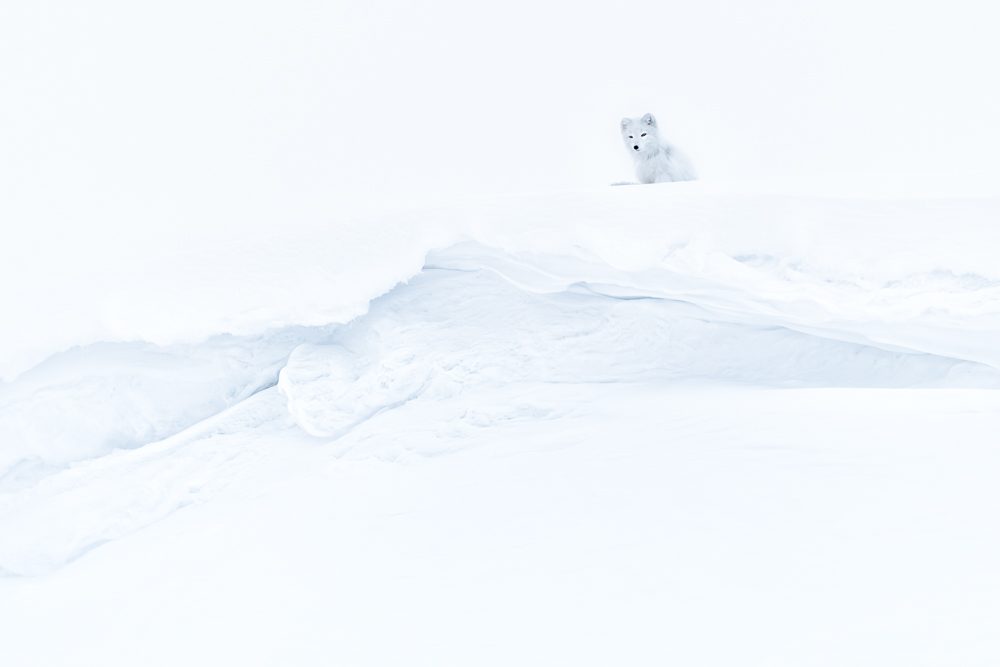
The photograph of the month for July 2025 comes from my winter Svalbard trip in April this year (Read the Trip Report). This white-morph Arctic fox was wonderfully posed on the very top of a snow drift from where it could best survey its territory. This was one of those encounters that lasted only the briefest of moments and required getting into position very quickly and without hesitation. We spotted the fox from some distance away and approached slowly on our snowmobiles. In order not to frighten the fox, we parked some distance away and approached on foot. I quickly unpacked my 600mm and approached as quietly as possible with the intention of using the beautiful snow drift to help give context to the snowy environment. Even with this careful and cautious approach, I could only squeeze off a couple of shots before the fox turned and disappeared behind the snow drift. This fox had been living in one of the abandoned coal mines and as such had a slightly grey coat, which really helped isolate it against the snow and sky.
Early in 2027, our Wild Nature Photo Travel team is going to be running a sold-out expedition to Antarctica on a private ship for just ten photographers. For this expedition, we will be flying over the Drake Passage in both directions, saving ourselves 4 days of rough sea travel. This expedition has been sold out for some time, but we are now offering the same trip in early 2028 (full details are here), and it felt like a good time to do a benefit analysis of the many different offerings out there.
The below is a direct comparison that breaks down the most significant benefits of our unique Antarctica offering. The most significant factors for many will be the flights over the Drake Passage (saving four days of rough sea travel), the number of actual days in Antarctica, the guide to client ratio, the number of zodiac operations and landings (including actual time ashore), early and late operations for the best possible light, and of course the actual realised cost per day in Antarctica.
*** Update to above – I forgot to include the airfare over the Drake in the final total. Once included, the per cost per day comes out at $2,138 USD. Over $1200 USD per day cheaper per day.
Many of you are patiently waiting for me to finalise the creation of the new A.I Noise Reduction presets for Canon’s professional mirrorless cameras. The good news is I have now finished all of the colour checker analysis over the last week, and I have also finalised and optimised A.I Noise Reduction settings for every single ISO for the Canon EOS R1. This was a painful, painstaking process of analysis that involved many days of staring at my computer screens. Whilst it may seem a simple process to tweak the single A.I noise reduction slider for each different ISO, the reality of getting it optimal is anything but. Different colours respond differently at different ISO settings, and optimising the amount slider is an agonising back-and-forth process that has taken much more time than I anticipated.
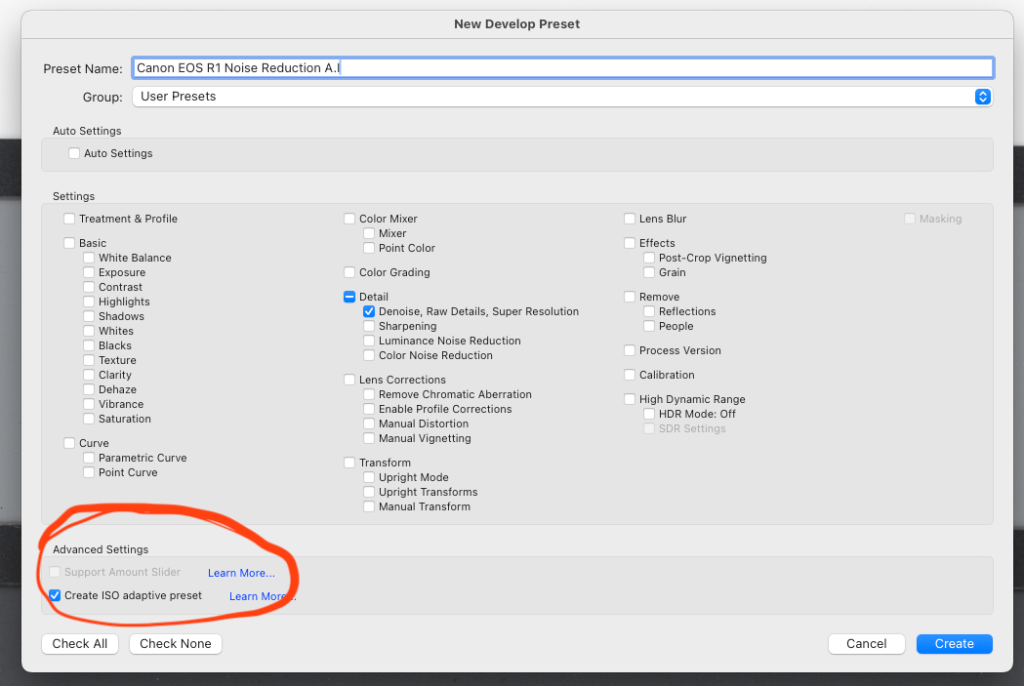
Today, I was planning to finish the last step and create the A.I NR preset and post my results, and the preset for sale. However, I have run into a significant problem. Adobe has not enabled the ‘Support Amount Slider’ for A.I Denoise, which means, in practice, the application of the preset does not set the amount slider for A.I noise reduction! You can see the screenshot below, the tick box is greyed out.
What this means in practice is that the preset will apply A.I Noise Reduction, but will set the slider amount to its default setting only. This effectively makes an A.I NR preset useless as you would have to manually adjust the slider (which defeats the entire purpose of a preset). I am unsure why Adobe has not supported the amount slider, but I have an email in with Adobe on this issue at present. More to come once I hear from Adobe.


 www.WILDNATUREPHOTOTRAVEL.com