For those of you that follow my blog on a regular basis you will be well aware that I am a big fan of the Gura Gear Kiboko 30L camera bag. Like most photographers I have a cupboard full of camera bags; but since I purchased and started using the Gura Gear Kiboko 30L about a year and a half ago no other bag has seen the light of day. If you are not yet familiar with Gura Gear then do yourself a favour and check it out. I won’t wax lyrical about it any further in this post – You can read my previous thoughts, comments and impressions HERE if you are interested. You may find them of interest as a prelude to my pre-flight review of the new Gura Gear Chobe bag. I was quite excited when I heard Gura Gear were developing a new bag that was over the shoulder and designed to carry laptops and other digital accessories (including camera equipment). I know quite a lot of photographers who on first encounter lamented the Kiboko for excluding the capacity to carry a laptop Gura Gear now also offer a mini-Kiboko that does have laptop capability for those photographers who want to carry their laptop in their main camera bag). However, such a design would cripple the truly remarkable ability of the Kiboko to swallow vast amounts of camera gear and carry it effectively in the field. A separate lap-top bag was and is always a better alternative and I am in complete agreement with Gura Gears chief designer and founder Andy Biggs in this regard.
As a photographer who spends quite a lot of time travelling one of the biggest hurdles I have to overcome is not only how to get all my camera equipment from Country A to Country B in carry on luggage; but also how to get all the required accessories onto the plane as carry on luggage – including Laptop, power supply, back up hard drives, card readers, universal power board and converters; and the list goes on. Until now I have more or less shoe horned as much of this equipment as possible into my laptop bag, vest pockets and camera bag – a solution that is really far from ideal and has seen me struggle through airports on more than one occasion with rather nasty excess baggage costs and less than friendly airport check in staff. This solution is also far from practical or comfortable. Needless to say I was quick off the mark to order the new Gura Gear Chobe when I first read about about its design and attempt to solve these problems.
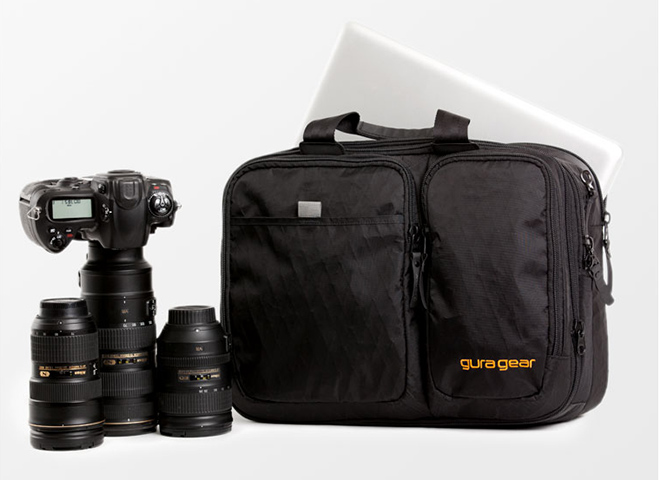
Anyone who has ever flown internationally with a DSLR, multiple lenses, laptop and seemingly endless accessories (seriously, is there any other profession that offers such a seemingly limitless need to accessorise?) will immediately appreciate the design of the Chobe. Designed to hold a 15″ MacBook Pro, Apple iPad (am I the only person that doesn’t actually own of these yet?), portable hard drives, power supplies, other digital accessories and camera gear via a clever insert the Chobe ticks all the boxes for the travelling photographer. From Gura Gears’s website:
Chobe is a well-designed full-featured business, travel, and photography bag with room for all of the necessary accoutrements. In its normal state, Chobe is the perfect business bag with room for a 15” laptop, iPad AND a Kindle or other tablet, business papers, magazines, travel documents, and all of the bits and pieces that make life comfortable on the road. With the flip of a zipper, the bag expands to accommodate a spare change of clothes and goes from day job to overnighter. Add the custom designed matching padded photo insert and Chobe’s role grows to camera bag extraordinaire hauling professional DSLR camera bodies and lenses in style.
I have not as yet had a chance to use my new Gura Gear Chobe bag (it only arrived a few days ago); but here is how I intend to use the Chobe on my Antarctica trip in a few weeks time: For travel to Antarctica from Australia I have packed my Kiboko full of camera gear. You can read a full list of just what fits in a Kiboko and what I am taking to Antarctica HERE. I will emphasise that this amount of gear is not inconsequential and fills the Kiboko (a little creative packing is required; but it does all fit). In the Chobe I am packing a 15″ MacBook Pro, Power Supply, 3 Back up 1 Terrabyte Firewire 800 drives, card readers, universal power strip, universal power converters, travel documents, passport, wallet, keys, etc (I can even fit a portfolio of a dozen A4 prints in the side pocket!). All of this fits into the Chobe leaving the large middle exapandable compartment completely empty. This empty compartment gets filled with the optional camera ‘insert’ (packed flat) and left empty for air travel. The beauty of this configuration is ‘if’ my Kiboko gets weighed as overweight for carry on luggage I can immediately remove several lenses and a body and pack them in the Chobe; effectively spreading the weight between the two bags. In this configuration this makes the Kiboko and Chobe a match made in travellers heaven for photographers carrying large amounts of equipment as carry on luggage. Just as an aside: Gura Gear state on their website that the Chobe is designed to hold a 15″ Macbook Pro. I would add to this that you can actually squeeze a 17″ Macbook Pro into the Chobe in the larger middle pocket (I know, because I tried). Whilst this is not ideal as you give up a good portion of the central storage area it does mean that in a pinch you can carry a full sized 17″ Macbook Pro (I recently ordered a new 15″ Macbook Pro for this trip as I wanted a smaller and lighter laptop than my current 17″ version and it was sheer co-incidence that the Chobe came on the market at a similar time).
Once I reach my final destination for this Antarctic trip (the Ocean Nova in Ushuaia) I can unload and reconfigure either the Kiboko or the Chobe for Zodiac and shore based trips as required. The flexibility of having two camera bags that can transport all of my photographic equipment and accessories between countries as well as serve in the field duties as required is a real plus. I can leave my laptop and accessories in my room and pack either the Kiboko and/or Chobe as required for each excursion. I briefly discussed camera bags for Antarctica with a good friend of mine earlier this week who is joining me on the trip to the bottom of the world and had a good chuckle to myself when I found he was taking both a Kiboko and a Chobe with exactly the same usage intentions.
Made of the same light weight but incredibly strong sail clothe the Chobe (like its big brother the Kiboko) weighs significantly less than most bags its size when empty. Every gram counts when travelling and starting with a light weight bag can make all the difference. From Gura Gear’s website:
Constructed of the finest materials, Chobe features lightweight, durable sailcloth, the same technology used in the America’s Cup race sails. The bag’s convertible function allows for multiple missions by discerning travelers that work as hard as they play. Because the bag was developed on the road, the little things are covered, like an expansion pocket for a drink and plenty of pockets and compartments to keep life organized. A concealed sleeve for sliding on rolling luggage means that Chobe can hitch a ride any time. The bag fits international requirements for carry on sizes and in most cases qualifies as a simple personal item.
The Chobe will also fit the bill nicely for shorter trips where a full size Kiboko is overkill or just not required. Given it can hold a laptop, DSLR and a slew of lenses it will be sufficient for most short trips or day / overnight outings. It will be ideal for everything from a family BBQ outing to the professional photojournalist on the road – And that is no minor accomplishment. One of the things I appreciate the most about both the Kiboko and the Chobe is that the design allows for the photographer to access all of their equipment without having to unzip and fold out a large flap. This might seem trivial to the non-photographer; but if you have ever used a generic camera bag in the field and have had to place it on the ground the problem with this large flap design becomes immediately apparent. When shooting from a vehicle or boat the problem is exacerbated even further. Both the Kiboko and the Chobe solve this problem (albeit in different ways) by providing the user the ability to access the equipment in the bag without this large flap.
In a market place that is more or less saturated with camera bags the Chobe manages to not only successfully differentiate itself from its competition by offering more versatility, storage and capability in a lighter weight package than its competition (and at the same time serve as the perfect accompaniment to its larger Kiboko brother) but also illustrate just how much more practical it is than the market alternatives through its ingenious well thought out multi-function design. I predict the Chobe is destined to become a staple of the travelling photographer and a long term stayer in the camera bag market. I know several other pro-photographers that have already jumped on the Chobe ‘wagon’ as the perfect addition to their Kiboko for the same reasons I have. The secret is now well and truly out of the bag when it comes to Gura Gear (pardon the intentional pun). I have no doubt that the Chobe will be a success for me on my upcoming trip; but I will of course report back on just how it fared throughout the trip on my return. Consider this pre-flight working review a prelude to a full review post my Antarctica trip.
I want to add a small disclaimer in conclusion to ensure clear air: I pay for all of my Gura Gear bags out of my own hard earned money. I am not payed to write reviews for Gura Gear or any other camera equipment manufacturer. I choose to write about photographic products that I like and use because I believe in the products and have found them successful in my own photography; not because a manufacturer incentivises me. I do and have supplied Gura Gear (and other manufacturers) with my photography for their website/s because I believe in their product. You can consider these op-ed. pieces my endorsement and/or recommendation of the products I choose to use in my own photography. And that is the highest recommendation I can give for a product.
By the way – expect a few ‘in the field’ Gura Gear photographs to appear on my blog post Antarctica. I have a bet running with a good friend on how many other photographers have gotten wise to the benefits of Gura Gear and some rather good bottles of wine are riding on it. :-)

 www.WILDNATUREPHOTOTRAVEL.com