Antarctica – The Global Warning was released in back in 2006. The photographs are by Sebastian Copeland and there is a forward by Mikhail Gorbachev and a Preface by Leonardo DiCaprio. At the time of release it retailed for approximately $70.00 AUD here in Australia. It can now be found for significantly less than that if you shop around. You might want to read this review in full however before you part with your hard earned dollars on this book. I have actually been meaning to review this book for some time now, but before I begin I just want to say a few words about what Antarctica is actually like for those of you who have never been there.
Antarctica is miraculous. It is a continent of stark and beautiful desolation and I feel very privileged to have now visited and led expeditions to this incredible continent numerous times over the last few years. No where else on earth have I experienced such a sense of wonder as what I have felt in Antarctica and no where else is the landscape so other worldly. There is a variation to the weather, light and landscape in Antarctica that is in my experience completely unique. Mother Nature is a mad scientist and Antarctica is surely her greatest creation.
I have seen and experienced Antarctica at it’s most sunlit, brilliant and dazzling. I have also experienced violent storms, catabatic winds, snowstorms and some of mother Nature’s wildest weather. I have experienced dark, moody and overcast skies, racing clouds, sunlit mountains and glistening blue glaciers, the gentlest of snowfall and the strongest of blizzards. The weather and conditions in Antarctica are as varied as anywhere on earth and every visit offers a new experience in this regard.
It is this varied weather and Antarctica’s ability to both dazzle with brilliance and glow with purity that I found so obviously missing in Sebastian Copeland’s – ‘Antarctica The Global Warning’ photography book. This omission might not have bothered me so much (if at all) if it were not for the title of this book; the connotation of which is undeniable. This is, in its most basic form, a book intended to fuel the global warming debate. I do not wish to enter into this debate in this review; suffice to say that in my experience global warming is undeniable (I have witnessed its effects every year in both Antarctica and the Arctic). The problem I have with Antarctica The Global Warning book is that it it only shows one face of Antarctica in an attempt to skew the viewers impression of what Antarctica actually looks like and that makes it only a half truth.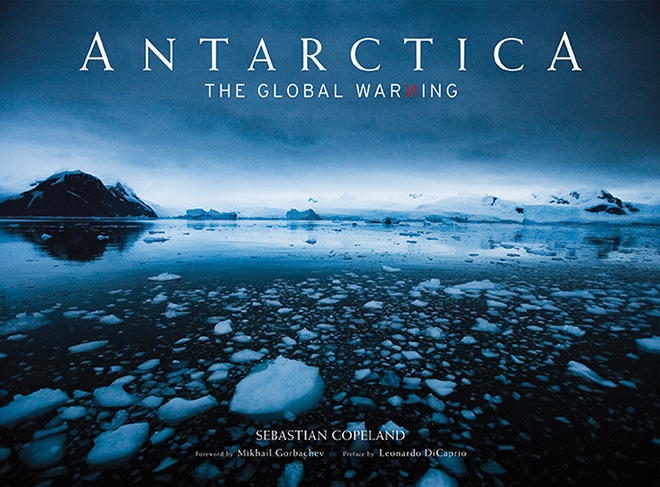 I feel there was an opportunity (and even a responsibility) in this book that has been missed by Sebastian Copeland. The opportunity existed to show Antarctica not only at its most mysterious, dark and ominous, but also in its brilliance and purity. Sebastian could have shown the ‘real’ Antarctica and the global warming message would have been even stronger. Yes, Antarctica can look like the dark images portrayed in this book. But it can also look brilliantly dazzling and incredibly pristine and pure. Indeed, it is often the most brilliant weather that truly portrays the rate of melt underway. I feel somewhat at odds saying this as a photographer who seeks out dark, moody and evocative landscapes in my own photography. Ultimately however, Sebastian’s book is not intended as a book of fine art photographs; it is intended to deliver a message and the images it uses to do so are only partially representative of the true Antarctica.
By far the majority of people who will read this book will have never visited Antarctica and will never do so in their lifetime. There is therfore an obligation in my view to present a more balanced viewpoint on what Antarctica is truly like when the intended purpose of the book is to highlight global warming.
It is hard to get past the message Antarctica The Global Warning is intended to deliver and I feel that is largely due to my own significant experiences in Antarctica. Had I never visited the continent I may well feel differently about the photographs in this book and their intended message. This leads me to believe that I and others who have visited Antarctica are not the intended audience for this book.
Print Quality: From the dust jacket I was disappointed with the print quality in Antarctica The Gobal Warning. There is clear evidence of banding, crushed and muddy blacks, blown highlights and poor tonal gradation. The photographs themselves are highly stylised with what I feel has been overly heavy-handed post production treatment (particularly in the 3/4 tones) and heavy vignetting. Many of the photographs are quite soft and exhibit excessive grain and noise; which, would appear to be a combination of over processing and poor quality offset printing. I am giving Sebastian the benefit of the doubt that these were not technical errors during capture. Overall, I was bitterly disappointed with the print quality in this book.
I personally have a strong preference for images that are printed with a white border around them to help contain and frame the photograph. Many of the images in Antarctica The Global Warning are full page, full bleed and appear awkwardly cropped to fit the page size. I find this approach detracts significantly from the photographs and the photographers vision. This approach leaves me feeling short changed as if the photographer or publisher decided it was more important to have a full bleed photograph than it was to respect the images naturally preferred crop. There are examples to numerous to document where important elements in images are arbitrarily cropped at the edge of the page which leaves the image experience incomplete.
I have attempted over numerous sittings with this book to come to a different conclusion; but ultimately I feel Antarctica the Global Warning is a propaganda piece likely intended for those who will never visit or experience the true nature of this miraculous continent. I do not believe photographers are the intended audience for this book or more care and attention would have been paid to the print quality, layout, cropping and selection of photographs. I feel this book is a missed opportunity and that to me is the most disappointing aspect to this book.
Overall Review – * Give it a miss. There are better books on this subject you should consider adding to your library first

 After a sunrise shoot tomorrow in the Lamar Valley we will pack up and head toward Old Faithful and spend several days exploring and photographing in this area. There have been reports of Bobcat activity along the Madison River and I am keen to see if we can find and photograph one of these elusive cats in the wild.
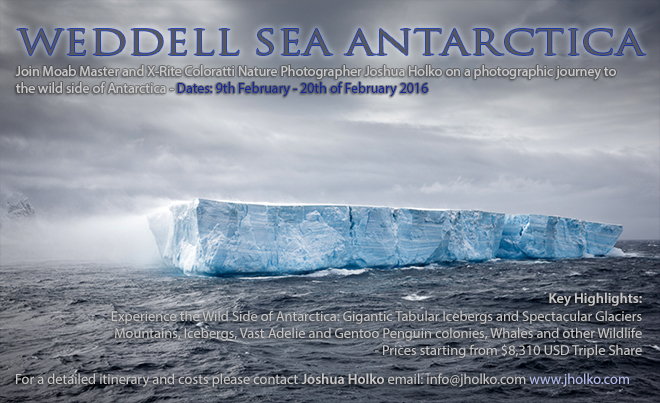 We will sail across the Bransfield Strait to Antarctic Sound on our journey toward the Weddell Sea. Antarctic Sound is home to literally monolothic tabular icebergs that break off the Antarctic ice shelf and float up out of the Weddell Sea. There are incredible photographic opportunities in this area and we will stop to take advantage of spectacular tabular icebergs as we encounter them. We then plan to travel down the east side of the peninsula as deeply as we can penetrate into the sea ice.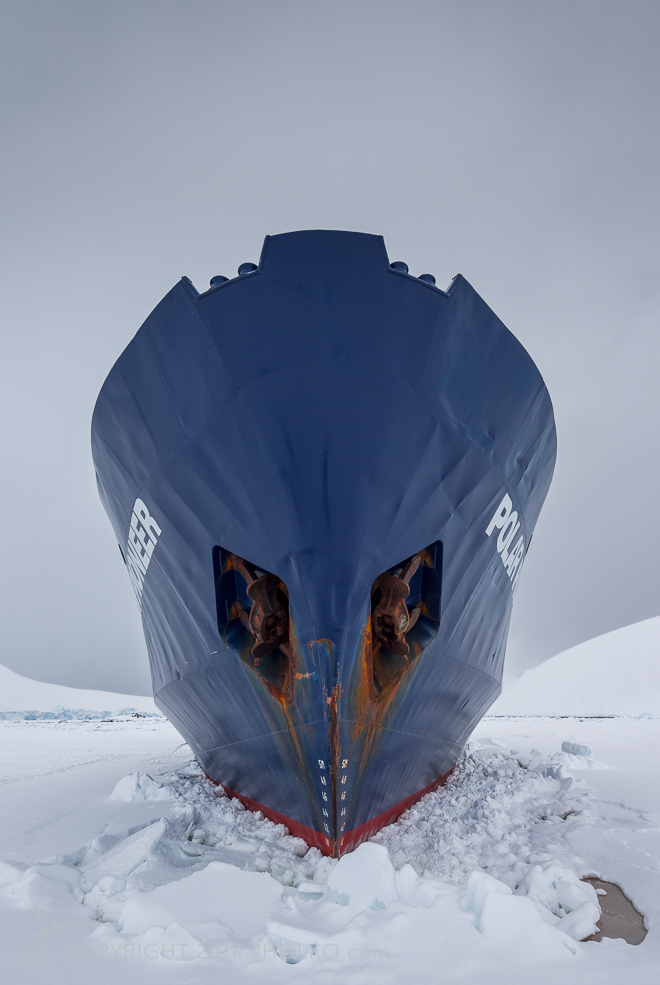

 Yellowstone in Winter is only my first stop during my time away from home and at the conclusion of this trip I will be travelling directly to Iceland for my annual