One of my recent purchases that I was very keen to test out in the South Island of New Zealand in Winter was the new Seal Skins gloves I purchased online just before I left Australia. In Part One of this mini-review I made mention that it has been a constant search for the perfect winter photography glove. I won’t restate the story thus far; suffice to say the search has been ongoing. Before I dive into it I just want to make a comment on the fingerless glove with the optional slide over mitten that many outdoor sports people and hunters use. These types of gloves don’t work for me. Although they provide plenty of tactile feel (because they are fingerless) they are not waterproof and far from warm enough in the sort of environments I sometimes shoot in.
The Seal Skins gloves on face value appeared to tick all the boxes for me. They are waterproof, warm (at least around the house!) and yet retain enough tactile feel that I can still operate my camera equipment effectively in the field. So how did they perform?
The result is a mixed bag. Firstly, the gloves are in fact waterproof as advertised. I spent several hours clambering over Fox Glacier in cold and wet conditions. Experience has shown me that my previous thermalite gloves (which were warm when dry) would have been totally saturated after half an hour of this kind of activity and thus totally useless. The Seal Skinz on the other hand remained totally dry; even when I was fumbling around in puddles of glacial water adjusting my crampons. They shed water beautifully and remain dry on both the inside and outside. Just on the subject of glaciers – I almost came to quite a nasty end at Fox Glacier. I am always extremely careful when traversing glaciers for obvious reasons.I have quite a bit of glacial experience; but you can never take them for granted. They are riddled with hidden dangers; falling ice, wave surges and crevasses are but some of the potential dangers. Glacial ice is pound for pound about the same weight as structural concrete and there have been several very unfortunate deaths over the years at Fox Glacier from falling ice. Fox Glacier is currently receding and this makes it more dangerous than an advancing glacier since it is shedding ice (at a fairly rapid rate). I was keen to get a photo of the terminal face of the glacier so had hiked up the side of the glacial river with a wide angle lens to get close to really give a sense of scale to the photograph. Getting close to the terminal face meant skirting the edge of a very large overhanging piece of glacial ice – not something I would normally do. I could see large boulders and rocks perched precariously on the ice flow 30 odd feet above. However, ‘photo fever’ got the better of me and I chanced it; I scrambled forward against the ice and river; set up my tripod and prepared to take a frame just as several rocks the size of basketballs came hurtling over the top of the ice landing only a few feet in front of me in the river. Needless to say that was enough for me. It was a timely reminder that no amount of experience on glaciers is worth a pinch if you find yourself somewhere you shouldn’t be . I beat a hasty retreat and decided it was far wiser, safer and more enjoyable to photograph the glacier and alps by helicopter.
I have photographed the Southern Alps and Glacier by Helicopter before in winter in 2009. I had chartered a small mountain helicopter with two other photographers. We had the doors removed and spent a couple of glorious hours shooting thousands of frames over the alps. The ambient air temperature was -19 degrees celsius during that flight plus whatever the wind chill factor was and even with several thermal layers I was frozen by the time we got back to the helipad.
I chartered another helicopter this trip and with the door off and harness on spent another hour photographing the alps and glaciers shortly after breakfast. It was not quite as cold this time at -9 degrees celsius; but it was still a good test for the Seal Skinz. What I found was that my fingers still got very cold (almost totally numb after an hour shooting); however, even with near numb fingers, the chopper door off and wind I was still able to change both CF and the tiny SD cards in my 1DSMK III with relative ease. In fact, I was really quite surprised at just how good the tactile feel is in these gloves. I never felt like I was going to drop any of the small cards; even when I had several between different fingers in an effort to ‘speed-change’ the cards. Helicopter charter is $1500 an hour – so you don’t want to waste to much time playing with camera cards and settings. In this respect the Seal Skinz gloves are nothing short of brilliant; giving all the tactile feel required for even the most difficult shooting environments. The downside is they are not quite as warm as I had hoped they would be and I can only rate their thermal protection as average at best.
In summary the Seal Skinz are the best gloves for cold weather photography I have yet tried and are therefore my current choice when I am shooting in these environments. They are waterproof, and give wonderful tactile feel and grip. They are not as warm as other thicker gloves; but I am willing to trade some warmth for ‘feel’. I suspect that in temperatures down to around -5 celsius they will do just fine for quite long periods of time. In colder temperatures I will want to have a warmer over mitten that I can put over the top after an hours shooting to re-warm my hands. This is the best current compromise/solution I can come up with. Seal Skinz do make a version of this glove that is lined with a polar plus material; which would undoubtedly make it quite a bit warmer. However, I suspect that one would trade quite a lot of ‘feel’ for ‘warmth’. The Seal Skinz will be accompanying me to Antarctica later this year so that is a pretty solid recommendation. The caveat is I will also be taking a pair of 66 North over mittens just in case it gets really freezing and I need to re-warm to carry on shooting.
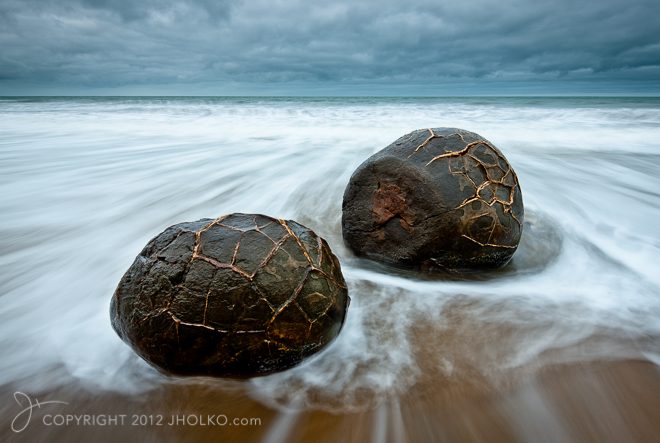 I took this photograph not long before sunset as the tide was going out on a very overcast stormy afternoon. I actually prefer sunset at the Moeraki boulders even though the sun sets behind the photographer and is lost behind mountains quite early in the afternoon. I found sunrise somewhat problematic as so many of the boulders are deep in shadow and the moment the sun rises it is hard to exclude the sun from the frame if shooting wide angle lenses. That said, I do have some photographs from sunrise that I like very much and will post over the coming days.


