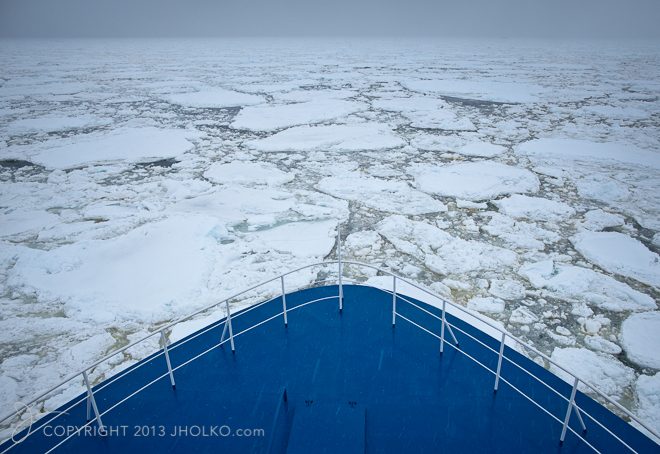
One of the most spectacular features of Antarctica we are looking forward to visiting on the expedition I am leading this November aboard the Polar Pioneer is the Lemaire Channel. This natural, narrow channel is flanked on both sides by high mountains and snow dusted rock spires and rates as one of the most wondrous and beautiful places I have ever had the pleasure to photograph. Slowly cruising through the channel is akin to what I imagine it would be like aboard a space ship gliding between towering and precipitous mountains on an alien world. Whether you are on the bow, aft, port or starboard the landscape is equally awe inspiring and impressive. On my last trip the conditions were overcast with frequent heavy snow and dark brooding clouds as we made our way slowly through the channel. Whilst a few photographers were bemoaning the lack of clear skies for sunset colour I was secretly thankful for the dark and ominous atmosphere. Antarctica is so often depicted for its brilliance that I find it refreshing to see images that depict a more ominous and portentous landscape.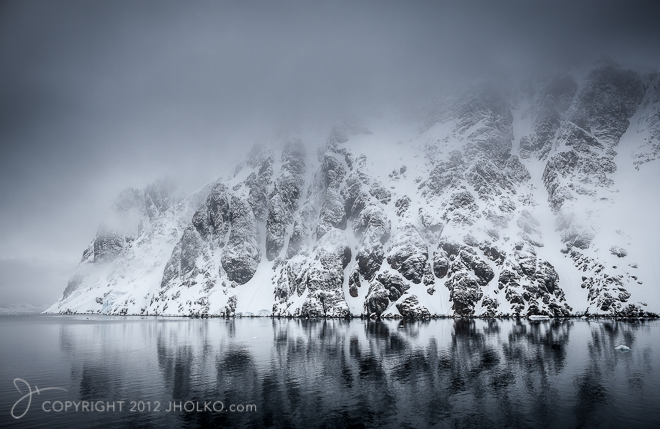 Frequently clogged with icebergs and pack ice the channel is really only safely navigable early in the season in an ice hardened expedition class ship such as the Polar Pioneer. Later in the season when the weather warms and the ice thins the channel is frequently visited by larger tourist based cruise ships; although the danger of ice bergs to their thin steel skin always remains. One of the real benefits of a photographic expedition to Antarctica aboard an ice hardened ship is the ability to not only get close to very large icebergs, but also to push pack ice out of the way greatly increasing the photographic possibilities in locations such as the Lemaire Channel.
 Although passage through the Lemaire Channel is never guranteed we do plan to sail through it (weather and ice conditions permitting) this November. I am secretly hoping for more dramatic weather and evocative atmospherics.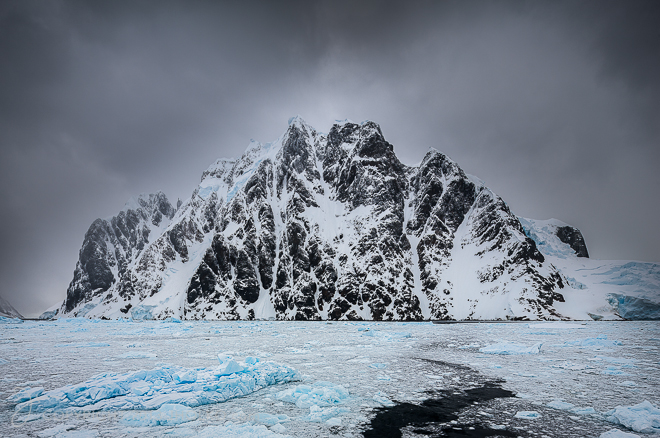
Category: Landscape Photographs
Landscape Photographs from around the World
Half Moon Bay in Antarctica
It has been sweltering hot the last few days in Melbourne Australia with temperatures today peaking at an oven roasting 40+ degrees Celsius. Those of you who know me well know that I would much prefer to be caught in a snowstorm unprepared than stuck in this kind of weather. With the mercury at a summer high the only way I could find to cope with the heat was to crank up the air conditioner and think of icebergs. So with the air conditioner working overtime in my studio I have been reviewing some of the images I shot in Antarctica in 2011 and found one I had not yet processed from Half Moon Bay. This photograph was taken during one of our early shore landings and was one of around a dozen frames I shot of this particular iceberg. This was one of the few images on the entire trip that I utilised a tripod for as I wanted a very slow shutter speed to soften the water and to better emphasise and juxtapose the chalky blue iceberg against the distant soft fog and snow. This frame was also the only sharp frame from the series as the iceberg was imperceptibly moving with the current which resulted in the rest of the frames suffering from motion blur. I used the Canon 70-200mm F2.8L IS at the 200mm end at F11 with a 10 second exposure and the LEE Big Stopper. A higher resolution version of this photograph can be seen on my website at www.jholko.com. This photograph is also my photograph of the month for January 2013.
Outdoor Photographer of the Year Finalist 2012
I received notification via email yesterday that one of my photographs from Antarctica has made the finals in the 2012 Outdoor Photographer of the Year Competition. I feel I have been very fortunate this year as I was also a finalist and highly commended with 3rd place in the Travel Photographer of the Year ‘Single Shot Water Category’ and was a finalist in the ‘Fine Art Photographer of the Year’ competition in Paris a few months ago. This was the first time I have entered Outdoor Photographer of the Year and did so more or less on the spur of the moment as one of the category titles (‘The Spirit of Adventure’) really struck a chord with me whilst browsing their website. I had a particular image from Antarctica; which I felt really summed up ‘The Spirit of Adventure’. The photograph in question was taken from the deck of the Ocean Nova near the Lemaire Channel and is of mountain climbers nearing the summit of one of Antarctica’s precipitous mountains in rapidly deteriorating weather. The truth of this photograph is that I did not see the mountain climbers (or at least I do not recall seeing them) when I took this photograph. I do recall being attracted to the sinuous ridgeline, dark sky and swirling clouds as we cruised slowly past and perhaps on a subconscious level I did see the climbers; but my memory of this particular photograph is a little foggy. It was, after all, just one of more than 13,000 images taken on the trip.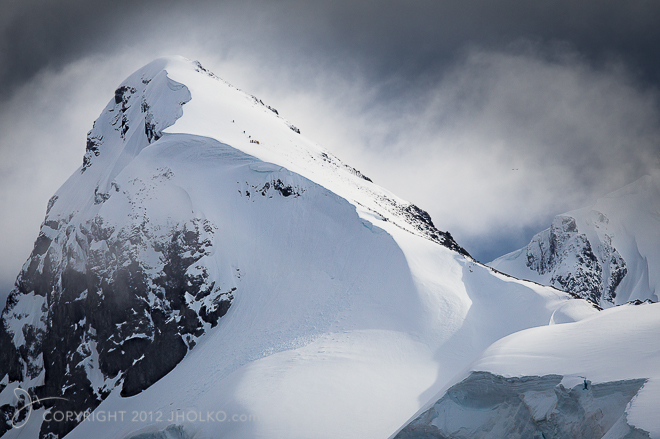 From the exif data I know I used the Canon 300mm F2.8L IS lens on the Canon EOS 1D MKIV body, which gave me an effective focal length of 390mm for this capture; which should help give an idea of just how far away these climbers were when I made this photograph. It was shot at ISO400 F7.1 at 1/2500th of a second. You can’t see it on this small jpeg; but there are two large sea birds perfectly sharp and frozen to the right of frame. A higher resolution version of this photograph can be seen on my website in the Antarctica Portfolio.
Footnote: Unfortunately, Outdoor Photographer of the Year is not judged on the ‘Print’; but rather on the submission of digital files. To their credit they do require the submission of the original RAW file as proof the photograph has not been significantly tampered with. As I have previously blogged however, I far prefer to have my work viewed in Print, which I regard as the ultimate output. Nevertheless I am very honoured to have made the finals of this prestigious competition and look forward to seeing the winning entries when they are announced early next year.
Iceland 2014 Workshop Dates
For those of you who would like to do some pre-planning and get in early on future workshops; I will be leading three trips to Iceland in March, July and August in 2014. The first of these in March will be a Winter Aurora trip and the second two will be Summer trips into the Highland regions. All three of these workshops will be co-led with my good friend and Iceland’s most experienced guide Daniel Bergmann and each will be limited to just twelve participants. We will be using highly modified Icelandic super jeeps (4-wheel drive monster trucks) to access the best areas in Iceland for photography. There will be no camping on these trips and we will be using guest houses and hotels as our bases. All accommodation, food and in country ground transport will be provided. The emphasis on these workshops is photography and as such we plan to be out in the field when the light is at its best.
Winter Aurora Workshop 2014
- March 8th – March 18th 10 Days / 9 Nights
Summer Highlands Workshop 2014
- July 14th – July 23rd 10 Days / 9 Nights
- July 28th – August 6th 10 Days / 9 Nights
I am not quite ready to start taking bookings for these 2014 trips as yet (that will happen early next year); but if you are interested in joining one of these workshops you can email me and I will contact you prior to opening these trips for bookings. The 2013 trips sold out fast (Summer sold out in 24 hours and the first winter trip sold out in just a few days) so if you are keen I recommend emailing early to avoid disappointment (no obligation at this point).
Cathedrale Notre Dame : Reims, France
France is home to some of the most magnificent and spectacular cathedrals, churches and chateaus I have had the privilege to visit in Europe. During my time in France in July this year my wife and I visited a great many throughout Paris and the French countryside and I spent a lot of time looking up with my camera at the wonderful architecture. Without doubt the most famous cathedral in France is the Notre Dam in the heart of Paris. I was actually unaware that there are in fact two Notre Dame Cathedrals in France. The first (where all the tourists go) and most well known is in Paris. The second is in Reims – Cathédrale Notre Dame; and is where this photograph was taken.
Many of the photographs I made in both France and Italy I have converted to Black and White and treated with Nik Silver EFX Pro 2 as I felt the monochrome tonalities better captured the timeless feeling of the various places for me. This first photograph however I chose to keep in colour (although the pallet is selective and somewhat muted) as I very much like the dichotomy of the stone and stained glass and the rays of sunshine streaming in through the windows. I did not in anyway ‘treat’ the colour in this image and simply left it as captured by the cameras sensor.
I admit to pre visualising this photograph as I wandered around the Cathedral with my camera in the late afternoon listening to the school choir. I had noted the angle of the sun on entry and had hoped it was going to strike the stained glass and indeed it did shortly after my arrival. It lasted only a minute or so before the light was gone; but it was a magical minute of wonderful light. In order to achieve this effect in a single frame without shenanigans I used the cameras spot meter and metered off the windows as I knew this would preserve the highlights and let the shadows fall where they may. I was then able to coax out the detail in the shadows in post-production in Lightroom with the Shadows slider.
Just an aside; but I continue to be absolutely amazed at the high ISO quality of the files from Canon’s 1DX camera. Shot at ISO3200 the RAW file is incredibly clean and the tiny bit of luminance noise that is apparent at 100% in the shadows at ISO3200 is easily cleaned up in Lightroom with small nudge of the luminance noise slider. The noise control of the 1DX is truly remarkable.

 www.WILDNATUREPHOTOTRAVEL.com