The 2011 (APPA Australian Professional Photography Awards) Gold award images are now finally online and available for viewing at the APPA website (although the Silver with Distinction and Silver awards have not yet been uploaded as of this time). The APPA awards are widely regarded as one of the toughest photographic competition in the world today and are one of the few photographic competitions that still actually judge the ‘printed image’ in the majority of the categories. The 2012 APPA awards are now only months away and it is definitely time to start considering entries for the year. My 2011 APPA Gold print; ‘Abandoned Blue Berg’, is currently on display as part of my ‘Colours of Iceland’ exhibition at the Wilderness Gallery at Cradle Mountain Tasmania. All of the prints in the exhibition are printed on my personal favourite paper – Moab Somerset Museum Rag.
Category: Landscape Photographs
Landscape Photographs from around the World
ANTARCTICA DEBRIEF REPORT
It has taken me longer than I had hoped to pull together this post Antarctica round-up debrief. Between jet-lag (which I just seem to take an inordinate amount of time to get over when crossing so many time zones – particularly between the Americas and Australia), Christmas, New Year social functions, a stomach upset, my kids, the wife etc. it has been longer than I would have liked between posts. I am also well behind in my image editing and processing from Antarctica; and not just because of the above. I am finding images from Antarctica require a very delicate touch in processing to really coax out all of the beautiful detail and texture that is so prevalent in the ice – and so easily lost in post production. Lots of staring time and a very delicate touch required. I also find that it is often wise to let a good amount of time elapse after this kind of ‘heavy-shooting’ trip to reflect on my RAW files in the light of a new day (and new eyes) as it were. Whilst this often leads to me looking at my images thinking ‘what on earth was I thinking when I shot this’ I do find that it frequently results in better editing and selection of ‘picks’. Given I shot over thirteen thousand images in the three weeks I was in Antarctica it is going to be some time in the far distant future before I get through even my initial selects. The only way to even contemplate approaching a task of this size is in small bit sized chunks; so I will likely slowly release my photographs over the coming year as I complete the editing and processing. I am including a few snapshots from throughout the trip in this post to give an idea of what it was like and to help illustrate where appropriate.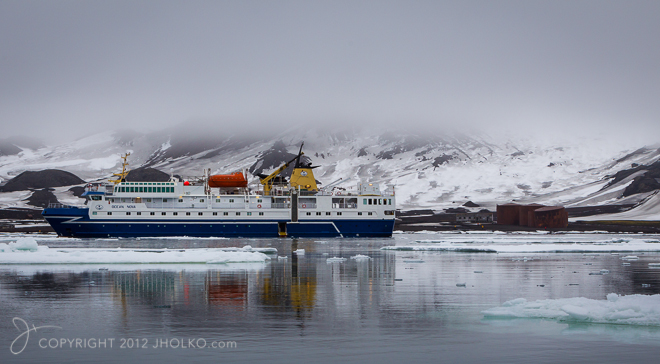 Now that some time has past and I have had some time to reflect on the trip to Antarctica at the bottom of the world I want to share my experience of what worked and what didn’t work for me during the trip (much as I did for the workshop to Iceland last year). Those of you who follow my blog will already be well aware that I like to plan meticulously in terms of where I am going and what I am going to take with me on my workshops and expeditions. This trip to Antarctica was a little different than normal in that I had no real say in exactly where in Antarctica I was going. Location was determined more or less on a day by day basis dependant on the prevailing weather conditions and our expedition leaders experience and local knowledge. This was in many ways a good thing as it freed me up to focus and concentrate on my photography. A quick word of praise and thanks to our expedition leader Graham who went above and beyond the call of duty on numerous occasions to ensure we were in the best locations at the best possible time. Trying to please 70 odd neurotic and maniacal photographers all mad keen on making the most of their Antarctic adventure is no easy feat. Yet Graham managed his role and duties with great aplomb. His role is in many ways an unenviable thankless task so it is important to take moment to recognise and thank him for his excellent work throughout the trip.
It is worth mentioning at this point in time that shooting from ship presents its own unique challenges. In some ways shooting from ship is quite easy; one can simply step outside from their cabin onto the deck, frame and shoot. Tripods are obviously out of the question so all one really has to do is select a focal length, ensure shutter speed and aperture are appropriate and wait for the subject to roll past – pretty easy stuff that makes for very civilised photography. Shooting from zodiac however presents a different set of challenges – not the least of which is keeping camera gear dry and operating. The logistics of shooting from zodiac make the entire photography equation much more complex and I will write a dedicated post on the pros and cons and how to approach this style of shooting at a later date.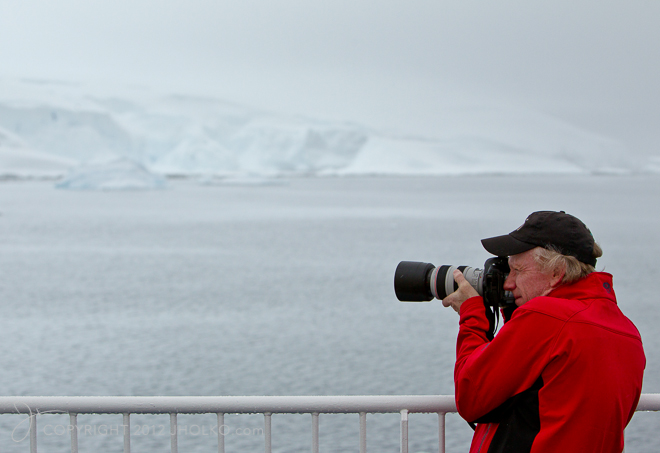 All of my camera gear operated and performed flawlessly the entire trip. I noted in my initial blog post on returning from Antarctica how harsh the shooting conditions were and it is worth re-iterating that on multiple occasions my cameras were covered in sea water and salt spray in freezing conditions when shooting from zodiac. I was extremely glad that I decided to take two 1-series Pro bodies with me for this trip as these cameras are all but indestructible and are designed to cope with very adverse shooting environments (and Antarctica certainly qualifies as an adverse shooting environment). Between the salt spray, cold, dust (when changing lenses – Antarctica is an incredibly dusty place), snow and ice there are lots of opportunities for cameras to fail. Several other photographers had failures with Canon 5D MKII’s and 7D’s. It is a testament to the build quality of Canon’s 1-series cameras and L-series lenses that they continue to operate in such extreme environments under such adverse conditions. There is no question that I am both hard and demanding of my equipment. When in the field I take little in the way of precautions to keep my gear dry. In fact, I pretty much gave up during several zodiac excursions as the sleet and spray were overpowering and focused on just wiping away the worst of the spray off my lenses so I could keep shooting. It is also worth noting that there were also several medium format digital rigs on this expedition including a couple of Hasselblad cameras with Phase One backs and a Mamiya 645D. To my knowledge there were no issues with any of the medium format equipment; although I never saw any of it in operation from zodiac.
 I used all of the lenses I took with me (see my earlier post on what I took to Antarctica HERE) except my Canon 50mm F1.2L; which did not make it out of my camera bag. It’s not that I didn’t need it – simply that I was too busy shooting with my other lenses. By far my most used Lens was my Canon 24mm F1.4L MKII, and my 17mm F4L Tilt / Shift. I really enjoyed shooting with the 17mm Tilt Shift from zodiac where I was able to use the shift feature to change the perspective to raise the view ‘off the water’. I occasionally used a small amount of tilt to extend depth of field or correct the perspective of particularly tall ice bergs. Both my 70-200 F2.8L IS and 300mm F2.8L IS were also mainstay lenses that saw plenty of action throughout the trip. The reality of shooting in Antarctica is that there is quite literally a shot almost everywhere you look and almost any lens will work in most circumstances. I saw other photographers shooting with everything from 14mm all the way to 600mm throughout the expedition. I always shot with two bodies; which gave me the opportunity to have two different focal lengths immediately on tap. I would have been very frustrated had I been limited to one body only. In fact, I think I could probably have managed a third body when shooting from the deck of the ship. Given Canon’s 1-series camera bodies run well north of $6000 plus I am highly unlikely to purchase a third.
I was very glad I made the switch from a full size 17″ macbook pro to the smaller and lighter 15″ Pro for this trip. I really noticed the saving in weight, size and convenience during the many hours spent in airports and in transit. I really appreciate the ability to keyword my photographs in Lightroom during my trips (as well as check sharpness and exposure on the laptop monitor) so prefer to travel with a full size laptop as opposed to a small card reader/viewer. That said, I really appreciate the weight and space saving of image viewers and although I do not own one I am keen to try one on a future endeavour.
In many ways this was the Gura Gear trip to Antarctica. I would estimate somewhere around 40-50% of all the photographers on this trip were sporting at least one Gura Gear Kiboko camera bag. And who can blame them? There is no such thing as the perfect camera bag for all occasions; but it was universally agreed amongst all those photographers I spoke with that the Gura Gear Kiboko is the best camera bag on the market and as close to perfection as possible. I am utterly convinced that the Kiboko is the number one camera bag on the market and it was great to be able to spend some time with Gura Gears founder and chief designer Andy Biggs to relay my experience with the Gura Gear product. One of the added side benefits of the Kiboko is that it has very much become the photographers ‘introduction tool’. With so many photographers choosing the Kiboko it has become a symbol for the travelling photographer and both my friend Martyn and I had conversations with several others at airports who recognised us as fellow photographers due to our Gura Gear bags. All good fun and a really great way to meet other photographers.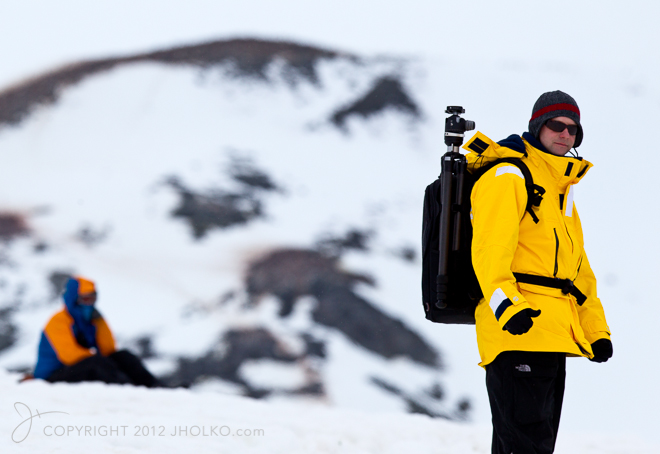 This was the maiden voyage for the Gura Gear Chobe for me. If you read my pre-flight review HERE then you are already well aware that I had high hopes for this bag based on my initial impressions and thoughts on how I planned to use it. I am very pleased to report that the Chobe lived up to my expectations throughout the trip. In fact, the Chobe has convinced me that it really can serve as both an overnight bag and as a dedicated camera bag depending on your specific needs at the time. Given its ability to also carry a laptop, card readers, back up hard drives and other accessories it really can meet just about any demand. Whilst I wouldn’t do any serious hiking with the Chobe (and it was never designed for this purpose) I would quite happily sling it over my shoulder and carry it in the field for an extended period. Quite a few other members of the trip were also sporting Chobe’s in addition to their Kiboko’s for additional camera gear, laptops and accessories – Gura Gear are definitely on a winner.
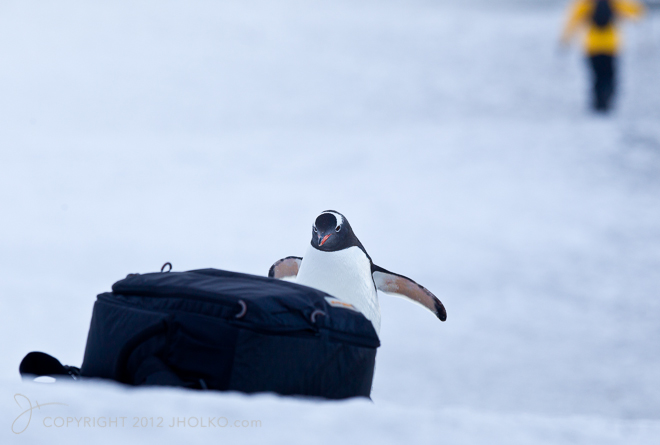 One of the real joys of the trip for me was the opportunity to shoot with the Leica S2 and 120mm Apo-Macro Summarit lens. I have been half toying with the idea of adding a Leica S2 to my kit for some time and I relished the opportunity to put one through its paces in the field thanks to good friend Andy Biggs. I was particularly keen to see how reliable the Leica was in the very adverse shooting conditions found in Antarctica as I have heard somewhat spurious second hand reports of S2 failures in the field before. The S2 is a wonderful camera that feels like it was carved from a single block of ‘unobtanium’ and I am pleased to report it performed flawlessly during the trip. Its somewhat slow to focus compared to my Canons and dialling in exposure compensation requires far too many button presses but it otherwise has an intuitive user interface and produces stunningly sharp files. The increase in resolution over the Canon 1DS MKIII is most definitely advantageous – at least when viewing files at 100% on screen. The ‘S’ series lenses are quite simply the best I have experienced with outstanding corner sharpness and contrast. I have to continually wipe the drool off my keyboard every time I inspect the files. I have not as yet had a chance to make any prints from the S2, but I am very much looking forward to seeing a few prints roll off the printer. Is there a Leica S2 in my future? No. Put simply, the economics of the S2 currently don’t stack up for me for a number of different reasons. But there is probably a revised Leica S2 in my distant future and I will be keeping a good eye on Leica’s lens range and support for the S2.
As is usually the case for me I packed too many clothes for this trip. This is something I continually struggle with on all my photographic expeditions. On location I tend to more or less live in the one set of clothes and almost always come home with some unworn items of clothing. I really need to work on minimising my clothing attire. I travelled almost exclusively with 66 North clothing for this expedition and it kept me both warm and dry the entire trip. I was pleased to see several other members of the expedition had taken my pre-trip recommendation and also purchased 66 North clothing – it really is one of the best (ok, the best) range of outdoor clothing on the planet.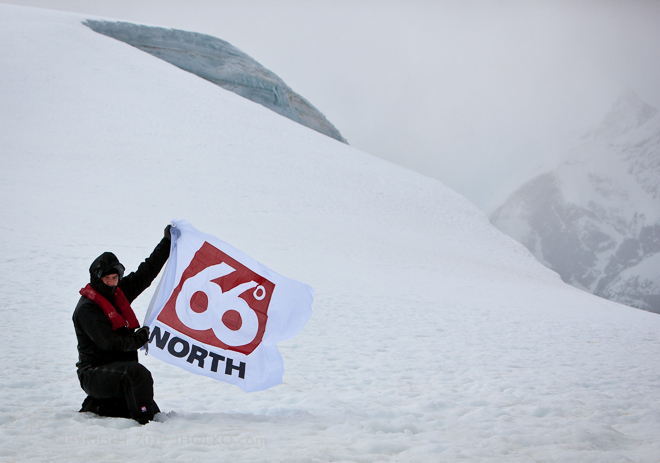 I already made mention in my initial return post from Antarctica that Quark Expeditions were outstanding in every way and I stand by my prior thoughts and comments. My expectations were continually exceeded by all of the Quark crew (including the legendary secret weapon – Captain Alexey). This praise applies across the board from the ships cleaning staff, to the multiple chefs and culinary staff to the zodiac drivers, biologists, ornithologists, expedition leader and crew. To my mind they could not have provided a better experience. It is worth noting that Quark title their trips as ‘Polar Expeditions’ and not ‘cruises’. Expeditions is an appropriate word as the emphasis on our trip was in getting the photographers to the best possible locations in whatever the prevailing conditions. Although the level of service was exemplary in every way I would encourage those looking for luxury 5+star cruising to look elsewhere. Alighting a pitching zodiac in Antarctic winds with pounds of camera gear in large swells is not for everyone. Remember its Quark ‘Expeditions’ – Not Quark ‘Cruises’.
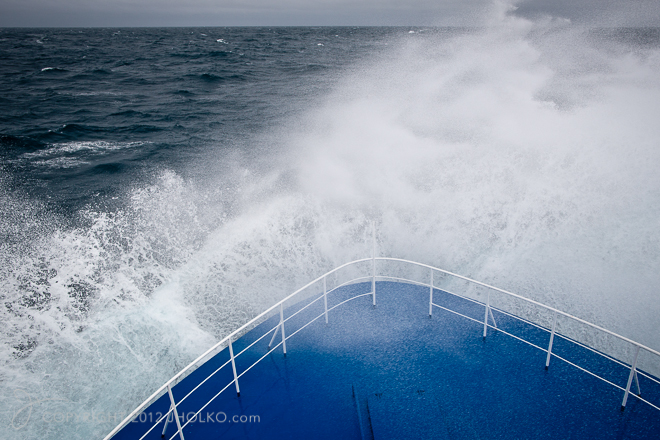 It is also worth taking a moment to talk about the Drake Passage and seasickness. As I have previously mentioned I have never suffered from any kind of motion sickness but I took preventative medication on this trip in the form of ‘scopolamine’ patches; which are designed to act of the part of the brain that causes nausea. Unfortunately these patches (which last quite a long time – 24 hours+) have some rather dramatic side effects including severe drowsiness, a very dry mouth and a very horrible metallic taste on the pallet. I found they made me so drowsy on the trip over that I felt the urge to quite literally go straight back to bed after breakfast (having already slept ten hours) and sleep another six hours until lunch. No matter how much water I consumed I could not overcome the dry and metallic taste in my mouth so was very glad to rip off the patch when we arrived in Antarctica. For the return trip across the Drake I chose to pop a ‘Kwells’ tablet and keep my ginger levels up by drinking plenty of ginger ale as a precaution. This worked far better for me as I did not suffer side effects from the tablet. On future trips I would avoid scopolamine patches at all costs. I can’t complain however, many of the photographers on this trip were laid completely flat out by sea sickness and unable to even make lunch or the evening meal. I am sure they would have been very glad of just the side effects I suffered.
My flights for this trip were with Qantas and Aerolineas Arengtina. I was fortunate to be travelling at the front of the aeroplane so to speak for the long haul sections of this trip from Melbourne to Buenos Aires and these flights were about as comfortable as fourteen hours in an aeroplane can be – not much more need be said. For my internal South American flights I travelled with Aerolineas; which proved the other end of the comfort scale. Firstly, I was more than annoyed to arrive at the airport in Buenos Aires to find that I had been bumped to a later flight after pre-booking and pre-paying a full eight months in advance. Aerolineas took an opportunity to resell my seat to a higher paying customer because of flight cancellations due to union issues (and sold to the public under the guise of volcanic ash fro the Chile volcano) – most annoying. Aerolineas also really need to do something about the quality of their inflight food. Powdered milk for coffee is not acceptable in my book under any circumstances (even UHT milk would have been better) and the less said about the ham and cheese roll the better. The internal flights from Buenos Aires to Ushuaia and back were also on old MD-88 jets; which are not my favourite passenger jet and always make me a little nervous. I was very glad to touch down both in Ushuaia and Buenos Aires and leave the Byzantine MD-88 behind. I did not have any luggage weight issues on any of my flights and was able to carry on both my 18+ kilogram Kiboko and my 5 kilogram Chobe without issue. I did see a couple of other photographers get nailed for being overweight with carry on luggage on the trip from Ushuaia to Buenos Aires. Aerolineas seem quite happy to randomly select and penalise those they take a dislike too. Personally I have always found a smile and a friendly hello goes a long way with airport check in staff; but your mileage may vary as they say.
If some of the above seem somewhat like nit-picks its because I really did not have any other issues the entire duration of the trip. All of my camera gear and computer equipment operated flawlessly and I never once found myself wishing for anything other than an assistant to hand me another lens or load a new CF card. One of these days I must get a travel assistant!
Antarctica has been a long time dream for me and this expedition was very much the trip of a lifetime. I mean how often does one get to travel with roughly 70 like minded enthusiastic photographers to one of the worlds last pristine wilderness locations on a trip dedicated to nothing but photography! As a photographer who has a passion for ice bergs there really is no location more appealing and it goes without saying that I can hardly wait to return (which I will most definitely be doing in future expeditions). They say you travel to Antarctica a tourist and come back an Ambassador and I think those words ring very true for me.
2012 SAILING INTO THE NEW YEAR
With 2011 now done and dusted, I just want to say thank you to all of you who regularly come back and visit my Landscape Photography Blog to check out my latest posts. It has been personally rewarding for me to watch the blog grow, and I am very appreciative of the many emails that I have received from so many of you throughout the year.
Whilst I don’t subscribe to the idea of new years resolutions; I do hope to try and post more regularly throughout 2012. I do have quite a lot of new content planned for the year as well as a lot of upcoming travel; which should provide plenty of fuel for the blog throughout the new year . I am still working on my 2011 Antarctica what worked and what didn’t article; and hope to have it finished in the next couple of days.
Lastly, Happy New Year to all of you and all the very best for 2012. May all your travels be safe and your photos be keepers!
ANTARCTICA – ‘GREEN ICE AND PEBBLES’
As has become customary after returning from a significant overseas photographic expedition I have been more or less hibernating for the last few days whilst I attempt to recover from a nasty case of jet lag and general post trip exhaustion. The combination of long waking hours (from shooting well into the small hours), irregular sleep patterns and general lack of sleep during my trip all combined with crossing multiple time zones (both coming and going) really screws up my body clock and biological rhythm. I seem to manage just fine during the travels (lots of coffee and great company helps) but always seem to fall in a gaping hole on my return to Australia when I finally slow down and it all catches up with me. I love living in Australia, but it is on overseas trips such as these that I am reminded of how far Australia is from most of the rest of the world; or at least from those places to which I love to travel and photograph. I have barely been able to raise myself from my bed over the last few days and even a few short hours catching up on general unpacking and household duties has seen me quickly exhausted and searching for my bed. Not to overplay my jet lag but there really is nothing at all romantic about international travel with pounds of camera gear in toe. The dream is most definitely the destination and not the journey.
Now, nearly a week on from returning I am finally feeling sufficiently recovered and ready to tackle to enormity of the editing and processing task that lies ahead of me. Antarctica was an absolute photo orgy of photography. Never before have I shot so many fames so intensely over so short a period with so many like minded photographers. If ever ones enthusiasm was starting to wane (and really how could it in Antarctica!) there was always a nearby photographer ready to re-inspire and re-enthuse. As I have already blogged; it may well be years before I have fully mined all of the gems from this remarkable photographic expedition. The only way to even begin to tackle this project is in bite sized chunks and to this end I have made a couple of very quick passes through my RAW captures and made a few initial selects for processing. I expect to spend many hours over the coming days / weeks and months editing in small ‘chunks’ to get down to my final selects from the trip.
This first photograph was one of only around a dozen images I shot from tripod during the entire trip. As a landscape photographer who is used to shooting from tripod it was a real change of pace (read: frenetic pace) to shoot from ship and zodiac handheld; where it is of course impossible to use a tripod. I enjoyed the freedom of shooting handheld (especially from zodiac); but there is something about using a tripod that I quite enjoy and occasionally missed. Those few instances where I did have an opportunity to slow down and use my tripod during shore landings were greatly appreciated. The mere act of setting up a tripod, getting out a cable release and filters gives my mind a chance to slow down and think contemplatively about my photography. This was also one of the only photographs from the trip where I used the LEE ten-stop ‘Big-Stopper’ Neutral Density Filter to slow my shutter speed to sufficiently soften the water around the ice. I had thought I would make more use of this filter during shore landings on the continent; however, time ashore was limited and therefore so were long exposure opportunities – such is life.
To state the palette of colour in Antarctica is extensive and extraordinary is to fail to do justice to Mother Nature. Many of the icebergs are the most incredible surreal deep blues above water and the deepest darkest fluroescent greens below the waves. This small piece of water carved and polished ice was lying on polished pebbles in around a foot of crystal clear water on one of our early shore landings. Its form and structure immediately struck me and I new I had an opportunity to capture a photograph with a slow shutter speed that would be quite different from most iceberg photographs. Other than the slow shutter speed – you don’t need to suspend your disbelief. As those who attended this trip will attest; the colours in Antarctica are quite literally unbelievable and no embellishment is required in post processing. The wind would have been a good 30-40 knots when this photograph was taken and you can see large plums of spindrift coming off the distant mountain peaks across the channel.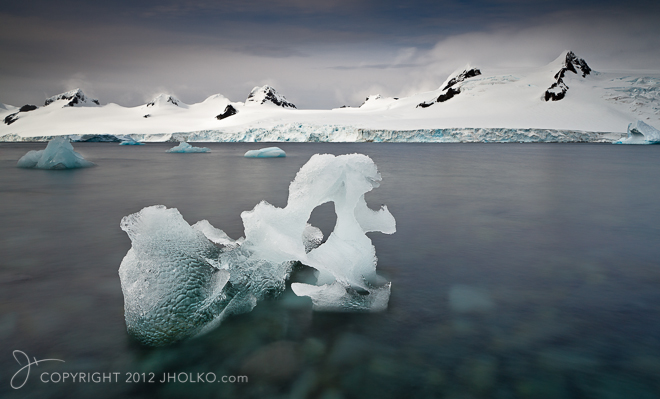 A higher resolution version of this photograph can also be seen on my portfolio website under Antarctica at www.jholko.com. I am currently working on my ‘Antarctica what worked and what didn’t’ blog entry and hope to have that finished in the next week or so along with more of my images from this remarkable trip. My friend Andy Biggs also has an extensive blog entry on this Antarctica expedition and Gura Gear (my number one camera bags of choice) – check it out at the Global Photographer and Gura Gear.
ANTARCTICA DISPATCH #6 RETURN TO CIVILISATION
There are no words that any poet could pen that could possibly do justice to the raw beauty, grandeur and natural wonder that is Antarctica. The white continent is quite simply a thing of unbridled, unhinged primordial beauty that is breathtaking in the extreme. It truly feels like an unexplored prehistoric world – a last frontier. I can only hope that I can bring some sort of justice to the amazing Antarctic landscape in my photographs.
I had hoped I would get some time to update my blog during the expedition; however, the frantic pace of photography meant that any down time away from the cameras was spent either eating or sleeping. Any time awake was spent either cruising iceberg fields in a zodiac or in shore landings or in shooting from the deck of the ship as we moved from location to location. Gearing up and down for shore landings and zodiac cruising in Antarctica is quite the logistical exercise. Although the ambient air temperature was never really very cold (it never got below around -5 celsius air temperature) it was often bitterly cold with wind chill factor around -30 degrees Celsius. Multiple layers of clothes, waterproof shell, boots, life jacket and many pounds of camera gear makes getting into and out of pitching zodiacs somewhat tricky – especially when both the ship and zodiac are pitching in large swells. Shooting from zodiac is also tricky and it can be a real battle to keep cameras dry and operating in freezing weather/wind, snow and pervasive salt spray. On multiple occasions I had myself and cameras quite literally drenched in salt spray and sea water when shooting from zodiacs. It was necessary to meticulously clean all of my gear after each shoot to remove the salt spray. Thankfully my cameras and lenses never missed a beat – thanks to the rugged build quality and extreme weather sealing found in Canon’s 1-series cameras. Some of those shooting 5D MKII’s were not so lucky (or well prepared). Although I don’t have an official count of camera failures I am led to believe at least 3 5D MKII’s failed and another 5D MKII and 7D operated sporadically and seemingly at random. To my knowledge there were no issues with any of the medium format cameras in use (Including a couple of Hasselblads with Phase backs and a Pentax 645D). Andy Biggs’s Leica S2 likewise never missed a beat. Antarctica is without doubt the most hostile environment for photography I have ever experienced. The combination of extreme cold, salt water spray and dust (Antarctica is incredibly dry and dusty) will push any camera and photographer to their operational limits. With around 70 photographers on board and most of them sporting at least two DSLR bodies some camera failures were unfortunately inevitable.
We were extremely fortunate to have the renowned Russian captain Alexey for our expedition. Alexey (otherwise known as ‘The Secret Weapon’) was prepared to place the ship extremley close to some truly massive icebergs (ice the size of football fields) for photography as well as navigate ice pack fields and the ice chocked entrance to the Lemaire channel. Some of the icebergs we photographed were the size of a football field and thanks to some very skillful sailing I was able to shoot many of them with the Canon 17mm Tilt Shift lens from the deck of the ship as we glided slowly past. Captain Alexey even circled some of them several times to ensure we had the best angle for our photographs. Our ship the Ocean Nova is an ice hardened ship; which meant we could get closer to big ice and visit locations other ships could not reach. This was a real plus for all of the photographers on board. I would not have been able to capture some of the images I have come back with without such a skillful and experienced Captain. I took the opportunity on several occasions to visit the captains office (the bridge) and it was a real privilege to see him at work navigating the treacherous waters. The reality of this kind of sailing in Antarctica is that there is no coast guard and typically no other ship for hundreds of miles. One only has their own resources to hand if you get into trouble. One could quite easily gauge the Captain’s stress levels by his chain smoking speed and there were a few moments when there was one in the hand, one in the ash try and another ready to light. There is something quite surreal about standing outside the Captains bridge on the deck of the ship in a pristine wilderness with the smell of nicotine wafting down from the bridge. I tip my hat to captain Alexey for some truly remarkable sailing. The crew of the expedition (including the zodiac drivers) were likewise outstanding and extremely sympathetic to the neurotic needs of the many photographers to make ‘just one more pass’ around an iceberg. I will write more about my experience of shooting from zodiac and the Quark crew later. Suffice to say for now that they performed above and beyond my expectations in every way (and I consider myself a difficult photographer to please). The quality of the food aboard ship was equally outstanding and from everyone I spoke with aboard the ship was well above their expectations. I will again write more about this later (It really deserves its own journal entry).
The weather is fickle in Antarctica. Most of the trip was overcast with grey brooding skies, mist and dark clouds; which proved perfect for my style of photography. I find dark and moody skies highly evocative and the perfect back drop for photographing icebergs (my favorite photographic subjects). We also had quite a lot of snowfall during the trip; which added to the drama of the scene (and also increased the complexity of keeping cameras operating). Whilst it was nice to see the sun on the last full day in Antarctica it made photography more problematic with a much wider dynamic range; which created more of a challenge to isolate the subject from busy backgrounds. I feel fortunate to have experienced Antarctica in its natural state as for much of the year the continent is shrouded in cloud, fog and mist. Bright sunny days are not suited to my style of photography. Although the ice can look truly brilliant in sunshine I find it lacks the brooding moody feeling I am trying to capture and convey in my photography. We did not get any blazing surises or sunsets during the trip due to the overcast conditions. In fact, we rarely saw the sun period despite the fact it never really got dark. One could easily read a newspaper between the short hours of sunset and sunrise. Sunset was around 11:30pm and sunrise around 2:30am.
What about the Drake?
We were somewhat fortunate (fortunate is probably the wrong word) with our crossing of the Drake Passage to have relatively average seas. Our two-day sailing journey to Antarctica from Ushuaia saw us encounter swells in the order of 20-30 feet (with the odd larger rogue topping out at close to 40 feet) with the ship pitching around 30-40 degrees (15-20 degrees to starboard and then 15-20 degrees back to Port). I am told this is an average crossing and not extreme by Drake standards. The constant large swells took their toll on the group however with somewhere around 25% of the photographers on board going down with chronic seasickness for most of the crossing. A few particularly badly affected individuals did not re-surface until we reached the calmer waters of the continent. Those that managed to stumble from their cabins now and again looked more than a little green around the gills. I was fortunate to avoid any seasickness; although I have felt somewhat dehydrated the entire trip due to the sea sickness prevention patches I used. I am not sure if the cure is worse than the disease when it comes to seasickness medication. It makes one very drowsy and dehydrated. Although I have never been sea sick before I decided a preventative patch would be a good idea just in case. On our return crossing we were greeted with some truly massive seas as we entered the Drake Passage – the biggest swells I have ever experienced. Watching the breakers smash into the rocky islands as we sailed out into the Drake and throw spray a hundred feet into the air was awesome in the true sense of the word. The massive swells quickly took their toll on our expedition members and many disappeared into their cabins in an effort to minimise sea sickness.
In terms of photography, I shot a total of 13,481 images over the course of the ten-day expedition. My heaviest days shooting was a total of 3143 images and my lightest 481. I did not bracket my exposures as I was comfortable dialing in exposure compensation on the fly. I am used to looking at the cameras histogram to ensure I have a good exposure that is well exposed to the right. In fact, exposure and dynamic range were really quite easy to deal with in the overcast conditions (nature’s soft box). Most of the time I was dialled in around +1 and 1/3rd stops. I also took an opportunity to shoot with the Leica S2 bought along by Gura Gear’s Andy Biggs during one iceberg shoot (thanks Andy!). I will write more on my experiences with the Leica later. There were also some wonderful wildlife photographic opportunities throughout the trip and I will likewise write more about these at a later stage as I process and release my wildlife photographs. For now I will simply comment that Penguins are wonderfully whimsical critters and I enjoyed photographing them very much.
I very much enjoyed shooting alongside my friend Martyn again and it was great fun to compare notes at the end of each days shooting with other photographers over dinner. It never ceases to amaze me that a large group of photographers can visit the same location yet all come away with such different images and interpretations – truly remarkable. I should also note that Link with whom Martyn and I shared a cabin proved a perfect room mate. Thank you to both Martyn and Link for making the trip such a successful and enjoyable experience.
Now I have many weeks of, sorting, editing, ranking and processing in front of me. It may well be years before I have mined all the gems from this remarkable photographic expedition. I am still compiling my thoughts and feelings about Antarctica and will no doubt write much more in due course about all aspects of the trip after due contemplation and reflection. Although I am very keen to start sharing my images from Antarctica I am mindful of my need to spend some time contemplating my photographs before I begin to release my serious work. Until then I just want to share a few snapshots that I hope will convey some of the feeling of what this trip was like. This first photograph I feel conveys the feeling of what it was like to photograph from the zodiacs amidst the icebergs. Believe it or not this photograph has been processed with absolutely zero vibrance or saturation and is as straight a photograph as digital allows – these are the real natural colours of Antarctica. This should also help give a sense of scale. A zodiac is very small protection in Antarctica and I hope this photography also conveys some sense of the environment.I hope to go back to Antarctica one day if time and logistics allow. I feel that I could spend a year or more down there with my cameras and barely scratch the potential photographic possibilities. As a photographer who has a passion for ice the possibilities in Antarctica are quite literally limitless. For several photographers on board this was their second, third or even fourth trip to Antarctica and now having experienced the raw beauty of the continent myself I can fully understand the addiction. I will most definately be back.
I will be writing up a post over the coming days/weeks about what worked and what didn’t (much as I did for my Iceland trip last year) as well as many more thoughts and moments from the trip. But for now I am keen to get home from Buenos Aires and to take some time to reflect and consider my work.
I will up date the photo of the month for December later this month when I release the first of my Antarctic images.

