LAND OF FIRE AND ICE AND ANTARCTICA WELCOME PACK

I feel I am getting close now to mining all the gems from my trip to Iceland back in July / August this year. As I have blogged about before, sorting, editing and processing has been a continuous albeit sporadic affair when time has permitted. The pace of family and work life these days seems to run at light speed. Finding time to slow down in peace and quiet and work in a contemplative fashion is tough. Now, three months after returning from the trip Iceland is starting to feel like a completed project for me. That doesn’t mean I don’t want to go back; because I dearly do. There is still the entire Snaefellsness Peninsula for me to explore as well as the North East corner of the island. Plans are afoot as they say…

I have now processed most of my ‘selects’ and made prints of a good many of them. I have an exhibition coming up in March next year and am very much looking forward to sharing my prints from the trip. I still have many hundreds of trip snapshots to sort through; many of which are no more than a traveller’s record of the trip for me. I will continue to post photographs from the trip to my blog over the coming months.

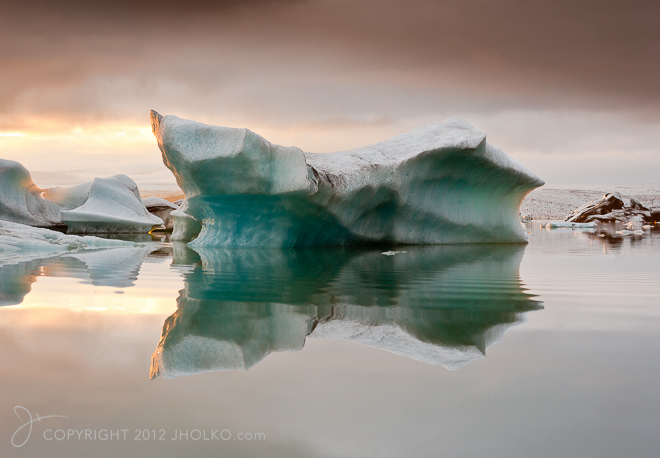
This photograph was taken during my first visit to the Jokulsarlon glacial lagoon as the sun set behind the distant Vatnajokull glacier [Europe’s largest glacier]. The combination of evening light and ice is magical at the lagoon. It is hard to say any particular location in Iceland is my favourite above all others as so many of them are stunningly beautiful in their own right. The Jokulsarlon lagoon however certainly rates in the top three. I know of nowhere else in the world where icebergs can be photographed carving into a lagoon and then photographed several hours later having washed out to sea on the black volcanic sand beaches.Looking forward to Antarctica next year I received a welcome pack from Quark Expeditions which included several informative booklets on Antarctica, a large detailed map of the area, luggage tags, list of recommended clothing and equipment and associated paraphernalia. Even though this trip is still just over a year away it is now starting to feel very real and I have on several occasions when the moment has been right found myself day dreaming about what it will be like and considering what I will take with me. I have not as yet booked accommodation in Buenos Aires or Ushuaia but have been recommended a couple of different hotels; both of which look really good. I am planning to meet up with my good friend Martyn who travelled  and photographed with me in Iceland for the shoot in Antarctica. We plan to meet in Buenos Aires a couple of days early for some photography to ease any shutter finger aches before we head down to Ushuaia and set sail for the big Antarctica shoot. I cant wait!
THE QUESTION OF HDR AND POST PRODUCTION

From time to time (and with increasing frequency) I get emails asking ‘how many, if any, of my photographs are HDR or High Dynamic Range?’

The answer is: None.

For any reader who may be unaware: HDR photography is the art of capturing several (usually two or three) different exposures of the same scene. Each exposure will be optimised at the time of capture for either the highlights, shadows or mid tones of the scene. The multiple frames are then composited in Photoshop or alternative program and tone mapped. The final output is a single photograph that captures a dynamic range wider than what the cameras sensor was capable of recording in a single exposure. Usually, but not always, the results are unnatural and somewhat ‘odd’ (at least to my eyes).

All of the photographs on my Portfolio website and on my blog are single exposures that were captured that way in the field. I may well have taken multiple exposures (bracketing) at the time of capture; but this was simply to give me choice of picking the best overall exposure to work with back in my studio – Never for the act of combining for a HDR image. Not that there is anything wrong with HDR photography; but it just isn’t something that interests me, or frankly that I even particularly like.

I am also often asked “if the colours in my photographs are real?”

The answer is: Yes.

I actually do very little post processing work to my photographs in the vast majority of cases. Probably 99% of my photographs never even make it to Photoshop – receiving only basic post processing corrections in Adobe Lightroom. These corrections include adjustments such as white balance, setting white and black points, burning and dodging etc. I am a strong advocate for ‘getting it right in the field’. I use graduated neutral density filters extensively to tame the high dynamic range found in nature and these allow me to capture scenes with a single exposure without resorting to post processing techniques such as HDR tone mapping. I spend many many hours in the field waiting for the right light for my photography and frequently revisit locations for better light.

My shooting style is pretty simple – I like to arrive at my location with plenty of time before the light is at its best. Usually, this means at least an hour before sunrise or sunset (I generally prefer sunrise – the best light being just before the sun crests the horizon). Almost always, if possible I will have scouted the location earlier in the day to ascertain what I wanted to photograph. However, I am always ready to go with the flow, and if I see something happening nearby (maybe the light is reflecting off a pool of water, or whatever) will change my plans accordingly. I shoot with a tripod, mirror lock-up and a cable release. I like to take my time to compose my photographs thoughtfully; I use ‘live-view’ to assist with composition and focusing.

Once I am ready to take the photograph I may make several different exposures so that I can later on choose which is best for my purposes. I will also usually do a number of different compositions and again later in my studio choose which I prefer. During post processing I will endevour to draw out any subtle tones and colours that were captured by the cameras sensor at time of exposure. These adjustments or enhancements if you prefer are usually no more than corrections for the inherent flatness of a RAW file compared to a jpeg; which has already and automatically had post production performed in camera.


Gallery Representation – Source Photographica

I am extremely pleased to report that going forward Source Photographica in Melbourne will be the Australian and International Gallery representative for my fine art landscape photography. Limited edition ‘pigment on paper’ prints of my photographs will be available exclusively through Philip and Source Photographica. I will no longer be offering prints for sale directly through my website. An exhibition of my recent Iceland work will be on show at Souce Photographica in Melbourne early next year before it tours the country with Philip. I will post exhibition dates and locations as soon as they are confirmed.

Source Photographica was founded and is owned and managed by Philip Kulpa; a 25+ year veteran in the visual arts industry whose formidable knowledge is internationally recognised in the field of photography. Additional information about Source Photographica is available on their website.


Iceland – Shades of White

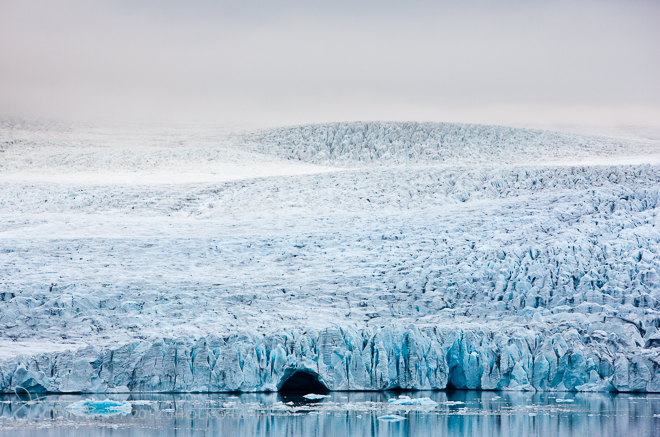
Wandering the shores of the Jokulsarlon Glacial Lagoon in Iceland rates in my top ten photographic life experiences. The sheer number of possible photographs in this remarkable location make even an extended stay seem just way too short for the keen landscape photographer. No matter what the weather or lens there are wonderful photographs to be made at the lagoon. This photograph was shot looking directly at the carving face of the Vatnajokull glacier  as an arctic fog and mist rolled down the glacial tongue from the slopes above. There is a wonderful suppleness and velvety feel to the fog as it spills down the rolling wave like formations of the glacier. This photograph was very tough to print with its many white-on-white subtle tonal variations; but the end result really works for me and is a photograph that at least for me captures the essence of the Vatnajokull glacier. A higher resolution version of this photograph is on my Portfolio website at www.jholko.com.