The photograph of the month for May was taken this Winter on the east coast of Svalbard and is of a large male Polar Bear climbing some blue ice on the frozen sea. We were extremely fortunate to have the bear on blue ice with some wonderful winter sunset light. 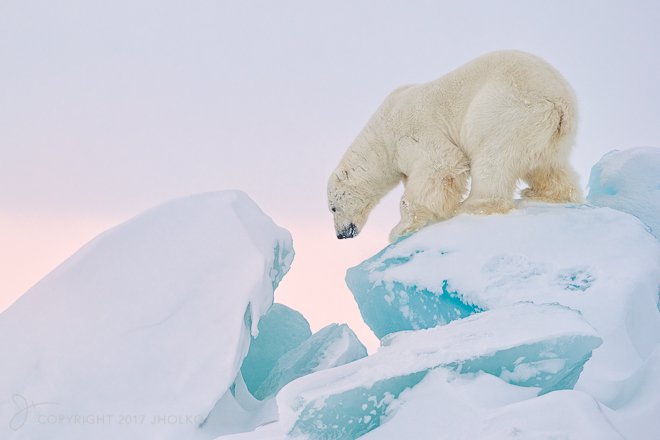 If you are interested in photographing Polar Bears there is now only a single place available on my Svalbard expedition this July before the expedition will be sold out (Read the report from last years expedition). The expedition runs from the 25th of July until the 4th of August and is strictly limited to twelve participants – one place remaining only.
Category: Photographs
Photographs
Polar Bears of Svalbard Expedition July 25th – August 4th 2017 Single Place Availability
There is now only a single place available on my Polar Bears of Svalbard expedition this July before the expedition will be sold out (Read the report from last years expedition). The expedition runs from the 25th of July until the 4th of August and is strictly limited to twelve participants – one place remaining only.
The High Arctic is a place to inspire the imagination. Nowhere is it more accessible than the Norwegian archipelago of Svalbard, located deep within the Arctic Circle. Nowhere else can the Polar Bear be seen more reliably in its natural habitat, and photographing these magnificent animals will be our main objective. We will also search for walrus and the other wildlife of the region. Dramatic glaciers, plunging cliffs and beautiful drift ice formations will be present as well. Our intention is to sail directly north from the small town of Longyearbyen in Svalbard to approximately 80o degrees north, to the very edge of the permanent pack ice. At our northerly most point we will likely be less than 600 miles from the North Pole and depending on the sea ice we may get even closer. We will be using the ice hardened expedition ship M.S Origo that will enable us to skirt the edge of the pack ice searching for and photographing Polar Bears. M.S Origo is widely regarded as the best ship in the Arctic for Polar Bear Photography. With low-lying decks and operable portholes a mere 60cm above the water line we can photograph at eye level with wild Polar Bears. Our expedition ship is also equipped with sufficient zodiacs (2 x Zodiac MKV models) and crew for all photographers to be shooting simultaneously with plenty of room to spare for camera equipment – So bring what you need!
 Watch the expedition video ‘Kingdom of the Ice Bear’ to get an idea of what this expedition entails.
 If you are excited by the idea of traveling to the edge of the permanent pack ice to photograph Polar Bears in their natural environment with a small group of dedicated photographers now is the time to secure the very last place. You can download a detailed PDF itinerary HERE.
Canon Australia – No One Sees it Like You Feature
Canon Australia have just published a short feature on their Facebook Page on some of my polar photography. The feature series ‘No One Sees it Like You’ is designed to showcase the work of professional Australian photographers working with Canon equipment around the world.
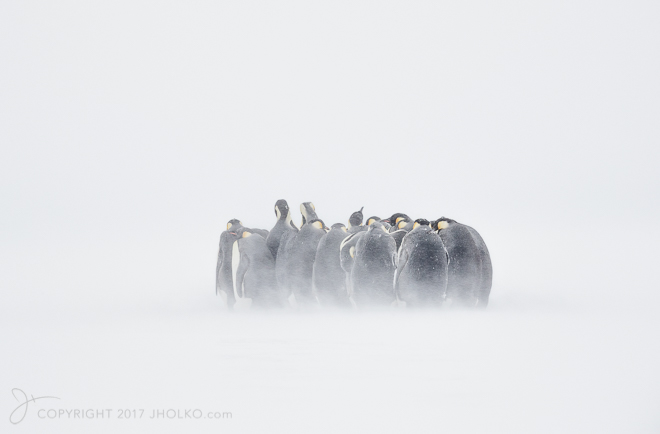
World Penguin Day Today
Happy World Penguin Day! This year, we can celebrate the news that the Adélie and Emperor penguins from Antarctica’s Ross Sea now live in the world’s largest marine protected area.
The world’s experts on Antarctic marine conservation have agreed to establish a marine protected area (MPA) in Antarctica’s Ross Sea.
This week at the Meeting of the Commission for the Conservation of Antarctic Marine Living Resources (CCAMLR) in Hobart, Australia, all Member countries have agreed to a joint USA/New Zealand proposal to establish a 1.55 million km2area of the Ross Sea with special protection from human activities.
This new MPA, to come into force in December 2017, will limit, or entirely prohibit, certain activities in order to meet specific conservation, habitat protection, ecosystem monitoring and fisheries management objectives. Seventy-two percent of the MPA will be a ‘no-take’ zone, which forbids all fishing, while other sections will permit some harvesting of fish and krill for scientific research.
Svalbard in Winter 2017 Expedition Report
In late March 2017 I lead a new ship based expedition to Svalbard in Winter to photograph the wildlife and arctic landscapes of this remote archipelago in a winter setting. The primary reason for choosing late March was at this time of the year (and at this latitude of nearly 80º North) the sun is very low in the sky all day and thus there is hours of golden light available for photography. Dawn and Twilight light at this time of year typically last three or more hours and even at midday the sun is still very low in the sky. This situation provides hours and hours of superb light for photography. There is also something about the quality of light in winter at this latitude that translates very well into photographs. The light is soft and ethereal and often has wonderful pink and blue pastel shades not found at other times of the year. This combination of light, snow and ice is simply unmatched in my experience.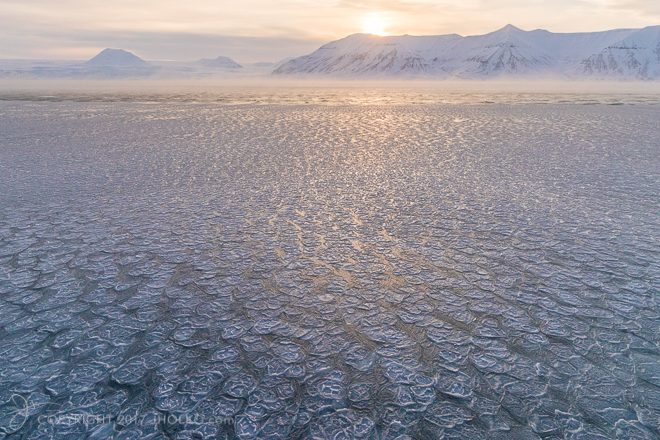 This expedition was for just twelve photographers and utilised the same ice-hardened expedition class ship I have been using for Polar Bear photography over recent years. On this expedition we encountered three individual Polar Bears including a courting male and female and a third unwelcome male who was chased off after a late night fight. We spent approximately two and a half days photographing these bears while we were parked in the pack ice. On one occasion early in the morning they approached within just a few feet of the boat. On others they were between one hundred and four hundred metres away on the frozen sea ice. The opportunity to watch them interact was extraordinary and this encounter rates as one of the best I have witnessed from a behaviour standpoint.
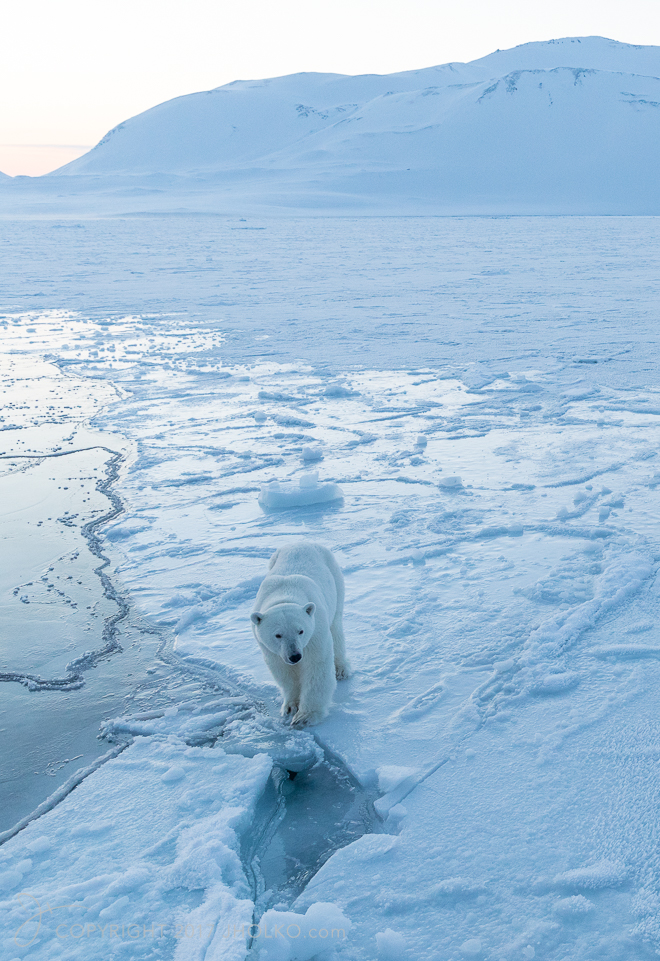 Temperatures during our expedition ranged between -10º celsius and -30º Celsius plus wind chill factor. Our coldest day was around -50º Celsius with a 20+ knot wind and air temperature of -28º celsius. I can tell you from experience that these sort of temperatures are quite demanding on body and camera. However, the wonderful thing about ship based expeditions such as this is its easy to walk back inside the ship (where its around plus 20º degrees celsius) and warm up with a hot drink. Being outside and making photographs in these sort of temperatures does require some thought and planning in terms of both equipment and clothing but if you are properly prepared its quite possible to spend very long periods of time out on deck making photographs.
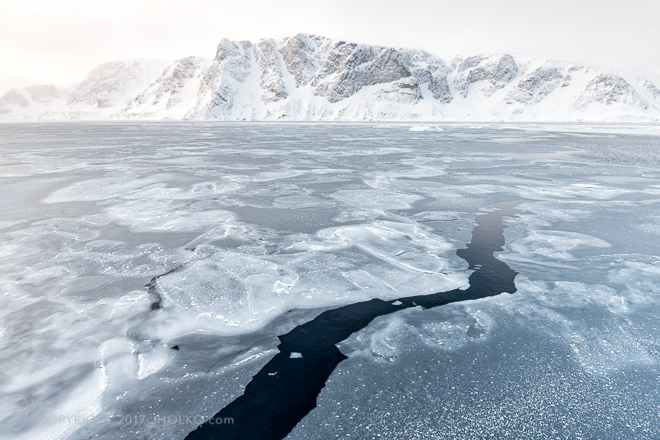 The landscape opportunities in Svalbard in winter rate as the very best I have ever experienced (even better than Antarctica). The formation of new sea ice is nothing short of spectacular and set against a back drop of snow covered peaks and glaciers with sea smoke billowing off the open areas of ocean and you quite literally have one of Natures most dramatic and breathtaking scenes.
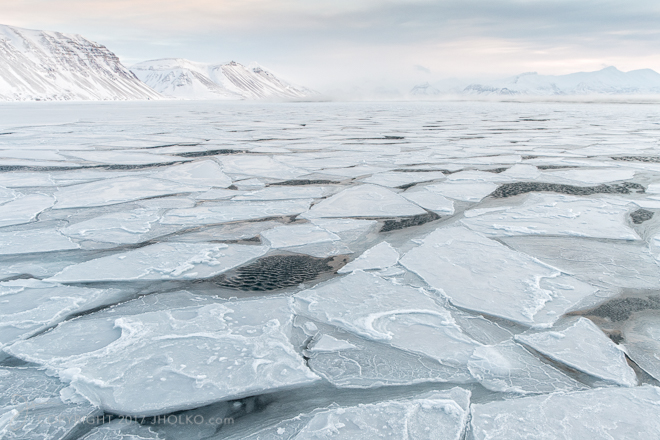 The sea smoke phenomena is caused by super cold air passing over the much warmer ocean water (although the ocean is only just above freezing the air temperature can as low as -30º Celsius). The smoke adds a wonderfully dramatic element and really elevates the interest and mystery in the landscape.
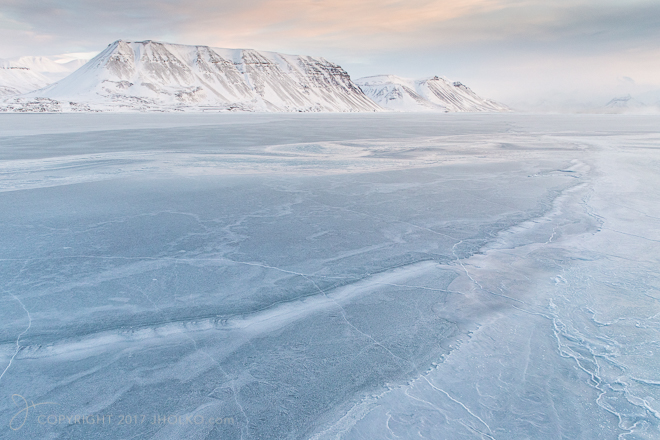 One of the great pleasures of ship based photography is that the scene is constantly changing as the boat moves slowly through the ice filled fjords. Opportunities for photographs are everywhere and part of the experience is watching the incredible landscape roll past. I particularly enjoy this sort of landscape photography as no two images are ever the same.
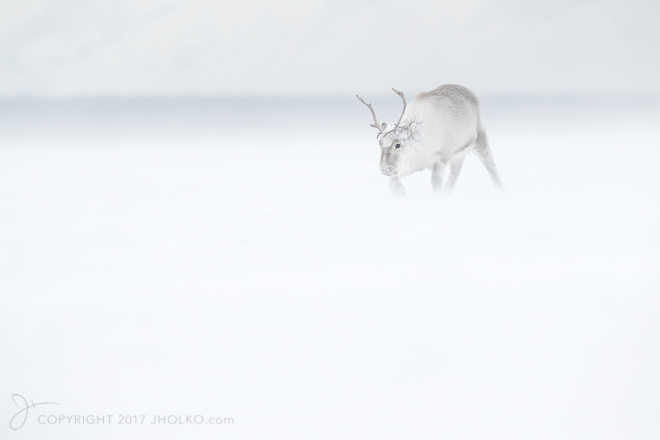
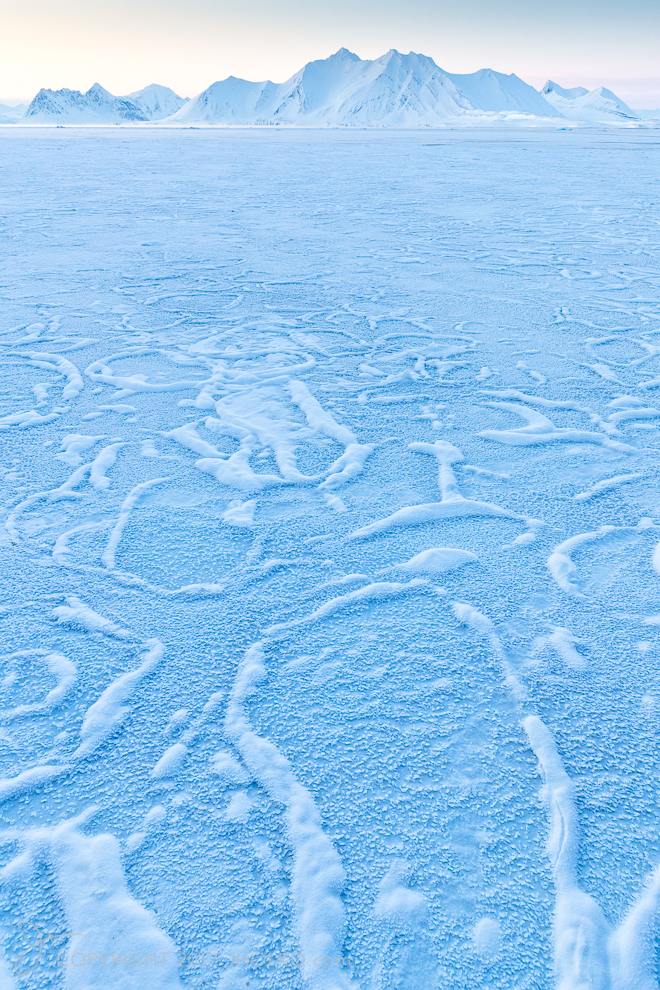 During the expedition we also saw and photographed Reindeer, Arctic Fox, Walrus on sea ice as well as sea birds such as Fulmars and Gulls. The opportunity to photograph Walrus on sea ice is a wonderful addition in winter as they are normally found either in the water or on land in summer. Walrus can be somewhat skittish on sea ice but we were able to manoeuvre quite close on several occasions for some wonderful photographs.
 Svalbard (and the Arctic in general) in winter is not for the faint of heart. With temperatures well below freezing it can be challenging to both person and equipment. However, the rewards for those brave enough to take on the challenge are absolutely extraordinary and not to be missed. In my own personal opinion Svalbard in Winter offers the most extraordinary opportunities for dramatic landscape imagery I have had the good fortune to experience. It is quite literally breathtaking.
If you are interested in travelling to the Arctic and photographing the incredible landscapes and wildlife of the Svalbard archipelago in a winter setting I will be repeating this expedition in late March next year (March 26th – April 3rd 2018). Late March offers us the best opportunity for wonderful light over the dramatic winter landscape. Due to initial registrations and bookings places are already extremely limited. If you would like more information or a detailed itinerary please just drop me an email.
 www.WILDNATUREPHOTOTRAVEL.com