One of the key functions of Adobe Photoshop Lightroom (hereafter referred to as just Lightroom) is its database and the capability for users to store and manage tens of thousands of photographs. Key-wording is an integral and core component of the database management. For those who might be unfamiliar with the concept of key-wording: Key-wording enables you to very quickly find a specific photograph or a specific series of images that have been tagged with one or more keywords. I know a great many photographers who use key-wording to various degrees in their work-flows. Personally, I keyword extensively on import so that I can effectively manage the more than one hundred thousand images in my Lightroom Library.
When it comes to wildlife I like to keyword with with the species type (Mammal, Crustacean, Reptile etc.) and then break this down by individual animal in each category. Its a hierarchical keyword structure that works well for me in my work-flow. Once set up in Lightroom its very quick for me to keyword my wildlife images on import. But what about key-wording for Birds?
Birds can be problematic to keyword for several reasons. Firstly, there are more than ten thousand different species across the globe which can make identification difficult, and secondly its massively time consuming to create keywords for them as you import your photographs (especially if you want to add Latin names and appropriate synonyms). I ran into this problem head-on on my recent Falkland Islands workshop where I spent a concentrated week photographing many different species of birds. I shot over 5000 photographs of birds that week and subsequently nearly gave up trying to identify them all, let alone create keywords for them all (and forget synonyms). Thankfully, there is now a solution to at least the second part of this problem….
Good friend and expedition partner Ole Jorgen has recently completed the herculean effort of creating a complete hierarchical list for Lightroom of all of the birds of the world (yes – all ten thousand four hundred plus of them). Not only has he put them all into a suitable structure for Lightroom and made it available for photographers to purchase, but he has also offered a number of different versions depending on your needs. You can check them out in his Web Shop or by clicking on the image below.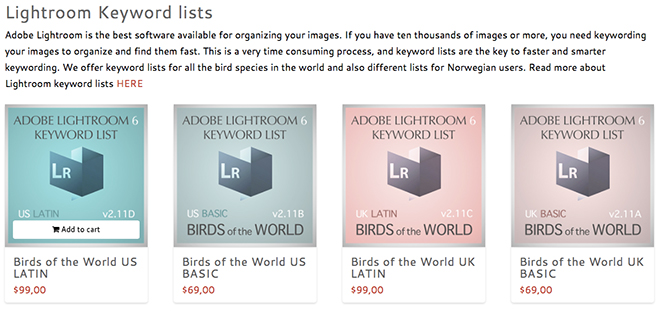 Over the last few days I have been extensively testing the Birds of the Word UK Latin Edition and have found it absolutely invaluable in key-wording the many thousands of bird photographs in my Lightroom library. Integrating the list into your existing keyword structure is as simple as importing the list in the Meta-Data drop down menu of Lightroom. The lists are built in a hierarchical structure which makes them easy to manage as well as easy to understand. The UK Latin Edition I have been testing also contains synonyms for added granularity and detail. One of the added benefits of using a complete species list such as these is to actually see how many of a given type of bird you have photographed as well as what other types might be similar. Wether you are a keen bird photographer, or want to save time with your key wording of birds (as well as increase your accuracy and add finer granularity), or just wanting to increase your knowledge of birds I believe you will find these keyword lists to be extremely useful in your work-flow.
Anyone up for creating a complete list of the Mammals…?


 Access to these two islands is only obtained by first flying into Mount Pleasant near the capital Stanley and then taking a much smaller B-2 Islander plane out to the smaller Saunders and sea Lion Islands. The weather around the Falklands is a constantly changing variable and as such flights to these islands are never assured – everything is a weather dependant. Our first stop at Saunders Island was roughly a forty five minute flight from Stanley. We were touch and go for this flight due to very low cloud and fog in the area, but in the end we made it by flying under the cloud and super close to the water. I knew we were low when I looked out the window at the passing cliffs and saw a flock of sheep looking down on us.
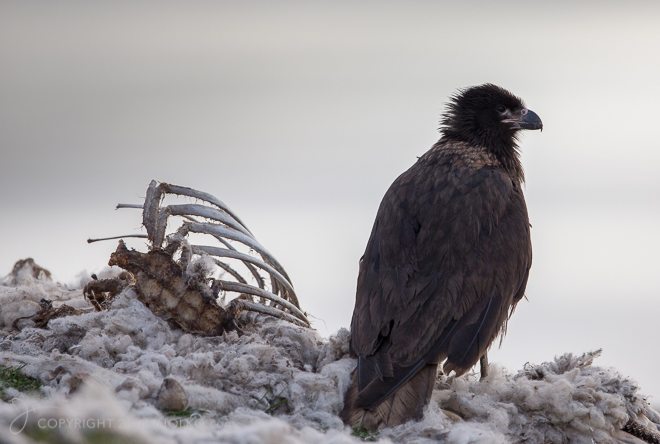 On arrival at Saunders Island we made the 45 minute drive by 4-wheel drive out to the ‘Neck’ area which would be our home for the next few days. The Neck is a remote part of the island with only basic self contained accomodation. The wonderful thing about this location however is the sheer plethora of bird life literally right outside the window. The Neck is really a very special area and we certainly got our moneys worth with changing conditions and amazing wildlife. In addition to Gentoos, Magellanic and Rockhoppers there was also a group of King Penguins out here, as well as one pair of Macaroni Penguins in the Rockhopper colony. The Caracaras (Johnny Rooks) and the Turkey Vultures were also very active here and there were a great many small birds including Meadowlarks, Black Throated Finches, Plovers and more. In addition there were Oyster Catchers, Gulls and other sea birds. Some of us also made the trek out to two of the remote ponds where we were able to photograph Black-headed Swans and the beautiful Silver Grebe. At the Rookery we enjoyed the Rockhoppers and also a huge number of breeding Black-browed Albatross in spectacular landscapes. I know of no other place in the world where you can photograph Black-browed Albatross in flight with a wide angle 16-35mm lens!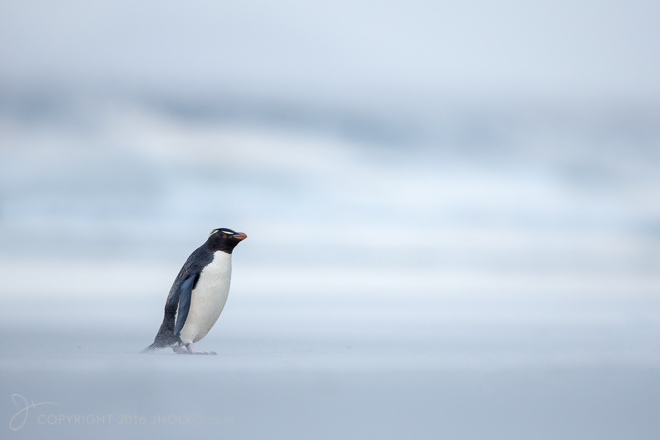
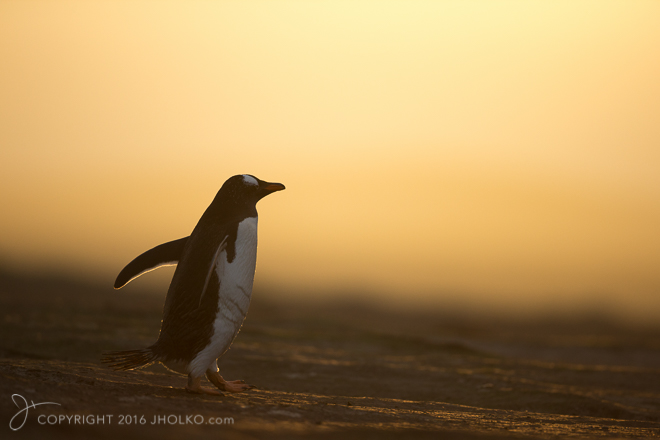 When we had finished at the Neck we took another small plane ride to Sea Lion Island where we spent three more days photographing Gentoo and Magellanic Penguins and also Rockhoppers and Cormorants a short drive from the lodge. In addition we had some fantastic shorebirds, Caracara, Blue Eyed Cormorant as well as several different species of the wetland birds found in the Falklands (several of them endemic to the islands). One of the highlights for me personally was the short-eared Owl which I spent the better part of two days to locate and photograph.
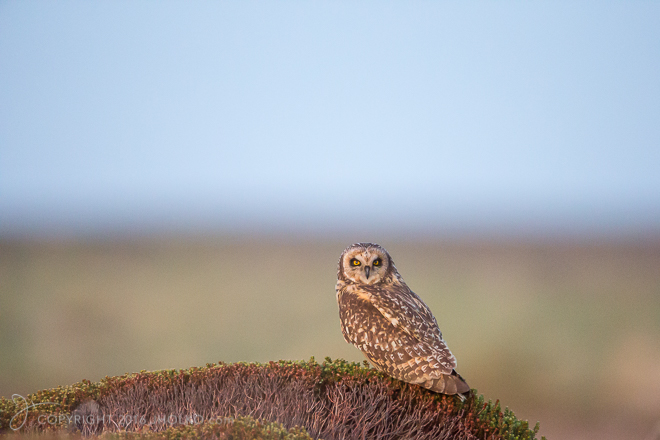 The Falkland Islands is a world class location for bird photography and is a remarkable location for any wildlife photographer to spend time. With so many of the birds being approachable the photographic opportunities are extensive. As yet I have only had time to process a small handful of the photographs I made in the Falkland Islands, but hope to find time to work through many more over the course of this year. I am also looking forward to returning to the Falklands for a future workshop.
 www.WILDNATUREPHOTOTRAVEL.com