I was very pleased to learn yesterday that I was selected as a finalist in the 2012 Capture Magazine Top Emerging Photographers in Australia in the Landscape category. This is Capture’s fourth annual awards showcasing the very best of Australia’s emerging photographic talent as chosen by some of Australia’s preeminent professional photographers. Over 4000 images were received this year for judging and I am very honoured to have had my portfolio of six photographs amongst them and to be selected as one of only three finalists in the Landscape category. Capture Magazine is Australia’s top selling pro-photography magazine and has also previously featured my work in 2011.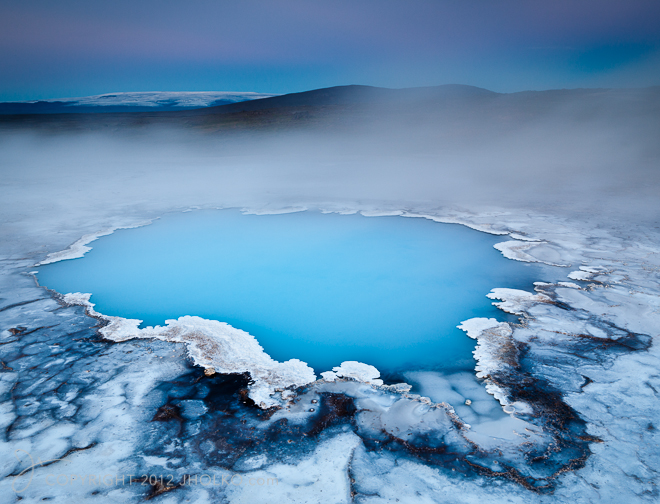
Category: Wildlife Photographs
Wildlife Photographs from around the World
MELBOURNE WEEKLY BAYSIDE NEWSPAPER – ‘SOURCE OF INSPIRATION’
The current March 21st edition of the Melbourne Weekly Bayside newspaper has an introduction to my new exhibition opening tonight at Source Photographica in Brighton.
THE IMPORTANCE OF PATIENCE AND CONDITIONING IN WILDERNESS PHOTOGRAPHY
It occurred to me about a week or so ago (when I was forced to drop down into an ‘Everest gear’ to grind out one of the big hills on the mountain bike trail that I ride near my house) just how out of condition I am after my time in Antarctica (over-indulgence in good food during the Christmas New Year period has not helped either). During my time in Antarctica, on board ship, I never really did any exercise; yet I regularly stowed away three square meals a day (large three-course meals at that). Since I didn’t suffer from sea sickness, I was able to keep all those meals down (thankfully). My cardiovascular fitness has really deteriorated and it feels like I am missing a lung as I drag myself up the hills on the bike. After 20 kilometers on the trails, my body feels quite battered and broken. Overall, my time off the bike over the Christmas-New Year period has left me feeling quite unfit and out of condition. Subsequently I have actually managed to crack my bike frame and am undergoing a forced hiatus while I wait for my bike to be rebuilt.
The connection to photography may not be apparent at first. But physical fitness plays a major role in successful wilderness photography. A good level of physical fitness enables you to hike faster, further and arrive at your destination ready to shoot, in better condition. It can be the difference between arriving at the top of the hill and getting the shot before the best light is gone and arriving on location exhausted and disappointed. It can even mean your not making it to the top at all. This is not to say the best shot is always at the end of an uphill hike. However, you will never know if you don’t make it up there to see for yourself. You don’t have to be an elite athlete to be a wilderness photographer, but I find a good level of physical fitness certainly helps.
Whilst I was puffing my way up the hill on my mountain bike, I also got to thinking that mountain biking is like photography in that to get good at it you have to do a lot of it. To stay in peak condition you have to be persistent. I have observed this many times when I am out on my photography excursions. My shots continue to improve as the days roll past and my ‘conditioning’ improves. It takes time to get into the ‘groove’ —the right frame of mind that enables me to recognize the good images from the bad. Antarctica was like that: it took me time to assimilate. After extensive international travel, the few days I had in Buenos Aires and Ushuaia gave me the opportunity to wind down, leave the stress of daily life behind, and start to focus on photography. This time was crucial because I had the chance to relax, which is just as important as being fit for the task. Buenos Aries itself didn’t turn me on photographically. It is a crowded and polluted city, quite unlike my expectations of Antarctica. But, at least, I was in the right frame of mind—relaxed—when we eventually left for Antarctica.
Before I arrive this July for my 2012 workshop in Iceland I am going to be spending a couple of weeks travelling through France and Italy (specifically, driving down from France to Venice) photographing the countryside as a precursor to the workshop. I am hoping to use this time to get my eye in, as it were, and ensure my state of mind is at or near its peak when I arrive in Iceland.
Landscape and Nature photography requires a serious commitment. You must be prepared to spend countless hours outdoors, frequently in inclement weather or harsh environments. It also requires hours of patience to get the best possible light. I have spent many hundreds of hours in the wilderness waiting for the right conditions. Nature and landscape photographers who are truly committed are a rare breed; we have to put up with a lot—fitness, patience, vigilance, and an eye for the main chance. It takes a certain mindset and dedication to stand around in freezing conditions and rain for hours, waiting for the right light when what beckons is a nice dinner and a glass of wine in a warm hotel somewhere. You need commitment and dedication to get the shot. One thing I have learned through experience is that it is always worth sticking it out to the bitter end when waiting for the best light, no matter the prevailing weather conditions. Generally, brief moments of special light don’t fill the bill; you have to see it out to the end. All too often, the light changes in the last few moments and in these instances the light is often at its most spectacular. I recall a very poignant example of this, which I have blogged about before in Iceland in 2010 when I arrived at the top of one of the highest mountains in Landmannalaugar in Iceland, more than three hours before sunset. They skies were dull and grey and we were exposed to the full force of the Arctic winds. My friend Dmitry and I decided to hunker down and wait out the 3+ hours before sunset. I just wanted to hike back to the 4-wheel drive to warm up with a hot cup of coffee and a piece of cake, but the wait proved worthwhile. The shoot provided some of the most spectacular light I have ever experienced anywhere. We had distant rain showers, rainbows and light that can only be described as sensational. Lesson learned – Never Give In. Above all, patience!
THE TIP OF THE ICEBERG – FEATURE MAGAZINE ARTICLE FEBRUARY / MARCH 2012
The current February / March edition of Australian Digital Photography magazine that is just hitting the news stands is tagged as ‘The Landscape Issue’ and has an eight page feature article on my photography (sub-titled ‘Insights into the world of extreme landscape photography’) from Iceland. This was an interesting interview for me as much of the talk was about equipment, technique and the process, rather than discussion of the actual photographs themselves. A high resolution copy of the article can be downloaded HERE.
ANTARCTICA – THE LAST BASTION : WHEN INSTINCT TRUMPS PRECONCEPTION
An overtly strong preconception of how a new location or subject will photograph is an all too-easy pitfall for the landscape photographer to fall into. It is a problem I have discussed with other photographers, and I find myself struggling with the problem every now and then. As a landscape photographer who is forever chasing the best possible light, I frequently find myself headed to new, often exotic locations with a strong preconception of, not only what I will photograph but also the quality of light I will encounter. At times this preconception will even lead me as far as framing the image in my mind. The danger of the preconception is that it is inevitably stronger than the reality. Indeed, in my experience the stronger the preconception the more likely it is to lead to disappointment. Such is the power of the human imagination. The preconception can easily lead to disappointment and even, at times, to not getting the camera gear out of the bag. Reality can sometimes have quite a sobering effect on the vision. The preconception can also blind us to the obvious. With too strong a picture in the mind’s eye, it is all too easy to spend all one’s time looking for that shot, when the real gem lies dead ahead but remains unseen for our inability to see past the preconception.
With such a long build up to my Antarctica expedition late last year, I had literally months and months to build preconceptions, hopes and dreams for my Antarctic photography. Believe me when I say my mind was running wild with thoughts of blazing sunsets and sunrises, soft pastel light and a depth of colour that would ignite a fire in even the most cynical landscape photographer’s dreams. Browsing through my collection of photography books on Antarctica did little to quell my raging imagination. I am a realist at heart, however, and even though my mind was running amok with the possibilities, I was also acutely aware that what-would-be would-be and that there was very little I was going to be able to do about it once on location, except make the most of things. Antarctica is not an easy place to get to and arranging a re-shoot is logistically impractical. When you are shooting from a ship, when time is limited and the costs are high, you must make the most of the cards you are dealt.
As it happened, there were no blazing sunsets or sunrises that would result in an explosion of fiery oranges and pink pastels during the expedition. As I am oft heard to say in such situations – ‘Sometimes you get the candy bar, sometimes you get the wrapper’. But is the lack of blazing colour really always the wrapper? Most definitely not.
Despite the lack of sunrise and sunset colour during the expedition I was nevertheless thrilled with the quality of the light. I am on record as preferring overcast and dark, moody skies in my photography rather than clear sunny days. I love the drama of storms, dark brooding skies, and racing clouds. There is a drama to such scenes that I find highly evocative and strongly emotional. There is a primordial quality to dramatic skies that I find very appealing. Hence, I found myself really struggling on the one bright and clear sunny day that we did have in Antarctica.
I have seen many photographs from the Lemaire Channel in Antarctica with wonderful golden evening or pre-dawn light, and this was indeed the preconception in my own mind’s eye as we turned into the channel for what would be one of our final shoots of the trip. The fact that the skies were dark, brooding and filled with snow did at the time give me pause to stop and think ‘damn… I wanted sunset colour!‘ However, I quickly realized that this was also an opportunity to produce a photograph that was very different to others I had seen from the Lemaire Channel. Instead of the classic channel shot bathed in golden sunset light, I could instead take advantage of the dark overcast skies to frame one of the imposing mountains overlooking the channel, one that I had not seen before.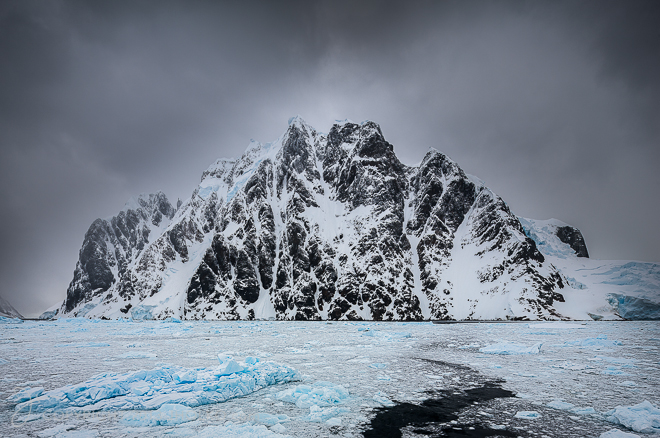 I chose to shoot this with Canon’s 17mm Tilt and Shift lens on my 1DS MKIII as I wanted to use some in-camera perspective control to prevent the mountain appearing to fall away from the viewer. I have previously blogged about this phenomenon in my post about ‘The Fortress‘ iceberg. I have found, through experience, that I prefer to accomplish my perspective control in-camera, rather than in the digital darkroom. I do not recall the exact amount of tilt I used in this photograph but it was somewhere around 1.5 degrees. As I was photographing from several stories high on the aft of the ship I also used a significant amount of lens shift to get lower to the water.
What I was aiming for in this photograph was to convey the imposing and seemingly menacing nature of the mountains that guard the entrance to the channel. I wanted the chalky blue nature of the ice to contrast against the black and frigid water. I also wanted to capture the wake left by our ship as a leading line into the frame. Lastly, I was hoping to try and give the impression of rivers of ice running down the mountain, juxtaposed against the dark skies and the back-lit mountain. Because it is impossible to use filters with the 17mm TSE due to it bulbous front element I had to add a graduated effect in post-production in Adobe Lightroom to achieve this result. I would normally have used a graduated neutral density filter in the field to achieve this.
By far the majority of photography from the world’s southern most continent consists of classic icebergs and penguins and I have many photographs of this kind that I am very pleased with. There are few photographs that I feel speak to the raw natural power and primordial beauty of Antarctica. I hope that this photograph has captured at least some of that majesty and power. A higher resolution version of this photograph can also be seen in my Antarctica portfolio at www.jholko.com

