Wildlife Birds #2

Another from the same photo shoot as the Emu photograph ‘Eye-to-Eye‘. This time of the Australian Cockatoo in flight  at Healesville. I shot this with the Canon 300mm F2.8L IS wide open at F2.8 ISO400 1/2000th of a second to freeze the action. Tracking birds in flight is not easy – this was one of only a few good sharp frames where I was also very happy with the pose. In order to make the Cockatoo better stand out from the background I created a second layer in Photoshop, converted it to Black and White and then masked off the Cockatoo. This effect dramatically helps in isolating the bird and creating a clear point of focus.
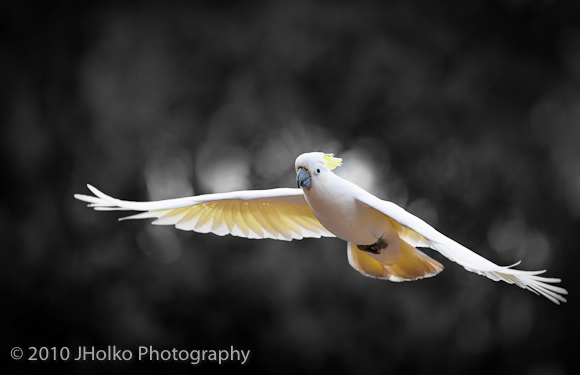
Cleared for Landing

Wildlife – Birds

I am starting to wind down my Wildlife Portraits project as its only a week now until I leave for Iceland and I have a seemingly never ending list of things I need to complete before I can leave. The plan was to run the project up until I left for Iceland. However, I have subsequently shot a lot more frames than I initially thought I would have and still have images to sort through and process. So, rather than finalise a project that feels somewhat incomplete I am simply going to put it on hold until I get back and have a chance to pick up where I am leaving off. I will then see the project through until the end of the year. The additional time should give me greater opportunity to expand the portfolio into a more complete form. I hope to still post a couple more images (including this photograph) before next week when the project will officially go on hold.

Eye to Eye

Wildlife Portraits Project – Parrot

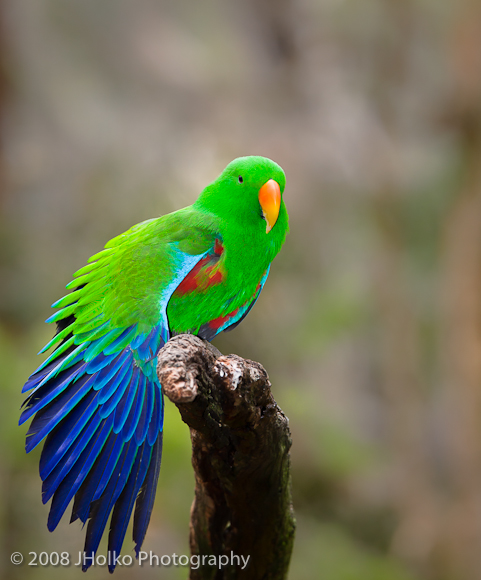
Birds have not been high on the list of subjects for my wildlife portrait photography. The longest lens I own is a Canon 300mm F2.8L IS; which even when coupled with my 1.4 Tele-Extender on my full frame 1DS MKIII still only gives me quite limited reach for photographing birds. Most serious bird photographers I know are shooting with a minimum of 500mm on crop sensor cameras (often with Tele-Extenders) for seriously long reach; because you need that kind of each most of the time. In this case I got lucky, and was able to catch this Parrot with his colourful wing extended with the 300mm lens. The light was quite dull and overcast so I used fill flash to bring out the colours in the plumage. I am hoping I get an opportunity to photograph some of the native Icelandic birds (including the Puffin) later this month and August whilst I am in Iceland.

Show Off

Wildlife Portraits Project – Australian Dingo

Every time I have visited Healesville Sanctuary in the past to photograph wildlife the Dingo’s have been sleeping (I think they might actually sleep more than cats). On my last visit they were up and moving around so I couldn’t resist ripping off a few frames on my way past. This frame ended up as quite a nice portrait – handheld with the 300mm F2.8L IS at F5.6 1/100th of a second.

Australian Dingo

Snow Leopard – Its a Mac Thing

It isn’t really a ‘Mac Thing’ (or maybe it is!) – But the Snow Leopard is definitely my ‘favourite’ of the big cats (I also have a soft spot for the Persian Leopard); which accounts for my continual return visits to photograph them whenever possible at the Melbourne Zoo. This photograph was taken during the same shooting session as ‘Snow Leopard in Profile‘, but captures a very different moment and feeling. My only regret with both of these photographs is that this is a captive animal and not wild. But since Snow Leopards are native to a foreign country, endangered and extremely rare I hope you will forgive the captive nature of these photographs and instead enjoy them for their merit in their own right. I used the Canon 300mm F2.8L IS lens for this shot at ISO400 on the 1DSMK3. I have had a few emails from readers asking me how I photograph these animals without any ‘bars or cages’ in the shot – ‘Did I have special access?’ The answer is no – I photographed all of the animals either in the wild or from normal public Zoo access. The trick when faced with caged animals is to use a lens with a wide aperture like the Canon 300mm F2.8L IS and to put the lens as close as possible to the bars; whilst putting the animal as far away from the bars as possible. This effectively throws the bars or cage so far out of focus that they become invisible. Its a very useful technique to photograph captive animals.