CANON ‘GEAR IN ACTION’ INTERVIEW – THE 1DX IN FRANCE, ITALY AND ICELAND 2012

CANON: I was recently interviewed again for Canon Australia’s CPS ‘Gear in Action’ website and the content of the interview is now online at CPS Australia. Unlike my previous interview HERE which primarily focused on Fine Art Printing this time the emphasis was on cameras and my experience with Canon’s new tour-de-force 1DX camera during my recent travels through France, Italy, Venice and Iceland. There is also a small gallery of images– which I have not yet even uploaded to my website. I hope you enjoy the interview.For CPS members there are also details of the expedition I am leading to Antarctica with Daniel Bergmann on Canon Australia’s website HERE. This expedition is of course open to all photographers. You don’t have to shoot Canon or be a member of Canon’s Professional Services. :-)

PHOTOKINA: If you are heading over to Germany for Photokina later this month be sure to stop past the Moab and Legion Paper stands where some of my prints from my Iceland series will be on display on my favourite paper: Somerset Museum Rag.

A small disclaimer: Although I both shoot and print exclusively with Canon cameras and printers I am not sponsored by Canon. I pay for all of my own equipment with my own hard earned money. I choose to use Canon cameras and printers because I have found them to offer outstanding results and reliability in my photography – not because I am incentivised by the manufacturer. I am a Canon CPS Gold Member and rely on CPS to assist me with sensor cleaning and loan equipment from time to time.

CANON 1DX IN THE FRENCH ALPS

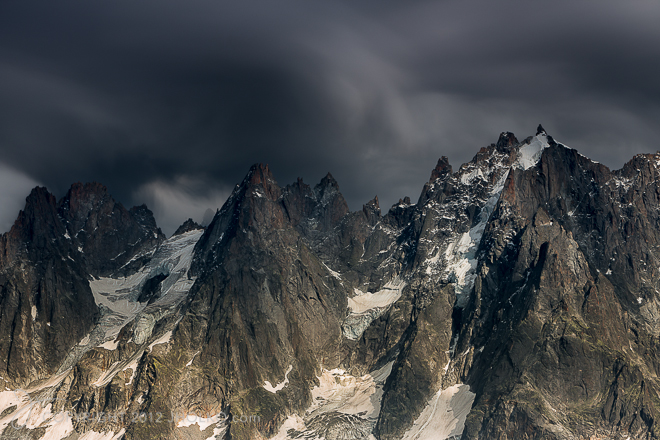
One of the real highlights of my trip through France was the opportunity to visit the alpine town of Chamonix. Widely regarded as the mountaineering Mecca of France, Chamonix is a magnet and playground for mountaineers and alpinists from around the world. With its high altitude mountains, precipitous and jagged peaks, and high quality granite spires it is easy to see why.

The town itself is filled with all manner of outdoor clothing, mountaineering and adventure shops. The only other place I can recall seeing such a collection of stores and brands in such a small a geographical area was in Ushuaia at the bottom of South America from where the majority of Antarctica expeditions depart. In short, if you can’t find it in Chamonix you probably don’t need it (although the prices might leave you reeling).

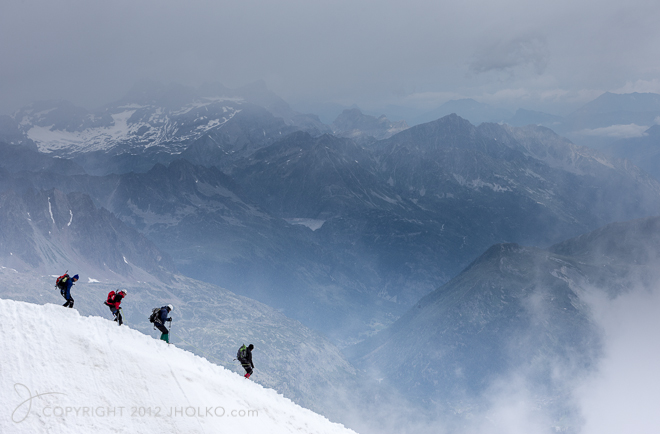
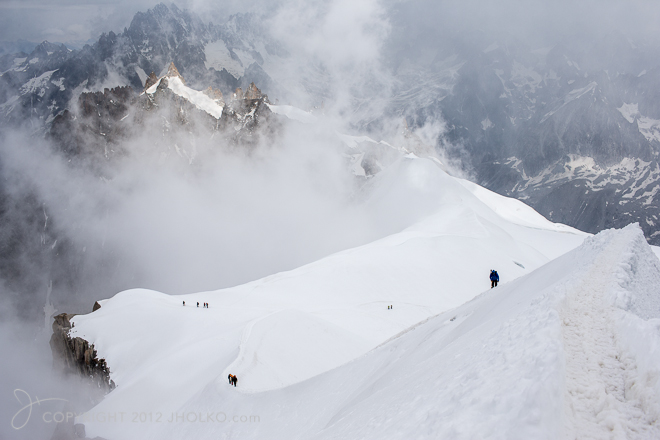
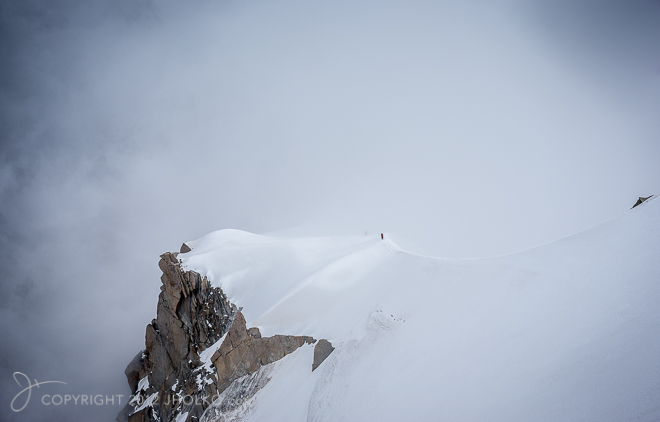
With a day free in Chamonix before heading for Venice, I jumped at the opportunity to take the two cable cars up to the Aiguille Du Midi at just over 12,600 feet for some mountaineering photography.With no real mountains to speak of in Australia, I am not used to high altitude climbing and suffered from constant lack of breath, light-headedness and a severe headache after twelve hours at nearly 4000 metres. Whilst my Austrian companion seemed unaffected by the altitude I was forced to stop every few minutes to try and catch my breath as we made our way up the ridgeline. It was worth the pain, however, as the opportunity to photograph climbers returning from Mont Blanc along a very exposed ridge provided breathtaking views and photographic possibilities. We were taking a little bit of a chance with this climb as it was very windy and the pressure was dropping, with the possibility of a forecast storm. Spindrift was whipping off the peaks and, with eleven people loosing their lives on Mont Blanc in the last few weeks, I was less than thrilled at the thought of getting caught in an exposed position.  I was, however, very keen to get some photographs, because the wind was whipping clouds and fog across the mountain at a rapid rate which was creating a lovely play of light. In the end, I climbed only a relatively short distance up the ridge as the conditions were just too dangerous for my experience at that altitude.This was the first opportunity I had to use the Canon 1DX at high altitude in cold weather and it did not disappoint. At -15 degrees Celsius the Canon 1DX performed flawlessly and I was able to squeeze out nearly 600 frames without any effort, finding no need to warm the battery or swap it for another from a warm pocket. This is remarkable performance in such a hostile environment and is consistent with my experience with the 1DS MK3 and 1D MKIV cameras in Antarctica.I hope to return to Chamonix in the future and spend more time in the stunningly beautiful French Alps. Along with the Andes mountain range in South America, they rate as some of the most rugged and beautiful mountains I have seen.

For now, I have arrived in Iceland and am looking forward to heading out into the wilds tomorrow morning.

CANON 1DX AND FRANCES NOTRE DAME CATHEDRALS

Paris is, of course, well known for its magnificent Notre Dame Cathedral, the sheer scale and majesty of which is biblically awe-inspiring. Photographing the Notre Dame, however, is a challenge. By break of day the building is surrounded by thousands of tourists streaming through its grand doors and climbing its towers, and the numbers do not waiver until nightfall. There is simply no opportunity to capture the building free from visitors. Because I wanted to do more than merely walk away with the usual tourist postcard photograph, I was left searching for alternatives.

In an effort to make a better photograph I decided I would get up before sunrise and try a long exposure from one of the bridges across the river Seine in the hope of capturing the Cathedral in a more peaceful and serene environment.  This viewpoint is one I had not seen before and one in which I could utilize the river to place the Cathedral in context. Although the Cathedral is partially obscured behind the trees I like the angle for the added mystery. I used a ten stop ND filter to obtain a 4 minute exposure to soften the sky and create a sense of movement in the clouds and water.As much as I enjoyed indulging myself in Parisian café culture it now feels good to be out in the countryside and away from the hustle and bustle of the city. This has been my first visit to France and it has been as picturesque and scenic as I was led to believe. With its manicured fields and gardens the French countryside is beautiful and its many small villages quaint and adorable.

Over the last few days I have spent some time in the Champagne region (where healthy portions of fine Champagne were sampled and keenly devoured), Reims and the small town of Ambois located in the Loire valley where I have visited a number of spectacularly opulent chateaus located nearby.

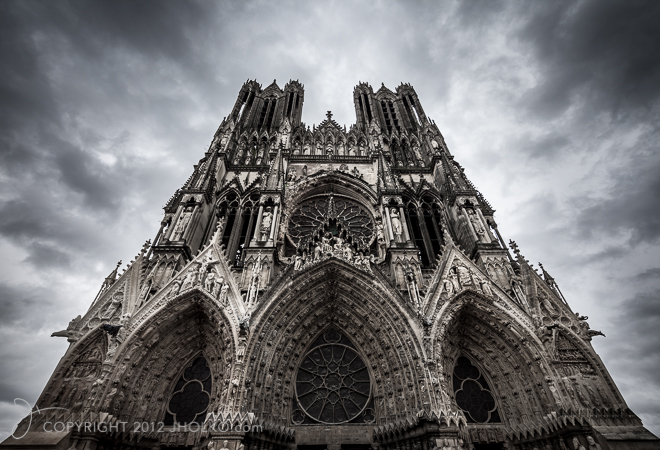
I was not aware that there is in fact a second Notre Dame cathedral located in Reims and was fortunate to stumble across it whilst driving though the town. The choice of how to photograph this gothic Cathedral struck me as I stood below its imposing form and leering gargoyles. I wanted to make this Cathedral appear to be both rooted to the earth and soaring toward the heavens in order to do justice to its gothic architecture and imposing stature. I accomplished this using Canon’s 17mm wide angle lens and pointing the camera up toward the towers to create an exaggerated perspective. This photograph was handheld since the use of tripods, even on the external grounds, is strongly discouraged. The key to making this work was a combination of the wide angle lens, camera angle and symmetry to create the desired effect. I was also fortunate to have some dramatic clouds and lighting which add to the atmosphere and enhance the Cathedral’s foreboding presence.This trip has been a wonderful opportunity to shoot with the new 1DX camera which is continuing to surpass my expectations. It has the best metering and autofocus of any camera I have used. Tomorrow I will be heading for Dijon where I look forward to more photography with this remarkable new camera and of course some more “boudoir the grape.”

CANON 1DX – MAKING THE IMPOSSIBLE POSSIBLE

Paris has been the first opportunity I have had to shoot with Canon’s new 1DX multi-media powerhouse camera. I had only limited opportunity to test the camera before I departed for Europe because the camera arrived only a couple of days before my flight departed. With all the delays since its announcement in September last year I was having serious doubts whether Canon were going to deliver. I managed some initial tests to ensure there was no immediate problem with the camera and these proved very promising, with excellent results.

After two days in Paris and around 500 frames I can now report that the Canon 1DX has exceeded my expectations for low light and autofocus performance in every respect. One of the real highlights in Paris for anyone interested in history and architecture is its incredibly impressive cathedrals and churches. The sheer scale, grandeur, and majesty of Notre Dame, and others, make them wonderfully impressive subjects for photography. They can be hard to capture in their entirety as there is a fine balance between placing the structure in context and the creation of a mere postcard. Nevertheless, I enjoyed the challenge and I could happily spend many days prowling the streets and cobblestone alleys for new and different angles.

As impressive as the Cathedrals are externally, they are equally awe-inspiring on the inside. Unfortunately, all of them are extremely dark inside and tripod photography is forbidden (as is the use of flash – although, this last ‘law’ seems very poorly enforced) necessitating the use of high ISO photography to ensure sufficient shutter speeds and depth of field. It is not uncommon to have to push the ISO as high as 10,000 or even 25,600 in some cases to obtain 1/40th of a second at F4 in the darker areas.

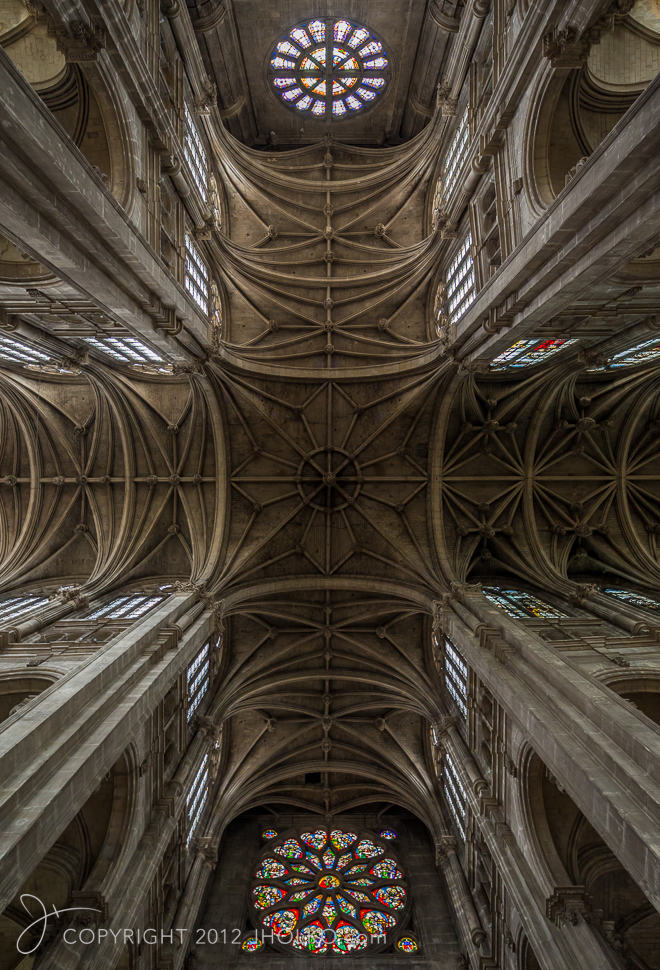
This photograph was taken inside the Eglise Saint Eustache cathedral with the Canon 1DX and 17mm F4L TSE, handheld at ISO 6,400, 1/60thof a second, F 4.5. I want to emphasize that it was extremely dark inside the cathedral and that the light streaming through the stain glass windows was extremely hot. The dynamic range far exceeds the capabilities of any camera to record; yet the 1DX has managed to produce an excellent exposure without intervention from me. This photograph simply would not have been possible with such low noise with any previous camera I have owned or tested. The image has had only minimal post processing and noise reduction in Adobe Lightroom 4.1. There is virtually no appreciable noise of consequence in the RAW file, at least nothing that is not easily corrected with a small amount of noise reduction (a modest setting of 25 in Lightroom was used in this example to reduce the luminance noise grain – no color noise reduction was required). The results are simply astonishing and I am very much looking forward to the new opportunities created by the amazing capabilities of the 1DX. Although in this example I utilized the 17mm F4L TSE which is a manual focus lens I also shot several frames with the 24mm f1.4L MKII and 35mm F1.4L lenses, and in all cases the 1DX was able to immediately nail focus in near total darkness, center of frame. The era of shooting in the dark has truly arrived.Although street and city photography is not my preferred landscape, I have very much enjoyed my time in the city of romance and rate it as one of the most beautiful and charming cities I have visited.  There is a wavelength and ambience in Paris that I can immediately harmonize with. Its cobblestone streets are steeped in history and charm and this, combined with my love of the café culture, make it a city I could easily call home. I am looking forward to wandering its streets over the next few days before I head for Venice.
Au revoir for now…
Battle of the Big Stoppers – LEE vs. HI-TECH Pro 10 Stop ND Filter Showdown

The LEE 10 Stop Neutral Density Filter, which is affectionately known as ‘The Big Stopper’, has been a staple part of my filter and photographic kit since it was released by LEE back in 2010. I was fortunate to receive one of the very first production units and have subsequently found ten stops of neutral density extremely useful in the creation of dramatic landscape photographs. The ability to slow shutter speeds down to minutes instead of seconds can really add a lot of drama to fast moving clouds and flowing water. It’s addition to a photograph can often be the difference between the recording of something otherwise banal and the creation of something truly extraordinary.There are a number of different options from which to choose for photographers looking to add ten stops of Neutral Density filtration to their filter kit. As well as the LEE ‘Big Stopper’, there are options available from B+W, Sing Ray, Hoya and Hi-Tech (and there may well be more I am not aware of). Each of these is designed to achieve the same thing – provide ten stops of ‘neutral’ density (emphasis on ‘neutral’).  It turns out however, that at least one of these filters (sample as tested) is anything but ‘neutral’.*

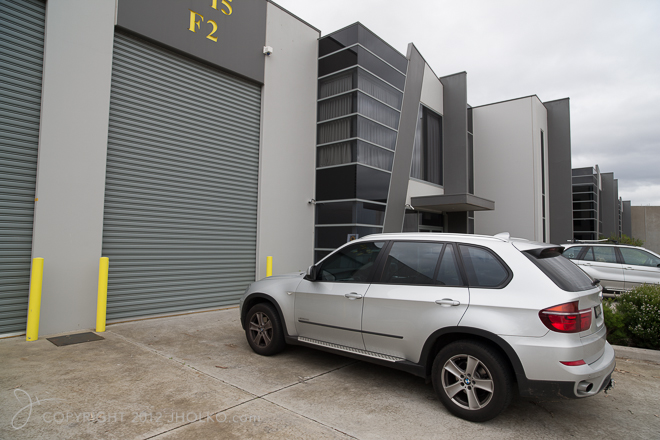
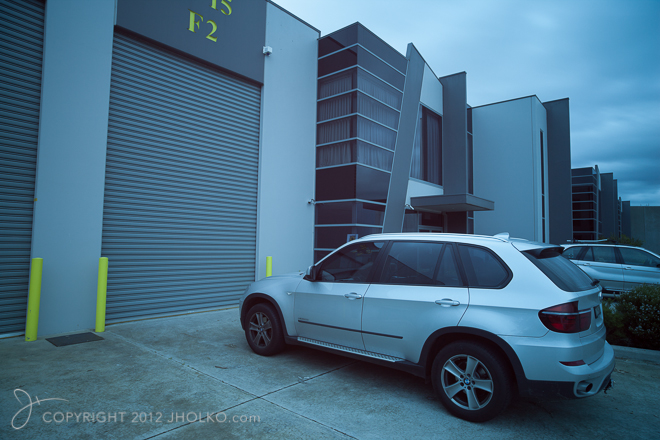
One of the participants on my upcoming expedition to Iceland in a few weeks time recently contacted me and asked if I would mind doing some testing with them of 10 Stop ND filters before we leave. They had been experiencing a severe (and virtually uncorrectable) colour caste with their brand new Hi-Tech Pro and were concerned that the filter may be faulty. Never one to shy away from an invitation to play with camera gear I quickly agreed and we set up a time to test the LEE Big Stopper against the Hi-Tech 10 Stop ND filter in a head to head comparison. We also had a B+W 10 Stop screw in filter for the Leica M9 and took the opportunity to also compare it. For our subject we had to hand a factory car park – crude, but nevertheless convenient. The day was overcast so no shenanigans were required to obtain acceptable exposures.Control – No Filter White Balance as shot: 5350 +4LEE Big Stopper White Balance as shot: 6450 -4HiTech 10 Stop PRO Filter White Balance as shot: 7800 +80

In order to make the comparison fair we used the same camera and lens (my Canon 1DS MK3 21.1 mega pixel camera with a Zeiss 21mm lens on my Gitzo GT3530 LSV tripod with a  RRSBH55 ball head) to test both filters. Although its somewhat irrelevant the photographs were taken with the mirror locked up with 2 second self timer at F5.6. We then proceeded to take three photographs. The first is our control without any filter. The second is with the LEE Big Stopper in place and the third is with the Hi-Tech 10 Stop filter. The results are inarguable and consistently repeatable regardless of the exposure time or aperture. The LEE Big Stopper provides outstanding performance in terms of neutrality as can be seen in a direct comparison with the ‘control’ image. The Hi-Tech on the other hand is nothing short of a complete disaster. It is in fact more ‘blue’ than an equivalent exposure with the LEE Sky Blue Graduated filter and its performance is simply unacceptable. Even on the LCD screen on the back of the camera I could immediately see that there was a major problem with this filter.

In order to ensure that we were not actually seeing things or that something went wrong during our test we repeated the test with both a Leica M9 and Nikon D800E (each with an equivalent lens) with the same results. In both cases we used the same camera and lens for comparison and only ever varied the filter. I suspect that the particular sample we tested may have come from a bad batch and that there may well be others out there with defective copies.  Hi-Tech have subsequently offered to replace the filter (which was actually brand new and purchased less than a month ago).

As a side note, the LEE filter is glass (sometimes referred to as Black Glass or BG) and the Hi-Tech is resin and the procedure for adding neutral density to these surfaces is very different. Resin filters are dipped in a dye bath where as glass filters (according to my understanding) use a glazing process. In the case of the sample Hi-Tech we tested I suspect that something has gone wrong during the dye process giving the filter a blue caste. It is worth noting that LEE’s Graduated Neutral Density filters are also resin (as are Hi-Techs) and effectively exhibit no colour caste.

I also took this opportunity to test the new LEE 3 Stop Pro Glass Neutral Density filter I purchased last week and its performance proved excellent. It is well worth taking the time to test any new piece of photographic equipment before an expedition. Time invested before hand can save many hours of work and frustration down the line. In this case it has saved this participant what would have been many hours of possibly uncorrectable post production work.

* Footnote: In my experience all ten stop filters have some degree of colour caste. The idea however is to be as close to neutral as possible.