RETAIL THERAPY – PHOTOGRAPHER STYLE

I admit to being a complete shopaholic when it comes to photographic accessories. I just keep on buying different brands and models of ‘things’ until I finally settle on a product I am completely satisfied with. Online reviews are useful and aid me in making a purchase decision, but it is really my own use and experience in the field that ultimately determines my level of satisfaction with a product.

Being somewhat of a perfectionist, I get frustrated when a product comes up short of my expectations and convince myself that I can do better. This inevitably leads me to my next purchase. Camera bags and cold weather gloves for photography are two accessories that I have continually purchased in the quest for ultimate satisfaction. I finally reached the end of the camera bag road shopping spree when I purchased the Gura Gear Kiboko after my 2010 Iceland expedition. I had finally found the perfect camera bag for my needs. Gura Gear followed this in 2011 with the Chobe which solved my laptop and accessory bag dilemmas in one go. It is quite literally the perfect bag combination and I no longer feel the need to even visit the camera bag section of a photography store.
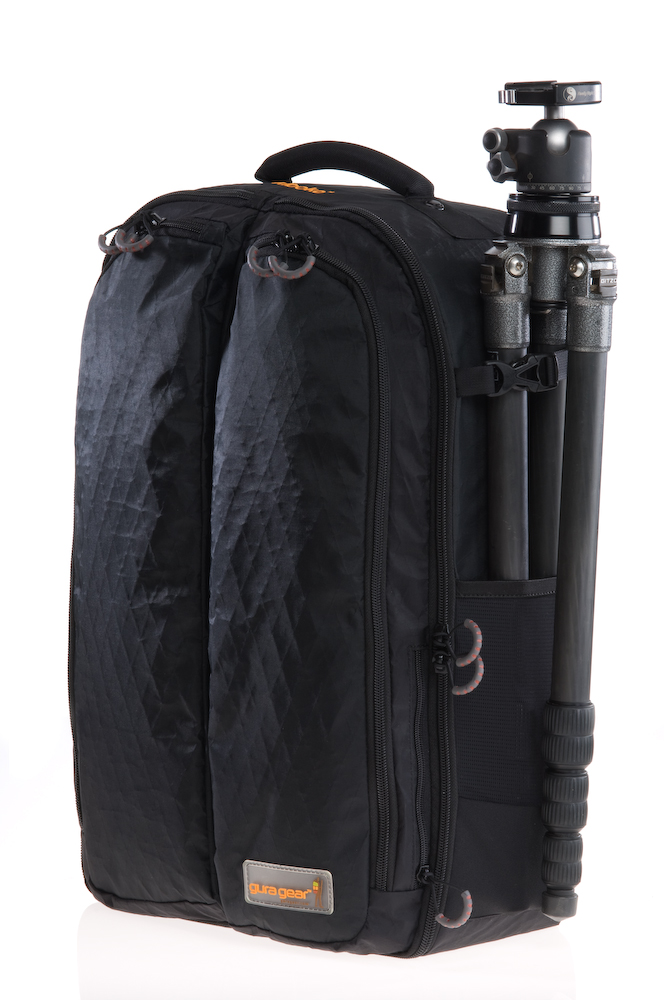
Kiboko

I feel I am also close to the end of my journey for cold weather photography gloves with the Helly Hanson sailing gloves I discovered late last year. I shot extensively in Antarctica with these gloves and found they provided a high degree of tactile feel for operating camera equipment while supplying sufficient warmth, making them (almost) ideal for my sort of photography. If someone would manufacture this glove in a waterproof (or even water-resistant) version I would be at the end of my search.

Outdoor clothing is part of my photographic accessories since I do the majority of my landscape and nature photography in remote locations and often in inclement weather. I have a cupboard full of inner and outer layer jackets which have been accumulated over a number of years from a wide range of manufacturers. I used to find it very difficult to walk into an outdoor clothing store and not walk out with a new jacket of some description. I believe I can lay the blame for this vice squarely at my father’s feet since I recall in my youth his tendency to purchase jackets on a more than regular basis. I have strong recollections of his cupboard being full of beautiful outdoor jackets and I guess it more than rubbed off on me. However, I think I finally cured myself of the ‘jacket addiction’ when I discovered the 66 North Eldgja mid layer jacket and their Gylmur eVent outer waterproof jacket and pants. This combination works for me – it’s extremely light-weight, breathable and waterproof. I have now worn this clothing from Iceland to Antarctica, Australia, Tasmania, and New Zealand across a wide range of weather conditions and it has met my needs across all elements. I no longer feel the need to purchase anything else. (Although I did just order another Eldgja jacket because I like to have one to wear when the other is in the wash, so perhaps the addiction is not quite at an end yet!)
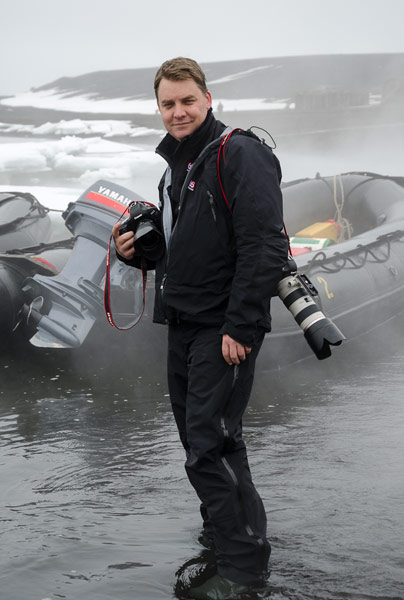
66 North Glymur eVent Jacket and Pants

This brings me to another product that has multiplied in my closet: Photography vests. My first photography vest was a Domke and it served me very well for many years before I finally caught it on one-too- many rural barbwire fences and it met a grizzly, though probably not untimely end. At the time I did not really consider any other options and simply purchased another one. It took me quite a long time to realize that I was never truly happy with the Domke. For starters, it’s made from cotton, which means when it gets wet (and it isn’t waterproof) it gets heavy (and it takes a long time to dry). Secondly, large lenses placed in the front pockets tend to dangle low and bang around the knees the moment I crouch down. And lastly, the Domke really isn’t very practical for travelling on and off airplanes as it draws too much attention to itself – it doesn’t actually scream ‘photographer – I’m carrying an overweight camera bag!’, but it certainly speaks in a loud voice and in today’s age of airport clamp-downs it is less than ideal.
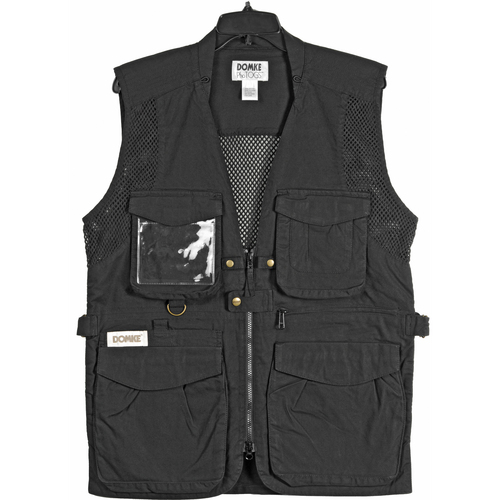
Domke

In the search for a replacement for my Domke, last year I purchased an Xtrahand photo vest (somewhat in frustration) as I could not find anything else on the market that I thought would be suitable for field work. To be clear, I never had any intention of using this vest for anything but remote wilderness work. It is just too ‘tactical’ for any public appearance and it most definitely screams at the top of its lungs: ‘I’m a photographer with huge amounts of heavy equipment and I don’t mind looking like Rambo!‘ The Xtrahand vest is the ideal solution for the photographer walking into the wilderness who does not wish to carry a camera bag. It holds ridiculous amounts of photography equipment (and I do mean ridiculous) and manages to spread the load palatably on arduous hikes. It meets its design criteria perfectly. What I did not know at the time was that I prefer to carry my Kiboko camera bag rather than wear the vest. It’s just a personal preference based on my habit of dropping my backpack on the spur of the moment. Whilst the vest is easily removed, it was somewhat tiresome to put it back on and difficult to extract gear from when it was on the ground. I also prefer the layout of the Kiboko for my equipment.
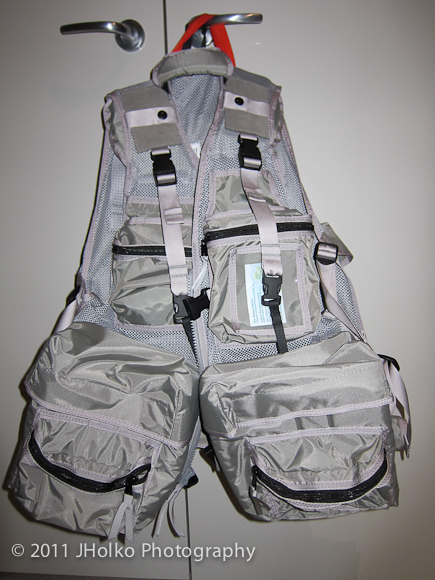
XtraHand Photo Vest

Thus, the photo vest saga turned out to be one of those examples where I did not realize my needs until I had tried something different. After some months with the Xtrahand vest I became aware that it simply wasn’t for me and it has gathered dust alongside a multitude of camera bags and my Domke vest since. I am going to be clearing house over the coming weeks and many of these items will find their way to eBay where I hope they will meet someone else’s needs.

With my trip to Paris, Venice and Iceland now only a couple of weeks away, I visited my local photography store a few days ago to grab a coupe of last minute items, including yet another LEE Neutral Density filter (more on filters in another blog post, but I clearly also have some sort of addiction to purchasing filters) and other various small, but necessary accessories. As I am prone to do, I wandered the store (dangerous decision for a shopaholic like me) whilst the salesperson checked the items and totaled the bill.  Wandering up and down the aisles, my eyes were drawn to a vest made by Italian tripod company Manfrotto that I had read about over a year ago – The Pro Photo Vest. At the time, I remember reading that it had been designed specifically by photographers in conjunction with an Italian design company in Milan – it was stylish, understated (in photography vest terms) yet very practical looking – and I was told at the time that they were probably a good six months away from production and likely longer than that before they reached Australia. I subsequently put them out of my mind and had completely forgotten about them.
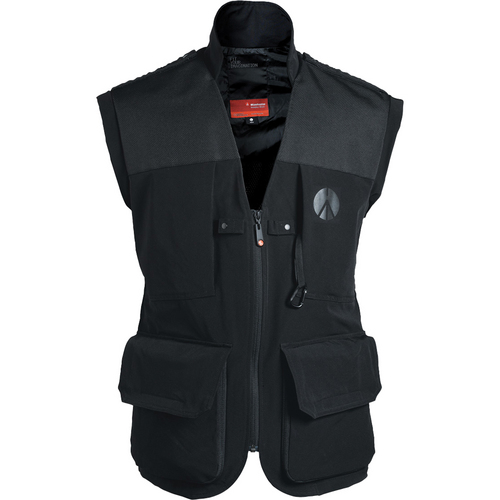
Manfrotto Pro Photo

Fifteen minutes later, after trying one on and getting my head around the typical Manfrotto price tag, I purchased one. What got me over the line was exactly what I recalled about the vest when I read about it more than a year ago – stylish, understated, and practical (incidentally those are three characteristics that my Gura Gear camera bags and 66 North clothing all have in common). Much like my beloved 66 North Eldgja jacket, it ‘just felt right’ the moment I slipped it on. I won’t wax lyrical about it here as clothing is a very personal item and really needs to be tried on to appreciate. Suffice to say, at this point I am quite excited with this new vest and very keen to test it out on my coming trip. There was never a question of the Xtrahand vest travelling to Paris, Italy and Iceland with me since the Gendarmes would be very quick to swoop on anyone sporting such a military style vest. I was also loathing the thought of taking the venerable Domke with me (yet again) and the thought of it getting wet in Iceland was giving me the shivers.   Now with the Manfrotto vest, I feel I have this problem licked and I am keen to see if this new accessory meets my expectations and needs. Given that it ticks my three boxes of stylish, understated, and practical, I have high hopes that it will.

Or, perhaps this will turn into yet another step in a jacket and vest addiction that will never go away!

HOW TO: USE LEE GRADUATED ND FILTERS ON THE CANON 17MM F4L TSE LENS

One of my favorite lenses is the Canon 17mm F4L Tilt and Shift, an optically superb lens and one of the sharpest in the Canon wide angle range (along with the 24mm Tilt and Shift). With stellar optical performance and perfect tilt and shift movements, it is the ideal tool for wide-angle landscape photography.

Except that there has been a problem: a big problem.

Because of its bulbous front element, it is more or less impossible to use filters with this lens. I use neutral density graduated filters extensively and frequently find I cannot use the 17mm F4L TSE effectively because of the inability to use a filter to tame the dynamic range of the scene. This has sometimes left me frustrated with this lens for landscape work.

LEE designed and developed a solution for a similar issue with the Nikon 14-24mm wide angle zoom lens (which also has a bulbous front element) and that solution has been widely available for some time now. Unfortunately, no such solution has been forthcoming for the Canon 17mm F4L TSE lens, leaving many of us who rely on filters left out in the cold.

I know many photographers who have abandoned their filter kits in favor of multiple exposure HDR (High Dynamic Range) composites and for those photographers there is no longer a requirement for an effective bracket for using Graduated filters. However, I dislike HDR photography and prefer to capture my images in a single exposure without the need for digital blending during postproduction in Photoshop.

Consequently, I have often had to reject the 17mm TSE lens because of the scene’s dynamic range and the inability to use filters, which has more or less relegated that lens to internal architectural photography or occasions such as Antarctica (where I shot with the 17mm Lens extensively). In Antarctica, dynamic range was simply not an issue and I was able to capture the scene without use of a graduated filter (thank goodness for overcast conditions!). I shot extensively with this lens both from the deck of the Ocean Nova and from Zodiacs and I really came to appreciate the benefits of the lens when shooting handheld from ships. What was particularly useful was the ability to shift the lens down to get closer to water level when shooting from the deck of a tall ship.

With my trips to Paris, Italy and Iceland looming, I have been agonizing over whether to pack the 17mm F4L TSE lens in my kit, as its weight is not inconsiderable. The thought of carrying this lens around Europe and not being able to use it effectively for a significant amount of my landscape photography work gave me serious cause to consider its usefulness. That was until I stumbled upon a possible solution to my problem.

It turns out an enterprising photographer from Germany has cleverly solved the ‘filter problem’ using regularly available off the shelf parts from both Canon and LEE. I subsequently discovered (thanks to a user on the Luminous Landscape forum) that Fred Miranda had also constructed one of these adapters and had posted in his forum about his own experiences. After some further reading and research, I acquired the necessary parts and began constructing my own custom adapter that would enable me to use filters with the 17mm F4L TSE lens. This custom adapter bracket allows for the standard LEE foundation kit to be used with this lens. And, unlike the LEE solution for the Nikon 14-24mm lens, you do not need to purchase a new set of larger filters.

I cannot take the credit for this ingenious solution, but I can report that construction is relatively straight forward and that the finished product looks for all intents and purposes like it was manufactured by Canon or LEE. I followed the clear instructions laid out on the German website and found them straight forward and easy to follow and as such have not re-documented the construction process.

There are limits to both the tilt and shift mechanism, due to vignetting with the custom adapter and LEE kit in place, but this does not pose a significant issue for me as I am usually only tilting the lens by a very small margin and rarely use the extreme shift functionality. In any case, the custom holder can be further modified to improve both tilt and shift by removal of the inside of the LEE adapter ring with a Dremel as documented in the Fred Miranda link.

Canon 17mm F4L TSE with Custom Bracket and LEE Foundation Kit

CANONS ‘X’ FACTOR & NIKONS 5D MKII KILLER

The Internet forums were abuzz with talk of the merging of the Canon 1DS and 1D lines into the new ‘multi-media powerhouse’ 1DX DSLR, when Canon announced it late in 2011. I actually predicted the merging of the 1DS and 1D lines in my blog HERE just prior to leaving for Antarctica. However, I was way off beam on the effective mega pixel count. I did not expect Canon to announce a new 1 series camera with a lower pixel count than the 1DS MKIII (I was quite sure at the time that the camera would be at least 30+ mega pixels). I had been hoping any announcement from Canon would come well before my Antarctic expedition so that I could take one of their new cameras with me. However, in typical Canon fashion they announced the product literally months before actual planned release. If rumors are to be believed, it was Canon’s way of heading off Nikon’s impending D4 announcement – read into that what you will. Irrespective, as of today the camera is still not even available for pre-order at B&H. Planned release for the 1DX was March this year, but I am now hearing the first cameras will not be delivered in Australia before April at the earliest. I ordered my 1DS MKIII the day they were announced and it took nearly three months to receive the camera in Australia, and this is simply not good enough. Canon should take a lesson from Apple’s marketing department. When Apple announce a new product it is almost always available that very same day – or very shortly thereafter. With the Olympic Games only a few months away it is quite obvious that the bulk of new 1DX cameras will first be delivered to photographers attending the Games. Although I was quick to put my name down for the 1DX, I doubt I will actually receive one before April at the earliest.

I have been holding off making any comment on the 1DX until I had an opportunity to actually see some sample images from the camera in order to consider the implications from moving to a new body with a lower pixel count than my existing 1DS MKIII. I was preparing a post with my thoughts on the 1DX, when Nikon officially announced the world’s “worst kept secret” – the 36 mega pixel D800 and D800E. In case you missed it, the D800 and D800E are identical, with the exception of the use of a traditional anti-alias (blurring) filter on the E version to remove potential moiré issues. The announcement of the D800/E is highly significant in 35mm digital terms. There is no doubt that Nikon has really thrown down the gauntlet to Canon with the announcement of the D800/E cameras. The Nikon also marks a serious move into low-end medium format digital resolution at a price point that must be keeping medium format camera manufacturers up at night. Importantly for Nikon, it also effectively kills Canon’s 5D MKII Golden Goose. Up until now, Nikon had nothing to compete with the amazingly low street price and high pixel count of the 5D MKII. Nikon photographers had to purchase a D3X at $8000 US dollars to compete on a purely mega pixel basis. A 5D MKII, on the other hand, could be had for under $3000 US dollars. I shudder to think how many 5D MKIIs Canon has sold, but you can bet its many tens of thousands more than Nikon’s D3X.

With the D800 and D800E slated to ship in March/April at an estimated retail price of $3000 and $3,300 US dollars respectively, the game has well and truly changed for landscape and studio photographers. The pendulum has now swung firmly back toward Nikon. Landscape photographers with bags of Nikon glass can rejoice as their prayers have been finally answered in the D800 and D800E. With an effective pixel count of 36.3 mega pixels, the D800 and D800E ‘should’ be able to produce stunning files with exceptionally fine detail.

There are, however, some serious caveats to consider. Firstly, lens quality, camera technique, and diffraction are going to play a very significant role in final output quality from these two new cameras. I suspect any lens that is not up to the task is going to really disappoint with these cameras. Likewise, poor technique and stopping down too much will result in mushy files that fail to utilize the full sensor’s capabilities. However, on the flip side of the coin, a good sharp prime lens shot at F5.6 on a tripod with mirror lock-up, cable release etc. should result in a file with stunning detail. I do predict an outpouring of ‘this lens is soft!‘ from Nikon shooters as the D800 finds its way into end-user’s hands. One thing is for sure, and that is the D800/E will clearly test the limits of not only Nikon’s best glass but also its users’ techniques.

Nikon wasted no time putting sample images from the D800 online for potential purchasers and armchair critics to scrutinize. I don’t want to spend a lot of time critiquing the sample files since they are 8 bit jpeg files and it remains unclear how they were processed. Suffice to say at this point, the jpeg files are not without issues, but they do show a significant amount of high frequency detail that has been captured by the camera’s sensor. They are (for all their issues) quite impressive, and if I were a Nikon shooter I would be salivating over these limited samples. Incidentally, I think the move by Nikon to offer a D800E without the traditional form of anti-alias filter for landscape photographers is a brilliant move on their part. Anyone looking to purchase an expensive medium format system in the sub 40 mega pixel bracket would now seriously have to consider a D800E as a more cost- effective viable alternative. Medium format manufactures have long touted the superiority of their sensors because of the lack of the AA filter. By removing the filter Nikon has removed this argument effectively, thus neutralizing one of medium format’s unique selling propositions. The Nikon also uses a CMOS sensor, which means it can handle much longer exposures than most medium format sensors.

In a move that can only be considered a knee-jerk reaction, Canon has finally released limited sample jpeg files for the 1DX. It can hardly be a coincidence that 1DX files appear online within 24 hours of Nikon’s D800 announcement! Interestingly, the files provided to date are quite restricted in their ISO range. There are, as yet, no really high ISO files available (as of this post), which is where the 1DX is really supposed to shine. Additionally, none of the samples to date are of subjects with high frequency detail. This is not really surprising since the 1DX is clearly not targeted at landscape photographers and it would be better compared against Nikon’s new D4 camera. Those files that have been made available are extremely impressive, however. They are exceptionally clean and free of noise, smooth and, without overdoing the superlatives, they are gorgeous. These 8-bit jpeg files also upscale very nicely in Photoshop to 200%. 16 Bit Tiff files should look even better. It is difficult to make further comment on the sample files to date as, like Nikon, the Canon files are 8 bit jpegs and it remains unclear how they have been processed. I suspect they are either jpegs straight from the camera or have otherwise been processed in Canon’s own Digital Photo Professional software.

Canon made quite the show when they announced their new 1DX camera in late 2011. Clearly the 1DX is targeted at Sports, Photojournalist and Wedding photographers (and not Landscape and Studio photographers). With its low-light capabilities and its gazillion frames-a-second capabilities it is also going to be an outstanding camera for Wildlife photographers. If I were only shooting wildlife I would be ecstatic at the new 1Dx and very excited by the sample files posted to date. However, I am primarily a landscape photographer and mega pixels are important to me in order to make large prints. There is no substitute for cubic inches, as they say in the automotive game. Yes, the quality of those pixels is of critical importance.

I don’t want to get into the whole pixel game, sensor size, or noise debate in this post since that is a can of worms that needs a thesis of its own and this post is not intended to be a technical analysis of either Canon or Nikon cameras. There are plenty of technical comparisons already available online, and DXO will no doubt post their own findings in due course. I merely point out that, at the end of the day, it is the actual output file that matters and not the specifications. If (and I consider it a big IF) Canon can produce a file from the 1DX that can be upsized 200% in Photoshop and provide a better image than a native 36 mega pixel file, then the 1DX may yet prove a viable landscape camera. However, I suspect that Canon hasn’t as yet revealed all their cards and are holding back a large mega pixel camera to compete against the Nikon D800/E. I have no inside information to confirm this; it’s just a gut feeling based on the needs of the marketplace. If Canon is to announce such a camera they will need to do so soon, since we are likely to see somewhat of a flood of 5D MKII’s on the second-hand market as Canon owners abandon their cameras for Nikon’s newest bad boy on the block. For the Canon stayers, this may be an excellent opportunity to pick up some cheap pre-loved glass from those switching camps. For Nikon it’s an opportunity to lead the field in pixels and sales—at least for the time being.

CANON AUSTRALIA PROFESSIONAL SERVICES [CPS] INTERVIEW – ‘GEAR IN ACTION’

I was recently interviewed for Canon Australia’s CPS Pro website and the content of the interview is now online at CPS Australia. Although the discussion was wide ranging and varied there was an emphasis on large format printing and the fact that I do all of my own printing in-house. Printing is a critical part of producing photographic fine art and next to actually working in the field with my camera equipment is an aspect of my photography that I very much enjoy. Hope you enjoy the interview.

A small disclaimer: Although I both shoot and print exclusively with Canon cameras and printers I am not sponsored by Canon. I pay for all of my own equipment with my own hard earned money. I choose to use Canon cameras and printers because I have found them to offer outstanding results and reliability in my photography – not because I am incentivised by the manufacturer. I am a Canon CPS Gold Member and rely on CPS to assist me with sensor cleaning and loan equipment from time to time.