GURA GEAR CHOBE – ‘PRE FLIGHT’ REVIEW

For those of you that follow my blog on a regular basis you will be well aware that I am a big fan of the Gura Gear Kiboko 30L camera bag. Like most photographers I have a cupboard full of camera bags; but since I purchased and started using the Gura Gear Kiboko 30L about a year and a half ago no other bag has seen the light of day. If you are not yet familiar with Gura Gear then do yourself a favour and check it out. I won’t wax lyrical about it any further in this post – You can read my previous thoughts, comments and impressions HERE if you are interested. You may find them of interest as a prelude to my pre-flight review of the new Gura Gear Chobe bag.I was quite excited when I heard Gura Gear were developing a new bag that was over the shoulder and designed to carry laptops and other digital accessories (including camera equipment). I know quite a lot of photographers who on first encounter lamented the Kiboko for excluding the capacity to carry a laptop Gura Gear now also offer a mini-Kiboko that does have laptop capability for those photographers who want to carry their laptop in their main camera bag). However, such a design would cripple the truly remarkable ability of the Kiboko to swallow vast amounts of camera gear and carry it effectively in the field. A separate lap-top bag was and is always a better alternative and I am in complete agreement with Gura Gears chief designer and founder Andy Biggs in this regard.
As a photographer who spends quite a lot of time travelling one of the biggest hurdles I have to overcome is not only how to get all my camera equipment from Country A to Country B in carry on luggage; but also how to get all the required accessories onto the plane as carry on luggage – including Laptop, power supply, back up hard drives, card readers, universal power board and converters; and the list goes on. Until now I have more or less shoe horned as much of this equipment as possible into my laptop bag, vest pockets and camera bag – a solution that is really far from ideal and has seen me struggle through airports on more than one occasion with rather nasty excess baggage costs and less than friendly airport check in staff. This solution is also far from practical or comfortable. Needless to say I was quick off the mark to order the new Gura Gear Chobe when I first read about about its design and attempt to solve these problems.

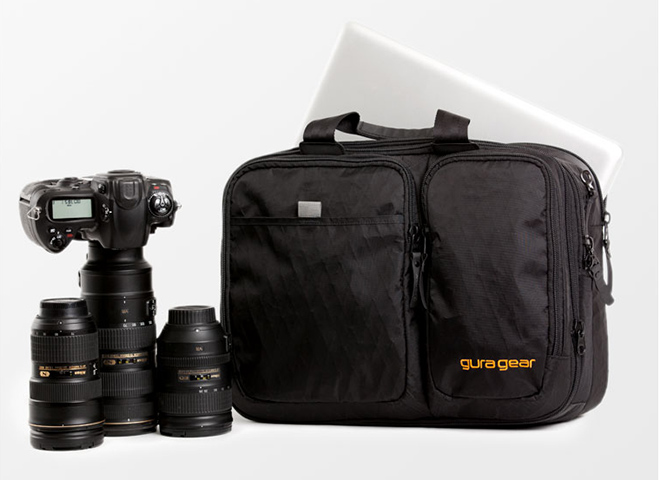
Anyone who has ever flown internationally with a DSLR, multiple lenses, laptop and seemingly endless accessories (seriously, is there any other profession that offers such a seemingly limitless need to accessorise?) will immediately appreciate the design of the Chobe. Designed to hold a 15″ MacBook Pro, Apple iPad (am I the only person that doesn’t actually own of these yet?), portable hard drives, power supplies, other digital accessories and camera gear via a clever insert the Chobe ticks all the boxes for the travelling photographer. From Gura Gears’s website:

Chobe is a well-designed full-featured business, travel, and photography bag with room for all of the necessary accoutrements. In its normal state, Chobe is the perfect business bag with room for a 15” laptop, iPad AND a Kindle or other tablet, business papers, magazines, travel documents, and all of the bits and pieces that make life comfortable on the road. With the flip of a zipper, the bag expands to accommodate a spare change of clothes and goes from day job to overnighter. Add the custom designed matching padded photo insert and Chobe’s role grows to camera bag extraordinaire hauling professional DSLR camera bodies and lenses in style.

I have not as yet had a chance to use my new Gura Gear Chobe bag (it only arrived a few days ago); but here is how I intend to use the Chobe on my Antarctica trip in a few weeks time: For travel to Antarctica from Australia I have packed my Kiboko full of camera gear. You can read a full list of just what fits in a Kiboko and what I am taking to Antarctica HERE. I will emphasise that this amount of gear is not inconsequential and fills the Kiboko (a little creative packing is required; but it does all fit). In the Chobe I am packing a 15″ MacBook Pro, Power Supply, 3 Back up 1 Terrabyte Firewire 800 drives, card readers, universal power strip, universal power converters, travel documents, passport, wallet, keys, etc (I can even fit a portfolio of a dozen A4 prints in the side pocket!). All of this fits into the Chobe leaving the large middle exapandable compartment completely empty. This empty compartment gets filled with the optional camera ‘insert’ (packed flat) and left empty for air travel. The beauty of this configuration is ‘if’ my Kiboko gets weighed as overweight for carry on luggage I can immediately remove several lenses and a body and pack them in the Chobe; effectively spreading the weight between the two bags. In this configuration this makes the Kiboko and Chobe a match made in travellers heaven for photographers carrying large amounts of equipment as carry on luggage. Just as an aside: Gura Gear state on their website that the Chobe is designed to hold a 15″ Macbook Pro. I would add to this that you can actually squeeze a 17″ Macbook Pro into the Chobe in the larger middle pocket (I know, because I tried). Whilst this is not ideal as you give up a good portion of the central storage area it does mean that in a pinch you can carry a full sized 17″ Macbook Pro (I recently ordered a new 15″ Macbook Pro for this trip as I wanted a smaller and lighter laptop than my current 17″ version and it was sheer co-incidence that the Chobe came on the market at a similar time).

Once I reach my final destination for this Antarctic trip (the Ocean Nova in Ushuaia) I can unload and reconfigure either the Kiboko or the Chobe for Zodiac and shore based trips as required. The flexibility of having two camera bags that can transport all of my photographic equipment and accessories between countries as well as serve in the field duties as required is a real plus. I can leave my laptop and accessories in my room and pack either the Kiboko and/or Chobe as required for each excursion. I briefly discussed camera bags for Antarctica with a good friend of mine earlier this week who is joining me on the trip to the bottom of the world and had a good chuckle to myself when I found he was taking both a Kiboko and a Chobe with exactly the same usage intentions.

Made of the same light weight but incredibly strong sail clothe the Chobe (like its big brother the Kiboko) weighs significantly less than most bags its size when empty. Every gram counts when travelling and starting with a light weight bag can make all the difference. From Gura Gear’s website:

Constructed of the finest materials, Chobe features lightweight, durable sailcloth, the same technology used in the America’s Cup race sails. The bag’s convertible function allows for multiple missions by discerning travelers that work as hard as they play. Because the bag was developed on the road, the little things are covered, like an expansion pocket for a drink and plenty of pockets and compartments to keep life organized. A concealed sleeve for sliding on rolling luggage means that Chobe can hitch a ride any time. The bag fits international requirements for carry on sizes and in most cases qualifies as a simple personal item.

The Chobe will also fit the bill nicely for shorter trips where a full size Kiboko is overkill or just not required. Given it can hold a laptop, DSLR and a slew of lenses it will be sufficient for most short trips or day / overnight outings. It will be ideal for everything from a family BBQ outing to the professional photojournalist on the road – And that is no minor accomplishment. One of the things I appreciate the most about both the Kiboko and the Chobe is that the design allows for the photographer to access all of their equipment without having to unzip and fold out a large flap. This might seem trivial to the non-photographer; but if you have ever used a generic camera bag in the field and have had to place it on the ground the problem with this large flap design becomes immediately apparent. When shooting from a vehicle or boat the problem is exacerbated even further. Both the Kiboko and the Chobe solve this problem (albeit in different ways) by providing the user the ability to access the equipment in the bag without this large flap.

In a market place that is more or less saturated with camera bags the Chobe manages to not only successfully differentiate itself from its competition by offering more versatility, storage and capability in a lighter weight package than its competition (and at the same time serve as the perfect accompaniment to its larger Kiboko brother) but also illustrate just how much more practical it is than the market alternatives through its ingenious well thought out multi-function design. I predict the Chobe is destined to become a staple of the travelling photographer and a long term stayer in the camera bag market. I know several other pro-photographers that have already jumped on the Chobe ‘wagon’ as the perfect addition to their Kiboko for the same reasons I have. The secret is now well and truly out of the bag when it comes to Gura Gear (pardon the intentional pun). I have no doubt that the Chobe will be a success for me on my upcoming trip; but I will of course report back on just how it fared throughout the trip on my return. Consider this pre-flight working review a prelude to a full review post my Antarctica trip.

I want to add a small disclaimer in conclusion to ensure clear air: I pay for all of my Gura Gear bags out of my own hard earned money. I am not payed to write reviews for Gura Gear or any other camera equipment manufacturer. I choose to write about photographic products that I like and use because I believe in the products and have found them successful in my own photography; not because a manufacturer incentivises me. I do and have supplied Gura Gear (and other manufacturers) with my photography for their website/s because I believe in their product. You can consider these op-ed. pieces my endorsement and/or recommendation of the products I choose to use in my own photography. And that is the highest recommendation I can give for a product.

By the way – expect a few ‘in the field’ Gura Gear photographs to appear on my blog post Antarctica. I have a bet running with a good friend on how many other photographers have gotten wise to the benefits of Gura Gear and some rather good bottles of wine are riding on it. :-)

The Ultimate Photography Glove – A Sailing Glove?

I have written before quite extensively on the subject of outdoor photography gloves for cold weather and as of my last ‘glove find post‘ I thought I had finally found the best option out there – the Seal Skinz. I still believe the Seal Skinz are an excellent glove for outdoor photography in cold weather. However, I discovered another glove today that ticks all the boxes for cold weather photography by outdoor clothing company Helly Hansen. As is often the case with these things, I was not actually shopping for yet another pair of gloves; I was just picking up a few last minute thermals for Antarctica in a months time and spied these gloves on the rack. What immediately caught my eye is that these gloves (Sailing Gloves) are fingerless on only two fingers per hand – the thumb and forefinger (a very clever design). The very two fingers that are required for almost all of the fine manual dexterity when operating a camera’s controls. This makes them absolutely ideal for photography. In fact, the genius of this design strikes you the moment you slip a pair on and pick up your camera.

According to to the information on the website – These durable gloves provide extra protection for handling abrasive equipment. Made of Amaro leather with adjustable wrist and reinforcements in areas of maximum wear.

What I immediately noticed upon trying a pair on is how they felt like a second skin more than a glove. Most gloves are too thick for easy camera control and are a hindrance to operating the camera quickly and efficiently. These sailing gloves are exceptionally soft and malleable against the skin and are designed to provide warmth, protection yet still give sailors a high degree of fine dexterity control for operating rigging  – just perfect for photography. And of course, being designed for use at sea these gloves are water resistant. Note they are not waterproof like the Seal Skinz; merely water resistant. I immediately purchased a pair and will be taking them to Antarctica with me along with my Seal Skinz.

CARRYING AND TRANSPORTING PHOTOGRAPHIC GEAR IN THE WILDERNESS – PART TWO

In Part One of this article I talked about the problem of wildnerness photography in relation to how to comfortably carry equipment into the field on extended hikes and some of the problems I have encountered over the years. I also talked some more about the Gura Gear Kiboko camera bag now that I have been using one for a year in the field. At the risk of repetition the Gura Gear Kiboko is I believe the best camera bag on the market that I have tried for my style of photography.

In Part Two of this article I am going to talk about how the custom Khumbu Xtra-Hand Vest performed for me in the field over a couple of days shooting up at Mount Buffalo in Victoria in the middle of winter. I was very keen to get out into the wilderness with my new vest from Vested Interest to see if it would live up to my hopes and expectations. I was relatively fortunate with the weather over the weekend as it was mostly fine; although a little overcast on Sunday. It was quite cold up at Buffalo with temperatures well below zero for the sunrise shoots and hovering around zero during most of the day before plummeting again at sunset. It did not rain or snow over the weekend although the occasional wind blasts were very cold and quite damp.

Xtra-Hand Vest at the Cathedral

I did several long hikes with the vest including a single hike of approximately ten kilometres through quite deep snow loaded up with a Canon EOS 1DS MKIII with a Really Right Stuff L Bracket, a 70-200mm F2.8L IS lens, a 24mm F1.4L MKII lens, a 17mm F4 TSE lens, a Canon S90 Point and Shoot, my Lee Filter Pack and Filter Holders, Polarising filters, spare battery, spare memory case and cable release, my full size Gitzo Tripod and Really Right Stuff Ballhead and of course my small thermos of coffee as well as all the normal personal items like car keys, mobile phone etc.. This is not an inconsiderable amount of equipment and although I did not weigh it I would estimate it to be in excess of ten kilograms and possibly quite a bit more. I wore a marino wool long sleeve thermal top, my 66 North Eldja mid layer jacket with a 66 North Glymur waterproof jacket over the top. The Xtra-Hand vest went over the top of all this without issue. Because the side straps of the vest are adjustable it is very easy to wear this vest in both the height of summer and dead of winter. I would rate this adjustability among the vests strongest attributes as it means this is an all year accessory; and not season specific. Synching the vest up is a snap with the side straps and its very quick and easy to make adjustments.

Shooting Mahomet's Tomb at Sunset Mount Buffalo

A few thoughts on how this vest performed in the field: I can easily reach my hand over my shoulder and pull out my tripod from the large back pocket to set up a take a photograph without having to remove the vest. This is very convenient when one needs to work quickly. It means I can stop anywhere and access everything I need without having to take off the vest. Putting the tripod back is difficult without taking off the vest and really requires either removing the vest (which only takes a moment) or having an assistant or nearby photographer drop it back in the pocket. I should stress that I use a full size Gitzo GT3530 LSV Carbon Fibre Tripod. This is a very large 3-section tripod and it is a testament to the excellent design of this vest that it can be carried on the back securely, without flopping around and lifted out without the need to remove the vest. Every back pack that I have ever tried that claims it can carry a tripod on side straps fails to adequately support the large Gitzo. Incidentally, I made comment in Part One of this article that I can fit my 300mm F2.8L IS lens in the back pocket of this vest. In point of fact, the pocket is actually large enough to store up to a 600mm F4L lens with the lens hood reversed mounted to Canon 1D MKIV. That should go a long way toward giving you and idea of the storage capacity of this pocket. Of course, there is no way you could remove a 600mm lens and attached camera without first removing the vest. The pocket has a velcro lid and also a drain hole should water get in – another solid plus in the design.

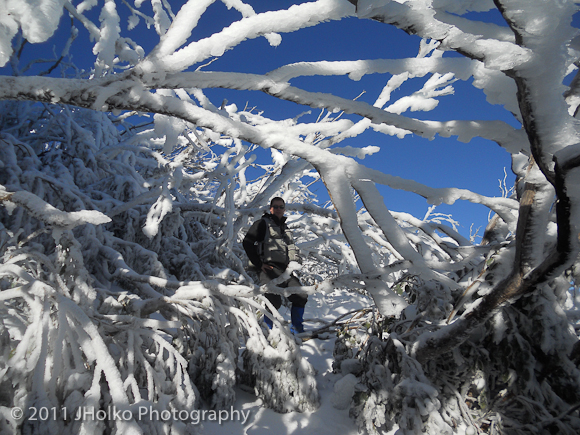
Hoar Frost Forest

I found the side pockets of the vest a great location for storing lenses up to the size of the Canon 70-200mm F2.8L IS. I can reach around and take a lens in and out of these pockets with relative ease without having to remove the vest. The 70-200mm F2.8L IS lens is somewhat of a tight fit in these pockets and if I was ordering this vest again would have the circumference of one of the pockets increased slightly to more easily accommodate this lens. As it stands its acceptable with the 70-200 F2.8L IS and easy with anything smaller. The ability to retrieve and stow a lens or thermos in the side pocket is a real boon as I found it very convenient when I wanted a cup of coffee on a hike or wanted to access a lens quickly.

The padded hip belt was I feel a significant factor in the comfort this vest provided over long hikes. During a three and a half hour hike through relatively deep snow I never felt any back or neck discomfort. I only removed the vest once during a snack break and only then to climb a nearby boulder more freely for a better view of the surroundings. The vest does an outstanding job of spreading the weight of the equipment much better than a traditional back-pack that loads the shoulders and tends to make you somewhat unbalanced. By loading up the front pockets of the vest as a counterweight to the large rear pocket weight is more evenly distributed and makes hiking much easier. The padded hip belt just helps spread the weight and transfer some of it to the waist. Because of the nature of this product being a vest everything is easily accessible in pockets; which is extremely convenient and makes working in the field with a backpack seem very primitive.

Waiting for Sunset at The Monolith

Overall I am very impressed with how this vest performed in its first field test. It has met my expectations and actually proved more comfortable on long hikes than I had envisaged it would be. As I mentioned in Part One, these vests are custom made for the photographer. They are about function and convenience and not style and looks. I am certainly not going to win any fashion awards in the field with this accessory; but it is going to make my hikes more comfortable and my equipment more accessible and that makes it a well designed product in my book.

CARRYING AND TRANSPORTING PHOTOGRAPHIC GEAR IN THE WILDERNESS – PART ONE

GURA GEAR AND THE XTRA-HAND PHOTO VEST

I will endeavour to never again make the comment to my wife that she owns too many handbags for the simple reason (as she so eloquently pointed out to me; while I was busy pointing the finger) that I own more camera bags than she does handbags. That was quite a head scratching moment for me – just how did I end up with so many photography bags?

The answer is a combination of trial and error and horses for courses. Over the years I have purchased different camera bags for different applications and uses. They all seemed a good idea and ‘must-have’ accessory at the time; but oh, for the benefit of hindsight! All of them have been used at one stage or another and some more than others and as of the last twelve months one more than any.

When I got back from my expedition to Iceland a year ago (where has the time gone…) I decided I was ultimately fed up with my current and then bag of choice the Lowe Pro Nature Trekker II. For a multitude of reasons it was no longer fulfilling my needs. After reading some reviews I went ahead and purchased the Gura Gear Kiboko camera bag and subsequently commented on how happy I was with it in my ‘Iceland – What worked and What Didn’t‘ article. Now, nearly a year on from the purchase and many photographic trips later (both local and international) it seems a good time to reflect on my travels with the Kiboko. And on my latest acquisition; which I hope will be the perfect photographic shooting partner to the Kiboko – the XtraHand Photo Vest from Vested Interest.

Kiboko on the West Coast of New Zealand's South Island

My Kiboko is as fantastic today as the day I purchased it and I cannot imagine my life now as a landscape and nature photographer without it. For storing and transporting my photographic gear, getting in and out of vehicles, through airports, negotiating international travel and shooting out of the boot of the car or relatively close by  there is nothing that works better in my experience for my style of shooting. ‘My style’ for what its worth is to cart as much of my photographic kit as I can physically manage to my destination. I just don’t like to leave anything at home in case I might need it. The Kiboko is the ideal camera bag for me in that it comfortably holds all of my photographic equipment that I like to take with me on a landscape and wilderness shoot. But this is a double edged sword…Because the problem with the Kiboko for me is that it holds ALL of my photographic equipment (except my laptop); which means that it is heavy; really heavy. Fully loaded and ready to depart on a dedicated landscape and nature shoot my Kiboko weighs in at over 28 kilograms and that makes it just too heavy for any serious wilderness trekking. Even with the Kiboko’s excellent backpack harness system I can hike for no more than a few hours over steep terrain before I am pretty trashed. But, the Kiboko is the best means of getting all that gear to the start of the hike or for any type of shooting for that matter that does not involve extensive hiking. So what is one to do?

I have tried taking a 2nd smaller backpack with me and just repacking what I want for a given hike into that; but this approach causes more problems than it solves. For starters it necessitates packing a 2nd pack; which takes up a significant amount of space when flying or travelling and I am already juggling another laptop bag, my tripod and a suitcase (assistants really should be mandatory for nature photographers!). The other problem I seem to constantly run into is that when I finally get to the position I want to shoot from there is frequently no where to put down my bag that isn’t either soaking wet, muddy or otherwise less than ideal to plonk an expensive bag full of expensive cameras and lenses. Hanging the bag from a hook underneath the tripod is not a suitable solution as it makes accessing the bag problematic. Plus if shooting in the mud or snow or at the beach the extra weight often causes the tripod to slowly sink into the soft ground causing blur. Even when I do find somewhere to put my bag down I frequently wander afar in my search of subject and composition necessitating the need to occasionally jog back to my bag for a filter or alternate lens. Or, as happened in New Zealand’s South Island a couple of weeks ago to rescue my bag from the incoming tide.

I have also tried and used my Domke photography vest over the years with mixed success. Whilst it somewhat alleviates the requirement for carrying a camera bag into the field it is extremely limited in its carrying capacity and to be totally honest isn’t that great at carrying those items it can hold. Lenses in the large lower pockets tend to dangle low below the waist and bang into objects. Its made of cotton so the moment it rains it acts like a sponge soaking up the water and adding weight. And when loaded up with a few lenses its uncomfortable for any length of time and gives me no end of neck discomfort. It might be fine for a photojournalist walking the city streets with some small Leica lenses, a mobile phone, passport and wallet; but its not much use to me in the inclement weather of the wilderness with big heavy equipment. I recently replaced my Domke with a similar style of vest that is not quite so overtly ‘photographer in nature’ for international flying and believe this is firmly the best use for this style of vest. They have no place in the wilderness.

I could of course half empty my Kiboko bag into the boot of my car before embarking on a trek; and I have done so on numerous occasions. This approach is relatively successful most of the time as it lightens the bag significantly to the point where I can comfortably hike for most of the day. It does not solve the problem of where to put the bag when I am shooting however or of being caught short a lens I left in the boot of the car. I like to shoot with Prime Lenses so I am almost always changing lenses. Nor is it an ideal solution when shooting in foreign countries as there is frequently no safe place to leave gear behind.

Enter the Xtra-Hand photo Vest from Vested Interest. Now right off the bat let me be clear that you dont really want to walk into the local cafe at the end of a days shoot wearing this vest. It is about as ‘tactical’ as a Navy Seal and about as subtle as a house brick. Wearing this vest in a public place is going to get you a lot of unwanted attention. However, when I am standing in a swamp trying to set up a shot with no where to put my bag; well.. it ‘aint a fashion contest out there’. It took me a long time to finally get around to ordering one of these vests.  I just didn’t think I needed something that appeared so overtly Rambo. I needed to mentally get over the ‘look’ of the vest and focus on its function.

Custom Vested Interest Khumbu Model

Now that I have finally ordered and received my Xtra-Hand vest I feel somewhat silly for having waited so long to purchase one. Or possibly, I just needed to go right through the suite of options out there before I finally got to it. Irrespective I now own one and am very happy with it – even though I have only been on a couple of shoots with it. I headed up to the mountains and snow this weekend past for a couple of days shooting and put the vest through its paces in the field. I did several quite arduous hikes to remote locations that saw this vest put to the stress test. But for now as Part One of this article I want to further elaborate on the vest itself as well as the extensive modifications I had done to it and why. Part two of this article will follow on in the next week or so once I have had more of a chance to consider my impressions after using it in the field.

After much pondering I finally decided on the Khumbu model from Vested Interest as the base for my ideal vest. I chose this model for the extra large pocket that is included on the back of the vest to enable me to carry a large telephoto lens like my Canon 300mm F2.8L IS or my Gitzo Carbon fibre tripod, or even a thermos or food. I also liked the addition of the two sewn on side pockets for both by 70-200 F2.8L IS lens and a small coffee thermos I like to carry in the field. I frequently find myself scrambling over rocks needing both hands to keep my balance so a large pocket that can hold my tripod is a very welcome addition. I hope this pocket will also serve as a great place to store my tripod when shooting from zodiacs in Antarctica later this year before we go ashore (where I will want and need my tripod).

In order to ensure a custom vest is properly fitted you need to provide Vested Interest with your measurements. There is a downloadable and printable order form on their website to complete with all of the required details. Even though measurements are important to ensure the vest is properly sized the side straps on the vest provide a huge amount of adjustability meaning this vest can be worn over a t-shirt in hot weather or over multiple layers in colder weather. There is a choice of colour including Tan, Camouflage, Black, Navy, Grey, Green, Desert Camouflage and Digital Camouflage. I went with the very non descript grey and I feel it was the right choice to minimise unwanted attention. Wildlife photographers may want to consider a Camouflage if photographing skittish subjects or shooting from a hide.

A few other brief points – The Xtra-Hand vest is predominantly made of nylon; which means its pretty much waterproof and does not absorb water. This is a very important consideration for me as I often find myself shooting in the rain or snow. As I have stated above, cotton and non waterproof materials just don’t work for me. The vest itself is designed to carry a huge amount of equipment into the field and to spread the weight strategically for long term comfort. The shoulders and neck are extensively padded to ensure that when loaded up with heavy cameras and lenses discomfort is kept to a minimum.

There are some standard options available when ordering any of the Vested Interest models and I chose to include some of them; the first of which was the Padded Hip Belt. The padded hip belt is simply an additional waist belt that is designed to help get some of the weight off the shoulders. It is both adjustable and removable. I would encourage anyone considering acquiring one of these vests to include this option. It is relatively inexpensive at $40.00 US and provides a greater level of comfort. I also included the optional shoulder pads at $20.00 US and again would consider these mandatory to avoid discomfort on long hikes.

I cannot take credit for the following modification to the vest that was first devised and implemented by Art Morris who runs the website Birds as Art. Art also has an extensive article on is website that is well worth a read. Although Art chose to use the Magnum as the base for his vest (I used the Khumbu) the alterations applied are the same. The first of these modifications is the inclusion of a bright orange handle so that I know where to safely grab the vest to lift it up and put it on when its full of camera gear. The handle is stitched into the actual frame of the vest to hold the full weight and is the safest place to pick up a fully loaded vest. Something I have not yet mentioned is that Vested Interest who make these vests are actually a division of a parachute manufacturing company so as you would expect the quality of construction and stitching is absolutely first class. The only other place I have seen stitching of this standard and quality is on rock climbing harnesses and slings.

Custom Grab Handle

I had both the front large bottom pockets sized the same as those on the Magnum vest as these are a size that comfortably  holds a Canon 1DS MKIII or MKIV with a Really Right Stuff L Bracket attached. The Khumbu normally comes with one front pocket that is even larger and I had no requirement for a pocket this size.

Both the top pockets were modified to have zips in lieu of velcro as I often store my mobile phone, wallet and keys in my top vest pockets and didnt want there being a chance of anything falling out accidentally. Zippered top pockets added around $20.00 to the overall total.

A very welcome addition is the inclusion of a detachable ground cloth. When shooting in the snow, mud or wet there is often either nowhere to sit down for a few minutes or nowhere clean and dry to place objects. The detachable and waterproof ground cloth gives me somewhere clean and dry to sit or place equipment. I also included the optional camera straps.

In part two of this article I am going to report on how this vest performed in the field and on long hikes. I spent last weekend up at Mount Buffalo photographing out into the wilderness with my new vest and have some strong initial impressions. More to come soon.

Shooting Hoar Frost at Mount Buffalo with the Xtra-Hand Photo Vest


ICELAND LANDSCAPES – BY DANIEL BERGMANN

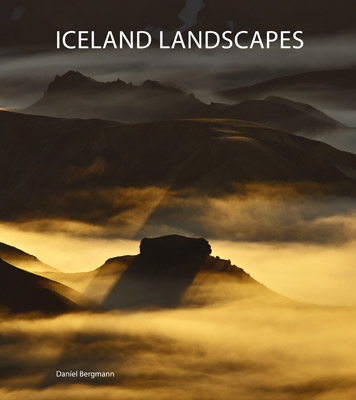
A couple of weeks ago I received an email from my Iceland friend and photographer Daniel Bergmann that his new book ‘Iceland Landscapes’ was now finished and available for order. I was just passing my laptop on the way to bed when I saw his email but could not resist the temptation and ordered a copy then and there on the spot. I have subsequently been eagerly waiting for it to arrive; which it did yesterday and I have now had a chance to sit down, read, and absorb the wonderful photographs contained therein.

I spent a couple of weeks travelling through Iceland with Daniel Bergmann in July and August, Summer 2010 and have visited many of the locations photographed in this new book. Indeed, I feel a personal connection to some of the photographs as I was standing alongside Daniel (or, was at least in the nearby vicinity) when they were taken. As such, I have a wonderful emotional connection to the photographs that is for me at least quite visceral. Photographs of locations I have not yet visited – well; they inspire me to return to this amazing country to seek out the light and subject captured by Daniel.

Iceland Landscapes

Iceland Landscapes includes 110 landscape photographs from Iceland, mostly taken during the last five years. The book is in English and covers both the locations photographed along with technical information and thoughts on photography. Renowned English landscape photographer David Ward wrote the introduction and an Icelandic author, Pali Asgeir Asgeirsson, wrote the preface. The book is 144 pages long and is 24 x 28cm. It was printed in Iceland on high quality semi-gloss paper. It is self published by Daniel Bergmann. The print quality is extremely high and the colours and beautifully reproduced. This is an extremely well produced book.

Iceland Landscapes is not yet another tourist book on the amazing geological landscapes of Iceland. It is rather a successful effort to capture the essence, soul and stunning light found in Iceland. It is a book that is going to appeal to photographers and those who appreciate fine art photographs on many levels. It will serve as an inspirational guide to those wishing to travel to the remarkable country of Iceland for Photography and inspire them to visit some of its many wonders. It will also fill the cup of those who want to experience Iceland through the pages of a fine art photography book.  David Ward eloquently sums up Iceland Landscapes better than I can in this excerpt from his introduction –

… More extraordinarily, the photographs reveal that Daníel can find new perspectives in subjects that are familiar to him. This requires a particular openness of mind that, as I know from my own struggle, is extremely hard to achieve. American photographer Wynn Bullock wrote, “Mysteries lie all around us, even in the most familiar things, waiting only to be perceived.” The photographer needs a desire to explore, a yearning to look in new aesthetic directions as well as to tramp all points of the compass. Only by prolonged and in-depth observation can a photographer begin to see beyond the expected and reawaken a childlike sense of wonder. In this way one might begin to see one’s homeland, as Daníel does, with the eyes of a stranger. And imagine what a gift that is…

Daníel Bergmann’s images in this book succeed as both distillations and revelations of his country’s amazing landscape. Both beauty and the sublime are evident in his photographs, and his work even manages to transcend Iceland’s amazing subject matter.

I encourage any photographer (or non photographer for that matter) who may only have even a passing interest in the amazing, varied and often primordial landscapes of Iceland to purchase a copy of Daniel’s new book ”Iceland Landscapes. The photography and print quality are wonderful and having spent time in Iceland can say with some degree of experience that Daniel has captured the soul of his countries amazing landscapes in this new work.

I already had plans in place to return to Iceland in July next year 2012 for a couple of weeks with Daniel. Now that I have read Daniel’s new book I feel totally re-ignited to get out in the amazing landscapes of Iceland.

Iceland Landscapes can be ordered online at HERE and shipping is available worldwide. I highly recommend this book.

Conclusion: **** You should own this book and consider it an important part of your photography library.