I am back from my recent trip to Mungo and the Walls of China in New South Wales and it was quite a memorable trip for a number of reasons. Firstly, with all the rain and flooding that has been going on in Australia of late (in particular Victoria and Queensland) it was kind of inevitable that it affected the trip – as indeed it did. Part of the Calder Highway was underwater during the recent floods and the subsequent traffic of big trucks after the waters have receded has destroyed the road in parts – forcing more than an hour long detour around the damaged sections. This turned what should have been approximately a seven hour drive into nearly eight hours. And that was just to get to Mildura. Mungo is another hundred and forty kilometres past Mildura and a good eighty kilometres of that is rough dirt road. As it turned out I seriously underestimated how long it would take to get there. Thankfully, I wasn’t travelling alone this time and had taken my cousin along for the ride – which at least gave me someone to chat to on the long drive.
I learned the hard way from previous attempts to get into Mungo that the road is often closed during and shortly after rains. The surface is mostly a very fine red Mallee dust that when mixed with water turns into something akin to high strength cement (I am sure you could lay foundations with the stuff). This time I checked in with the parks office who assured me the road into Mungo was open; although there was some water on parts of the road and they were advising caution and a recommendation of four wheel drive vehicles (which is fine as I have a 4WD – albeit with road tyres). The road around the park was closed due to storm damage; but that was ok as I did not intend to circumnavigate the park but rather camp in one spot and photograph the lunette and Walls of China feature.
With the long delay caused by the floods detour we were already racing the setting sun to have any chance of a sunset shoot on arrival. Unfortunately I took a wrong turn shortly after Mildura; which cost us another hours delay before I realised my error (memo to BMW: Please add the Arumpo Road outside of Mildura to your Satellite Navigation DVD upgrade). Finally back on track we arrived at the entrance to the Park and the beginning of roughly eighty kilometres of dirt road. With the sun already setting it was now clear we were not going to make it in time for a sunset shoot so the plan changed and became one of at least getting there before total dark to work out where to go in the morning for the dawn shoot.
Roughly fifty kilometres into the dirt road the sun was set and twilight showed a wonderful pastel mauve glow in the sky that had me cursing the wrong turn and lost time. It was about then that we hit a large patch of water/mud/cement at around eighty kilometres an hour that quickly saw us bogged knee deep in the infamous Mallee mud. Even with the BMW 4-Wheel drive system we could do no more than roll back and forward maybe five metres – well and truly stuck in deep mud-filled tyre ruts that were all but invisible on approach under the water.
Twenty minutes of cursing and continued effort saw us slowly able to get the car sideways and extricate ourselves from the bog. I am sure a 4 wheel drive fitted with ‘real’ off road tyres would have been out quick smart – but the road slicks of my car made the job that much more difficult.
We finally arrived at camp at Mungo just as the first stars were appearing. We were able to locate the ten kilometre road into the Walls of China feature for the planned dawn shoot and sat down to a meal and some sleep. The whole trip had taken more than nine hours. By the time we crawled into our sleeping bags it was after midnight and I was totally knackered from the long drive. It was to prove worth the effort however as we were rewarded at both Dawn and the following Sunset with some gorgeous light for photography.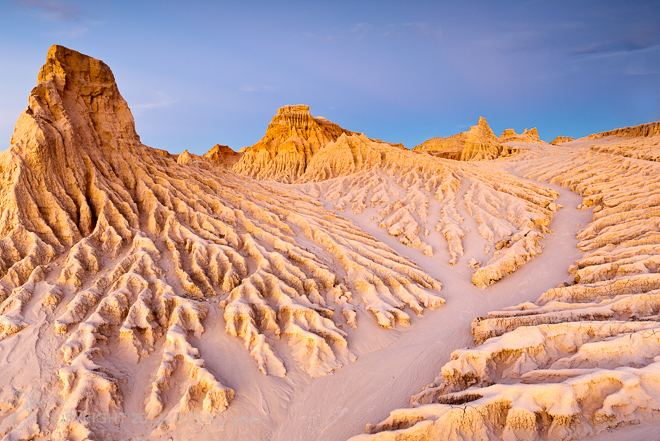 This first photograph was one of the last exposures I made at the Walls of China and is subsequently one of my favourite images from the trip. Whilst wandering around the features I was immediately attracted to the curving line of sand leading from left to right that I have used in my composition to draw the eye into the photograph. I am always looking for leading lines in Nature as they help convey a sense of depth to a photograph that greatly enhances the viewers experience. The natural formations of the Walls of China really add a sense of drama to this photograph that I find very appealing. This photograph was taken around ten minutes after sunset. You can still see a very faint glow in the Eastern sky. The sandstone features of the Walls of China are softly illuminated by reflected light off the high cloud.
I will post some more photographs from the trip over the coming weeks as I get time to finish sorting and processing the roughly four hundred frames I took over a period of two days.
For anyone who is interested there is some interesting information about Mungo and the Walls of China and how they formed on Park New South Wales Website.



 www.WILDNATUREPHOTOTRAVEL.com