The New Year is already well and truly behind us and 2013 is marching forward at what seems an ever quickening pace. In a few weeks time Andy Biggs and I will be headed to Iceland for back-to-back Winter Aurora workshops with twenty four other keen photographers; which means it is time to start considering camera equipment and clothing for the month we are going to be in the ‘deep freeze’ of an Iceland Winter. There is always a temptation to pack too much in the way of clothing on these trips and I frequently find myself coming home with articles of unworn clothing. I will make an effort to pack less than usual this time as I tend to more or less live in the same set of clothes during these workshops; just changing my under clothes unless I get my outer layers wet or really dirty.
Clothing
It can get bitterly cold in Iceland during the winter months if the Arctic wind is up and as such a winter expedition requires more serious apparel than a summer trip. Regular readers of my blog will already be familiar with my outdoor clothing of choice from 66 North – Iceland’s own brand of outdoor adventure clothing. Originally I was attracted to 66 North because of its high quality construction and use of new and innovative materials such as e-Vent (an alternative to Goretex). I have subsequently found it high quality clothing (like all good outdoor clothing it is somewhat expensive) that I have come to rely on for all my polar and sub polar trips. As such I will take a good selection of my 66 North wardrobe with me in March including my favourite Eldgja jacket and Vatnajokull Outer Shell. In addition to my 66 North gear I am also taking a new Arc’teryx Kappa jacket for when the temperature really plummets. This is the first Arc’teryx jacket I have purchased and I am keen to see how it performs in the field.
Footwear
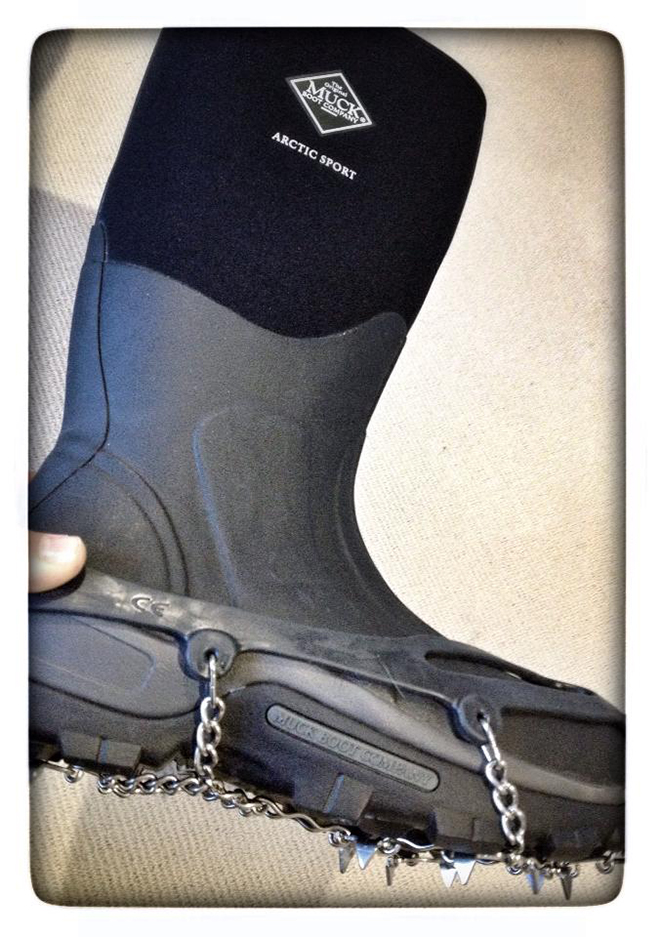
I am trying a new pair of Arctic Muck Boots this year that are waterproof to just below the knee and that are specifically designed for cold weather (rated to -40 degrees F). Made by the ‘Muck Company’ you would be forgiven for thinking that these appear to be nothing more than a glorified pair of gumboots. The reality however is that there has clearly been a lot of thought given to the design of this boot and it is in fact very different to your average pair of gumboots. That is not to say that this is a boot suitable for long hikes (because it clearly isn’t) but rather is ideal for standing around in sub zero temperatures photographing Aurora. I am combining these boots with a pair of Kahtoola micro-spikes to ensure I keep my footing on the icy winter landscape. Although these boots look heavy they are quite light considering their size and construction. I chose these particular boots over something more traditional like a Caribou as I wanted a boot that was waterproof to just below the knee making it also suitable for wet zodiac landings in the Arctic and Antarctic. I have in the passed persevered with the gumboots provided by the ship charter companies for my polar trips but I really find them uncomfortable and not at all to my liking. Whilst the Arctic Muck Boots should keep me both warm and dry in Iceland they are totally inappropriate for getting on an off airplanes and general travel and as such I will also take with me (and wear during my travels) my usual pair of Raichle Goretex hiking boots. These boots have served me very well and have now travelled all over the world. I am going to resist the temptation to also pack a pair of general runners as I am comfortable living in my hiking boots and shoes take up quite a lot of space in my bag.
Gloves
In the never-ending search for the ultimate cold weather photography glove I am trialling yet another new glove this year made by Freehands. The Freehands gloves are made of 4-way stretch material and are lined with Thinsulate insulation for warmth. They have a full digital palm grip and they provide waterproof/windproof protection for the back of the hand. The thumb and forefinger can be exposed for operation of camera controls. I have in the past tested gloves from Helly Hanson and Seal Skinz. Whilst I like the Helly Hanson gloves very much for their tactical feel and maneuverability they are not waterproof and once wet my hands get quite cold. The Seal Skinz on the other hand are waterproof and quite warm but offer poor camera feel and control by comparison. I am hopeful that the Freehands gloves will finally prove the best combination of warmth and tactile feel for camera control whilst simultaneously being waterproof. My thanks to Terry who is joining Andy and I on our first workshop to Iceland for the referral and recommendation of these gloves. Should they prove successful I will also take them to the Arctic and Antarctic later this year. Freehands gloves can be purchased from B&H Photo online and are surprisingly inexpensive.
Camera Equipment
The Canon 1DX will be my primary camera of choice for this trip. I will also carry my original 1DS MK3 as a back-up in the unlikely event of a failure. I will also carry a number of spare batteries so that I can cycle them in and out of warm pockets. If Canon can supply me the new 200-400mm F4L IS with inbuilt 1.4 teleconverter before I depart (unlikely at this point) I will take it instead of the 300mm F2.8L IS lens.
During the 2nd workshop I will also have access to a Phase One 645DF and IQ160 60 mega pixel digital back and look forward to putting this state of the art digital medium format system to the test in the Iceland winter landscape. Stay tuned for some exciting news to come on Phase One in future posts.
Andy and I have our fingers crossed for some Aurora (northern lights) opportunities whilst we are in Iceland this March. The sun is at its peak of the eleven year solar cycle which should mean some blazing and spectacular Aurora if the skies are clear and conditions just right. It is going to be a lot of fun and I am very much looking forward to escaping the blistering heat of the Australian summer. It has only been a few months since my last Iceland workshop but I am already missing the countries amazing and ever changing landscape.


 www.WILDNATUREPHOTOTRAVEL.com