SEARCH FOR THE ULTIMATE PHOTOGRAPHY GLOVES – PART TWO ‘THE VERDICT’

One of my recent purchases that I was very keen to test out in the South Island of New Zealand in Winter was the new Seal Skins gloves I purchased online just before I left Australia. In Part One of this mini-review I made mention that it has been a constant search for the perfect winter photography glove. I won’t restate the story thus far; suffice to say the search has been ongoing. Before I dive into it I just want to make a comment on the fingerless glove with the optional slide over mitten that many outdoor sports people and hunters use. These types of gloves don’t work for me. Although they provide plenty of tactile feel (because they are fingerless) they are not waterproof and far from warm enough in the sort of environments I sometimes shoot in.

The Seal Skins gloves on face value appeared to tick all the boxes for me. They are waterproof, warm (at least around the house!) and yet retain enough tactile feel that I can still operate my camera equipment effectively in the field. So how did they perform?

The result is a mixed bag. Firstly, the gloves are in fact waterproof as advertised. I spent several hours clambering over Fox Glacier in cold and wet conditions. Experience has shown me that my previous thermalite gloves (which were warm when dry) would have been totally saturated after half an hour of this kind of activity and thus totally useless. The Seal Skinz on the other hand remained totally dry; even when I was fumbling around in puddles of glacial water adjusting my crampons. They shed water beautifully and remain dry on both the inside and outside. Just on the subject of glaciers – I almost came to quite a nasty end at Fox Glacier. I am always extremely careful when traversing glaciers for obvious reasons.I have quite a bit of glacial experience; but you can never take them for granted. They are riddled with hidden dangers; falling ice, wave surges and crevasses are but some of the potential dangers. Glacial ice is pound for pound about the same weight as structural concrete and there have been several very unfortunate deaths over the years at Fox Glacier from falling ice. Fox Glacier is currently receding and this makes it more dangerous than an advancing glacier since it is shedding ice (at a fairly rapid rate). I was keen to get a photo of the terminal face of the glacier so had hiked up the side of the glacial river with a wide angle lens to get close to really give a sense of scale to the photograph. Getting close to the terminal face meant skirting the edge of a very large overhanging piece of glacial ice – not something I would normally do. I could see large boulders and rocks perched precariously on the ice flow 30 odd feet above. However, ‘photo fever’ got the better of me and I chanced it; I scrambled forward against the ice and river; set up my tripod and prepared to take a frame just as several rocks the size of basketballs came hurtling over the top of the ice landing only a few feet in front of me in the river. Needless to say that was enough for me. It was a timely reminder that no amount of experience on glaciers is worth a pinch if you find yourself somewhere you shouldn’t be . I beat a hasty retreat and decided it was far wiser, safer and more enjoyable to photograph the glacier and alps by helicopter.

I have photographed the Southern Alps and Glacier by Helicopter before in winter in 2009. I had chartered a small mountain helicopter with two other photographers. We had the doors removed and spent a couple of glorious hours shooting thousands of frames over the alps. The ambient air temperature was -19 degrees celsius during that flight plus whatever the wind chill factor was and even with several thermal layers I was frozen by the time we got back to the helipad.

I chartered another helicopter this trip and with the door off and harness on spent another hour photographing the alps and glaciers shortly after breakfast. It was not quite as cold this time at -9 degrees celsius; but it was still a good test for the Seal Skinz. What I found was that my fingers still got very cold (almost totally numb after an hour shooting); however, even with near numb fingers, the chopper door off and wind I was still able to change both CF and the tiny SD cards in my 1DSMK III with relative ease. In fact, I was really quite surprised at just how good the tactile feel is in these gloves. I never felt like I was going to drop any of the small cards; even when I had several between different fingers in an effort to ‘speed-change’ the cards. Helicopter charter is $1500 an hour – so you don’t want to waste to much time playing with camera cards and settings. In this respect the Seal Skinz gloves are nothing short of brilliant; giving all the tactile feel required for even the most difficult shooting environments. The downside is they are not quite as warm as I had hoped they would be and I can only rate their thermal protection as average at best.

In summary the Seal Skinz are the best gloves for cold weather photography I have yet tried and are therefore my current choice when I am shooting in these environments. They are waterproof, and give wonderful tactile feel and grip. They are not as warm as other thicker gloves; but I am willing to trade some warmth for ‘feel’. I suspect that in temperatures down to around -5 celsius they will do just fine for quite long periods of time. In colder temperatures I will want to have a warmer over mitten that I can put over the top after an hours shooting to re-warm my hands. This is the best current compromise/solution I can come up with. Seal Skinz do make a version of this glove that is lined with a polar plus material; which would undoubtedly make it quite a bit warmer. However, I suspect that one would trade quite a lot of ‘feel’ for ‘warmth’. The Seal Skinz will be accompanying me to Antarctica later this year so that is a pretty solid recommendation. The caveat is I will also be taking a pair of 66 North over mittens just in case it gets really freezing and I need to re-warm to carry on shooting.

2011 AUSTRALIAN APPA AWARDS – BLUE BERG WINS GOLD

The 2011 Australian APPA Awards have now come and gone. The awards dinner was held this evening in Sydney at Darling Harbour; unfortunately I was unable to attend as I only arrived home from New Zealand yesterday morning and had much to do on my return. I doubt I could have made it there regardless since flights have only now returned to normal due to the volcanic ash cloud from Chile (that must be because I have stopped flying for the moment!). I was shooting up in the wilderness near Arthur’s pass in the South Island when the judging from the APPA awards was being live streamed so was unable to tune in; but was thrilled to learn on my return to Christchurch that I had won a Gold award and three Silver awards for the four prints I had submitted. Gold Awards in the Landscape Category at APPA’s are extraordinary and I feel very privileged to have had my work judged to such a standard. The APPA awards are somewhat unique these days in that all judging is done of actual prints by a panel of highly experienced photographers (rather than by submission of digital images). The craft of the print is as important as the image itself and its fantastic to be a part of such an event. All of my prints were made on my absolute favourite paper Moab Somerset Museum Rag. Photography after all “Is all about the Print”. The photograph and print that won Gold was ‘Blue Berg’; which was photographed in Iceland last year near the Jokulsarlon glacial lagoon. My print received scores of 88, 90, 92, 92 and 93 from the five judges; giving it an average of 91 – a Gold Award.A higher resolution version of this photograph is available to view on my portfolio website at www.jholko.com under Iceland. This print is also currently on display as part of Nillumbik prize at Montsalvat in Eltham until the end of July. It will be part of an exhibition later this year at both Source Photographica in Brighton and at the Wilderness Gallery in Tasmania.

SEARCH FOR THE ULTIMATE PHOTOGRAPHY GLOVES – PART ONE ‘THE FIND’

For as long as I have been into landscape, nature and wilderness photography I have been searching for the perfect gloves for outdoor winter photography. The problem has been that I have struggled to find gloves that are waterproof, yet are thin enough to retain enough ‘feel’ to enable me to use my camera equipment unhindered. I have a drawer full of potential candidates that have all ultimately disappointed for one reason or another; usually because the gloves ultimately lack enough tactile feel for camera operation or are not waterproof. Believe me when I say it has been quite a search.

Up until recently I had settled on a thermalite glove liner; which was both warm and thin enough to enable me to use my camera equipment relatively unhindered. The problem is that they are not waterproof and every time I have been shooting with them in the snow I have ended up with wet and subsequently freezing fingers. It also necessitated having multiple pairs (since one pair always ended up wet). Last weekend I was shooting up at Wallace’s Hut at Falls Creek at sunrise in a sleet and snow with the thermalites and yet again ended up with wet and freezing fingers. I told myself at the time I just had to find a better solution before I leave for New Zealand in a few days and before Antarctica later this year. I have no desire to find myself shooting from a zodiac amongst the icebergs in Antarctica with wet and freezing cold fingers.

Later that morning when I was getting a late breakfast / early lunch in Bright I popped into a couple of outdoor stores just to see what they had in the way of gloves. Amongst the usual assortment of skiing gloves (which are just to thick), woollen gloves (which are to slippery and not waterproof) I found a pair of ‘Seal Skinz‘. On first inspection these gloves ticked all the boxes: Waterproof – Yes, Thin for tactile feel, Yes, Grippy and non-slip, Yes. The Seal Skinz are very similar in appearance to the Lowe Pro gloves (I have never really liked the Lowe Pro gloves finding them still too thick and not waterproof), however, they are slightly thinner for better tactile feel and completely waterproof. Only problem was they were just shy of $70 a pair and they did not have my size in stock. Unperterbed I decided to try and order a pair online when I returned to Melbourne; which I did and the gloves arrived late last week just in time for my trip to the South Island of New Zealand. As an aside, I was also able to find them significantly cheaper online. I ordered the standard version of the Seal Skinz glove. Seal Skinz also make a chill blocker version of this glove; which although warmer again with its fleece lining is too thick for photography for me. Time will tell if these gloves prove their worth. The South Island of New Zealand in the dead of winter should certainly be a good test. Last time I was there I experienced -19 Degrees celsius while shooting from Helicopter above the alps with the doors removed (and that was cold!).

As an outdoor photographer whose favourite season is winter I am willing to accept some degree of finger discomfort (cold) to keep good tactile feel with my camera equipment. I can put up with being quite cold as long as I am not also wet. The trick is finding the right balance of warmth and tactile feel and I am hoping these new Seal Skinz finally fit the bill. I will see how they fare in New Zealand as a precursor test to my Antarctica trip and report back.

THE IMPORTANCE OF STARING TIME – A THOUGHT PROCESS

It has been almost a year since I was in Iceland on my photographic expedition in July and August 2010. Since I have been back I have been on many other photographic trips and shoots – some local and some further afield. Yet, it is the many thousands of frames I took in Iceland that consistently draw me back for further editing and processing. It is this further editing and processing of photographs that has made me realise the importance of what I am calling ‘staring time’. That is, the importance of time to do nothing more than visually stare at a photograph so as to give both the conscious and sub conscious mind the chance to fully absorb and understand all of the subtleties and nuances of the photograph. It is not until the mind (at least my mind) has spent a significant amount of time staring at a photograph (often over multiple evenings and even weeks) that I feel I have fully understood what the photograph might need to truly ‘sing’ form a processing perspective. Subtle burning and dodging in just the right area, a slight colour temperature tweak or a different crop can often be the difference between a great photograph and one that truly shines. Staring time gives my mind the clarity in relation to the photograph to try and make those adjustments. It doesn’t always work and occasionally I find myself being unable to see the wood for the trees. In such circumstances I often find it useful to put the photograph away and revisit it at a later date.There is no hard and fast rule for staring time. Sometimes (rarely) I find there is quite literally no staring time required. The photograph comes into Lightroom off the CF card, is cropped, processed and exported as a Tiff in its completed iteration. This can be a process that takes no more than a few minutes. Alternatively it can be a long, slow and iterative process that might take any where from an hour to a few weeks (as is usually the case for me).

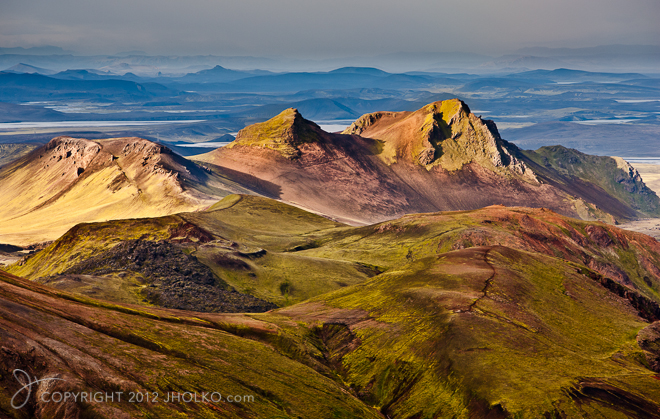
I want to use this photograph below from Landmannalaugar as an example of what I am driving at. This photograph has resided in my Lightroom library since I returned from Iceland in August 2010. It sat, unnoticed, unloved and unprocessed until a week or so ago when I was casually reviewing files from various shoots late one evening before bed. Something just clicked for me when this file came up and I realised I had a potential gem – a proverbial diamond in the rough. It was late however, and I was tired so I added the image to a quick collection for easier reference later and went to bed.

The next day I eagerly sat down in front of my computer and began to process the image. As is usual for me the first thing I like to do is to set both the white and black point correctly (to restore a lot of the contrast that is in the photograph – but not displayed on screen when the RAW file is imported. This gives me a pretty good indication right off the bat what I am dealing with in terms of how the final image will look. Many images never make it past this point for me. After setting the white and black point I tweak the color temperature and tint before setting the crop for the image. I will clean up any dust spots and then start to fiddle with the tone curve and other controls. This is where staring time enters the processing equation. I find it necessary to often make an adjustment  and then just stop and stare for a while; perhaps even leaving the image and coming back to it later – sometimes after a cup of coffee or sometimes another day. This staring time gives me a greater sense of clarity about wether the change I made produced the desired result. Its a back and forth process that may sound somewhat counter intuitive; but it works for me. This photograph from Landmannalaugar is one such photograph that has absorbed significant staring time. Throughout the processing of this photograph I just stopped and stared more than I perhaps care to accurately recall. In short, I spent a lot of time staring at this photograph, making small subtle changes to really make it sing to me. In the end if I look at the history tab in Lightroom what I find is a list of many changes that were made, unmade, sometimes remade in another form before I ended up at the final photograph. What this tells me is that me (the photographer) had to go on a unknown journey to get to my final destination. I could not simply plot a direct course from point A to point B to arrive at my final photograph. I was forced (ok forced is a little too strong a word) to find my way there by trying varying paths. At the risk of being somewhat controversial this is perhaps one of the key difference between producing a photojournalistic style record of an event (a snapshot) and Art.

Now; if staring time is so important during processing of the photograph it must therefore be equally important during the actual taking of the photograph – it stands to reason. I believe this photograph also illustrates this point. This photograph was taken after spending three hours at the top of one of Landmannalaugar’s highest mountains in the freezing arctic winds waiting for light. I have blogged about this days shoot before so wont repeat the story, but I had a lot of time to stare at the scene during this time; which ultimately lead me to my final composition. Perhaps if I had arrived just as the light was turning magical I would not have been able to make this photograph? The importance of staring time in my photography is considerable and it is a timely reminder for me of its importance on the eve of my trip to New Zealand’s South Island and Antarctica later this year.

A higher resolution version of this photograph is also on my Portfolio website under Iceland at www.jholko.com