Whilst in Kaikoura in the South Island of New Zealand I was able to spend a few hours photographing the native Sea Lions after returning from a morning shoot photographing Sperm Whales. The Sea Lions congregate amongst the extensive rock formations right along the side of the road as it winds its way along the coast – there are actually signs on the side of the road for drivers to watch out for them. I found they are quite approachable as long as you stay out of their threat range; which seemed to be something in the order of twenty feet or so. I shot a couple of hundred frames of the seals waiting to capture one of them actually doing something (most of the time they just lie around in the sun and open an occasional eye to keep a look out how close one gets). I was told by my guide that many people mistake the New Zealand Sea Lion for a seal; which it is not. Apparently they are distinguishable from seals by their ears. This fellow kindly posed for me and let out a growl (yawn) for me to show off his teeth. Photographing the wild New Zealand Sea Lion in its natural environment was very enjoyable and was possible without a super telephoto lens. This frame was shot at close to 100mm on the full frame Canon 1DS MK 3.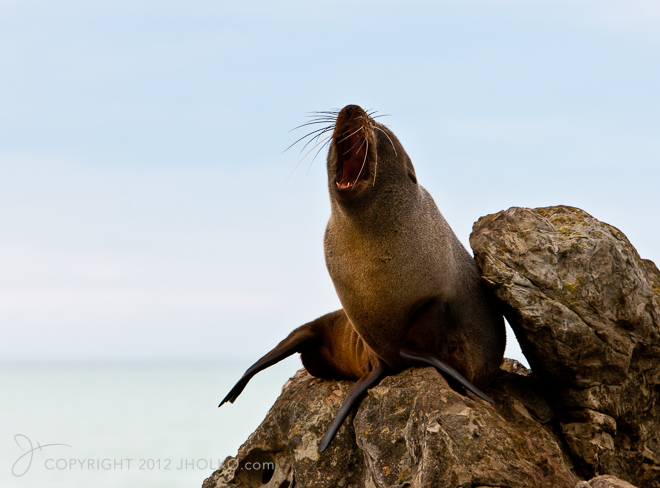
Category: New Zealand
Travel Photography in New Zealand
New Zealand – Fire Fall
Continuing in the same vane as my previous post and indeed from the same helicopter-shoot this photograph was taken within a couple of minutes of ‘Last Light’. With one side of the Southern Alps completely ensconced in cloud and the sun setting the heavy moisture laden clouds began to spill over the mountains. With the warm orange light of sunset it created a fire fall of cloud and light that was both spectacular and beautiful. Nature at its best.
New Zealand – Last Light on the Southern Alps
This photograph was taken from a chartered helicopter flight with the doors off (for better photography) at an altitude of approximately eleven thousand feet just as the sun was sinking below the horizon. Mount Tasman can be seen on the left and it’s taller brother Mount Cook (the tallest mountain in New Zealand) to its right. Fox Glacier can be seen in the lower right hand corner of the frame. There is something quite magical and elusive about Alpine Glow. The normal crisp clean whites of the snow and ice are cast in pink and mauve hues that add a wonderful dimensionality and colour that exists for only a few brief minutes when the conditions are perfect. I was very fortunate to be in this spectacular location with perfect weather in the dead of winter and to be able to photograph a wonderful example of Alpine Glow. This photograph was technically quite challenging. The light levels were already very low which meant punching the camera’s ISO right up to 800 in order to keep a shutter speed of at least 1/400th of a second. Shutter speeds of at least 1/400th of a second are needed to avoid any camera shake as a result of the helicopters vibration. I find the Canon EOS 1DSMK3 excellent up to ISO800 so was able to capture this image and apply minimal noise reduction in post processing and achieve an extremely clean tack sharp photograph.
Mathesons Lake – New Zealand
Mathesons Lake in the South Island is an icon for New Zealand landscape photography. Situated at the base of the Southern Alps it is possible to get near perfect reflections of the alps in the right conditions. This photograph was taken late in the afternoon while the reflection was at its best during my 2009 New Zealand trip. I made a total of three trips to this location in the hopes of capturing the mountains reflected in the dark waters. Two of the trips the mountains were covered in cloud and there was no photograph but I did get lucky on one visit. Despite appearances I did not use a polariser for this photograph; just a three stop soft neutral density filter to bring down the sky and hold the scenes dynamic range.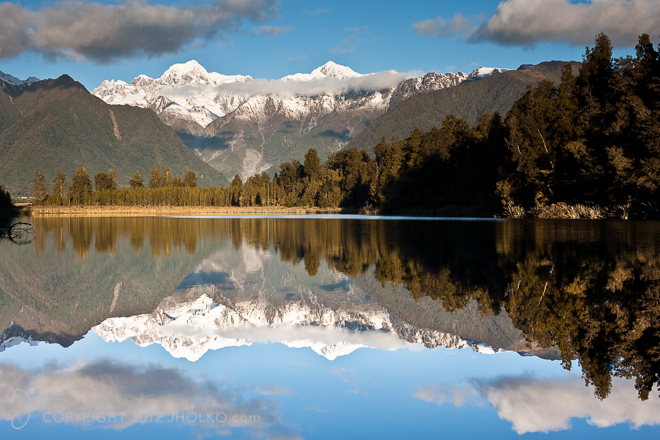 Despite its wild appearance this location is actually extremely easy to access. A short and pleasant 15-20 minute walk along a well maintained forest trail from the car-park leads to a convenient viewing platform. This was the only location during my entire two week photographic trip that I actually encountered a fellow landscape photographer. For all its magnificent beauty and stunning scenery New Zealand sure is a quiet place!
New Zealand Wildlife – Whales
One of my favourite expressions in photography is ‘It’s not a chiche if I haven’t done it before.’ Meaning of course, a photograph may have been taken hundreds or even thousands of times by other photographers, but is not something I have ever photographed before and therefore not a cliche. I dont know who first coined the phrase; but it rings true for me. So forgive me if you find these next photographs somewhat of a cliche; but its the first time I have done them. :-)
Whilst I was in the South Island of New Zealand earlier this year I took the opportunity to take a whale charter to find and photograph Sperm whales. I have never photographed whales before, but I have seen enough photographs of them to know that the decisive moment is either catching the fluke just before a sounding, or if one is really lucky a breach. Sperm whales rarely breach so I knew I would have to be extremley fortunate to see such an event, let alone capture it on the camera’s sensor.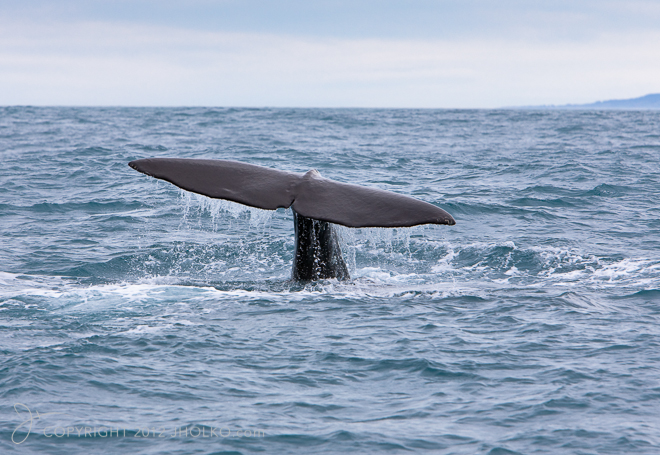 As fate would have it there were no whale breaches on the day. But, I was lucky enough to see and photograph several whale soundings. I used a 70-200mm F2.8L IS lens with a 1.4X Tele Extender on my 1DS MK3 for these photographs. I did not have the 300mm F2.8L IS in New Zealand; which would have been my preferred lens for this shoot. We were fortunate in that we had three independent whale sightings in the few hours we were at sea. The weather was overcast and grey throughout the day; which made keeping a high enough shutter speed to freeze the action somewhat of a challenge. The other interesting challenge is keeping the horizon in the photograph to keep the whale in the context of it’s surroundings. Getting low is the key and all of these photographs were taken kneeling down for the lowest possible angle of view from the bow of the boat.
 Wildlife photography is not something I do a lot of. I typically do not find the larger Australian mammals all that photogenic and there is somewhat of a shortage of big cats and wild game in this country!. This opportunity to photograph Sperm Whales off the coast of New Zealand certainly rates as one of my best wildlife photography experiences and one I hope to repeat soon.
 www.WILDNATUREPHOTOTRAVEL.com