
Late last week I returned home from a brand new Summer workshop to the South Island of New Zealand with my good friend Phillip Bartlett. Our workshop took us on a photographic journey into ‘Middle Earth’ – The spectacular South Island of New Zealand. In case you have not seen the Lord of the Rings movies, the South Island of New Zealand is home to some of the most spectacular scenery and landscapes in the world. It is no co-incidence that Peter Jackson chose the South Island of New Zealand to film the Hobbit and the Lord of the Rings movies. Perhaps nowhere else in the world can one see and photograph precipitous alpine mountains plunging into temperate rain forest and wild ocean beaches in so short a space. New Zealand is home to an incredibly diverse range of subject matter in a small island. Glaciers, waterfalls, spectacular valleys, imposing mountain ranges and black pebble beaches. It is an island of ever changing weather and spectacular light conditions. It is a country made for photography.
Our workshop took us on an eleven night / twelve day odyssey around the South Island to many of its iconic locations and some of its lesser known gems. During our travels we experienced some incredible weather and light as well as some fantastic landscape and wildlife photography opportunities. Two of the main highlights of this workshop included a privately chartered helicopter flight with the doors removed for photography over Fox and Franz Josef Glaciers and the awe inspiring Southern Alps and a privately chartered boat in Kaikoura to photograph Albatross and playful Dusky Dolphins. Both of these experiences were regarded by all on this trip as once in a lifetime and not to be missed. Included below is a brief summary of our travel and photography during our time in the South Island.
Day One – We began our workshop in Christchurch in two large 4-wheel drive vehicles that were to be our transport around the island for the next twelve days. One of the real benefits of travelling by 4-wheel drive instead of bus is the ability to get off the beaten path and into more remote locations and we certainly took advtange of this ability during our travels. Our first stop was Mount Cook on the East side of the Island where we photographed New Zealand’s tallest mountain against a sunset backdrop and some dramatic evening light and cloud.
Day Two – We rose early for Sunrise in the Tasman Valley where we had wonderful views looking back up the river to Mount Cook. Sunrise in the Tasman Valley can be an incredible experience if the weather is co-operating and we were fortunate to have some beautiful pre-dawn light during our morning shoot. After our morning session and breakfast we took advantage of our 4-wheel drives off road capability and went off roading up to the terminal face of the Tasman Glaicer where we scaled one of the large lateral moraines for spectacular views across the glacier. We returned in the evening and photographed sunset at the edge of the lake at Tasman Glacier.
Day Three – Day three saw us depart Mount Cook before dawn and head south toward Queenstown. Along the way we stopped to photograph sunrise at Lake Pukaiki with some incredibly spectacular light – quite literally one of the most breathtaking sunrises I have ever exeperienced. The southern shore of Lake Pukaiki is a fantastic location for photography as the waterline is dotted with giant boulders that lie partially submerged and make for wonderful foreground subject. In the distance Mount Cook can be seen illuminated with Alpine Glow. We spent several hours in this location basking in the incredible light and conditions.
After breakfast we also stopped to photograph dramatic storm clouds at Ahuriri on our way to Queenstown. My thanks to my co-leader Phillip for spotting the clouds in his rear vision mirror! This area of New Zealand offers a myriad of photographic opportunities with dramatic cloud cover and we spent an hour photographing the racing clouds in this location. Midday is often a time for driving between locations and usually not the ideal time for landscape photography. Every once in a while however the clouds and light combine to provide fantastic midday landscape opportunities.
After our midday shooting session we continued to Queenstown where we photographed Lake Wakatipu against the backdrop of the spectacular Remarkables mountain range. Queenstown was also a chance to stock up on snacks and souvenirs for those who wished to take home some nick-nacks.
Day Four – We rose again well before sunrise and travelled south to Glenorchy for sunrise at the edge of Lake Wakatipu. This part of Lake Wakitpu is home to some small Willow trees set against the mountains and makes for a great location for landscape photography. After breakfast we headed off road again up to the Routeburn where we photographed the forest, waterfalls and mountains in misty cloud by the shore of the river. New Zealand’s rivers are spectacularly pure and clean and I spotted several wild trout swimming slowly against the current whilst photographing in this area. At sunset we photographed in Queenstown at the shore of Lake Wakatipu with the Remarkabes mountain range as our backdrop.
Day Five – We again headed off road in our 4-wheel drives to a high vantage point for sunrise known as Skipper’s Canyon. Skippers Canyon looks down a valley into rural farmland and is an opportunity to capture long shadows and low hanging cloud and fog in the valley below. We were fortunate to have a perfect morning for this type of landscape photography with low cloud and fog hugging the trees in the valley below us.  After breakfast We travelled to Milford Sound, one of the icons of the South Island, and photographed the mountains at sunset by the shoreline in misty conditions.
Day Six – We photographed Milford Sound at Dawn and then took a boat cruise up the Sound where we photographed cloud swirling around the mountains and the waterfalls cascading down into the sound. Milford Sound is truly an amazing location with dramatic peaks that plunge for hundreds of metres into the water below. This entire area was once glaciated and the Sound is what now remains as a result of the glacier carving its way through the mountains. Milford sound has a great deal to offer in the way of Wildlife photography as well as landscape and I took this photograph of a white Heron whilst ankle deep in the inky black water near the shoreline (I did have to fight with the local and rather irritating sand flies to make this photograph!). After our cruise up Milford Sound we drove to Wanaka where we photographed another iconic New Zealand location – the Lone Willow tree.
Day Seven – Sunrise we photographed at lake Wanaka amongst the boulders in soft pastel light before driving to Fox Glacier. Fox Glacier is one of my favourite locations in the South Island. This small town boasts easy access to Fox Glacier and is the main hub for helicopter flights over the glaciers and alps. It also provides easy access to Gillespie’s beach where we had drizzly rain combined with dramatic cloud at sunset. The west coast beaches of New Zealand can be notoriously wild with their steep pebble beaches and large breaking waves. In this instance we were fortunate to have little in the way of wind and some dark brooding clouds that made for some very moody images.
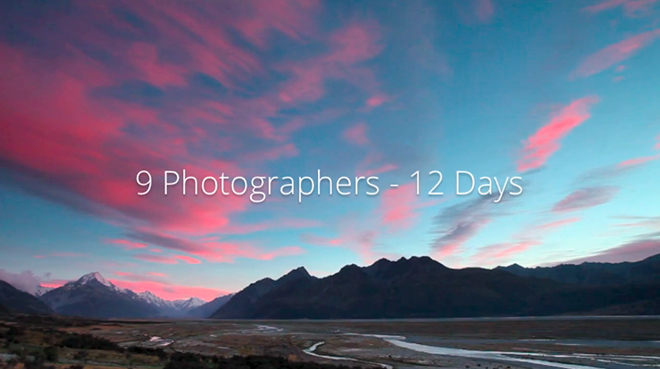
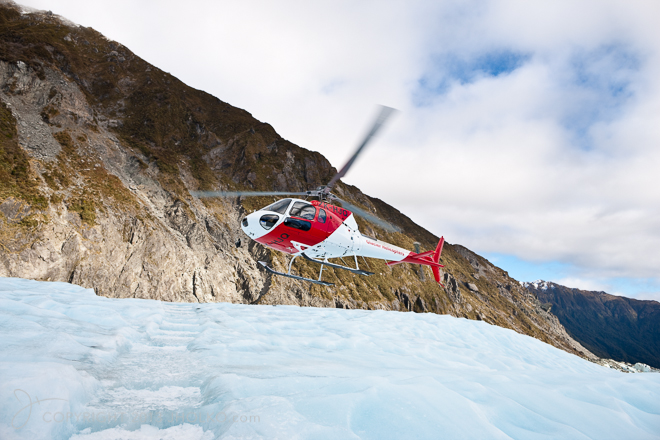
Day Eight – We took a pre-dawn hike to Lake Matheson for a viewpoint looking up to the Southern Alps. On a clear morning the southern alps can be seen reflected in the dark water of Lake Matheson and the well known viewpoint makes for an iconic photograph when conditions are right. After breakfast we photographed in the Goblin forest at the base of Fox Glacier. The forest at the base of the southern Alps is akin to a scene straight from the Lord of the Rings. The forest is full of old gnarled trees draped with vines and wonderful foliage. We took the opportunity to do some macro work for several hours under the dense canopy in misty rain. These sort of conditions are ideal for forest photography with the cloud over head acting as a giant softbox and the rain ensuring the greens of the forest are very saturated.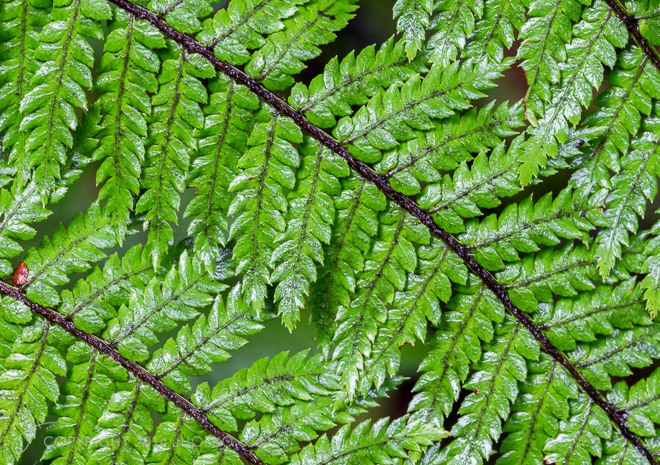 Day Nine – We rose early and took a chartered helicopter flight with the doors removed for photography over the Southern Alps in spectacular conditions. We photographed Fox Glacier, Franz Josef Glacier, Mount Cook and Mount Tasman in fantastic conditions. We were blessed with swirling moody cloud and breaking light dancing amongst the ice formations and mountains. Click on the image below to be taken to the RAW HD video footage from our aerial photography flight over the Southern Alps.

After our helicopter flight we drove north along the spectacular west coast to Punakaiki and photographed Pancake Rocks at Sunset. This location is one of the more easily accessed in the South Island and comprises of unusual layered pancake like rock formations that feature several blow holes. Large rolling swells crash against the rocks and throw spray high into the air that often catches the last golden rays of sunset.
Day Ten – We photographed sunrise at nearby Truman Beach in soft dawn pastel light before packing up and driving to the seaside town of Kaikoura on the East coast. We photographed at sunset on the rocks in the bay.
Day Eleven – Day eleven proved one of the real highlights of the trip as we took a private boat charter out to photograph Albatross and playful Dusky Dolphins at sunrise.  We also discovered a sperm whale at first light and a few of us captured this magical moment before the whale sounded and was gone. Having our own private boat meant we had plenty of space for photography and we were able to move and follow the Albatross and Dolphins as we wished.
 After breakfast we spent time photographing Sea Lions and sea Lion pups on the rocks north of Kaikoura. These Sea Lions (often incorrectly referred to as seals) are quite approachable and as long as you don’t get closer than about fifteen feet they are quite comfortable to pose for photographs as they bask on the rocks in the sun. January and February are great times for photographing the sea lions as the more aggressive bull males have moved on and the pups are curious for all things and often approach quite closely to investigate.
Day Twelve – Saw us travelling from Kaikoura to Christchurch and completing our twelve day odyssey around the South Island.
The photographs above are just a very small sampling of the more than one thousand images I made during this workshop. As yet, I have not had time to sort, edit and process the vast majority and as I am leaving for Iceland in a few days for my annual winter workshop I will not have time to really devote to them until later this year. This was a very successful workshop and some fabulous photography resulted from all who participated. Our days were very long as we rose well before sunrise each morning and shot until after sunset each evening but we certainly made the most of all the locations we visited and opportunities that presented themselves to us.
Phillip and I will be leading another workshop to the South Island of New Zealand in May next year – May 2nd to May 13th 2015. This workshop will include even more aerial photography in privately chartered helicopters at areas including Milford Sound, Fjordlands and Fox Glacier and the Southern Alps. We will even be using helicopters to land us high in the Alps amongst the glacial seracs for a chance to set up our tripods and photograph these incredible formations as well as visiting and photographing areas inaccessible by 4-wheel drive. We will be limiting this workshop to just six photographers and It is going to be a very exciting trip. Look for details here on my blog and on my website in the coming months.
I will also be opening bookings in the next few days for my annual Winter Aurora workshop to Iceland with Daniel Bergmann in late February / early March next year. Our 2014 Winter workshop sold out in just a few days this year so if you would like to reserve a place or have any question about the trip please drop me an email at info@jholko.com.



 www.WILDNATUREPHOTOTRAVEL.com