The feedback I have received over the last few months since the release of Ghosts of the Arctic has been nothing short of amazing. Thank you very much to all of you who took the time to write to me with your thoughts on the short film. To date it has been screened or is scheduled to be screened at multiple film festivals across the globe, has been featured on multiple news sites including National Geographic, Daily Mail, Peta-Pixel and many, many more (I was even interviewed by the Today show on Channel 9 about the experience of making the film) and has been seen on both You Tube and Vimeo millions of times.  One of the common and recurring questions I have received since the release of Ghosts was would I do any future films and if so what? Well…The answer is ‘maybe‘. The truth is these short films are extremely time consuming and very expensive to produce. Ghosts of the Arctic was more than two years in the planning and when I look back at all of the work and effort (and cost) that went into the planning and production from all who helped its difficult to quickly make the mental leap into the next project. I do have several future projects in mind, but it is honestly a matter of getting time, man power, love and money to all align in perfect harmony (not an easy thing!). I also want to push more into documenting the radical climate change we are experiencing in the polar regions through both the Arctic Arts Project and Penguin World vehicles in which I am involved. Any future film project will likely be focused in this area and most likely involve the full team involved in each project. At the moment though my focus is on finishing my new hardcover fine-art book on Antarctica, which I hope will be published late in 2018 (more details to come).
Category: Travel Photography
Photography from around the World
National Geographic How to Photograph Polar Bears in One of the most Extreme Places on Earth
National Geographic have just featured Ghosts of the Arctic in their new post HERE How to Photograph Polar Bears in One of the Most Extreme Places on Earth.
Two polar bears, a mother and her cub, clamber over the sea ice with the pink winter sky glowing behind them. “These are the moments I live for,” says nature photographer Joshua Holko. [Edit – Its actually a large male and a female polar bear in the video]
High in the Arctic archipelago of Svalbard, Holko is on a mission to document polar bears in the wild. Braving the elements for up to 16 hours a day, he is joined on his quest by cinematographers Abraham Joffe and Dom West of Untitled Film Works. Despite technical issues and frostbite due to the subzero temperatures, the crew persisted in the depths of winter to capture the haunting beauty of this frozen expanse.
In Ghosts of the Arctic, get up close to polar bears in their natural habitat and experience the breathtaking Arctic landscape in stunning detail.
Antarctica White Nature November 2017 Expedition Report
In November of 2017 I lead a dedicated photographic expedition to the Antarctic Peninsula – Antarctica, White Nature – in search of wildlife and dramatic landscapes. The expedition was deliberately timed as the first of the season as typically this is when the weather is still quite unstable in Antarctica and there is the greatest chance of dramatic weather and light. Expeditions later in the season (December, January and February) typically have more settled weather and far less snow coverage on the ground. For wildlife photography this can be problematic as it can be difficult to find clean snow backgrounds for the penguins (Read my guide on how to choose a photographic expedition to Antarctica).

As it turned out fresh evidence of global warming was written all across the face of the Antarctic peninsula with unseasonably warm and stable weather that resulted in more blue sky days than I would have preferred for photography. In fact, there was a huge high pressure system sitting over the peninsula for the entire duration of the expedition (and the one that followed). To date, I have never seen so little snow, or such unseasonably warm and stable weather this early in November. Many of the glaciers I have become familiar with in recent years (such as those at Neko for example) are showing severe signs of melt and distress. Snow coverage was also lower than I have ever experienced in November. National Geographic recently published an outstanding article (July 2017) on the melt in Antarctica that should be mandatory reading for anyone even remotely interested in global warming (skeptics included). Titled: Antarctica; the bottom of the world as you have never seen it I recommend you try and pick up a copy. Putting the facts of the melt aside the underwater photographs by Laurent Ballesta that accompany the article are simply superb.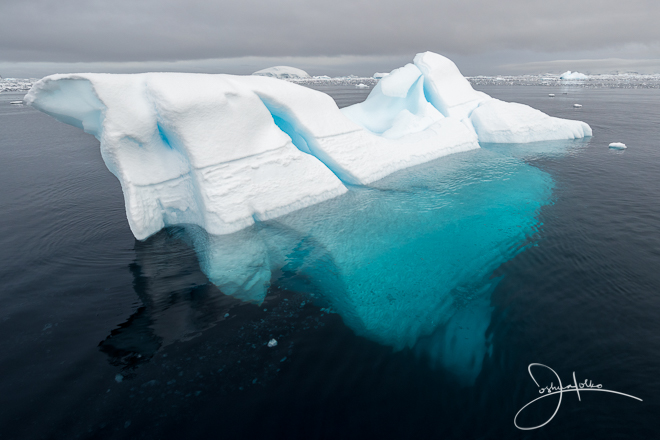 Our Drake crossing for the expedition was relatively mild (thankfully) by the usual standards and we enjoyed predominantly smooth sailing on both the journey down to the peninsula and the return journey to Puerto Williams in Chile. On a scale of 1-10 with 10 being the absolute worst possible crossing I would rate our crossing as a 4 on the way down and a 2 on the way back. All up, just about ideal sailing conditions and about as good as one can hope for. A side benefit of a smooth Drake is the opportunity to photograph the many sea birds that frequently follow the ship. Just some of the birds we photographed include the Black-browed Albatross, Royal Albatross, Wandering Albatross, Grey-headed Albatross, Light mantled Albatross, Giant Petrels, Fulmars, Cape Petrols, Storm Petrels, Diving Petrels and more.
 The map below shows our route for the expedition, including where we stopped for either landings or zodiac cruises. We tried on three occasions to make it through the Lemaire channel (always a long shot this early in the season), but we were blocked by heavy sea ice clogging the channel at its narrowest point on each occasion. Had we made it through the Lemaire it was my hope we would be able to stop at Peterman Island late in the evening. Peterman is one of my favourite landings in Antarctica and is mercifully free from the usual restrictions that mean you have to be off the island by no later than 10pm. As it turned out we were denied the Lemaire channel which meant we had other opportunities further north including an absolutely superb zodiac cruise in outstanding conditions in Curtiss Bay.
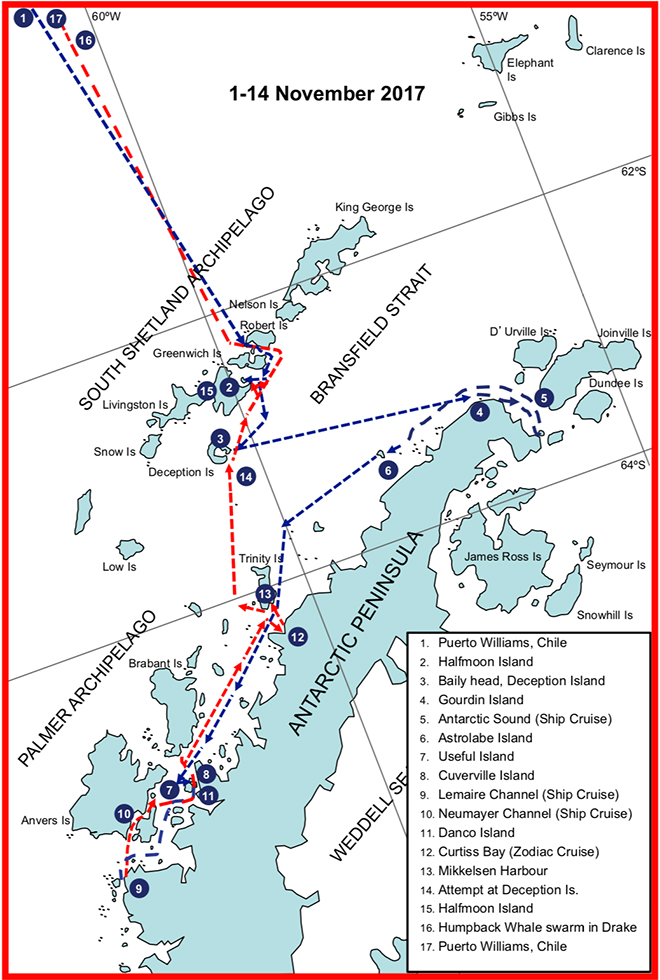 It was our intention to sail as far into the Weddell sea as possible and we did in fact get nearly as far as Paulet Island before we were blocked by sea ice. To date, I have never been able to get this far into the Weddell Sea this early in the season. We encountered some fantastic tabular icebergs in this area as well as a wonderful landing at Gourdin Island where we photographed Adelie Penguins. Gourdin is one of those landings that definitely benefits from snow coverage at this time of year. Later in the season the island is mostly free from snow and it can be very difficult to find clean backgrounds.
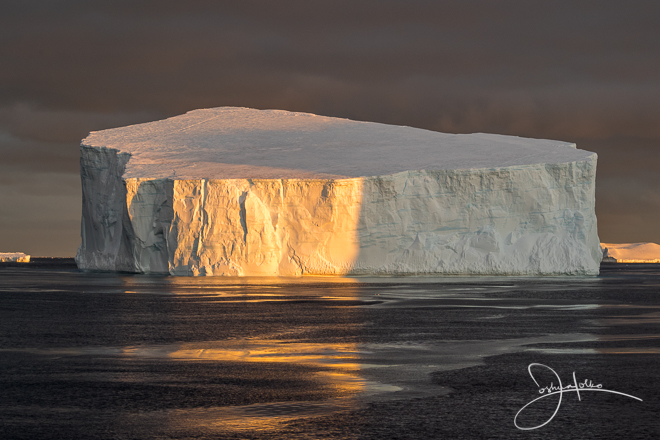
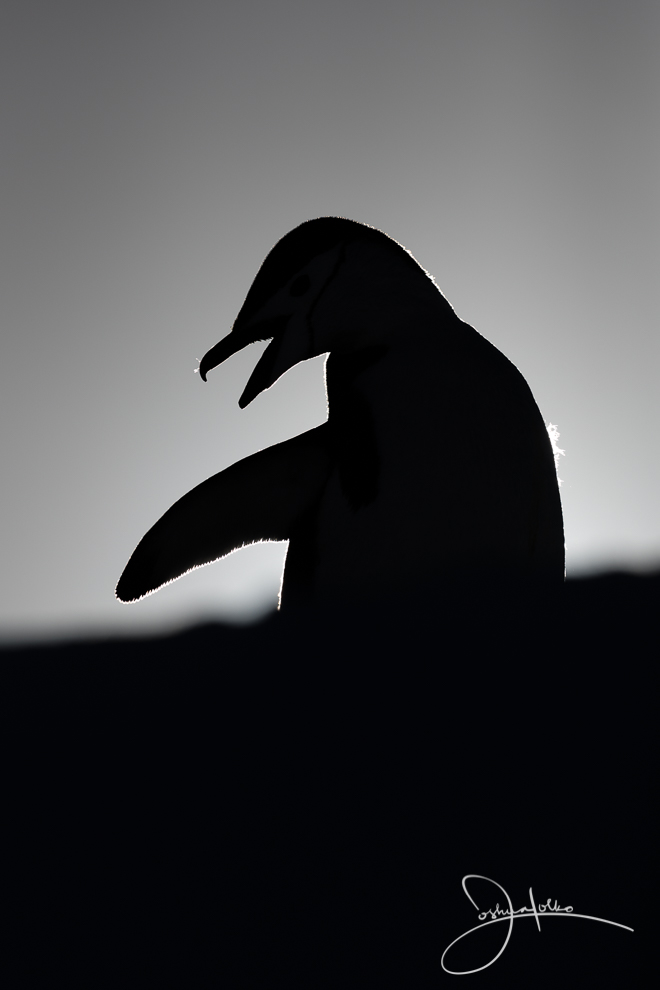 I wrote before our departure HERE that I had decided not to take my underwater housing with me to Antarctica. As it turned out I sort of wish I had (although I still feel my reasoning was valid) given the plethora of blue skies we encountered during the expedition. Blue sky days are just about ideal for underwater split photographs and I did miss some opportunities as a result of not having the housing with me (definitely next time!). For those that did have underwater housings with them there were wonderful opportunities and from what I have seen to date there were some incredible photographs produced. This early in the season the waters in Antarctica are crystal clear and visibility is at its absolute best for underwater work.Blue sky days did result in some really spectacular light at both sunrise and sunset on several occasions during our expedition. Of particular note was the sunrise we experienced near the entrance to Antarctic Sound in the Weddell Sea. Giant tabular icebergs made for absolutely superb subjects in the soft golden pre-dawn light. This was in my opinion one of the absolute highlights of our trip.
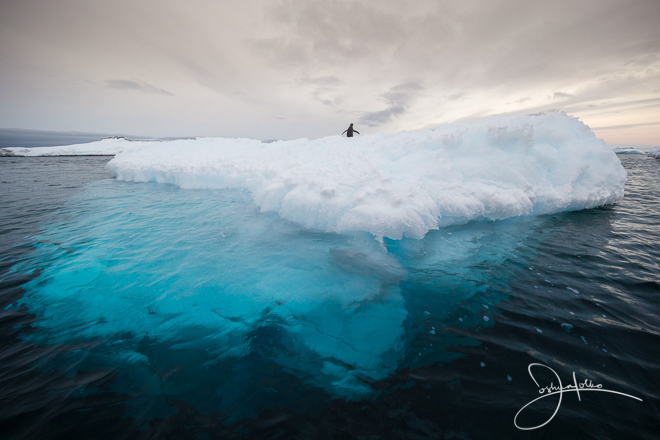
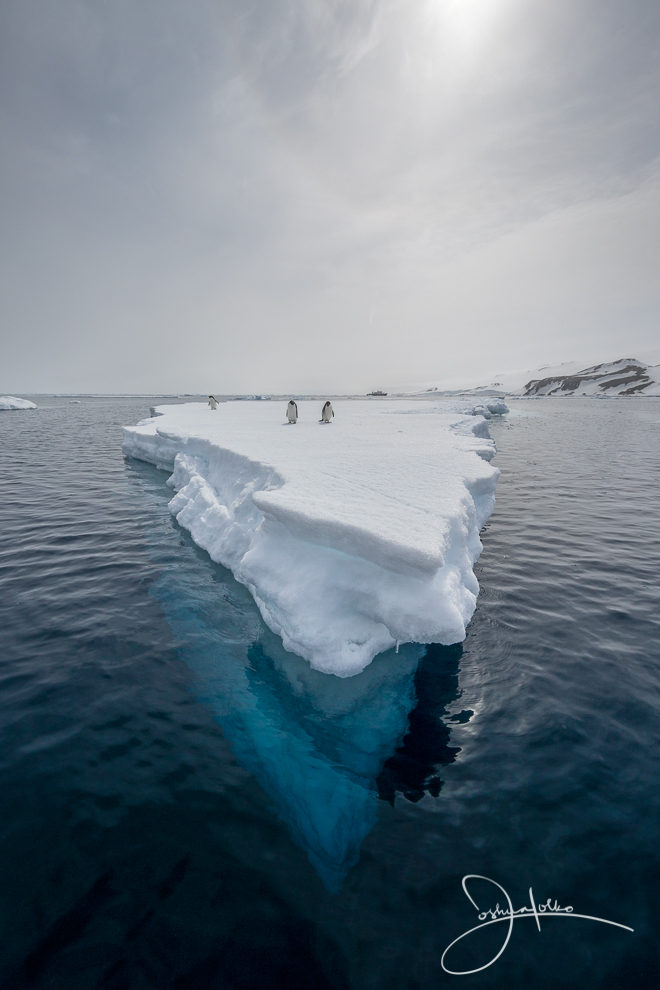
 On another occasion we encountered a large iceberg festooned with penguins drifting slowly through the ocean in the soft pastel light of dawn. These moments produced some absolutely wonderful photographs. It always pays to get up early on an expedition to Antarctica and with sunrise around 3am it meant early starts for all those keen on great light.
 Useful Island provided us with some superb evening sunset light and has proved itself a fantastic location on recent visits. The hike to the top of the island is steep, but short and provides 360º degree views of the landscape with lots of opportunities to photograph both Chinstrap and Gentoo Penguins with dramatic scenery.
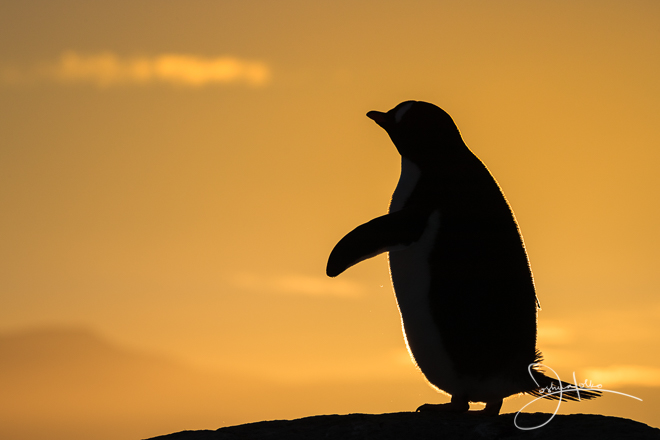 We were unable to land at Deception Island during the expedition due to a combination of strong winds and significant fast ice in Whalers Bay. Deception Island is a real highlight for many and it was unlucky we could not land to explore and photograph the old whalers remnants. We did however have an excellent landing at Half Moon Island where we photographed the large colony of Chinstrap penguins in blowing snow in what I felt was our best and most dramatic landing.
 On our return journey we were fortunate to encounter an extremely large pod of Humpback whales that were crossing the Drake bound for Antarctica. The size of the pod was immense and the sighting was the perfect finale to our expedition to the Peninsula.
I will be returning to Antarctica in November next year to lead my expedition to the remote sea ice of Gould Bay to photograph the mighty Emperor Penguins (only one place remaining before the expedition will be sold out – Read the 2016 Expedition Report). I am currently looking into options for 2019 expeditions on small vessels (50 people or less) and will have more details in the not to distant future – stay tuned.
Testing a New Lens – The Things You See…
Today I took some time in the late afternoon to test a new lens – the Canon 400mm f2.8L IS MKII (I have long wanted to add this exotic piece of glass to my arsenal for both its super fast aperture and superb bokeh). Camera (1DX MKII) and lens (400mm f2.8L IS MKII) in hand, I grabbed a portable hide and wandered down to the local park where Eastern Grey Kangaroos often frequent the open grass areas at dusk. Finding myself a secluded spot just inside the tree line I set up the camera and crawled inside the hide expecting a rather long wait…
From my concealed position I could see a group of Kangaroos out in the field ahead of me; perhaps at 800mm+ range, but too far for anything more than a record shot. They were not particularly active and were grazing in the shade of a large gum tree. A few moments later from around the corner on the walking path comes a lady walking her German Shepard. She spots the Kangaroos, stops and looks around to see if anyone else is around or watching her (she doesn’t see me concealed in a blind inside the tree line). Satisfied she is on her own she lets her dog off the leash and points for it to chase the Kangaroos. Of course, the dog charges off for the Kangaroos, startles them and they scatter. One of the smaller Kangaroos bolts in my direction and I snap off some frames from my hidden position. It was just about perfect with the Kangaroo coming almost directly toward me at full tilt.
Of course, the dog had no chance of catching the Kangaroo and it quickly tired of the chase when it realised it was outclassed. Satisfied the dog had done well the woman called back her dog and went on her way, none the wiser that I had observed the entire fiasco. In fact, neither the Kangaroo, the dog or the woman ever knew I was there. Despite the fact her behaviour was inappropriate the woman had inadvertently set up a great shot for me with exactly what I had been hoping for – a Kangaroo at full gallop coming almost straight toward me. Just about the perfect test for this lens – ISO400 f2.8 1/2000th of a second.
Photo of the Month December 2017 : Ice Climber
The photograph of the month for December (and the last for the 2017 year!) is from my winter snowmobile expedition to Svalbard earlier this year. Taken on the sea ice on the East coast, this large male Polar Bear was climbing this wonderful blue ice to get to the female bear (out of sight behind the ice). I was extremely fortunate to encounter this bear in some absolutely wonderful soft light right at the very end of the day. This was one of many photographs I made during a period of just a few minutes as the bear climbed across the ice. I am looking forward to heading back to Svalbard in March next year for a month of winter photography.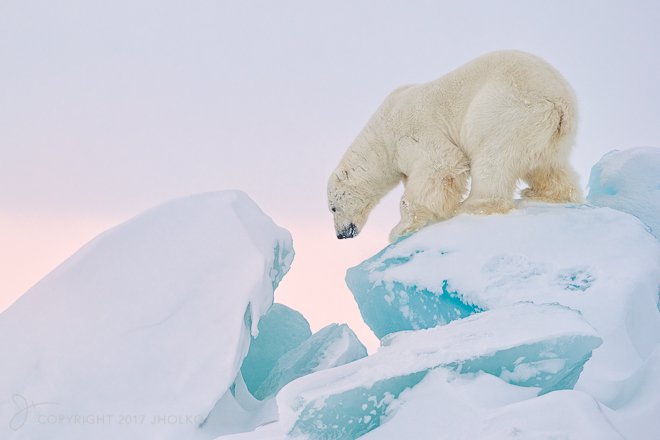
 www.WILDNATUREPHOTOTRAVEL.com