The August 2021 issue of Digitålis Foto magazine from Hungary includes a feature article on my photography ‘Ice Cold Passion‘. This is not the first time I have been published and featured in a foreign language magazine, but it is a first for me in this region of Eastern Europe. It is actually quite near and dear to my heart as my father was born in Cinobana Czechoslovakia (a country that does not exist anymore). You can download an extract of the article HERE. I hope your Hungarian is up to scratch :-)
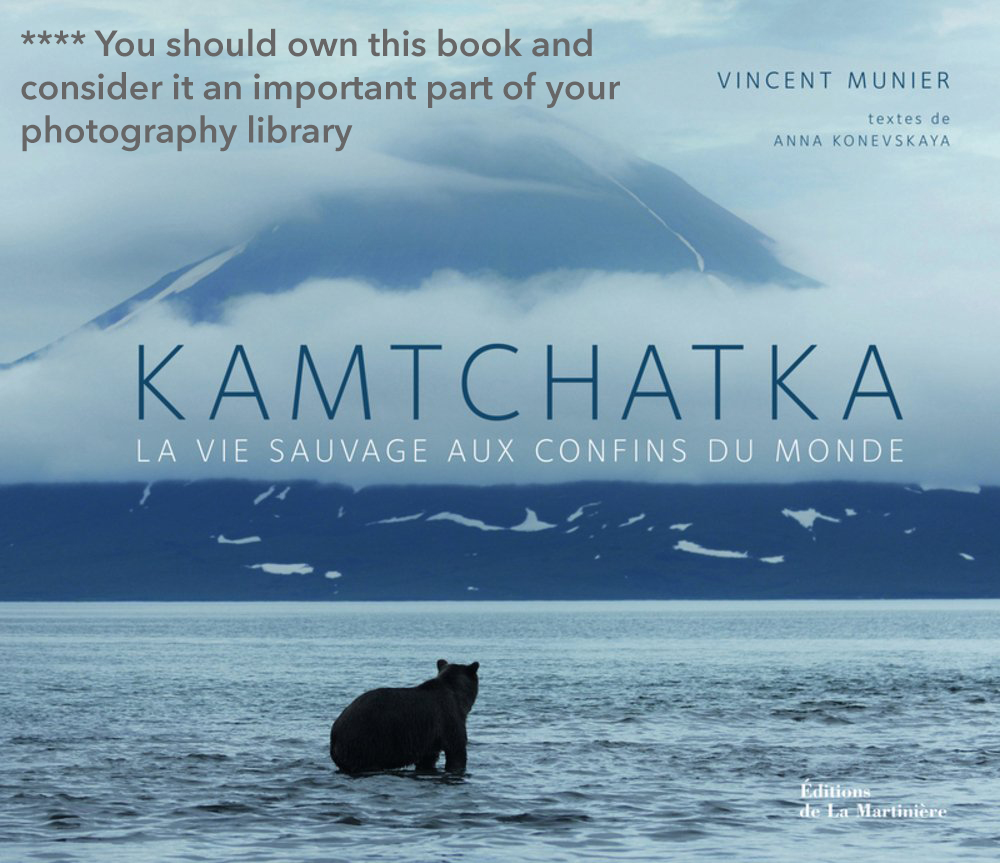
I have just published Episode #14 of my Wild Nature Photography Podcast. In this episode, we return to book reviews and discuss and review Vincent Munier’s wonderful (but sadly out of print) Kamchatka. For those of you who may be unfamiliar with Kamchatka; it is located in a remote part offar eastern Russia, lying between the Sea of Okhotsk on the west and the Pacific Ocean and the Bering Sea on the east. It’s renowned for its supervolcano, dramatic landscapes, and wild bears. If you can find a copy of Kamchatka in a second-hand book store anywhere I highly recommend you grab it at pretty much any price.
I have also added two new levels of support for the Podcast that include monthly image critiques for those of you who would like feedback on your work and one-on-one one hour mentoring sessions on Post production and Image Processing.
It didn’t take very long, but sometime last night the new Podcast trickled over 1000+ downloads. Thank you to those who have supported the Podcast channel either with feedback, comment or by buying me a coffee to help with the hosting fees (around $25 a month). By way of a glimpse into the future: Coming up will be more photography book reviews, more thoughts on the new Canon EOS R3, and my thoughts on preparing for photography workshops and more. I am also very much looking forward to Podcasting from the road and from the wilds of northern Finland in October later this year.
The photograph of the month for August 2021 comes from my 2016 expedition to the archipelago of Svalbard. Photographed from zodiac somewhere around midnight. The atmospheric conditions were sublime, with a combination of gently rising fog over the glacier and the sun burning through creating a wonderful warm glow over the glacier. The addition of the Gull adds a strong sense of scale. One of my most favourite landscapes from Svalbard.
This post is a transcript of Podcast Episode #13 – ‘How to Make Better Photographs’.
During a recent on-line photography question and answers session I was asked ‘What should I do if I want to make better photographs?’ I thought about this for a moment before I answered, but I think the question deserves more analysis and an answer that offers a deeper dive on how to improve. I am going to address this question from my own experience on what has worked for me, so please keep that in mind.
At the risk of stating the obvious, the first step to improving your’e photography and taking better photographs is understanding that you actually really need and/or want to improve. You have to not only admit, but realise deep down that your’e photography isn’t very good and that you have room for often significant improvement. In other words, you have to be your own harshest critic. That first step or realisation is often the hardest and is also the most important. It is the real key to improving your image making. If you can swallow this bitter pill (most people can’t as they lack insight into their own work) and if you are willing to make the commitment to improve then you are well armed to greatly improve your image making skills. In fact, if you can accept and take this on board then you are well ahead of the vast majority and will likely make incredible inroads into taking better photographs.
Before we dive further into how to improve your photography I want to follow up on a comment I made in a past post about being conscientious editors of our own photographs. As photographers we have to be truly objective when we edit our work and we have to be prepared to admit that the images we took on a given day of a given subject are not very good and that we should go back and try again. It sounds an easy and obvious thing to say, but I promise you it is a skill very few photographers actually possess. Most photographers look at their work from a days shoot, pick the best image from the day and fail to see past it. Here is the rub though, the best photo of the day isn’t necessarily a good photograph. It is just the best you did on the day and there is a world of difference between the two.
So let us assume you have taken the first step and admitted to yourself that your’e photography has (dramatic) room for improvement. You have eaten the humble pie, cleaned the slate and have an open mind to learning and improving. What do you do now?
The very first thing you should do is take a moment and pat yourself on the back. You just accomplished something that 99.9% of other photographers will never manage. The simple reason is that the vast majority (the 99.9%) cant see past their own ego and simply don’t think that this applies to them. They are wrong and as a result will never make significant improvements in their photography. Even though I have been photographing my entire life and have made a career from my image making; I still feel I have an incredible amount to learn and huge potential for improvement and growth. I am, and definitely remain, my own harshest critic.
In order to make better photographs we first need to understand what it takes to create them (hint – it requires a lot more than turning up to a location in beautiful light). There are in essence two distinct aspects to the creation of a powerful and emotive photograph. There is the technical craft (both field craft and post production craft) and the artistic intent. These two aspects of photographic creation are polar opposites that require a co-ordination of both left brain and right brain activity. Therefore the production of a high quality, powerful and emotive photograph is actually a combination and function of both sides of the brain. One side of the brain needs to deal with the technical aspects of the camera equipment and the other needs to create the photograph in your minds eye. The real trick is the side of your brain that is dealing with the technical aspects of the photographic craft needs to be put on auto pilot and left to do its ‘thing’ so that you can fee yourself up to be totally creative. You can only do this if you have mastered your tools and have muscle memory of your camera controls in combination with enough field experience to just let the technical side of your brain run free. Once you graduate to this state, you are free to be creative and to properly connect with your subject on a level that allows you to say something truly interesting. I discussed this at length in a recent podcast on why a new camera might be detrimental to your photography. You have to hone your technical craft to the point where it becomes muscle memory. If you have to stop and think about your camera controls in the field then I guarantee you are not producing your best possible work. You have to keep in mind though that field practice is almost entirely about the technical craft of photography and whilst it is important; it is no more important than your artistic intent. Artistic intent is developed through a study of art, reading photographic books and an emotional and often passionate connection with your subject. You have to master both the technical craft and continually develop your artistic intent if you want to consistently create strong photographs. Most photographers focus only on the former and ignore the later. Perhaps Ansel Adams said it best; ‘There is nothing worse than a sharp picture of a fuzzy idea’. Technical perfection without artistic intent is one way street to banal image making; which is why formal photographic tertiary courses spend so much time on artistic intent. In fact, the real benefit to a formal photographic education is not the technical craft; it is learning to hone your artistic skillset.
The technical craft of photography requires field practice – lots and lots of practice (like playing a musical instrument). In terms of field craft it is important too recognise that the path to improvement is not about being out in the field blazing away in the hopes that one or two shots at the end of a long days shoot might be good images. The machine gun approach might net you the odd good photograph but it is not a vehicle to the production of consistent high quality imagery. If you shoot enough then eventually you will make a good photograph. However, it is far more satisfying to produce quality work on a consistent basis than it is to have to wade through thousands of poor images in the hopes you might find a good one. In addition, if you don’t take the time to educate yourself on what actually makes a good photograph there is a very strong chance you will miss the strongest image during the edit process.
I have had the good fortune to meet and travel with a great many photographers of vastly different skill sets and with wildly varying degrees of talent. Almost universally, those photographers that have previously studied photography, art, or have had an interest in art or some sort of art background consistently produce ‘better’, more emotive and powerful work with deeper meaning than those who do not. Why is this the case? It might seem obvious on the surface, but once you master the technical craft of photography the creation of a good photograph becomes an artistic statement and personal interpretation of the subject. In other words, the process becomes one of a creative statement about the subject you are photographing. The photograph is your ultimate statement about the subject that you create in your mind before you click the shutter. This is a very difficult process if you have not yet mastered the technical aspects of image making. In fact, it is nigh on impossible for most photographers to ever get to this state because they never truly master the technical aspects of making a photograph (they are too busy upgrading their camera to ever properly learn the tool they already own).
When it comes to artistic intent, it is important to state that ‘you’ as the photographer need to be clear on what it is you are trying to say about your subject when you take a photograph. If you don’t know what you are trying to say when you have produced the final photograph then there is little chance the viewer will connect with the photograph in any sort of meaningful way. Content is king folks. One of the best ways to gauge an images success is to take a print of a photograph you are proud of and give it to someone whose work you greatly respect and gauge their reaction. If they don’t know what you were trying to say about the subject and if they cannot connect with it on an emotional level then it has likely failed as a photograph. You have to be open too critical, but constructive feedback during this process; but the benefits are well worth while if improving is your goal.
In order to make real tangible improvements to your artistic intent you need to make a significant investment in time. It simply isn’t enough to book a photographic trip somewhere every six months or spend an occasional weekend with your camera in an interesting location. You have to invest in yourself and make the time to study art, read photography books and make self-education a priority. True, you need to spend time building up the muscle memory of your camera controls (see podcast episode Why a New Camera May Be Detrimental to Your Photography) in the field, but you also have to spend at least an equal amount of time learning how to say something interesting about your photographic subject. Saying something interesting about the subject is critical regardless of whether your subject is Polar Bears, super models, pet dogs or kitchen utensils. One of the best ways to improve this skill is to look at the work of other photographers whose work you admire in your chosen genre. I don’t mean flicking through a few images on their website. I mean you need to sit down with one of their books and spend some real quality time absorbing, analysing and studying the photographs within. Ask yourself; when was the last time you sat down with a quality photography book and took the time to really study the images within? By way of example, I know of one photographer who wanted to become really good at the ‘intimate landscape’ style of photography. He spent months studying the work of Elliot Porter, David Ward and other masters of this sub-genre and putting into practice in the field the approaches he learned from studying their work. His photographs of the intimate landscape improved exponentially and after a lot of study and field craft, he is arguably now one of the contemporary masters of this style.
Instead of spending all your time taking photographs (field craft) you should aim to spend an equal amount (or more) of your time looking at the work of other photographers (and artists) and learning how they craft their images (artistic intent), how they compose, how they read the light and what it is they are saying with their images. You are not just going to look at their work though – you are going to have to truly study and analyse it. You need to grasp the principles of their approach so that you not only understand the composition, but so that you can start to pre-visualise stronger compositions in your own photography. You also need to look deeply enough to see the meaning in their photographs. Understanding what it is the photographer was trying to say with their photograph is key to unlocking the part of your brain that will get you thinking like an artist and not like a technician when you are in the field. The ultimate aim is to know what you are trying to say about the subject when you press the shutter and to subsequently successfully convey this statement to the viewer in the finished print. If you can do that your photograph will be far more successful than an image that is technically perfect but lacks any sort of emotive quality.
If you do make the investment in yourself to significantly improve and commit to not only mastering technical field craft, but improving your creative vision you will create truly powerful and emotive photographs on a far more consistent basis. In short, you will make far better photographs.
In my own genre of Nature photography I recognise that the creation of a photograph is first and foremost about being out in Nature and enjoying the experience. Nature inherently fails to co-operate with subject, light and weather most of the time. Thus being a successful Nature photographer is about realising that most of the time you are going to fail when shooting out in the field. However, each and every failure brings us closer to a success so it is important to keep trying. I like to tell myself, that even if I didn’t make a great photograph today, I still have to have had a great day out in the field. Irrespective of what Nature deals me on a given day, I owe it to myself to give myself the best possible chance to create a strong photograph; hence I devote more time to my artistic intent than I do to honing my technical field craft. Give it a try, you might be surprised at the results.





 www.WILDNATUREPHOTOTRAVEL.com