Following on from my recent guest photographer post from Kevin Horsefield – Iceland the Frozen North, I want to share a short interview and photographs from John Hurshman who recently accompanied me on my Iceland Frozen North 2016 Workshop. I have had the pleasure of travelling and photographing with John now in both Iceland and Namibia and am looking forward to sharing an expedition to Svalbard with him for Polar Bears next year. Please enjoy the interview by Digital Transitions and photographs from our most recent Iceland and Namibia trips.
DigitalEditors Note: While most of our clients are professional photographers deriving their income from their craft, we also have many clients for whom photography is a passion, but not a source of profit. We thought we’d share the work of one such client, John Hurshman, who has recently traveled to both Namibia and Iceland. This combination struck us as especially interesting as it highlights the robust nature of Phase One digital backs – from the heat of the African Desert to the cold of the Icelandic winter. We interviewed John by email, with some editing for length, clarity, and focus. DT: What is your relationship to the art and practice of photography?
John: I am a retired corporate CEO who has been involved in photography for 35+ years. While early on, I had work published by National Geographic Books, Audubon Calendar and National Wildlife Magazine, the demands of family, career and business travel precluded much time for photography. It is only since I retired in 2012 that I have had the time to re-establish my involvement in photography. Much of photo time is spent in the environs of Charleston SC, my adopted home. Additionally, I now have the time for photo tours/workshops… Namibia in 2014, Iceland in 2016 and Polar Bear of Svalbard scheduled for 2017.
DT: Have you switched to Phase One or do you use it alongside other cameras?
John: I haven’t really “switched” to Phase One, but use is in conjunction with another system… most recently Fujifilm X-PRO2 mirrorless. My primary reason for adding a Phase One back was to take advantage of more pliable files, improved color and tonal gradation, and greater resolution; I have not been disappointed! I am using my Phase One IQ260 on a Cambo tech camera, and enjoy the slower and more deliberate work flow. As a by-product of working with a Phase One back, I have adopted Capture One as my primary image editor; I prefer the interface, workflow and end product. DT: Why did you select Digital Transitions to make your foray into medium format digital?
DT: Can you tell us a bit about your trip to Nambia?
John: I first worked with DT when I was having trouble getting answers from another vendor that I had previously worked with. DT has not disappointed; you always respond promptly and clearly. I had a tiling problem with my IQ260, and your tech people quickly helped me resolve the problem.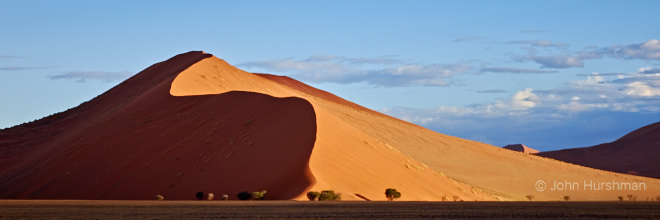
DT: Your trip to Iceland featured a near polar opposite (pun intended) landscape. What inspired you to travel there, and how did you plan your trip?
John: In April 2014 I completed a 20 day trip to Namibia to witness and photograph the country’s unique ecosystem with a group led by noted wildlife and wilderness photographers Joshua Holko and Andy Biggs. It’s one of the most arid regions in sub-Saharan Africa. My primary interest was the dunes at Sossusvlei which feature vivid pinks and oranges because of their iron content.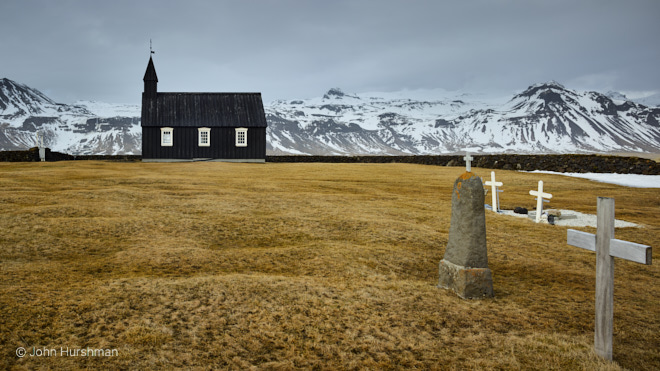
John: Iceland has been on my “Bucket list” for quite a while, due to its stark beauty, harsh conditions and geological history. I also prefer places where I can more closely interact with and get more involved in the environment… and take my time. Regarding planning my trip… that was done for me by the tour organizers, Joshua Holko and Daniel Bergmann. Following that 10 day tour, I hired another guide, Chris Lund, for 2 more days of travel to places that couldn’t be included in the first tour. DT: We especially enjoyed “Long Stretch of Black Sand Beach.” Can you step us through your mindset and process in creating this image?
John: My thought was for strong leading lines and a long depth of focus to convey the expansive nature of the scene. The image was captured with the Phase One IQ260 at ISO 50 on the Cambo Anniversary Edition with Rodenstock 40 HR-W lens at f/11. I wanted to have the patterns on the snow in the foreground illuminated by the sun, so the shadows would lead into the line of snow and wave receding into the distance. Additionally, I was hoping for the more distant section of the snow covered land to have some sunlight in order to draw the viewer’s eye more deeply into the picture. Sometimes, the foreground was illuminated, but not the background – sometimes vice versa – sometimes no illumination. But, there were enough thin spots in the clouds to encourage sticking with it. After about ½ hour of waiting, the thin spots in the clouds lined-up the way I had hoped. Also, the clouds did not clear completely, but thinned so that the sunlight was softened and not harsh. Sometimes you get lucky! Daniel Bergmann and I will be running our annual winter trip again in 2017 and bookings are now open and places are limited. Just drop me an email if you would like to join us.


 I am also looking forward to putting the new Canon EOS 1DX MKII cameras through their paces during this workshop. Over the last year I have been photographing with the Canon EOS 1DX and the EOS 5DSR 50 mega pixel camera. My experience with the 5DSR has been somewhat of a mixed bag and I have to say that on the whole I generally prefer the files from the original EOS 1DX (especially above the 5DSR’s base ISO of 100). Quite honestly, 50 mega pixels is just a whole lot more than I need for the vast majority of my photography and so I find myself reaching less and less for the 5DSR. The initial testing I have done with the new EOS 1DX MKII shows the files are considerably improved from the original 1DX; which in conjunction with the other improvements has me very excited about this new camera. I will have more to say about my thoughts on the new Canon EOS 1DX MKII in a future post as well as my thoughts on the current state of equipment in the industry.
 www.WILDNATUREPHOTOTRAVEL.com