In a few hours I will start the trek to South America where I will lead a twelve day photography Weddell Sea Expedition to Antarctica. On this expedition we are looking forward to giant tabular icebergs in the Weddell Sea as well as vast Adelie Penguin colonies. At the conclusion of this expedition I will travel to Iceland (poles apart) where I am going to spend ten days completing my project on the Arctic Fox before guiding my annual Winter Workshop with friend Daniel Bergmann. At the conclusion of our workshop I am flying to Lofoten where I will lead a new workshop for landscapes in winter with my good friend Martyn Lucas. I then fly to Namibia for a ten day workshop in the oldest desert in the world – the Namib. Its going to be quite the adventure!
This extensive travel schedule means I need to pack my Arctic / Antarctic winter gear as well as clothing suitable for the deserts in Namibia. I have juggled this packing challenge before (two years ago when I co-led a trip to Namibia with Andy Biggs) and found that it was possible to survive in Namibia with just a couple of pairs of light weight trekking pants and shirts (which thankfully don’t take up much space). As a specialised Polar photographer it does feel a tad strange to be packing a wide brimmed sunhat and sunshirts with my arctic boots and winter clothing. The issue of packing is somewhat compounded by the fact that Antarctica, Iceland, Lofoten and Namibia require very different approaches in terms of camera gear which adds both weight and complexity. Perhaps doubly so as I am carrying long and heavy telephoto lenses for my project on the Arctic Fox.
Two Canon EOS 1DX’s and a EOS 5DSR will be my cameras of choice for these trips. Although the new Canon EOS-1DX MKII has been announced it will be some time before actual delivery and as such I will continue to shoot with the EOS 1DX as my primary cameras.
Gura Gear Bataflae 32L: (carry on luggage – Believe it or not this does all fit in the one camera bag!)
- Canon EOS 1DX Pro Body Camera x2
- Canon EOS 5DSR Body
- Canon 16-35mm F4L IS
- Canon 11-24mm F4L
- Canon 24-70mm F2.8L MKII Lens
- Canon 70-200mm F2.8L IS MKII Lens
- Canon 6000mm F4L IS MKII Lens
- 1 x Spare Battery for the 1DX’s
- 2 x Spare Batteries for the 5DSR
- Leica Ultra-Vid HD Binoculars
- Cable Release
- Assorted CF and SD Cards totalling around 100 Gigabytes
- Rocket Blower and Dust Cleaning paraphernalia
- Complete LEE Foundation and Filter Kit with Soft and Hard ND Graduated filters and LEE Polariser
On my last visit to Namibia I carried two TSE lenses specifically for photography at Kolmanskop ghost town in Namibia. This abandoned town is the ideal location for Tilt and Shift lenses and I found them extremely useful during my time there. However, I decided against TSE lenses for this trip as I am already carrying an extensive array of lenses and I want to try a different approach to this location on this trip.
Gura Gear Chobe Bag: (carry on luggage)
- 15″ Macbook Pro with Lightroom 5 and Photoshop CS6 with the Nik Plugin suite
- MacBook Power Adapter
- Canon 200-400mm F4L IS Lens with inbuilt 1.4 TC (Watch the Unboxing Video)
- 1 x LACIE Thunderbolt External 1TB Hard Drive for in the field Back Up.
- Various Power Adapters / Chargers and Associated Cables
- Canon 1DX / 1DS MK3 Battery Charger
- Sandisk USB CF and SD Card reader
- Passport / iPhone / Wallet
- Portable battery for charging iPhone and other devices
- A lot of these items I store inside Gura Gear Etcetera cases inside the Chobe. (These cases are fabulous for organising accessories)
On top of the above I have two North Face duffle bags with the rest of my clothes and gear. Getting all of this to Antarctica and then onto forward destinations is always a challenge, but once on location the benefit of having the right equipment makes all the hardship worthwhile. See you in South America…

 Access to these two islands is only obtained by first flying into Mount Pleasant near the capital Stanley and then taking a much smaller B-2 Islander plane out to the smaller Saunders and sea Lion Islands. The weather around the Falklands is a constantly changing variable and as such flights to these islands are never assured – everything is a weather dependant. Our first stop at Saunders Island was roughly a forty five minute flight from Stanley. We were touch and go for this flight due to very low cloud and fog in the area, but in the end we made it by flying under the cloud and super close to the water. I knew we were low when I looked out the window at the passing cliffs and saw a flock of sheep looking down on us.
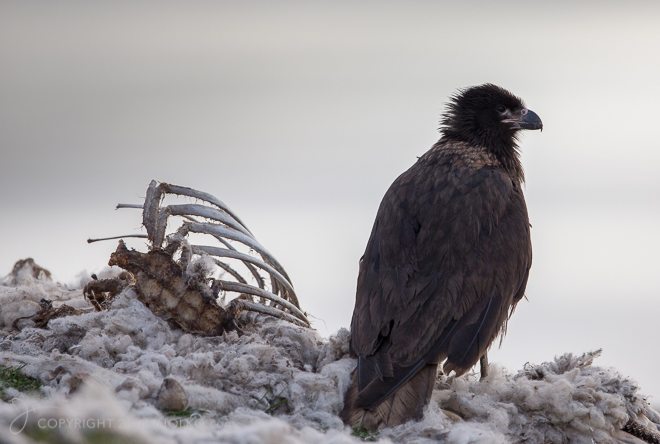 On arrival at Saunders Island we made the 45 minute drive by 4-wheel drive out to the ‘Neck’ area which would be our home for the next few days. The Neck is a remote part of the island with only basic self contained accomodation. The wonderful thing about this location however is the sheer plethora of bird life literally right outside the window. The Neck is really a very special area and we certainly got our moneys worth with changing conditions and amazing wildlife. In addition to Gentoos, Magellanic and Rockhoppers there was also a group of King Penguins out here, as well as one pair of Macaroni Penguins in the Rockhopper colony. The Caracaras (Johnny Rooks) and the Turkey Vultures were also very active here and there were a great many small birds including Meadowlarks, Black Throated Finches, Plovers and more. In addition there were Oyster Catchers, Gulls and other sea birds. Some of us also made the trek out to two of the remote ponds where we were able to photograph Black-headed Swans and the beautiful Silver Grebe. At the Rookery we enjoyed the Rockhoppers and also a huge number of breeding Black-browed Albatross in spectacular landscapes. I know of no other place in the world where you can photograph Black-browed Albatross in flight with a wide angle 16-35mm lens!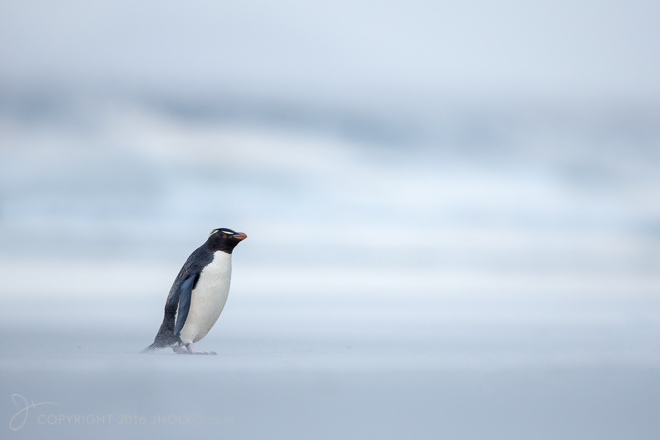
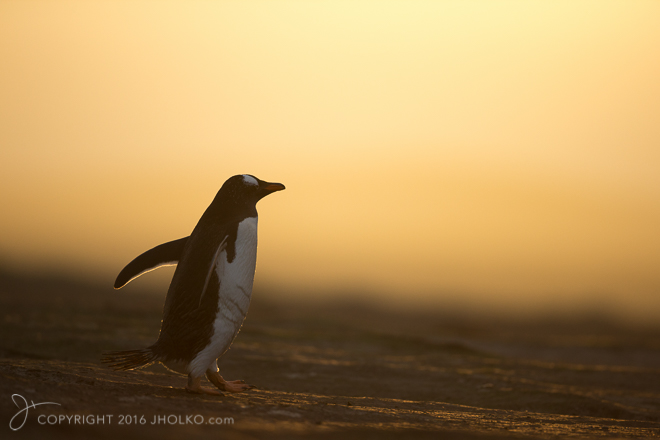 When we had finished at the Neck we took another small plane ride to Sea Lion Island where we spent three more days photographing Gentoo and Magellanic Penguins and also Rockhoppers and Cormorants a short drive from the lodge. In addition we had some fantastic shorebirds, Caracara, Blue Eyed Cormorant as well as several different species of the wetland birds found in the Falklands (several of them endemic to the islands). One of the highlights for me personally was the short-eared Owl which I spent the better part of two days to locate and photograph.
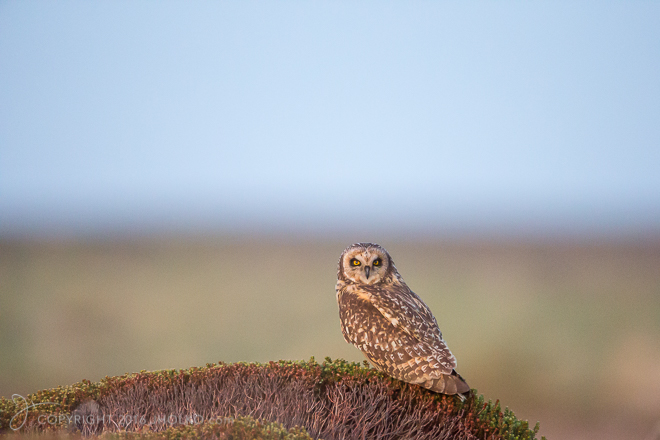 The Falkland Islands is a world class location for bird photography and is a remarkable location for any wildlife photographer to spend time. With so many of the birds being approachable the photographic opportunities are extensive. As yet I have only had time to process a small handful of the photographs I made in the Falkland Islands, but hope to find time to work through many more over the course of this year. I am also looking forward to returning to the Falklands for a future workshop.
 www.WILDNATUREPHOTOTRAVEL.com