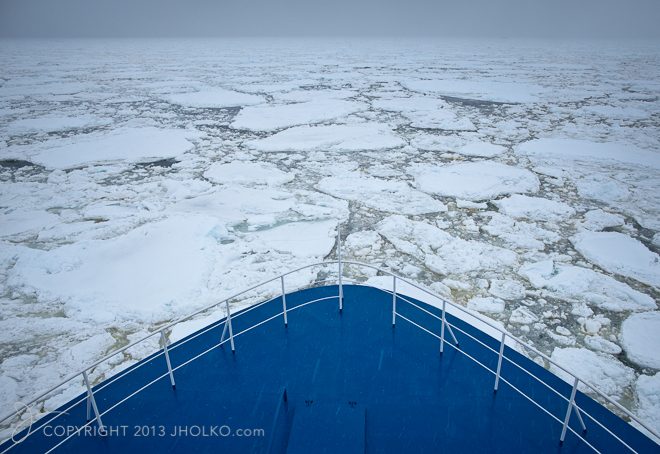
One of the most spectacular features of Antarctica we are looking forward to visiting on the expedition I am leading this November aboard the Polar Pioneer is the Lemaire Channel. This natural, narrow channel is flanked on both sides by high mountains and snow dusted rock spires and rates as one of the most wondrous and beautiful places I have ever had the pleasure to photograph. Slowly cruising through the channel is akin to what I imagine it would be like aboard a space ship gliding between towering and precipitous mountains on an alien world. Whether you are on the bow, aft, port or starboard the landscape is equally awe inspiring and impressive. On my last trip the conditions were overcast with frequent heavy snow and dark brooding clouds as we made our way slowly through the channel. Whilst a few photographers were bemoaning the lack of clear skies for sunset colour I was secretly thankful for the dark and ominous atmosphere. Antarctica is so often depicted for its brilliance that I find it refreshing to see images that depict a more ominous and portentous landscape.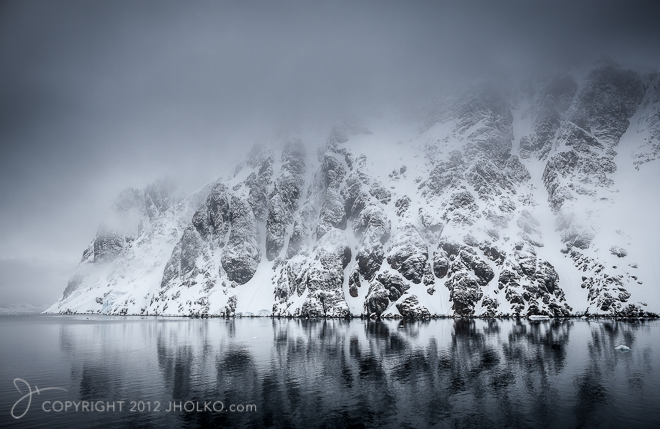 Frequently clogged with icebergs and pack ice the channel is really only safely navigable early in the season in an ice hardened expedition class ship such as the Polar Pioneer. Later in the season when the weather warms and the ice thins the channel is frequently visited by larger tourist based cruise ships; although the danger of ice bergs to their thin steel skin always remains. One of the real benefits of a photographic expedition to Antarctica aboard an ice hardened ship is the ability to not only get close to very large icebergs, but also to push pack ice out of the way greatly increasing the photographic possibilities in locations such as the Lemaire Channel.
 Although passage through the Lemaire Channel is never guranteed we do plan to sail through it (weather and ice conditions permitting) this November. I am secretly hoping for more dramatic weather and evocative atmospherics.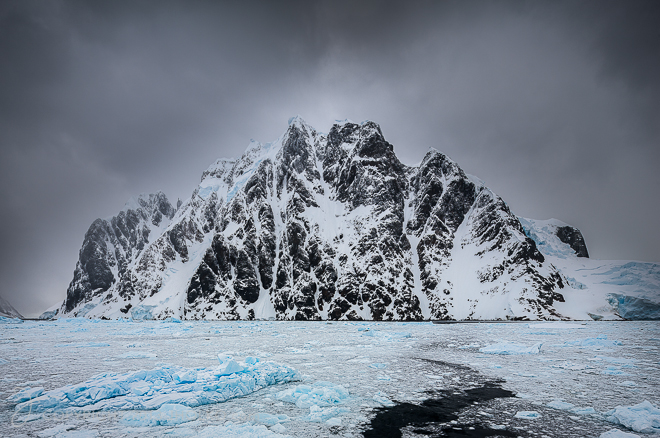
Whats in Josh’s Gura Gear Bataflae 32L?
In part two of the new Gura Gear Bataflae series of videos we have a look at just what I pack in my camera bag for both international travel and local landscape photography. Depending on where I am travelling and what I am shooting I occasionally swap lenses in and out of this collection. As you will see, you can fit quite a bit of gear in a Bataflae 32L! I actually discovered another tele-converter in the bag on top of all the other equipment when I was repacking the bag after we finished filming. Just click on the image to watch the video via You Tube. I hope you enjoy. You can order the Gura Gear Bataflae cameras bags directly from Gura Gear.
Gura Gear Bataflae 32L vs. Gura Gear Kiboko
My good friend Antony Watson and I were standing around at a nearby nature reserve late last year and decided we would make a short video of the differences between the original Gura Gear Kiboko and the new Bataflae 32L camera bag whilst we waited for the light to improve. It just so happened that between us we had the original Kiboko, the new Bataflae 32L and the Bataflae 26L in the field as well as enough hands, gear and motivation to make a couple of short videos. This first video is a straight comparison of the differences between the original Kiboko and the newly designed (and I think much improved) Bataflae 32L. Just click on the image to view the video on You Tube. I hope you enjoy.
Half Moon Bay in Antarctica
It has been sweltering hot the last few days in Melbourne Australia with temperatures today peaking at an oven roasting 40+ degrees Celsius. Those of you who know me well know that I would much prefer to be caught in a snowstorm unprepared than stuck in this kind of weather. With the mercury at a summer high the only way I could find to cope with the heat was to crank up the air conditioner and think of icebergs. So with the air conditioner working overtime in my studio I have been reviewing some of the images I shot in Antarctica in 2011 and found one I had not yet processed from Half Moon Bay. This photograph was taken during one of our early shore landings and was one of around a dozen frames I shot of this particular iceberg. This was one of the few images on the entire trip that I utilised a tripod for as I wanted a very slow shutter speed to soften the water and to better emphasise and juxtapose the chalky blue iceberg against the distant soft fog and snow. This frame was also the only sharp frame from the series as the iceberg was imperceptibly moving with the current which resulted in the rest of the frames suffering from motion blur. I used the Canon 70-200mm F2.8L IS at the 200mm end at F11 with a 10 second exposure and the LEE Big Stopper. A higher resolution version of this photograph can be seen on my website at www.jholko.com. This photograph is also my photograph of the month for January 2013.
X-Rite Interview – Photographing Icebergs and More
The good folks at X-Rite have posted a short five minute audio interview on their blog I did with them a few weeks ago as part of their Coloratti program.
Coloratti Josh Holko is our newest member of the Coloratti program from Melbourne, Australia. Josh is an accomplished nature photographer and workshop leader. He received word this month that his photographs of Antarctica have made set him as a finalist in 2012 Outdoor Photographer of the Year. Already an award winning photographer Josh’s blog says, “I feel I have been very fortunate this year as I was also a finalist and highly commended with 3rd place in the Travel Photographer of the Year ‘Single Shot Water Category’ and was a finalist in the ‘Fine Art Photographer of the Year’ competition in Paris a few months ago.”
We caught up with Josh a few weeks ago to talk about his photography and yes, I admit it, to enjoy his lovely Aussie accent! You have to hear about his thoughts on “luxury shooting” in his workshops.
Visit the X-Rite blog for the complete interview.
 www.WILDNATUREPHOTOTRAVEL.com