When out shooting in the field I usually find that the subject and composition will dictate the orientation of the frame – either horizontal or vertical in the 35mm format. Almost always I will go with my first instinct when making framing, composing and orientation decisions and usually my first instinct results in the best overall frame. Once I have taken that photograph I will then experiment with different compositions and usually a different camera orientation. Often, an alternate orientation produces an equally good photograph and occasionally a superior one. It almost always results in a photograph that ‘reads’ differently and the experience can be quite different for the end viewer.
Speaking extemporaneously it is no skin off my nose to experiment with an alternate camera orientation in the field. It takes little to know time to re-orientate the camera after shooting a horizontal or vertical composition; especially with the Really Right Stuff L bracket that I use on my primary Canon 1DS MKIII. This is something I find myself doing a lot as the alternate orientation gives me a choice of options during the editing process back in my studio – and choice is always a good thing. Even if the different orientation ends up a banal photograph destined to reside in my Lightroom catalogue without ever seeing ‘print’ I do at least have the photograph for comparative purposes.
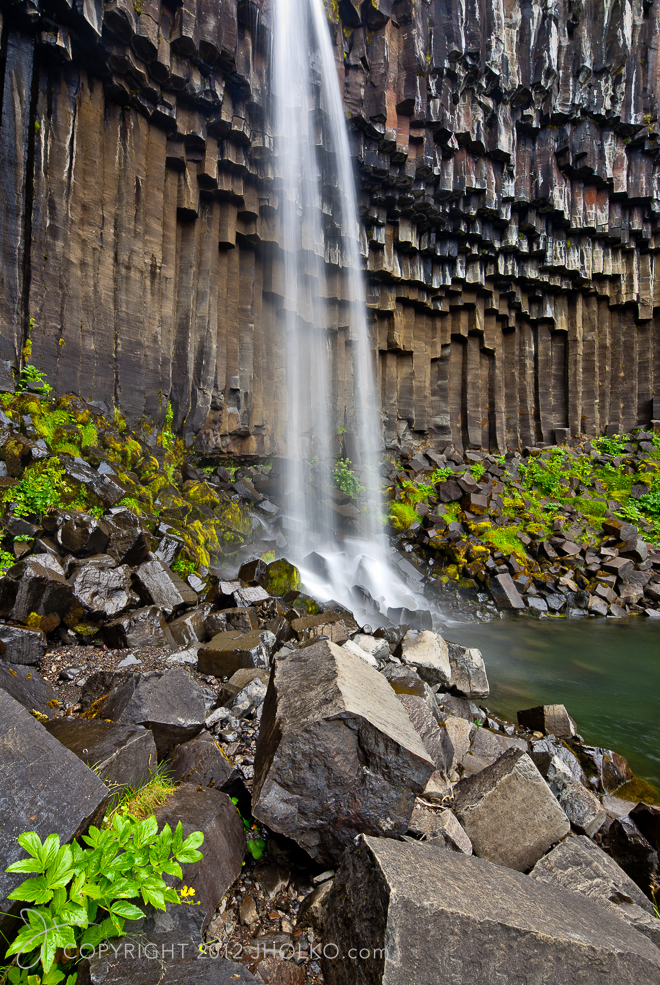
Every now and again I end up processing both the horizontal and vertical frames as I cant decide which I prefer; or I like both equally as in the case of ‘Selfoss Before Storm’. Both the horizontal and vertical compositions work to my eye for this photograph and both for quite different reasons. Each orientation places the emphasis on different elements in the frame and each; although similar, is visually quite a different experience. The vertical composition more successfully coveys a sense of height to the waterfalls that cascade down this martian like canyon. On the other hand the horizontal orientation conveys a greater sense of grandeur; giving a sense of scale to the width of the falls. In both instances the racing storm clouds are positioned to emphasise the orientation of the frame. I like both – Which do you prefer?
Iceland is a country well known for its waterfalls. One of its most famous is Selfoss; a waterfall I made several repeat visits to during my 2010 trip. What makes Selfoss so unique and other worldly is the way it cascades down both sides of a deep rocky canyon. I have not seen such a geological feature anywhere else in the world and as far as I know it is unique to Selfoss and Iceland. The light was very different on my second visit to Selfoss and on this occasion a storm was building and dark storm clouds were racing across the arctic sky as I set up my tripod to take this photograph. The water has an almost chocolate colour as it is glacial and full of sediment from melting glaciers upstream. Not long after I made this exposure it began to rain heavily and I was forced to abandon any further shooting; but it didn’t matter as I had the photograph I wanted and an image I have titled ‘Selfoss before Storm’. A higher resolution version of this photograph can be seen on my primary portfolio website at www.jholko.com under Iceland. Limited Edition Fine Art Pigment on Paper prints are available of this photograph through Source Photographica in Brighton.
Last year I schlepped my 17″ Macbook Pro, power pack and accessories all the way from Australia to Iceland (along with 25+ kilograms of camera equipment). I learnt an important lesson from this exercise: I should not have purchased a 17″ laptop for field work (international or otherwise); a 15″ would have been more than sufficient and saved considerable weight and space. I will not make the same mistake again of selecting such a large laptop. I was seduced by the increased real estate of a 17″ screen and the proposition that I could actually do some image processing in the field. The reality however, is that laptop screens are a very poor substitute for my wide gamut 26″ professsional image editing monitor in my studio. Even calibrated with a high end colorimeter the colour on laptop screens just sucks – period.
Given the price of a fully loaded 17″ Macbook Pro with 8 gigabytes of RAM and a 256 Gigabyte Solid State Drive is a dime or two more than chump change I am resigned to living it with until it reaches the end of its useful life and is subsequently replaced with a 15″ (or smaller) model. Unfortunately, (or forutnately for my bank manager) my 17″ MacBook Pro is going to still be well within its useable life cycle when I leave for Antarctica in November this year and I cant justify ditching it early just to save a bit of travel discomfort.
Unlike Iceland, New Zealand or Tasmania (or pretty much any of the other trips I have done) this time I will be based on a ship with only short zodiac excursions and the occasional shore landing. This means that once housed in my ship quarters I can pretty much set-up the laptop and leave it that way for the duration of the trip – a very appealing proposition instead of carting it from location to location. Yes, I am going to have to haul it all the way from Melbourne Australia to Ushuaia South America; through quite a few airports with lots of security checks with all the annoyances that comes with the pleasures of airline travel these days. But, at least on boarding of the ship it will become a static operation.
So, armed with my 17″ laptop for the trip I will have several advantages over small back-up devices such as the Hyper Drive. Firstly, a much larger screen for reviewing files and second the power to run Adobe Lightroom and Photoshop on location. Since space is really not an issue on this trip there is little to no advantage to additional and somewhat expensive devices such as Hyper Drives. These kind of devices are really space and weight saving options and are ideal for hikes or trips where its just totally impractical to carry a full size laptop. I can do all of my key-wording in Lightroom on location at the end of each days shooting on my laptop and even some initial image selection (should I find enough time). I won’t be doing any actual processing of my RAW files since as I mentioned above I find the quality of the screen not up to scratch for this purpose.
In terms of back-up I plan to take a couple of Lacie external rugged firewire drives; which I will use to back up my files on a daily basis. One drive lives permanently in my laptop bag and the second drive will stay with my person for the duration of the trip. In the unfortunate event (touch wood) that I loose one drive I still have the second back up plus my laptop. Its the belt, suspenders and a piece of string mentality.
I will be taking a large number of 8, 16 and 32 gigabyte compact flash and mini SD cards with me – more than enough for a couple of day’s heavy shooting (and I am envisaging major giggage on this trip!); and after backing up the cards at the end of each day will erase and re-use them. I don’t advocate taking enough cards to never have to erase and re-use; since I want to import and key-word my files at the end of the day in Lightroom anyway and back them up to multiple hard drives. Plus I find it too easy to forget which cards have been used and which have not.
This approach and methodology has worked well for me over the last few years. The only real downside is the size and weight of my 17″ Macbook Pro – a situation I will remedy when my laptop next comes up for refresh sometime next year. In the meantime, if anyone wants a pre loved, fully loaded 17″ Macbook Pro at a discount please drop me a line!
I’ve been away up at Mount Buller for some skiing and snow play with my kids over the last few days and I was very pleased to learn on my return to Melbourne last night that one of my photographs has been selected as a semi-finalist in the Windland Smith Rice International Awards. There were more than 21,000 photographs submitted this year to this award; which is run by Natures Best Photography and I thrilled to have one of my photographs selected to go through in to the semi-finals. At this stage I need to supply additional ‘exif’ information and a higher resolution file for further judging. I cannot as yet disclose which photograph has been selected as the next round of judging has not yet been completed; but will do so as soon as possible.
In Part One of this article I talked about the problem of wildnerness photography in relation to how to comfortably carry equipment into the field on extended hikes and some of the problems I have encountered over the years. I also talked some more about the Gura Gear Kiboko camera bag now that I have been using one for a year in the field. At the risk of repetition the Gura Gear Kiboko is I believe the best camera bag on the market that I have tried for my style of photography.
In Part Two of this article I am going to talk about how the custom Khumbu Xtra-Hand Vest performed for me in the field over a couple of days shooting up at Mount Buffalo in Victoria in the middle of winter. I was very keen to get out into the wilderness with my new vest from Vested Interest to see if it would live up to my hopes and expectations. I was relatively fortunate with the weather over the weekend as it was mostly fine; although a little overcast on Sunday. It was quite cold up at Buffalo with temperatures well below zero for the sunrise shoots and hovering around zero during most of the day before plummeting again at sunset. It did not rain or snow over the weekend although the occasional wind blasts were very cold and quite damp.
Xtra-Hand Vest at the Cathedral
I did several long hikes with the vest including a single hike of approximately ten kilometres through quite deep snow loaded up with a Canon EOS 1DS MKIII with a Really Right Stuff L Bracket, a 70-200mm F2.8L IS lens, a 24mm F1.4L MKII lens, a 17mm F4 TSE lens, a Canon S90 Point and Shoot, my Lee Filter Pack and Filter Holders, Polarising filters, spare battery, spare memory case and cable release, my full size Gitzo Tripod and Really Right Stuff Ballhead and of course my small thermos of coffee as well as all the normal personal items like car keys, mobile phone etc.. This is not an inconsiderable amount of equipment and although I did not weigh it I would estimate it to be in excess of ten kilograms and possibly quite a bit more. I wore a marino wool long sleeve thermal top, my 66 North Eldja mid layer jacket with a 66 North Glymur waterproof jacket over the top. The Xtra-Hand vest went over the top of all this without issue. Because the side straps of the vest are adjustable it is very easy to wear this vest in both the height of summer and dead of winter. I would rate this adjustability among the vests strongest attributes as it means this is an all year accessory; and not season specific. Synching the vest up is a snap with the side straps and its very quick and easy to make adjustments.
Shooting Mahomet's Tomb at Sunset Mount Buffalo
A few thoughts on how this vest performed in the field: I can easily reach my hand over my shoulder and pull out my tripod from the large back pocket to set up a take a photograph without having to remove the vest. This is very convenient when one needs to work quickly. It means I can stop anywhere and access everything I need without having to take off the vest. Putting the tripod back is difficult without taking off the vest and really requires either removing the vest (which only takes a moment) or having an assistant or nearby photographer drop it back in the pocket. I should stress that I use a full size Gitzo GT3530 LSV Carbon Fibre Tripod. This is a very large 3-section tripod and it is a testament to the excellent design of this vest that it can be carried on the back securely, without flopping around and lifted out without the need to remove the vest. Every back pack that I have ever tried that claims it can carry a tripod on side straps fails to adequately support the large Gitzo. Incidentally, I made comment in Part One of this article that I can fit my 300mm F2.8L IS lens in the back pocket of this vest. In point of fact, the pocket is actually large enough to store up to a 600mm F4L lens with the lens hood reversed mounted to Canon 1D MKIV. That should go a long way toward giving you and idea of the storage capacity of this pocket. Of course, there is no way you could remove a 600mm lens and attached camera without first removing the vest. The pocket has a velcro lid and also a drain hole should water get in – another solid plus in the design.
Hoar Frost Forest
I found the side pockets of the vest a great location for storing lenses up to the size of the Canon 70-200mm F2.8L IS. I can reach around and take a lens in and out of these pockets with relative ease without having to remove the vest. The 70-200mm F2.8L IS lens is somewhat of a tight fit in these pockets and if I was ordering this vest again would have the circumference of one of the pockets increased slightly to more easily accommodate this lens. As it stands its acceptable with the 70-200 F2.8L IS and easy with anything smaller. The ability to retrieve and stow a lens or thermos in the side pocket is a real boon as I found it very convenient when I wanted a cup of coffee on a hike or wanted to access a lens quickly.
The padded hip belt was I feel a significant factor in the comfort this vest provided over long hikes. During a three and a half hour hike through relatively deep snow I never felt any back or neck discomfort. I only removed the vest once during a snack break and only then to climb a nearby boulder more freely for a better view of the surroundings. The vest does an outstanding job of spreading the weight of the equipment much better than a traditional back-pack that loads the shoulders and tends to make you somewhat unbalanced. By loading up the front pockets of the vest as a counterweight to the large rear pocket weight is more evenly distributed and makes hiking much easier. The padded hip belt just helps spread the weight and transfer some of it to the waist. Because of the nature of this product being a vest everything is easily accessible in pockets; which is extremely convenient and makes working in the field with a backpack seem very primitive.
Waiting for Sunset at The Monolith
Overall I am very impressed with how this vest performed in its first field test. It has met my expectations and actually proved more comfortable on long hikes than I had envisaged it would be. As I mentioned in Part One, these vests are custom made for the photographer. They are about function and convenience and not style and looks. I am certainly not going to win any fashion awards in the field with this accessory; but it is going to make my hikes more comfortable and my equipment more accessible and that makes it a well designed product in my book.