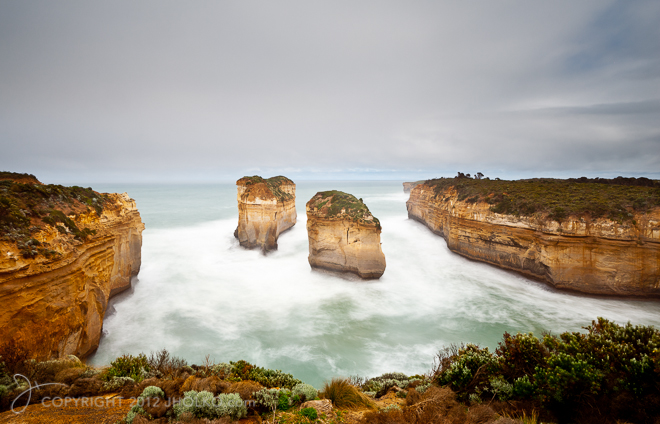
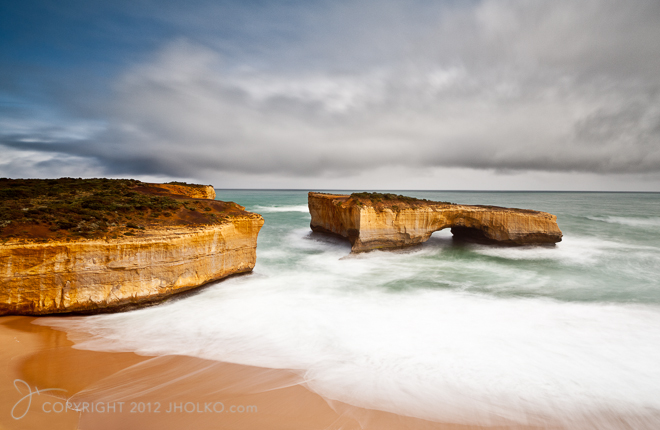
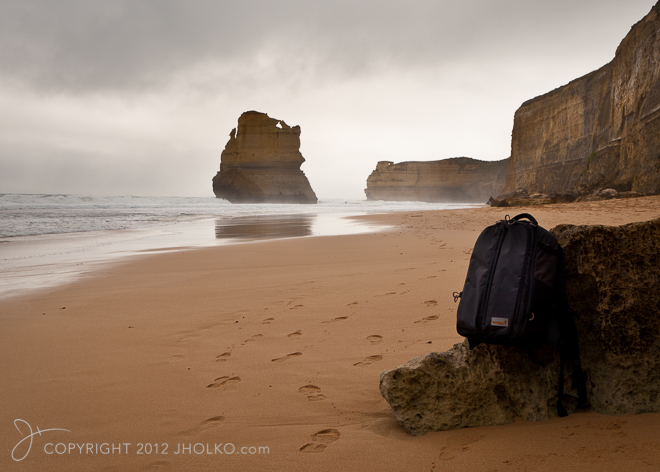
After spending so much time photographing icebergs in Iceland on the black sand beaches in July and August this year it was really wonderful to get back onto some golden Australian sand for some local photography. It was really enjoyable to just spend a couple of days driving down the Great Ocean road again through Lorne, Apollo Bay and on past the Twelve Apostles, Gibsons Steps, London Bridge, the Grotto, Loch Ard Gorge and Port Campbell. This part of Victoria is simply beautiful and is a wonderful world class location for landscape photography. If you are considering a photographic trip to Australia then this part of Victoria is a must. This first photograph was taken along the beach on an outgoing tide at dawn just before the drive into Lorne. You can just see the Lorne pier in the top right hand corner on the horizon. This short trip was also the first good opportunity I have had since returning from Iceland to put my new Gura Gear Kiboko camera bag through its paces in the field. This is going to be old news to those of you who already own the fabulous Gura Gear Kiboko camera bag; but thats ok. If you are fortunate enough to own one of these camera bags you need read no further and are summarily excused to go out and do some photography. If, you do not yet own a Kiboko then before you grab your current bag and head out the door take a few minutes and read on because I really do not know how I managed all these years without the Kiboko for carrying all my equipment in the field.
I recently blogged about the Gura Gear Kiboko on my return from three weeks photography in Iceland after I realised how dissatisfied I had become with my current Lowe Pro Nature Trekker back pack. As my photography equipment has grown over the years it had become increasingly difficult to fit it all into the Nature Trekker and inevitably something got left behind – and thanks to ‘Murphy’ that ‘something’ was usually what I needed in the field. Don’t get me wrong; the Nature Trekker is a great camera bag – its well made, virtually waterproof and is one of the toughest bags on the market; but its simply rendered obsolete by the Kiboko.
Physically, the Kiboko is almost the same size as the Nature Trekker; but that is where the similarities end. The Kiboko weighs less than four pounds – yes, less than four pounds. The Nature Trekker on the other hand weighs in at more than double that. And that is with the optional daypack removed! But the weight saving isnt even half the story. The real genius of the Kiboko becomes clear when you start to pack it with equipment. The Kiboko holds significantly more on the inside than its appearance would have you believe. In fact it will swallow a huge amount of equipment and give you easy access to it in the field.
Here is what I have in my Kiboko: (and the Kiboko meets airline carry on size restrictions with all of the below!)
- 1 x Canon EOS1DS MKIII
- Spare Battery for EOS 1DS MKIII
- Canon EOS1DS MKIII Battery Charger
- 1 x Canon S90 Point and Shoot
- 1 x Canon 17mm F4L TSE
- 1 x Canon 24mm F1.4L MKII
- 1 x Canon 35mm F1.4L
- 1 x Canon 50mm F12L
- 1 x Canon 85mm F1.2L MKII
- 1 x Canon 70-200mm F2.8L IS
- 1 x Canon 300mm F2.8L IS
- 1 x Canon 1.4 TC Extender MKII
- 1 x Canon Macro Extension Tube
- 1 x Canon Cable Release
- 1 x Bubble Level
- 2 x Polarisers
- 1 x UV Filter
- 1 x Lee Pro Filter Holder and 3 x Adapter Rings in LEE Pouch
- 6 LEE Grad Filters in LEE Pouch
- 2 x Micro Fibre Cleaning Clothes
- Packet of Lens Tissue
- All my CF and SD Cards in SanDisk Pouch
- All of the lens hoods for the included lenses
Oh.. and on top of that I still have room for at least another lens!



 www.WILDNATUREPHOTOTRAVEL.com