Video is the Current Buzz Word in Photography – Is 3D Next?

If your a photographer, you would have to have been living under a rock not to know that the addition of video to digital still cameras is the current ‘big thing’ in traditional still photography. With virtually every new camera released these days having some sort of video capability of varying quality it was only a matter of time before someone announced the worlds first 3D camcorder. Kudos to Panasonic for being the first – even if the price tag is a little on the high side.

The Panasonic AG-3DA1 will ship this Autumn in the USA with a hefty price tag in excess of $36,000 US for the full suite of products.

World's First 3D Camcorder

The comparatively lightweight 6.6-pound camcorder uses dual 2.07 megapixel 3-MOS imagers to record full HD 1080p video in 3D. Even using AVCHD compression, the camera gobbles up about 350MB every minute, requiring dual SDHC card slots to handle the massive outflow of data. With two 32GB cards in place, directors get about 180 minutes of shooting time. Where are you RED?

Additional specifications and Available for Pre-order from Digital Trends

Flinders – Knife Block Rock

Unfortunately the forecast storms yesterday evening did not eventuate. In fact, up until the sun actually set (although I never saw it hidden behind many layers of clouds) it didn’t even rain down at Flinders. The first spatters of rain were just beginning to fall as I was packing up to head back to the car in the dark. As a result there was no dramatic storm lighting or lightning so I decided against the long walk into Cape Shank and instead chose the easier option and walked into the Flinders Blowhole area. I had not photographed here before but the area comprises of the same black basalt rock formations as Cape Shank and offers good easy access. The turn off is poorly signposted so I was hoping the area would not be to crowded being a long weekend. Thankfully there were only a few tourists and several other photographers working the area when I arrived a few hours before sunset; but they all left not long after I arrived.

I often just dive right into shooting when I arrive at a new location; being eager to get a few frames in the can as it were – especially if the light is good and/or changing fast. This time I took a slightly different approach and just sat and waited for an hour or so observing the rock formations and considering potential compositions. I watched the other photographers going about their work and took time to slow things down in my mind. Mental preparation and getting in the right frame of mind is a large component of successful landscape photography. It is sometimes difficult to go from the frenetic pace of life to a slower and more contemplative pace that is more conducive to making artwork. I feel this approach worked and I will make an effort to have more contemplation time and what will hereafter be referred to as ‘staring time’ in my photography.

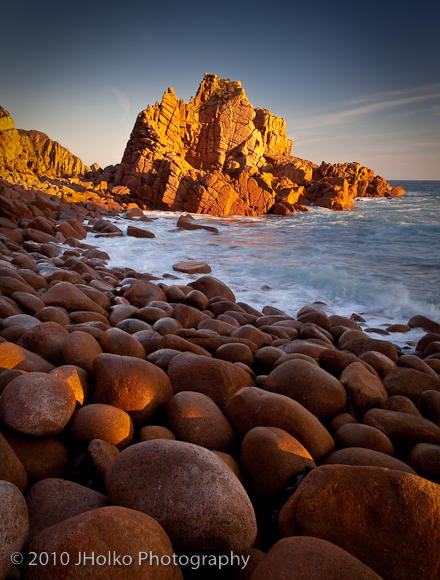
This photograph was one of only three compositions I shot in the four hours or so I spent down at the Blowhole and it is my favourite. I like the foreground rock; which reminds of a knife block and the curve of the rocky coast leading the eye through the frame. The milky, wispy ocean serves to help soften the harshness of the rocks and its deep marine colour adds dimension. Whilst I would have preferred dramatic storm lighting and some colour in the clouds I nevertheless feel that this photograph works on several different levels.

Knife Block Rock

Long Weekend Weather and a Lesson Learned

It has been overcast and raining on and off in Melbourne for the last couple of days. We had a good storm yesterday afternoon whilst I was out mountain biking at Lysterfield with hail the size of golf balls. For a short period I was forced to seek shelter under a tree with my pack over my head with some other riders to avoid the painful strikes (I have a few bruises today!). There were reports of smashed windows and damaged cars. Anyway, an interesting phenomenon happened after the hail and rain died down which I have only ever seen a few times before. Because the morning had been sunny and warm the ground had retained a lot of heat under the tree canopy; which meant that much of the rain and hail evaporated quickly. As a result an eerie fog rose up from the ground and hung low amongst the lichen covered gum trees and granite boulders. The combination of saturated lichen from the rain with hail on the ground and low fog was extremely unusual and photogenic. Unfortunately I was a long way from my car and camera and was unable to capture the scene (I did enjoy riding through it). I did make an attempt with the camera in my iphone but this was most definitely the fish that got away. I will make sure my small Canon S90 pocket camera is in my backpack on all future rides – lesson learned. More isolated rainstorms and  thunderstorms are forecast for late this afternoon so I am heading down to Cape Shank in the hopes of some good light.

New Zealand – Flax at Punakaiki

This photograph was taken only a few metres from the one below just after the sun had dipped below the horizon. Reflected light off the clouds and atmosphere illuminated the flax in the foreground with just enough soft diffuse light to capture this image with full detail in the foreground. I used a three stop soft graduated neutral density filter to hold back and darken the sky. This whole coastline is subject to quite a bit of weather and it is not uncommon to get really huge storm swells crashing into the rocks. Philip (my Guide) wrote to me after I returned to Melbourne to let me know that he had been back to photograph five metre waves crashing into the rocks only a week after my visit.  It was however extremely calm during my trip; so much so that the usual spouts from the blowholes at Pancake Rocks were still. Punakaiki is great location for landscape photography with many varied opportunities for composition and light and is a location I hope to return to sooner rather than later (late 2010).

Flax