Both May and June 2025 workshops to Grimsey Island, north of Iceland, to photograph the Atlantic Puffins and Razor Bills are already sold out – thank you. If you missed out and wanted to travel to Iceland to photograph these incredible birds, I am now taking expressions of interest for 2026 (no obligation at this point). Grimsey Island is one of the best places in the world to see and photograph the Atlantic Puffin. Nesting in burrows on the edge of Grimsey Islands’ dramatic sea cliffs, we have 24-hour access to photograph the Puffins under the spectacular midnight sun. Grimsey Island also offers amazing landscape opportunities of its plunging sea cliffs. Drop me an email to register your interest.
In late September 2023, I ran my Greenland East Coast Winters Cusp expedition to Scoresby Sund, the world’s most extensive (and spectacular) fjord system. This expedition was carefully timed for late September to ensure actual sunrise and sunset for optimal light. Journeys to this part of Greenland in June / July and August usually just result in overhead harsh light 24 hours a day, so the choice of time of travel is crucial for photographic expeditions to this part of the world. Proper darkness also provides opportunities for Aurora photography, something we took advantage of on several occasions. Scoresby Sund is, without a shadow of a doubt, the best place in the world to photograph monolithic icebergs, many of which can dwarf skyscrapers. The incredible sizes, shapes, textures and colours are a photographer’s dream, and the transient nature of icebergs makes each photograph unique – something exceptional these days in a world saturated with Instagram hot spot locations.
The map below shows the route we traversed for the duration of the expedition. Whilst we flew into Greenland (Constable Point) via private charter flight, we did return sail across the Denmark Strait (the stretch of water between Greenland and Iceland). Our return sail this year was a race against a furious oncoming storm (the Icelandic Coast Guard was reporting waves in our wake of more than ten metres). Mercifully, our race across the Denmark Strait saw us beat the storm, and we pulled into the safety of the big fjord in the north of Iceland in time to seek shelter.
This trip report is going to be a little different to the usual. Rather than write up my experiences, I will include the highly detailed PDF report that my expedition leader prepared day-by-day throughout our voyage (thanks, Jordy!). The report is split across two different PDF Files due to its size. Download Trip Report Part A HERE and Download Trip Report Part B HERE. Likewise, I am including one of the photographs below of Musk from my friend Marc, who assisted me with guiding me during the expedition. Both of the trip reports also contain a great many photographs taken by Jordy throughout the trip, as well as the history of many of the areas we visited.
I will be returning to the east coast of Greenland in September of 2024 to guide another expedition into this remote and spectacular region of Greenland. As of this writing, only a few places remain before the tour will be sold out. If you want to see and photograph incredible monolithic icebergs as they drift slowly and silently down the Scoresby Sund fjord system, then please drop me an email to register your interest. This is an incredible opportunity to explore one of planet Earth’s remaining unspoiled gems.
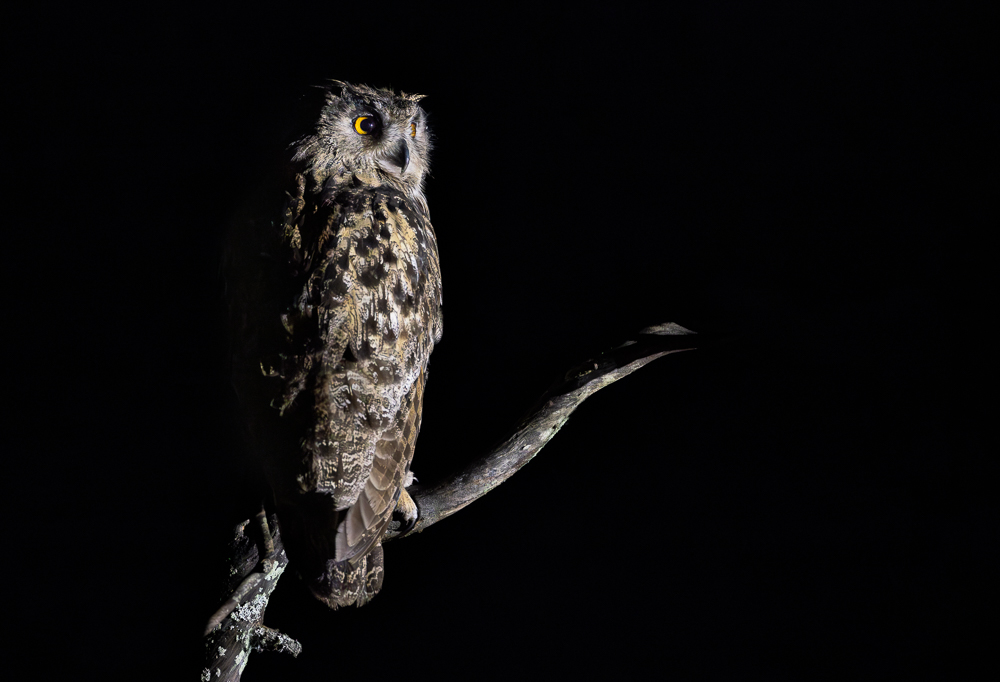
The photograph of the month for November 2023 comes from my recent Finland extension workshop (Read the Trip Report) and is of a European Pygmy Owl. This photograph was pure serendipity as I had gone into the evening hide to try and photograph an Eagle Owl (a nocturnal bird). Whilst darkness descended and I waited for a potential Eagle Owl sighting, this European Pygmy Owl flew down and landed briefly on a nearby branch. It only stayed a moment or two before it disappeared into the darkness of the night and forest, but it was an incredible few seconds and a fantastic sighting. It was so dark when I shot this that all I could see was a faint outline and silhouette of the owl on the branch. I could not tell what species it was, only that it was owl-shaped. This photograph of the Pygmy Owl would have been impossible just a generation of camera equipment ago. Shot at ISO12,800 at f4 at just 1/20th of a second, handheld with the Canon EOS R3 and Canon RF600mm F4L IS. The combination of the image stabilisation in the lens, working in conjunction with the IBIS in the EOS R3, enabled me to hold the camera and lens steady for a pin-sharp image, even at just 1/20th of a second. No flash or artificial lighting was used for this photograph. The EOS R3 locked focus on the eye of the bird in virtually total darkness – an incredible feat of technology. I also discussed the making of this photograph in Podcast Episode 83.
In late September 2023, I ran an extension for the participants in the Wild Wolves of the Taiga Forest workshop (Read the Trip Report) in northern Finland for golden eagles and eagle owls. Northern Finland is one of the best places to see and photograph these amazing birds reliably, and late September provides lovely colour in the boreal forest. Fortuitously, we had excellent photographic encounters with both species and many smaller bird species. We also had a miraculous encounter with a Eurasian Pygmy Owl.
For the duration of this extension, we were based near the small town of Muhos. We photographed exclusively from private hides dedicated to the Golden Eagle and Eagle Owl. A typical day saw us in the hides early after breakfast for the eagle and late into the evening for the Eagle Owl. As the Eagle Owl is most active at night, all of the photography of this unique bird is accomplished with pre-fixed lighting. Whilst this is a set-up scene, there is, of course, no guarantee that an owl will come to the planned location. Fortunately, we did not have to wait too long before the Eagle Owl put on a show for us.
Our first day in the hide for Golden Eagle saw us up well before sunrise and in the hide after an early breakfast before 7 a.m. During the day, we photographed multiple Sparrowhawks as well as many small species of birds, with the most common being the Eurasian Jay and Great Tit. We also had several sightings of Goshawk, but they did not land or provide photographic opportunities. The Sparrowhawks, in particular, provided an excellent aerobatic show throughout the morning, and many photographs were made of these fast-moving raptors.
On day two in the hide, a young male golden eagle briefly appeared at dusk just before we left the hide. Small birds were abundant throughout the day, although the sparrowhawks were strangely absent on day two.
On our third day, we headed to a different hide, hoping for encounters with the magnificent Eagle Owl. After an hour or so in the hide post-sunset, the Eagle Owl appeared and provided some fantastic opportunities throughout the half-hour, it stayed in the lit area.
On our fourth and final day, we returned to the eagle hide, hoping for more photographic encounters with this magnificent eagle. Late in the afternoon, as the sun began to get low in the sky the young male Golden Eagle returned and provided us some beautiful opportunities in golden light.
In addition to the Golden Eagle and Eagle Owl, we also photographed Eurasian and Siberian Jays’, many Tits, including the Great, Crested, Blue and Siberian, as well as the Great Spotted Woodpecker, Ravens, and a short but incredible encounter in the evening gloom at the Eagle Owl hide with a Eurasian Pygmy Owl. The pygmy owl was both a ‘lifer’ and a real thrill for me as this was the first time I had seen and photographed this species in the wild. Arriving just before complete darkness had descended, the owl landed on a small perch just metres away from my position in the hide. It stayed only a few moments before it disappeared silently into the night. Encounters such as this can never be planned and are pure serendipity.
This photograph of the Pygmy Owl would have been impossible just a generation of camera equipment ago. Shot at ISO12,800 at f4 at just 1/20th of a second, handheld with the Canon EOS R3 and Canon RF600mm F4L IS. The combination of the image stabilisation in the lens, working in conjunction with the IBIS in the EOS R3, enabled me to hold the camera and lens steady for a pin-sharp image, even at just 1/20th of a second. No flash or artificial lighting was used for this photograph. In near-total darkness, the Canon EOS R3 was able to find and lock focus on the eye of the owl – an incredible feat of modern technology.
The Golden Eagle and Eagle Owl extension proved a fantastic way to wrap up Finland in 2023. I will return to Finland in September 2025, for my Wild Wolves of the Taiga forest workshop. The workshop will run from the 15th to the 22nd of September, typically the peak time for Autumn colour in the Taiga forest at this latitude. On this workshop you can expect close encounters with Wolves, Bears and even Wolverine. Typically, on an average day, we will enter the hides in the early afternoon and return to our accommodation in the evening. We stay in nearby local cabins that are cozy and comfortable. For 2025, I will take just five photographers with several places already spoken for. If you would like to join or would like more information, please drop me an email to register your interest.
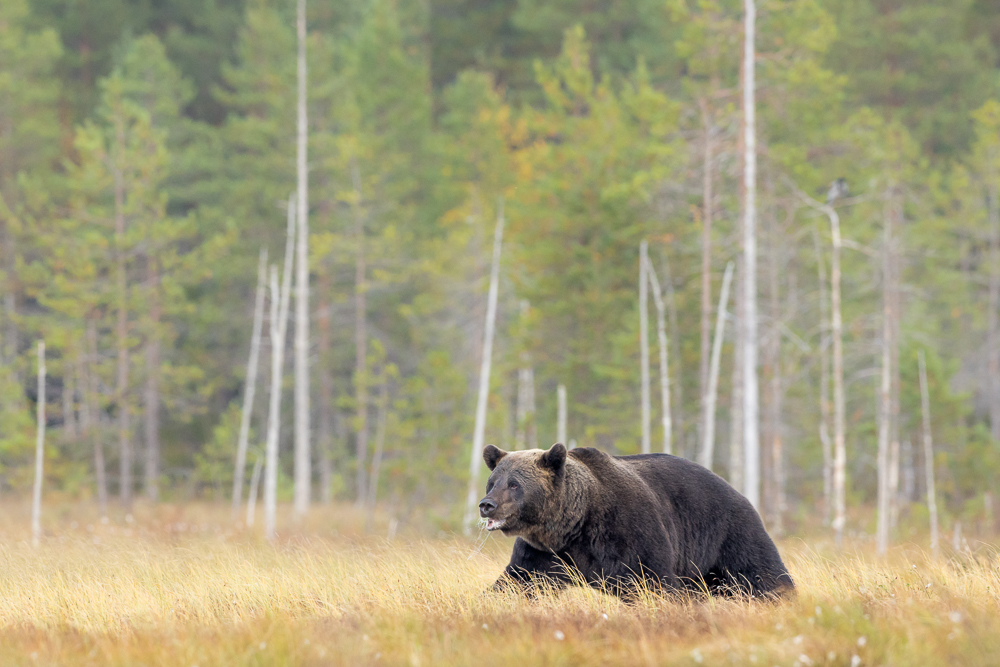
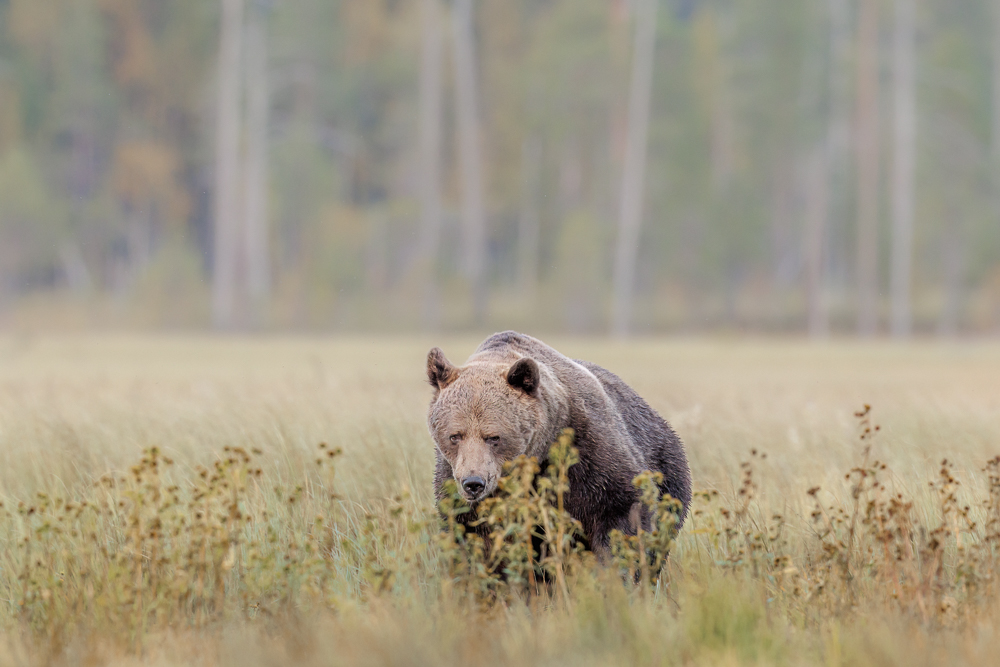
In September 2023, I led my semi-annual workshop in northern Finland to photograph the wild wolves, bears, and wolverines of the Taiga forest. Perhaps this year, I should have renamed the workshop Wild Bears of the Taiga forest, as the local brown bears put on a daily show for us during the week-long expedition. Wolves were thin on the ground this year, the result of an illegal shooting of the Alpha male and female that had grown up in this area and that I had photographed as pups several years ago (they are featured in my book Never Cry Wolf). The good news is my local operator has advised that the pack has now returned to the area and is being seen most days again.
Throughout this workshop, we photographed five different bears. Often, multiple bears were very close together, providing opportunities to photograph their interactions. This time of year, the bears are on an eating frenzy as they try to fatten up before the long winter hibernation.
From our hides, we photographed the bears at a range of as little as a metre to 800mm. I prefer longer lenses in this part of Finland because I can use telephoto compression to place the bears against the forest. Wide-angle can also work exceptionally well, however, when the bears approach close to the hides. Throughout this workshop, I personally shot several thousand images and am currently still editing and processing my favourites. As time permits, I will update this post with additional photographs.
Many of the hides have the option to shoot from a low-angle port for both ground and eye-level photography. My preference is always to try and shoot as low as possible, both to create a more intimate eye-level capture and to help clean up the foreground, which can often be muddy this time of the year.
During the 2023 workshop, we photographed almost exclusively at the ‘Paradise hides’, which are set up in front of a large open area inside the Taiga forest. Experience has shown me that this is the best location for clean backgrounds that provide a wonderful sense of environment. We also took the opportunity to photograph at the Lake hides, where we photographed two brown bears swimming in front of the hides. Some of us also took the opportunity to photograph the squirrels nearby to our accommodation.
I will be returning to northern Finland in the Autumn of 2025. The workshop will run from the 15th to the 22nd of September, typically the peak time for Autumn colour in the Taiga forest at this latitude. In this workshop, you can expect close encounters with Wolves, Bears and even Wolverine. Typically, on an average day, we will enter the hides in the early afternoon and return to our accommodation in the evening. We stay in nearby local cabins that are cozy and comfortable. For 2025, I will take just five photographers with several places already spoken for. If you want to photograph these fantastic animals, please drop me a note to register your interest.






 www.WILDNATUREPHOTOTRAVEL.com