Behind the Scenes Filming for the new BenQ SW272U Photographic Monitor

Earlier today, I completed filming with my good friend Tony Knight at his Melbourne studio for BenQ’s brand new flagship 27″ SW272U 4K Adobe RGB Photographic Monitor that is now available to pre-order from BenQ. The list of specifications is awe-inspiring, and this new flagship 4K monitor appears to tick all the boxes and be a game-winning home run for BenQ. Look for my unboxing and first impressions video in the next week.

BenQ SW272U

Fine-coated Panel with TUV-Certification
Certified with TUV Rheinland Reflection-Free Certifications, SW272U utilizes fine-coating anti-reflection panel to eliminate glare and reflection for simulated paper-texture visual experiences on screen under different types of ambient lighting to get perfect results.

The AQCOLOR Advantage

BenQ AQCOLOR technology delivers ‘Accurate Reproduction.’ This translates to the display of colour precisely as it is intended to appear. Led by a colour expert, the BenQ team took part in the ICC* and ISO** to establish colour-related standards and implementation guidelines. Covering 99% Adobe RGB, P3 and 100% sRGB colour spaces, with Delta E ≤ 1.5 and BenQ ICCsync, SW272U offers out-of-the-box and easy-to-reach colour accuracy. The 16-bit 3D lookup table (LUT) improves colour blending for precise reproduction.

BenQ Uniformity Technology

Create with confidence. Enjoy consistent colour accuracy and brightness consistency throughout each panel.

Calman Verified, Pantone Validated, and 3rd-Party Video Calibration Software Supported

BenQ PhotoVue monitors are accredited with Calman Verified, Pantone Validated and Pantone SkinTone Validated certifications. Creative professionals demand colour excellence, and BenQ delivers. Moreover, SW272U supports world-leading video calibration software, Calman and ColourSpace. Adjust your display’s 3D LUT (Lookup Table) for accuracy and consistency at all levels.

Palette Master Ultimate

Tune and maintain the color performance of your monitors with Palette Master Ultimate software and get the optimal colour consistency in 3 steps.

Realized Outputs As the Way You Intended

Whether you’re retouching photos in Adobe RGB or editing 4K videos in DCI-P3, SW272U’s wide colour coverage showcases your talent, letting your finished work look the way you intended.

Paper Color Sync

Paper Color Sync offers simulated images attuned to the colour settings, printer, and photo paper in use for easy and accurate photo preview before print.

GamutDuo Preview for Adobe RGB, sRGB, and more
Preview the same image in two color gamuts, side-by-side, for comparison in photo editing.

P3 Color Preview for Digital Outputs

Deliver accurate colours to videos with P3 colour space for your video projects.

Video Format Support

SW272U helps pros get the best video results with HDR support and multiple video formats.

Select SDI to HDMI Device Compatibility

BenQ has tested select SDI to HDMI devices as compatible with SW272U. Videographers can thus connect their SDI devices to the monitor for stable and non-compressed signal transmission and real quality video image.

HDR10 and HLG

Thanks to SDI to HDMI Device Compatibility, SW272U is also HDR10- and HLG-compatible, making it perfect to preview the HDR effect of video content during the editing process for best results.

Chroma Sampling Support or Video Format

Combined with the above video format compatibilities, SW272U supports 4:4:4, 4:2:2, and 4:2:0 sampling in determining monitor fidelity.

Expand Your Efficiency

Quick to transfer various data and deliver power.

Hotkey Puck G3

Cordless for unlimited convenience.

Convenient Design

Easy to access OSD, I/O port, and card reader efficiently.

Leatherette Base

Save the workspace for valuable items.

Pantone Connect Premium

Go digital with BenQ, the first brand to work with Pantone on a mobile app. As an existing owner or a new purchaser of BenQ professional monitors, you get one year of free Pantone Connect Premium for digitally mobile colour consistency and accuracy.

Shading Hood
The detachable shading hood effectively reduces screen glare from ambient lighting. Block external light for stellar colour accuracy.

CalMAN Certified
All BenQ PhotoVue monitors earn Calman Verified and Pantone Validated status. In close collaboration between BenQ and Portrait Displays, the Verified by CalMAN program ensures each display to be accurate out of the box and true to multiple industry-standard colour gamuts. The Verified by CalMAN mark is only given to the highest-grade of displays.

Pantone Certified
In 2019, BenQ announced that it’s SW series of monitors became the world’s first stand-alone displays to earn the Pantone Validated status, ensuring colour-matched inter-operability with a plethora of production-grade colour output devices qualified by Pantone. Pantone Validated provides designers and photographers confidence in the Pantone colours rendered on-screen throughout their creative process, to better align materials in Pantone colours or simulations using Pantone-licensed output solutions.

Rigorously evaluated and approved by Pantone colour experts, BenQ SW monitors offer integrated colour correction and BenQ-exclusive AQCOLOR technology to guarantee superior fidelity in colour accuracy, including tested quality in achieving Pantone Matching System (PMS) colours. In use by virtually every colour-critical industry and manufacturer worldwide, the PMS system is a universal language of colour that allows creative professionals to specify and match specific colours, regardless of the equipment and materials used to produce the exact colour.

You can read more information on BenQ becoming Pantone Verified here.

World’s First Pantone SkinTone Validated Certification

As of 2022, the BenQ SW series became the world’s first stand-alone displays to achieve Pantone SkinTone Validated certification. Pantone SkinTone Validated supports the Pantone SkinTone guide, the first of it’s kind for matching and reproducing a wide range of human skin tones that accurately reflects the diversity of our multicultural society.

Full specifications avaialble on BenQ’s website.
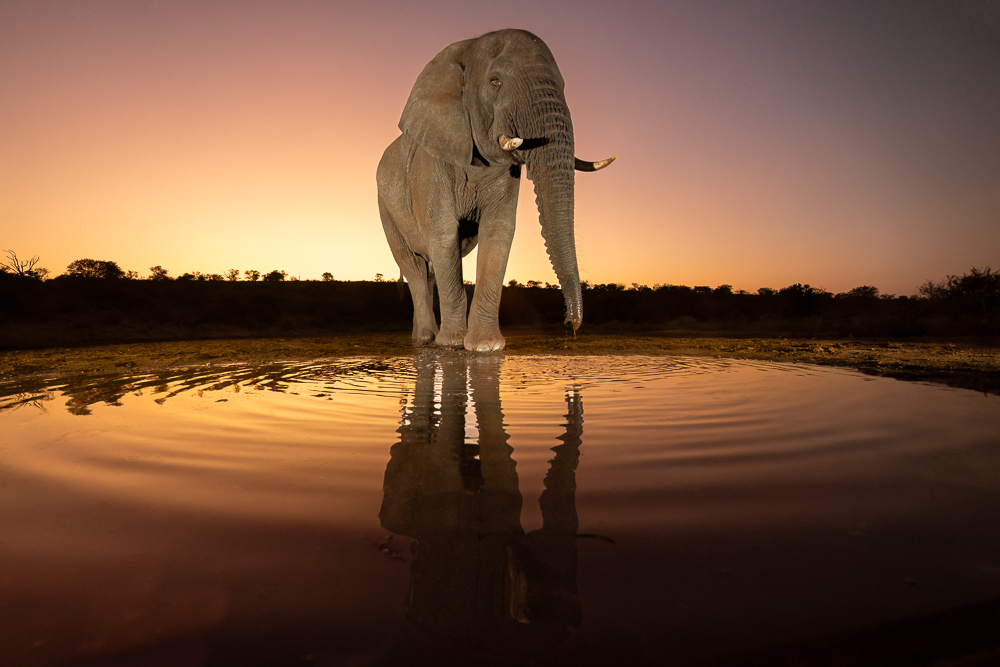
Photograph of the Month July 2023 – Elephant in the African Dawn

The photograph of the month for July 2023 comes from my recent ground-level wildlife masterclass in Zululand, South Africa (read the trip report) and is of a large bull Elephant that came to drink at one of the watering holes on first light. The photograph was taken from one of the game reserves’ state-of-the-art overnight hides with a 14-35mm f4L IS Lens at 14mm. I had set up the camera on a tripod, ready to go in the eventuality an animal would come to drink. After sitting in the hide all night, having such a wonderful opportunity was manna from heaven. Photographs such as this are often pure serendipity. Outside of having the technical proficiency to capture such rare opportunities, it sometimes comes down to a little luck with the wildlife arriving on the scene at just the right time. In this case, the night in the hide had been quiet, with no activity and no animals coming to drink at the watering hole (a test of patience). Then, on first light, this large male Elephant walked out of the trees to sake its thirst. The Elephant stayed in what was the best light of the day for maybe a minute before it wandered back into the bush. During the minute the Elephant came to drink, I don’t think I drew more than a breath or two, my heart racing, recognising the unique and special opportunity I was being provided. Best of all, I could share it with the others in the hide.

WNPP Episode #77 Lens Protection Systems Reviewed and Compared

I have just published episode #77 of my Wild Nature Photography Podcast. In this podcast episode, I compare and review two very different solutions by two competing companies to protect expensive telephoto lenses when out in the field – Lens Coat and AlphaGVRD. Lens Coat offers its traditional neoprene cover solution, and AlphaGVRD provides a more contemporary 3M Wrap. Which is best and why? Listen in for my thoughts and impressions on fitment, durability, ease of use, investment price and ultimately, my thoughts and impressions on which is best and why.

Birds of Barrow Alaska Scouting Trip Report June 2023

In June of 2023, I ran a private scouting trip for Arctic birds to the far northern slope of Alaska. For the duration of this scouting trip, we (the two of us) were based in the small Inuit town of Barrow and made nightly excursions via a 4-wheel drive vehicle to the surrounding Arctic tundra in search of birds to photograph. Barrow is far enough North that by June, it is illuminated by the midnight sun, and it is possible to photograph twenty-four hours a day. Working at night provides much softer light than traditional daylight hours, often further softened by sea fog rolling off the nearby pack ice. For the ten days we were in Barrow, we stayed in the King Eider Inn, which is basic but functional and conveniently located about a hundred metres from the airport.

Why Barrow for birds? Barrow, Alaska, is home to many highly sought specialty bird species for both bird watchers and wildlife photographers. It is the best place in North America to photograph many high arctic nesting birds. There are few places in North America where one could expect to see all four species of eiders (Common, King, Spectacled and Stellar), all three species of Jaeger (Pomaraine, Long Tailed and Arctic) or three species of loons (Red-Throated, Pacific and Yellow-billed) without tallying a Common Loon. In Barrow, you have a good chance of doing all three! We came very close to this goal ourselves! During this scouting trip, we saw and photographed all of the above, with the exception of the Yellow-billed loon and the Common Eider. We also saw and photographed approximately a dozen Snowy Owls (although none of them allowed us to approach close enough for anything more than distant record shots).


In addition to the above specialty species, Barrow is home to a wide array of nesting shorebirds, many of which exhibit fascinating breeding displays. If that were not enough, throw in the possibility of photographing Sabine’s Gulls and magnificent Snowy Owls, and it makes for a pretty engaging proposition for any birder or wildlife photographer. Despite the challenges of photographing in relatively harsh conditions, you will likely encounter many opportunities in this land of the midnight sun. Those opportunities are not necessarily easy, but they do exist.

Barrow is the largest city in the North Slope Borough, home to roughly 4000 people. Like many native communities, the town of Barrow is dry; no alcoholic beverages can be sold or brought into Barrow. The village of Barrow is perhaps most accurately described as a living garbage dump (sorry – but it’s true). It is a depressing place of broken down decrepit houses set amidst almost endless squalor of abandoned rusting vehicles. There are no pretty words to describe this town, and it, unfortunately, epitomises my experience in many native towns worldwide. Without overstating the squalid nature of Barrow, it is perhaps sufficient to say that it is a sad inditement of Western society.

All of that said, most photographers visiting Barrow will not be there for cultural sightseeing but rather to photograph many of the Arctic birds that transit through the surrounding Arctic tundra. The most notable species diversity occurs during the brief arctic summer that begins in early June; hence this scouting trip took place from the 6th until the 16th of June. Most birds generally arrive during the first week of June, with snow melting and tundra ponds thawing. We found our first couple of days to offer the best opportunities for Eiders, which mysteriously vanished in the following days. We saw and photographed the Stellars, King, and Spectacled Eiders in our first two days, after which we only encountered Kings and the occasional Spectacled Eider. If you were in Barrow in 2023 to photograph Eiders and you were not there on the 6th, 7th or 8th of June, you certainly missed the best opportunities.

During this scouting trip, we experienced temperatures that fluctuated between zero Celsius and approximately +10º degrees Celsius. We had some wind in our first few days that, thankfully, died away to still calm, rain-free evenings (except for our last evening when it absolutely poured).

Personally, I found the experience of photographing birds around Barrow to be extraordinarily challenging and frequently quite frustrating. With the exception of the many Phalaropes and Golden Plovers, the Eider and Loon species are extremely shy and difficult to approach if you want to make anything more than a record photograph. I chose to photograph with a 600mm F4 lens and a 1.4 Teleconverter for a total focal length of 840mm, which frequently proved inadequate for anything more than distant record shots. I discussed this problem extensively in Podcast number #76, Thoughts and Impressions of Barrow, Alaska. If you are planning a future trip to Barrow, I encourage you to listen to this episode.

Typically, and in my experience, most Eiders, Loons and Owls will swim and fly away before you can get close enough to make anything more than a distant record photograph. This situation occurred repeatedly, despite extremely slow and careful approaches. The birds often moved away from us before we exited the vehicle. I had to work extremely hard to get close enough for all of the photographs in this report. As I discussed in the above podcast, it is less than ideal to employ hides in Barrow due to the low density of birds. Not to belabour the point, but if you plan a trip to Barrow to photograph birds, I encourage you to temper your expectations accordingly. If you are just going to spot and watch birds, then I believe it will be just fine.

Although I enjoyed my time in Barrow photographing many Arctic birds, I will not be planning or running a future workshop at this location. The birds’ low density and shy nature make for challenging photography when working solo. Trying to work in a group of even four or five will significantly compound the problem and result in far too few opportunities for all participants. If you are only interested in sightings and record shots, then Barrow might be just your cup of tea, but it is highly challenging and frequently problematic for those looking to do more than make record shots.

Addendum – I will continue to update this post with more photographs as I get time to process them.

Canberra Photo Connect Wildlife Presentation August 2023 Pre-Register Now

In August of this year, I will present to the Canberra Photo Connect Association via Zoom. The presentation will focus on ‘Improving Your Wildlife Photography’ and will be free and open to all who pre-register for the event (You do not need to be a member of Canberra Photo Connect). The presentation will be held on August 19th and will include many examples of wildlife photography from around the world as well as details on my approach and philosophy on both wildlife photography in the field, as well as post-production of RAW images in the studio. To register for your place, please contact Canberra Photo Connect via email. Places for the presentation are limited.