Finland Wild Wolves of the Taiga Forest Workshop Report 2023

In September 2023, I led my semi-annual workshop in northern Finland to photograph the wild wolves, bears, and wolverines of the Taiga forest. Perhaps this year, I should have renamed the workshop Wild Bears of the Taiga forest, as the local brown bears put on a daily show for us during the week-long expedition. Wolves were thin on the ground this year, the result of an illegal shooting of the Alpha male and female that had grown up in this area and that I had photographed as pups several years ago (they are featured in my book Never Cry Wolf). The good news is my local operator has advised that the pack has now returned to the area and is being seen most days again.

Throughout this workshop, we photographed five different bears. Often, multiple bears were very close together, providing opportunities to photograph their interactions. This time of year, the bears are on an eating frenzy as they try to fatten up before the long winter hibernation.
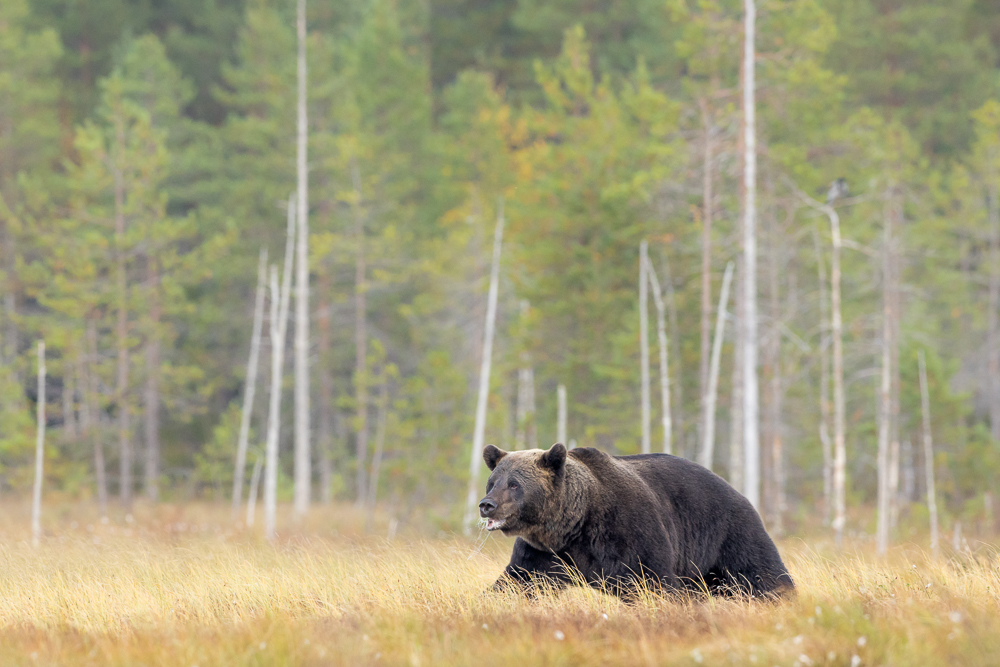
From our hides, we photographed the bears at a range of as little as a metre to 800mm. I prefer longer lenses in this part of Finland because I can use telephoto compression to place the bears against the forest. Wide-angle can also work exceptionally well, however, when the bears approach close to the hides. Throughout this workshop, I personally shot several thousand images and am currently still editing and processing my favourites. As time permits, I will update this post with additional photographs.
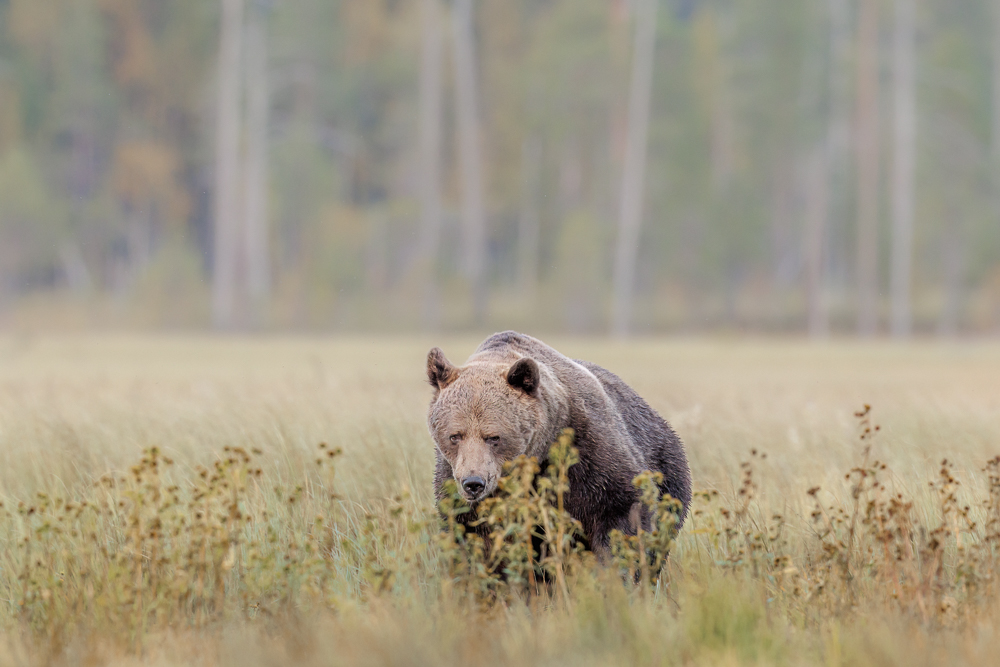
Many of the hides have the option to shoot from a low-angle port for both ground and eye-level photography. My preference is always to try and shoot as low as possible, both to create a more intimate eye-level capture and to help clean up the foreground, which can often be muddy this time of the year.

During the 2023 workshop, we photographed almost exclusively at the ‘Paradise hides’, which are set up in front of a large open area inside the Taiga forest. Experience has shown me that this is the best location for clean backgrounds that provide a wonderful sense of environment. We also took the opportunity to photograph at the Lake hides, where we photographed two brown bears swimming in front of the hides. Some of us also took the opportunity to photograph the squirrels nearby to our accommodation.

I will be returning to northern Finland in the Autumn of 2025. The workshop will run from the 15th to the 22nd of September, typically the peak time for Autumn colour in the Taiga forest at this latitude. In this workshop, you can expect close encounters with Wolves, Bears and even Wolverine. Typically, on an average day, we will enter the hides in the early afternoon and return to our accommodation in the evening. We stay in nearby local cabins that are cozy and comfortable. For 2025, I will take just five photographers with several places already spoken for. If you want to photograph these fantastic animals, please drop me a note to register your interest.

WNPP Episode #83 When Serendipity Meets Technology

I have just published episode #83 of my Wild Nature Photography Podcast. In this long overdue episode (apologies for the significant delay), I give my thoughts on two new Canon Lenses, the RF 10-20mm and the yet-to-be-officially-announced 200-800mm telephoto lens (look for the official announcement of this lens in the next few days). I also briefly discuss the new HDR feature in the latest version of Adobe Lightroom and the excellent new Point Colour / HSL local adjustment capability that is now available inside the individual masking tools in Lightroom. I also give my initial impressions of the 8th edition of the Bird Photographer of the Year annual book (includes three of my commended photographs) and Scott Portelli’s new Antarctica book (reviews of both will be coming in future podcast episodes). Additionally, I provide details of my upcoming webinar for BenQ on post-production. This webinar will be held on the 8th of November and is free (you just need to register). I also discuss the main topic of this episode: what happens when serendipity meets technology and my experience photographing the European Pygmy Owl in near total darkness in northern Finland with the Canon EOS R3 and Canon RF600mm f4L IS USM lens. By way of preview, the European Pygmy Owl will be the November photograph of the month for 2023.

BenQ Webinar RAW Workflow for Optimal Results

On Wednesday, November 8th, 2023, at 6pm AEST, I will present another webinar for BenQ – RAW Processing for Optimal Results. This will be a deep dive into the Lightroom / Camera RAW pipeline and will include a look ‘under the hood’ for many of the control sliders to help get a better understanding of what is really going on and how and when to use different adjustments for optimal results. The webinar is free to attend, but you do need to register HERE for the event.

Bird Photographer of the Year 2023 Commended Photographs

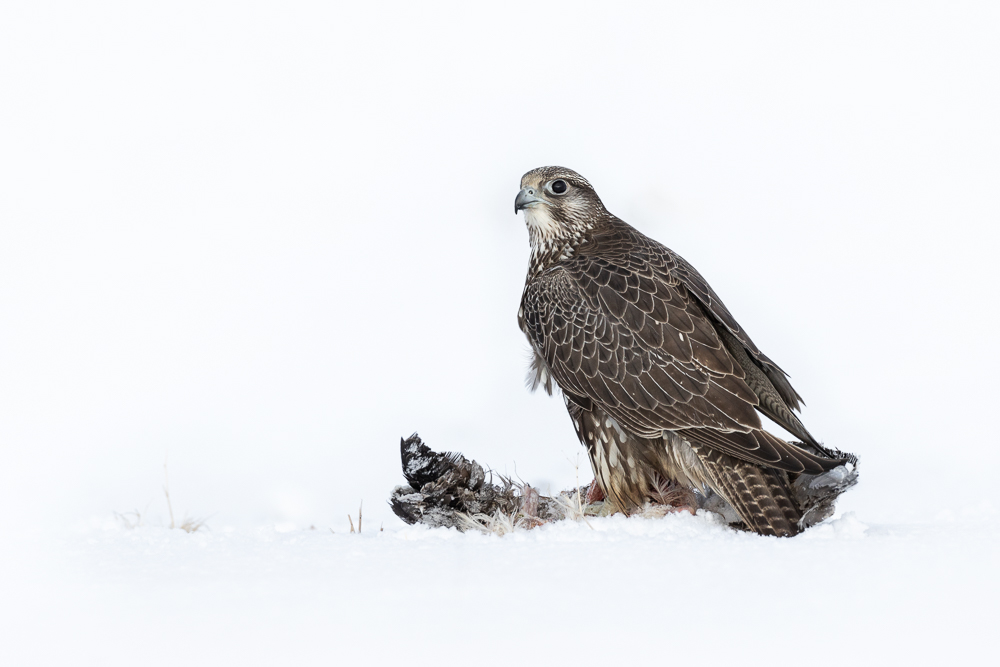
The 2023 8th annual edition of the Bird Photographer of the Yearbook has landed on my desk in Australia. This was the first time I entered Bird Photographer of the Year, and as I wrote on receipt of the news, I am thrilled to have had three images selected for inclusion in the annual book. Of the thousands of entries in the competition, fewer than three hundred (or less than 1%) are selected for inclusion in the book. Having three photographs chosen from the few I entered is lovely news, and I could not be happier with the result. The Gyr Falcon photograph was commended in the Bird Behaviour category, the Kittiwakes in front of the glacier in Svalbard was also commended in the Birds in the Environment category, and lastly, the Adelie was commended in the Comedy Bird category. You can order the Bird Photographer of the Year Book 8 online at the BPOTY website (www.birdpoty.com). The BPOTY books are fantastic references and an absolute must-have for any bird enthusiast or photographer interested in birds. I also reviewed the previous editions of Bird Photographer of the Year in Podcast number 57 – available HERE. I will review the 2023 edition in an upcoming podcast. Congratulations to all those included in the book, and I look forward to entering again in 2024!

Adobe Lightroom HDR / XDR Explained Plus Point Color! October 2023

October 2023: Adobe has released a significant new update for Lightroom that facilitates taking advantage of displays capable of HDR (High Dynamic Range). HDR displays such as Apple’s XDR (Expanded Dynamic Range) are required to take advantage of this new feature. If you do not have a HDR / XDR display you can effectively ignore this update since you cannot process images accurately into this expanded dynamic range space without a display capable of this technology. This new feature is bound to cause significant confusion in the marketplace as the terminology HDR is very likely to be confused with the traditional HDR approach of stacking images for an expanded dynamic range. However, this new feature is totally new and not related to the traditional HDR approach of stacking images. To further add to the confusion, Apple has called their display technology ‘XDR’ to further muddy the waters. Whilst the manufacturers and software companies play with different terminology for the same technology, there will be significant confusion in the marketplace. So what is this new HDR / XDR technology in Lightroom?

Friend and fellow photographer Eric Chan (engineer and architect at Adobe) has posted a very informative blog explaining the new technology and how and when you can take advantage of it. Just keep in mind that you need an XDR or HDR display to take advantage of this capability and that virtually all of the people who may view your HDR work online will NOT be able to see the expanded dynamic range. And, of course, it goes without saying that no printer can print it (HDR/XDR) either. Eric’s article goes point-by-point and explains how this new technology works and how you can take advantage of it. I highly recommend taking some time out of your day to read his article. Read Erics’ Article HERE.

How does this new technology fit into your workflow? The answer depends on your output and what you plan to do with your photographs. If you print your photographs, you can ignore this new feature since no printer can print photographs processed in HDR/XDR and display the full dynamic range on paper. The printer will simply print in its own SDR space since it is not possible to print whiter than than the white of the paper. If you are processing images to view on your own HDR / XDR display, then you can of course take advantage of this new technology. If you are outputting images to the web then it will depend on thew viewers’ display as to what they see at their end. So now, instead of just worrying our what color space the viewer is using we also need to worry about wether they are using a HDR / XDR display. I suspect we may see photographers start to build websites that ask the viewer to make a selection about their display – are you using a SDR or HDR/XDR display? All of this makes it an interesting (and somewhat confusing) time to be a photographer!

Also of significant importance (and quite honestly a much bigger deal to me personally), Adobe has added HSL capability to local adjustments via a new tool called ‘Point Color’. This is a huge upgrade and something I have been asking for since the new masking tools were released. Thank you Eric and Adobe!