These are some of my personal favourite photographs from throughout each calendar year – one for each month. Higher-resolution versions of these photographs can be seen on my portfolio website at www.jholko.com. None of my photographs are HDR (High Dynamic Range) or composite images. All photographs are captured from single exposures in the field. The majority of my photographs are processed in Adobe Lightroom.
I sell Limited Edition Fine Art Prints and license images for different purposes. I have different rates for licensing depending on individual requirements. Please Contact my Gallery Representatives or Me if you are interested in purchasing a Fine Art Print or licensing any of my photography.
DECEMBER 2024 – EMPEROR PENGUINS
The photograph of the month for December 2024 (and the last for the 2024 year!) comes from my recent expedition to the world’s most southerly Emperor Penguin colony at Gould Bay in the Weddell Sea region of Antarctica (Trip report coming soon). This was from what I felt was our best day on the sea ice with soft overcast light conditions and gently falling snow. In these conditions, it isn’t hard to make good photographs when you have such stunning subjects in front of you. In this instance, it was just about waiting for the tender moment when the adult bent down to better shelter its small chick; which was huddling close for warmth.

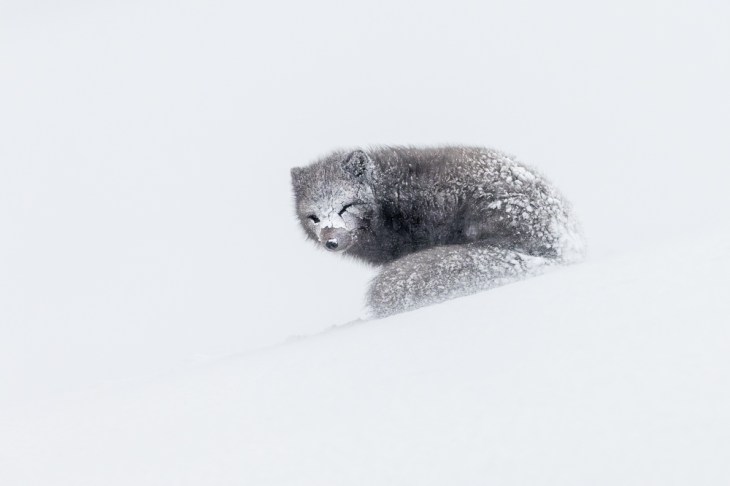
NOVEMBER 2024 – ARCTIC FOX IN FLYING SNOW
Without a doubt, my favourite conditions for photographing the Arctic Fox are winter blizzard conditions. The flying snow creates a white-out that cleans up any background mess, and the flying snow sticks to the fox’s coat and gives extraordinary context and much-needed drama. These conditions define the environment of the Arctic fox and paint the perfect canvas on which to photograph this amazing opportunist. Contrary to appearances, these conditions are far easier to photograph in than they appear. With modern auto focus in mirrorless equipment, the cameras have no problem finding and tracking the eye of the Arctic Fox in these conditions. In past years, I would often stop down the lens to ensure adequate depth of field if focus missed slightly. Now, with eye-auto focus, I can open up the lens and shoot wide open, as in this case – f4 at 600mm. Why shoot wide open? A wide-open aperture helps soften the surrounding snow’s slope, creating a contained picture inside the 35mm frame. This technique can be used to great effect to help keep the viewer’s eye both inside the frame and on subject.
OCTOBER 2024 – GREENLAND SOFT PASTEL LIGHT ICEBERGS
The photograph of the month for October 2024 comes from my just completed East Greenland Scoresby Sund expedition (trip report coming soon). Photographed from the deck of our expedition schooner, the Rembrandt Van Rijn, this image directly resulted from positioning the boat in the best location at the best time. It’s a great example of the key difference between a dedicated photographic expedition and a general tourist trip. With time on our side and a team of participants all dedicated to making great images, I decided to simply stay with these two icebergs and wait for the best light of the day. This soft pastel light post-sunset is a wonderful example of what makes Greenland alluring to photographers. These types of photographic opportunities are abundant in Greenland and easily made from the deck of a suitable expedition-class vessel. In this instance, I used a 24-105mm F4 RF lens at F5.6 ISO800 hand-held. As we slowly circled the icebergs (numerous times!) I made many different photographs from different angles so that I could choose my preferred angle in post-production.

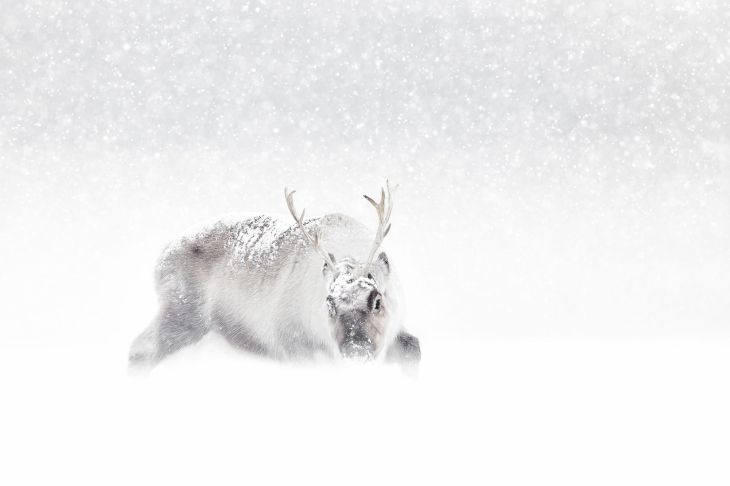
SEPTEMBER 2024 – RAGING BULL
The photograph of the month for September 2024 comes from a private expedition to Svalbard in Winter and is of a Reindeer in heavy snowfall just outside of Longyearbyen. This photograph is all about the gesture of the Reindeer, the limited colour palette and of course the drama of the falling snow. It is a very simple photograph in many ways, with a minimalistic approach that captures the movement of the Reindeer in an evocative and dramatic manner. Capturing the right gesture of wildlife is really key to powerful imagery. In this case, I lay down in the snow with a long lens and waited for the Reindder to lift its head from grazing under the snow. I was fortunate that as it did so, it also raised it’s from leg and twisted its body in exactly the same manner as the Bull on the Lamborghini emblem – hence, Raging Bull.
AUGUST 2024 – LION AT NIGHT
This photograph was made on my Zululand South Africa workshop (Read the Trip Report) earlier this year and is of a male lion at night. This photograph was made with a single spotlight on the lion as it walked up the road toward our vehicle, and it’s a great example of how a single light source can illuminate a subject and isolate it against the background. I will return to South Africa next year to lead another ground-level wildlife masterclass to this fantastic location. It is one of the very few places in Africa where you can actually get out of the vehicle and walk with Cheetahs (not lions!) and photograph from eye level with specially modified safari vehicles. This photograph was made using one of the specially modified safari vehicles that facilitates a much more intimate connection with the wildlife.

JULY 2024 – CHEETAH BROTHERS
The photograph of the month for July 2024 comes from my recent Zululand South Africa masterclass workshop (Read the Trip Report) and is of two Cheetah brothers playing at sunset. This was an extremely fortunate situation whereby we came across the Cheetahs in an open area of the game reserve right at sunset. I had the luxury of choice of how to shoot this scene and could have chosen to side-light it or even to take it front-lit. However, it was immediately clear to me that the backlight would provide the most dramatic image. The key to this sort of image is to always expose the brightest part of the frame (the sun) and to let the shadows fall where they may. In this exposure, the shadows were quite dark, and I opened them just slightly in post-production to give just a hint of the Cheetah’s spots. Of course, the moment is dramatic, with both Cheetahs off the ground. A fast shutter speed ensured both cats were sharp, and I stopped the 400mm f2.8L lens down to f6.3 to ensure I had sufficient depth of field to keep both cats sharp. The low angle of view was achieved by lying down in the grass – one of the key benefits to this particular location.

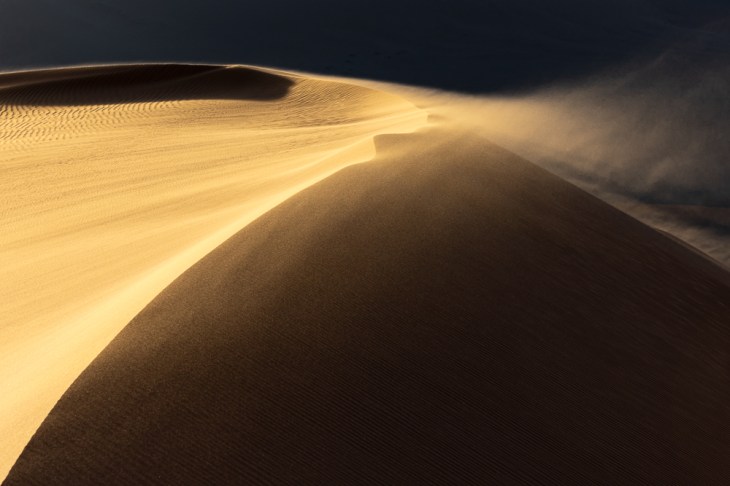
JUNE -2024 – DESERT FIRE
The photograph of the month for June 2024 comes from my recent Namibia Masterclass workshop (Trip Report coming very soon) and is of the Namib dune sea at sunset. This particular part of the Namib desert is one of my favourite locations. This an area I have been returning to on each visit, and it always offers a fantastic play of light, shadow and sand. Interestingly, I have never seen anyone else in this area – even though it is relatively easily accessed and is only a short walk off the main tourist road into Deadvlei. The photograph plays on shadow and light and uses geometric form as its subject. The interplay of shadow and light and the drama of the flying sand is what makes this such a strong photograph for me. I will return to Namibia again in 2026 – full details will be posted soon.
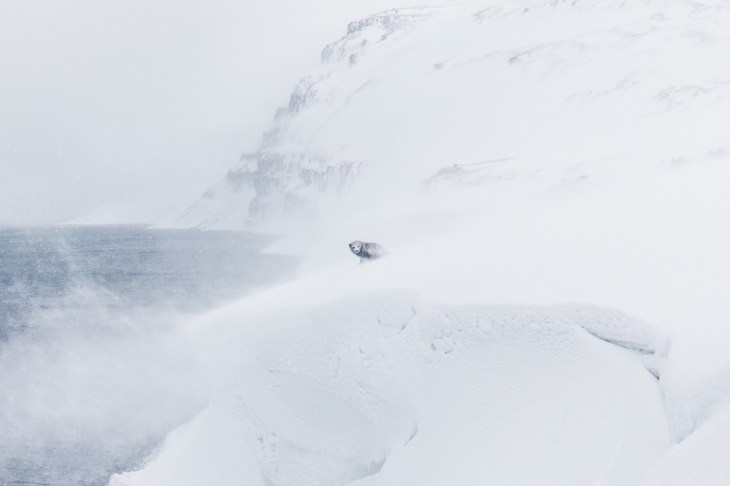
MAY 2024 – ARCTIC FOX IN BLIZZARD
The photograph of the month for May 2024 comes from my February workshop for Arctic Foxes in the far north of Iceland (Read the Trip Report). This photograph is my favourite from the trip as it speaks to me emotionally on many different levels. The environment is dramatic with the blizzard, reduced visibility and flying snow. We get a real sense of a winter storm and the brutal reality of the Arctic winter. We have the mountains and ocean for context and a wonderful foreground of steep snow bank. The Arctic fox is small in the frame, making it appear fragile and alone in the huge Arctic expanse. Additionally, we have the perfect pose of the fox, looking into the camera, dusted with snow, as it watches over the entrance to the fjord on a huge, steep and dramatic snow bank. This sort of ‘animal in the environment’ photograph is often far more evocative and tells a much more profound story than a close-up portrait. Shot with the Canon EOS R3 and the Canon RF 70-200mm f2.8L IS, this photograph is also a great example of when you don’t need a super expensive huge telephoto lens to make a fantastic wildlife photograph.
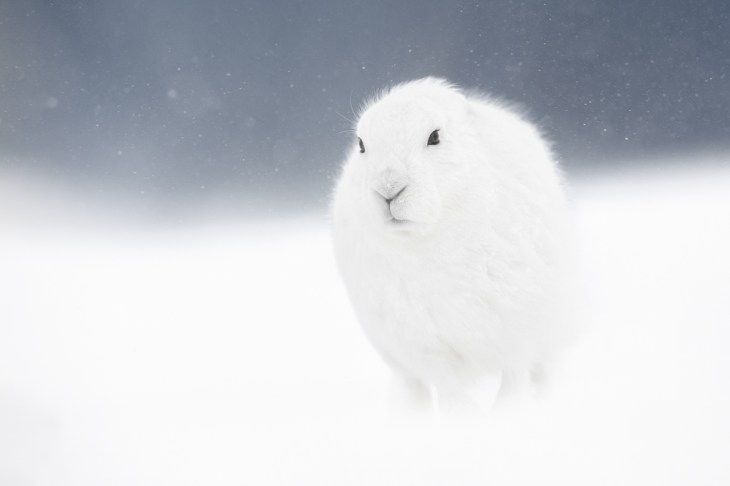
APRIL 2024 – SNOW HARE
The photograph of the month for April 2024 comes from my recent winter expedition to the east coast of Greenland (full trip report coming soon). It shows an Arctic Snow Hare in full gallop during a howling -40º C blizzard behind the small Inuit village of Ittortoqitormit on the East coast of Greenland. I photographed it with the Canon EOS R3, and the Canon RF 600mm f4L IS lens. The real challenge of this photograph (other than avoiding frostbite) was keeping the fast-moving subject in the frame as it galloped at high speed through the snow. The blizzard wind was incredibly strong, making hand-holding the lens impossible. To counter this, I lay down in the snow, using the snow cover as a makeshift tripod, cranked up the ISO to 1600 and opened up the f-stop to f6.3. This close to the subject meant the depth of field would be extremely narrow, making focus critical. Anything less than perfect focus on the eye would result in zero keepers. Incredibly, the Canon EOS R3 could track and nail focus on the eye of the fast-moving Snow Hare despite the howling wind and flying snow. Focus Case 2 was used to ignore the whirling snow around the hare. The blue background is not the sky (which could not be seen in the white-out conditions), but the wooden wall of one of the small painted houses in the village. This is an excellent example of how depth of field control can be carefully employed to control backgrounds and enhance a photograph. Without the blue background, there would be almost no contrast between the Snow Hare and the background.
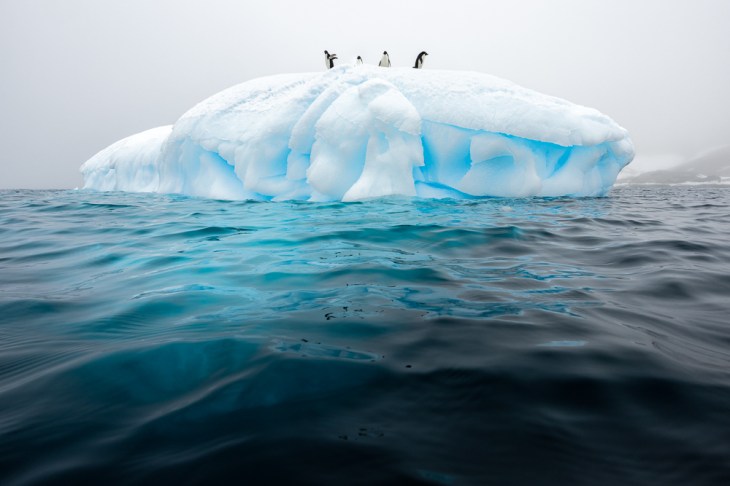
MARCH 2024 – RIDING THE ICEBERG
The photograph of the month for March 2024 comes from my recent December 2023 expedition to the Antarctic Peninsula (Read the Trip Report) and is of Adelie penguins riding an Iceberg. Photographed on our very last full day in Antarctica, this image was made by holding the camera with a wide angle 14-35mm lens over the side of the zodiac, just a few centimetres above the water line. The key to making this approach work is the focal point and the choice of f-stop to ensure sufficient depth of field. You really need to focus one-third into the frame and ensure you have stopped down enough to have the image sharp front to back. In this situation, I manually selected the focus point I wanted to ensure the depth of field was correct. The Auto focus would otherwise lock the penguins or iceberg, leaving the foreground too soft for my tastes.
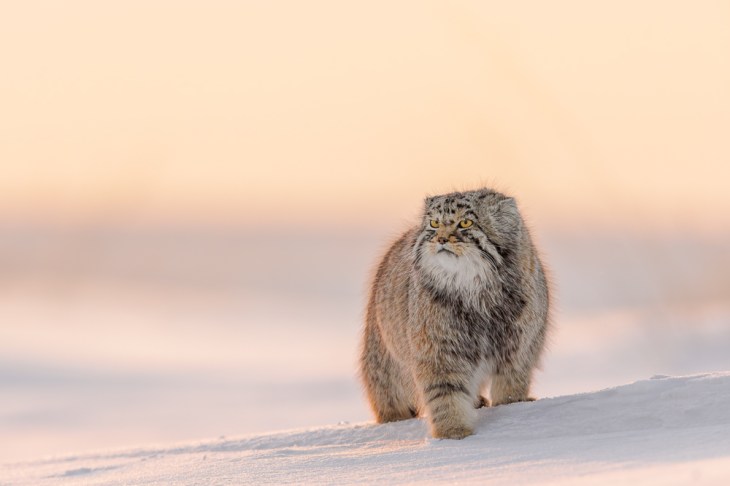
FEBRUARY 2024 – REGAL CAT
The photograph of the month for February 2024 comes from my recent expedition to the Steppe region of Mongolia (Read the Trip Report) to find and photograph the enigmatic Pallas Cat. Taken right at sunset, the stance and demeanour of this Pallas Cat (Manul) ‘make’ the photograph. Composed with the cat to the right-hand side of the frame and looking into the image to minimise the negative space, the soft evening light that paints the snow is the icing on the cake for what is one of my favourite images of this wonderful cat.
JANUARY 2024 – RIDE THE STORM
The first photograph of the month for 2024 (January) comes from my recent 2023 Antarctica Return to the White Continent Expedition (Read the Trip Report) and is of a group of Adelie Penguins riding a beautiful iceberg under heavy, overcast skies in the Weddell Sea region of Antarctica. What makes this photograph so evocative is the combination of the soft, heavy clouds, still dark waters and luminesce ice under the water. Of course, the penguins provide the much-needed sense of scale. These sorts of opportunities are the stuff dreams are made of on any Antarctic expedition. Photographed from Zodiac, the illusion of height was created by standing up on the bow box of the Zodiac and using an ultra-wide-angle zoom lens (RF 14-35mm F4L IS) at 14mm held up high over my head. This perspective enhances the glow of the ice under the water and adds a lot of depth to the photograph. This is a technique I have used extensively when photographing icebergs.

 www.WILDNATUREPHOTOTRAVEL.com