Our all new Best of Antarctica by Air expedition in January 2027 is already sold out – thank you. This bespoke fly-in, fly-out expedition (No Drake Passage!) to Antarctica is for dedicated and passionate Nature photographers who want to capture evocative and powerful photographs of Antarctica and its incredible wildlife. We have an extremely small group size of just ten people, a full fourteen days in Antarctica, and personal, one-on-one tuition for the duration of the expedition. Perhaps best of all for those prone to seasickness; we avoid the Drake Passage! As this expedition sold out so quickly, we are currently looking into the viability of a second trip if we can secure our preferred additional dates and vessel and will update both here on our blog and and our website in due course. If you are keen to photograph the majesty of Antarctica with the most experienced polar photography guides on earth please get in touch with us.
Why Travel to Antarctica with us? We have been leading and guiding expeditions to Antarctica for more than fifteen years and have an intimate knowledge and experience of the best places to visit at the best times – when the weather and conditions are right. Our experience ensures you are in the right place at the right time – when conditions and light come together – to give you unequalled opportunities. No two expeditions to Antarctica are ever the same and the choice of photography guide and leader is often the difference between a mediocre experience and an incredible one.
What our clients say about our Expeditions: “If you can only go to Antarctica once in your life you owe it to yourself to go with Joshua Holko and his team Wild Nature Photo Travel. Having done five different expeditions myself to Antarctica no one else has even come close to offering the same experience or photographic opportunities. Joshua will go the extra mile every time, putting zodiacs in the water for opportunities other leaders would missand making sure everyone is getting the best possible photographs. I cannot recommend his expeditions more highly. Go with the expert.”Dan.
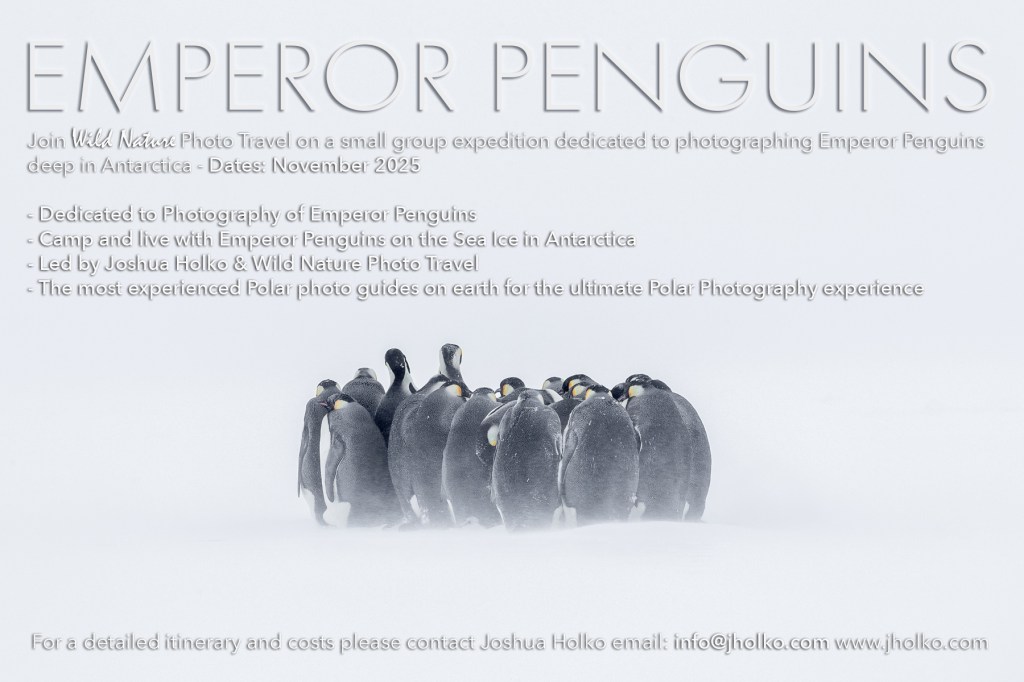
In late November / early December 2024, I ran my semi-annual wildlife expedition to the world’s most southerly Emperor Penguin colony at Gould Bay, deep in the Weddell Sea region of Antarctica. For this expedition, we flew from Punta Arenas at the bottom of Chile on a privately chartered Iceland Air 757 to the naturally occurring blue ice runway at Union Glacier in Antarctica. From this point, we overnighted at Union Glacier Basecamp before we took a 2nd smaller Basler aircraft another three hours out to the remote sea ice at Gould Bay, where we landed on the sea ice and established camp with the Emperor Penguins.
This year, for the trip report, I decided to utilise the video I recorded during each stage of the expedition to better illustrate the travel process to the Emperor Penguins and what it is like to camp, live with and photograph the emperor penguins. This year, we were fortunate to spend a full seven days (six nights) camped out at the colony. This provided us phenomenal opportunities and the chance to photograph in various weather conditions. Personally, my favourite day was heavily overcast with light snow. I have yet to encounter a full-on blizzard out at the colony, but I am hopeful for future years!
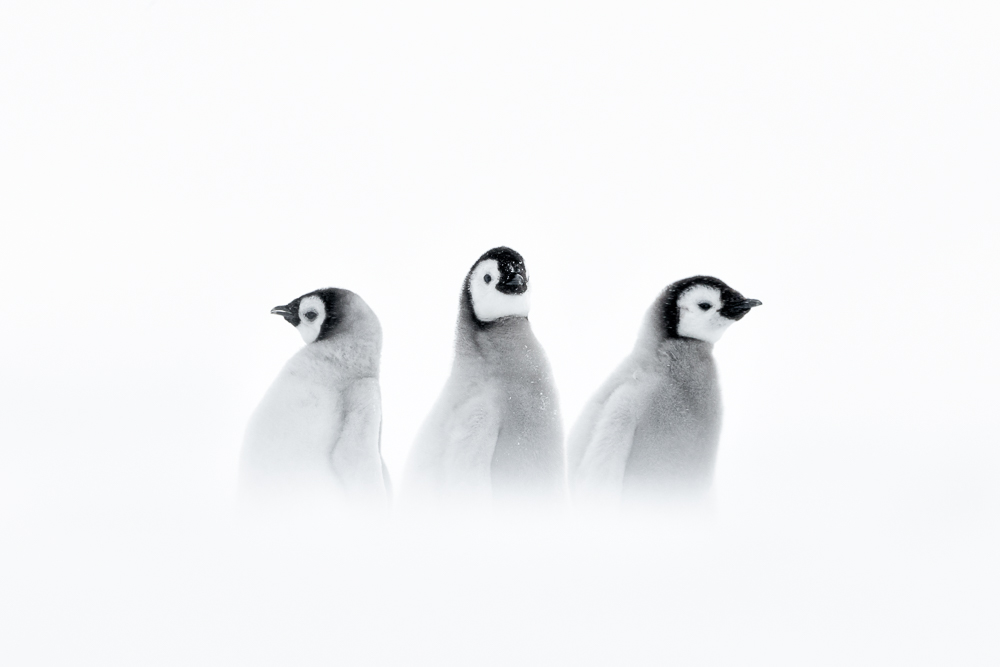
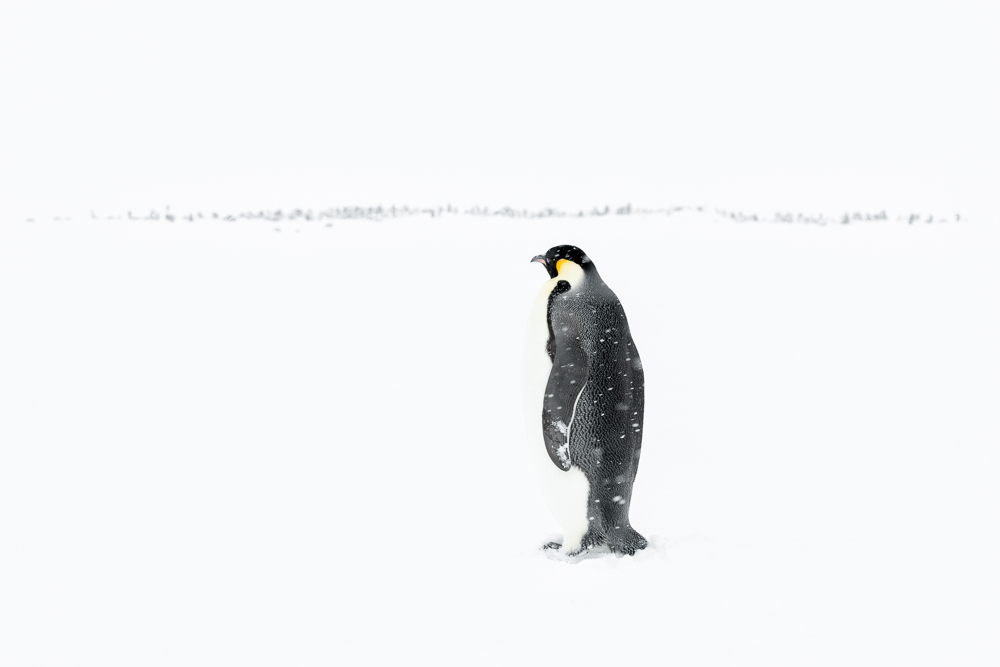
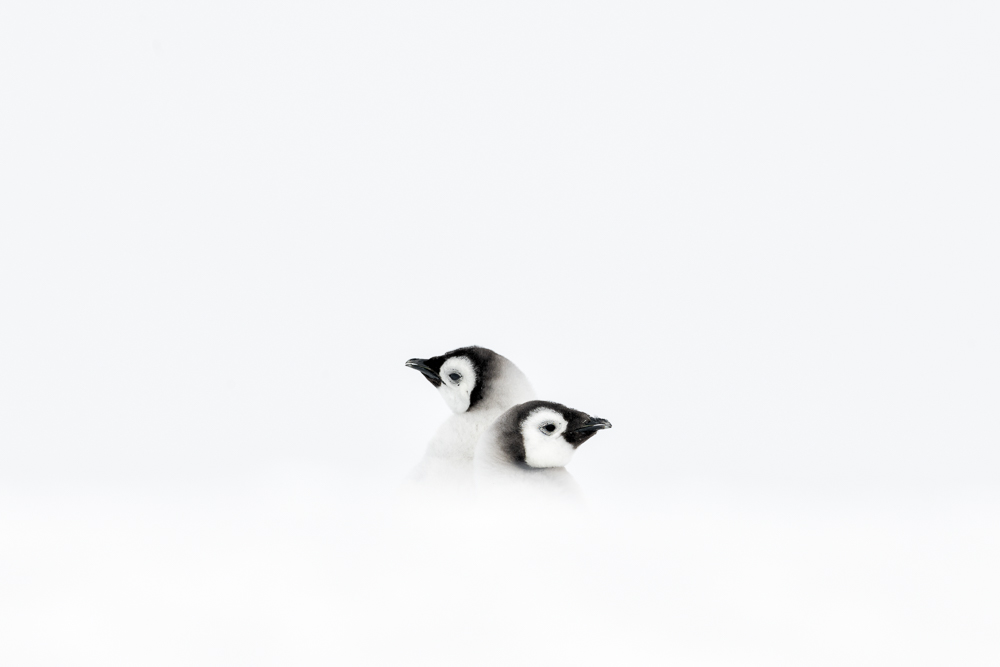
I am still working through the more than five thousand images I made during the course of the week spent out on the sea ice with the penguins, but I have included a few favourites already processed below from what I felt was our best few days – heavily overcast conditions and light snowfall.
The above montage footage was all shot with the new Canon EOS R1 at 4K 120 fps with the Canon RF 600mm F4L IS handheld. This was the first outing with the new Canon EOS R1, and I am blown away by both the ergonomics and performance of this camera. There is a purity and depth of colour to the 14-bit RAW files I have only seen before in much more expensive medium format cameras. The eye tracking focus (yes it can track the black eye of an Emperor Penguin against black feathers), the pre-capture, the build quality and overall performance all stack up to make this the best camera I have yet used. I will have more to say about this in a future podcast.
I will return to the world’s most southerly Emperor penguin colony in early November next year (2025) to lead another small group of photographers on this incredible expedition. If you have ever wanted to photograph the world’s largest and most elegant, photogenic penguin, this is the expedition for you. Limited places are still available on this extraordinary expedition. Please contact me for more details.
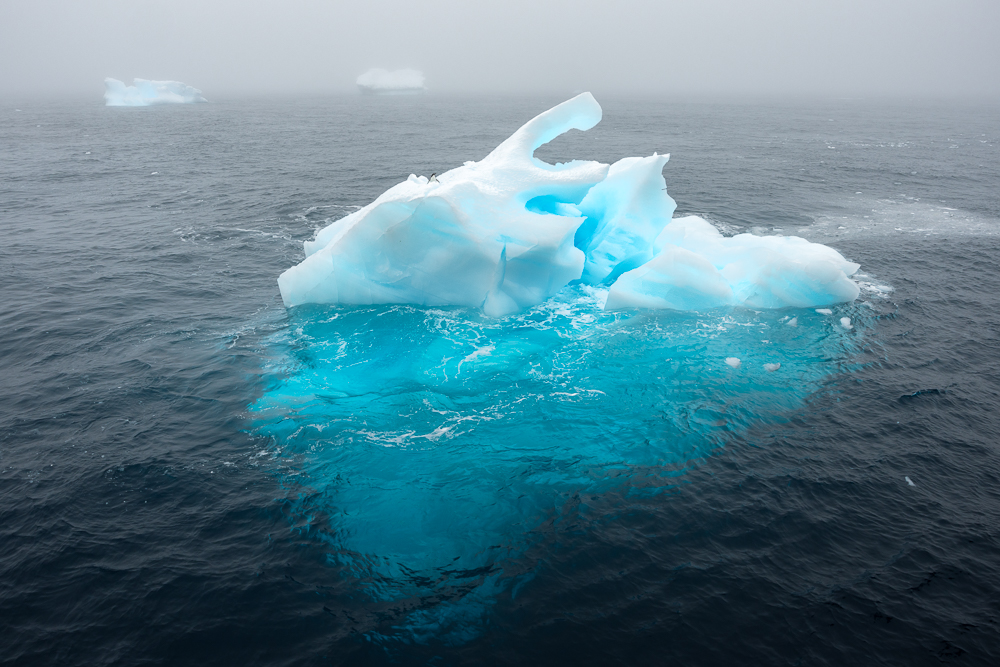
The photograph of the month for October 2024 comes from my just completed East Greenland Scoresby Sund expedition (trip report coming soon). Photographed from the deck of our expedition schooner, the Rembrandt Van Rijn, this image directly resulted from positioning the boat in the best location at the best time. It’s a great example of the key difference between a dedicated photographic expedition and a general tourist trip. With time on our side and a team of participants all dedicated to making great images, I decided to simply stay with these two icebergs and wait for the best light of the day. This soft pastel light post-sunset is a wonderful example of what makes Greenland alluring to photographers. These types of photographic opportunities are abundant in Greenland and easily made from the deck of a suitable expedition-class vessel. In this instance, I used a 24-105mm F4 RF lens at F5.6 ISO800 hand-held. As we slowly circled the icebergs (numerous times!) I made many different photographs from different angles so that I could choose my preferred angle in post-production.
My final expedition for 2023 was to the Antarctic Peninsula – a location that continues to inspire and fuel my creativity and one I never tire of returning to. This expedition was a full, dedicated charter to the Peninsula for landscape and wildlife – it was not a shared expedition with general Antarctic tourists. This trip was my twelfth season guiding expeditions to Antarctica, and it is always wonderful to return to this miraculous continent. Over the many years of leading trips to Antarctica, I have learned that the best possible experiences and photographs always come from dedicated expeditions that are not shared with general tourists.
This expedition began in early December in Ushuaia at the bottom of South America. Our trip was blessed with a smooth crossing of the Drake by the usual standards, which was probably a 3 out of 10, with gentle to moderate swells for most of the crossing. Our smooth crossing enabled us to make excellent speed (averaging between 11 and 12 knots) that saw us arrive in the South Shetland Islands much earlier than anticipated.
The smooth, fast crossing meant we had some additional time up our sleeve, which we took advantage of with a bonus sunset landing at Fort Point (our first sub-Antarctic landing). I had never visited this location before, but it offered some excellent opportunities with both Chinstrap and Gentoo Penguins as the sun was setting. For many aboard, this was their first-ever Antarctic landing.
On our first full-planned day in Antarctica, we landed at Half Moon Island in overcast conditions that provided a lovely softbox. Although we were early in the season, the snow was already quite patchy at this location due to a recent warm spell. Nevertheless, there were excellent opportunities to explore this large Chinstrap colony and the surrounding landscape. Half Moon Island is my favourite location in the South Shetlands for its abundant wildlife and diverse backdrops.
With suitably calm seas, we could squeeze in a much-anticipated landing at Deception Island in the late afternoon. I have been fortunate to land at Deception Island (Whalers Bay) in everything from blazing sunshine to heavy snowfall. However, this landing was the first time I had experienced rain this far south, this early in the season. The unwanted rain beautifully saturates and emphasises the patina in the many rusty relics from the bygone whaling era. Whalers Bay is a location that never ceases to amaze, with a never-ending array of photographic options to pursue, from the grand landscape to the intimate details of the many abandoned relics.
With Half Moon and Deception Island already in the bag, we heaved anchor and steamed south for Cuverville Island and its abundance of Gentoo penguins. Cuverville Island is one of the Antarctic Peninsula’s most picturesque and anticipated landing sites. The bay in front of the landing site is frequently home to many icebergs, and the island itself is surrounded by steep peaks and plunging glaciers that make for stunning backdrops. This island has been a highly profitable location in past visits, with many keeper photographs resulting from my many landings here. This year’s landing did not disappoint, with soft snowfall and many opportunities with the penguins.
We arrived at Cuverville Island in heavy snowfall and low clouds, perfect conditions for photographing the many Gentoo penguins that live on this fantastic island. Shortly after breakfast, we went ashore for over three hours in conditions that could only be described as perfect for photography. As the hours passed, the snowfall cleared, and the clouds lifted a little, providing spectacular views of the surrounding peaks and glaciers. Several of the group also took the opportunity to zodiac cruise amongst the nearby icebergs. Another of the benefits of a fully dedicated charter is the ability to split the group into those who wish to photograph icebergs and those who want to photograph the penguins.
The afternoon saw us land at Neko harbour under beautiful soft light with mirror reflections of the peaks and glaciers in the dark Antarctic waters. There were several carvings from the nearby glacier face during our landing, and this was also the first opportunity to photograph some Weddell seals hauled out on the snow and Sub-Antartic Skuas as they flew back and forth against the glacial backdrop. We steamed south in perpetration for the Lemaire channel on return from Neko the following morning.
The morning of the Lemaire greeted us with heavy overcast conditions as we sailed through this spectacular narrow channel. There was little ice in the channel this year, but the overhanging glaciers and precipitous mountains were as stunning as ever. The Lemaire channel remains one of the stand-out highlights of any expedition to the Peninsula. Successful navigation of the Lemaire is never guaranteed this early in the season, but the lack of ice made Captain June’s job easy as we traversed this narrow channel. As always, the Lemaire channel is best enjoyed and photographed from the bow of the ship, where our group spent most of their time as we navigated the channel.
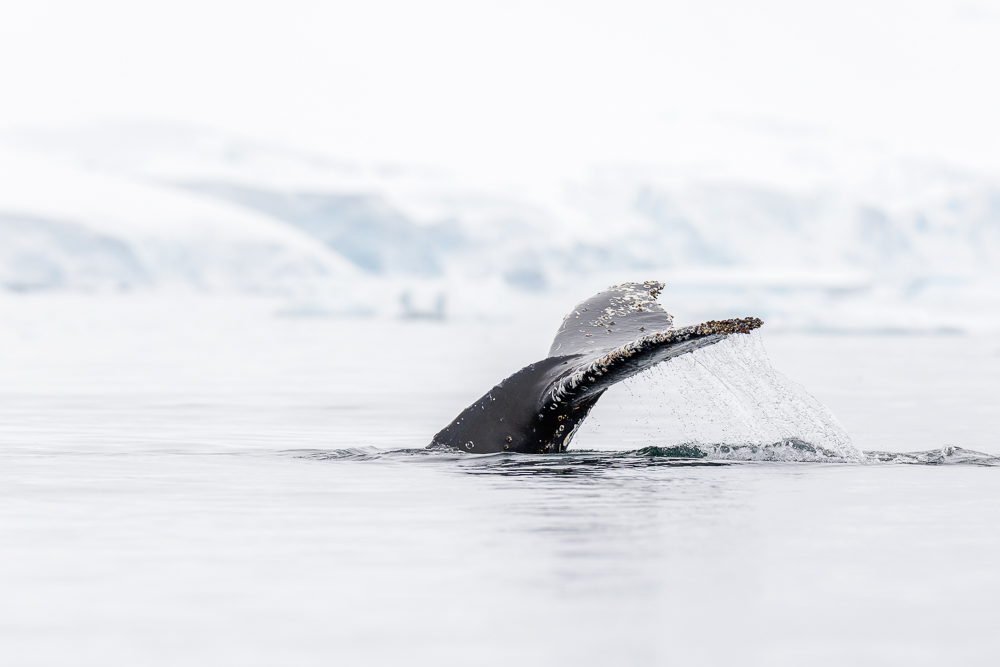
The following day, we had an early morning Landing at Petermann Island after breakfast in soft, overcast conditions, followed by a fantastic zodiac cruise with around half a dozen humpback whales feeding amongst the icebergs. Opportunities to photograph the whales against the many glacial backdrops were in abundance, and we spent several hours in the zodiacs photographing the many humpbacks. Whale photography can be problematic from the high decks of expedition vessels, but from the water level of a small zodiac, it is possible to capture powerful photographs of these ocean-dwelling giants.
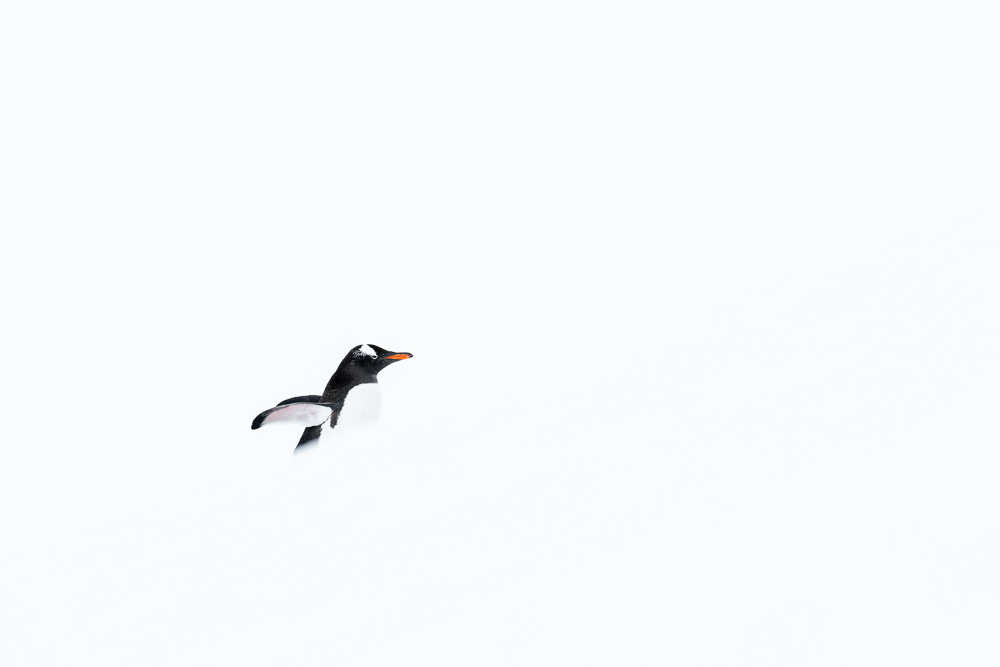
In the afternoon, we visited Port Charcot for a landing in heavy snowfall with the penguins. Port Charcot offered an opportunity for minimalist photography of the penguins in the snow. This site was a new landing for me and was one I found offered a lot of opportunities for minimalist photography.
The following day, after an early wake-up call, we visited Paradise Bay for an incredible zodiac cruise amongst the icebergs. In the mid-morning, some of us went ashore in stunning conditions for a pre-planned wedding of my good friends Sam and Michelle before we made our way north to Gourdin Island. Being the best man at the ceremony with my long-time friend Martyn Lucas was an absolute honour. We wish Sam and Michelle a wonderful and happy life together.
After a morning landing and zodiac cruise at Gordan Island with Adelie penguins, we had a ship cruise with Orcas in Antarctic Sound.
We then headed deeper into the Weddell Sea down the East coast of Snow Hill, cruising with incredible tabular icebergs in soft light and snowfall and Emperor Penguins! Due to the low sea ice conditions this year, we were able to get further south than ever before, arriving at the southern end of Snow Hill!
Our time in the Weddell Sea saw us in full expedition mode, cruising for tabular icebergs and Emperor penguins. Late in the day, I put Zodiacs in the water to photograph the Emperor Penguin and Adelies at eye level as they rested on a small ice flow in stunning soft light and gentle snowfall.
Enjoy the time-lapse video below of Photographers and our first Emperor Penguin encounter.
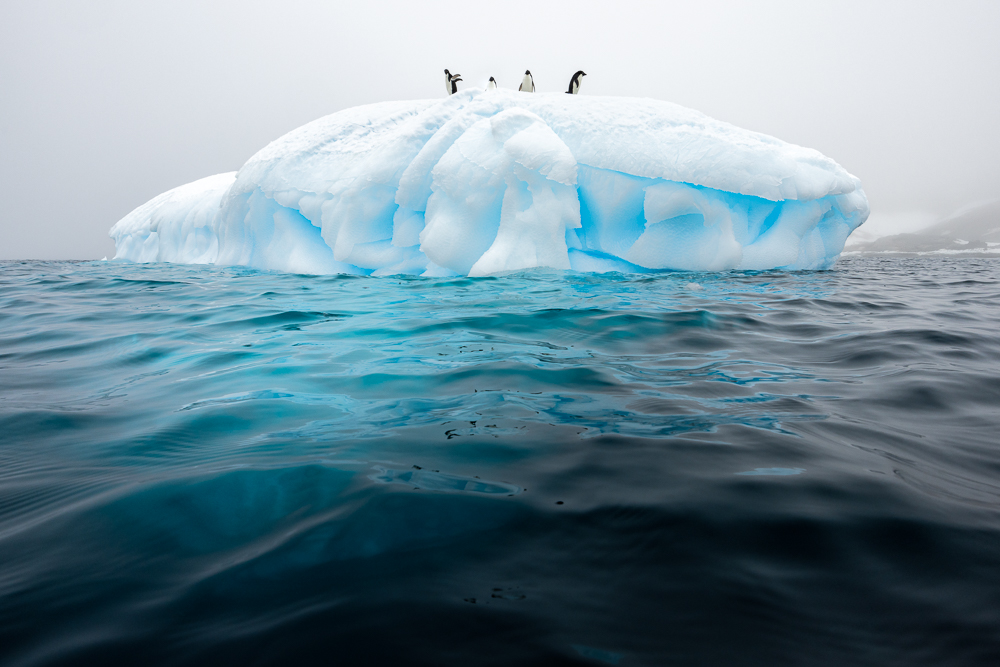
Our last landing was at Paulet Island with over 200 hundred thousand Adelie Penguins. Conditions remained blessedly overcast, with soft light and unique opportunities to photograph the penguins on the many icebergs around the island. For a final activity, we undertook a fantastic zodiac cruise with Adelie penguins on icebergs in overcast conditions.
Our expedition wrapped up with our safe return to Ushuaia after a reasonably average Drake crossing that, in fact, turned out to be much smoother than anticipated. The weather forecast was for formidable winds and seas that mercifully did not eventuate. Most of the return crossing saw us veiled in sea fog with average swells, making for a reasonably calm and pleasant crossing. We disembarked and completed our expedition on the morning of the 21st of December. My sincere thanks to all who participated and helped in making this a truly remarkable expedition.
My next expedition to Antarctica will be a sold-out expedition for Emperor Penguins to the world’s most southerly colony at Gould Bay in November 2024. If you missed out on a place, bookings are now open for 2025. Please drop me an email to register your interest.










 www.WILDNATUREPHOTOTRAVEL.com