
Air travel was once marketed as a symbol of progress, efficiency, and global connection. Today, for many travellers, it has become an exercise in endurance, lowered expectations, frustration and ultimately quiet resignation. Delays, cancellations, missed connections, lost baggage, understaffed flights, and total corporate indifference have become normalised to the point where passengers are expected to absorb inconvenience as if it were part of the ticket price. The real problem is not that things occasionally go wrong—aviation is complex, and weather, mechanical issues, and logistics will always create challenges. The problem is that airlines increasingly operate in an era of zero accountability, where customers are offered neither meaningful compensation nor even basic courtesy when service collapses.
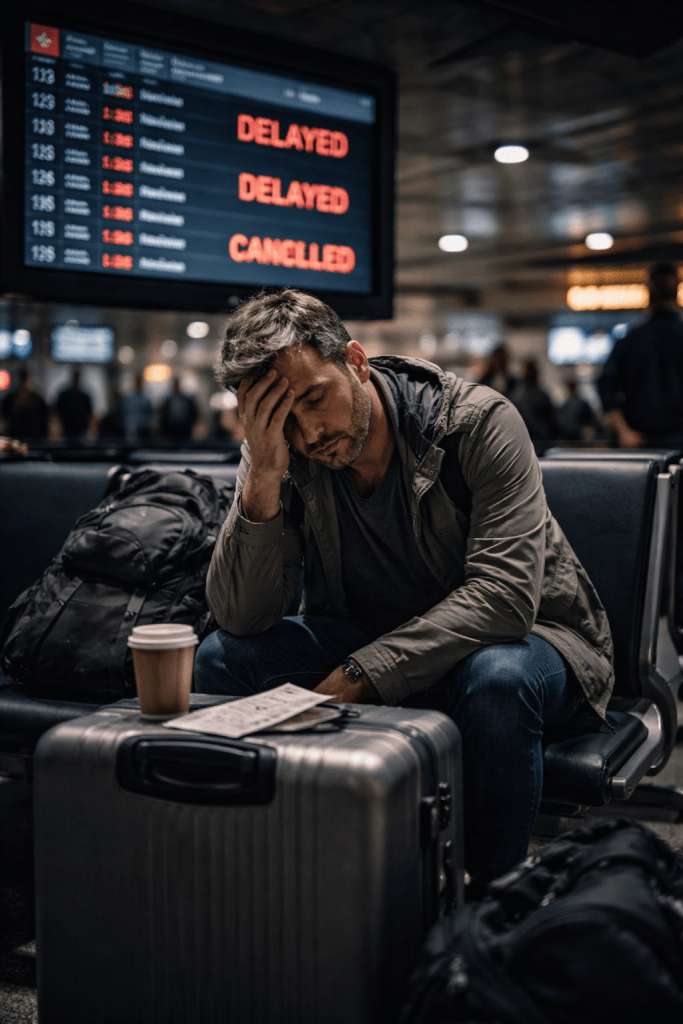
Recently, our outbound flight from Mongolia with Turkish Airlines was delayed by more than 6 hours. That single delay triggered a cascade of consequences: a missed onward connection to Stockholm and a fourteen-hour layover in Istanbul. Fourteen hours sitting in an airport terminal, overnight, with no hotel accommodation, no meal vouchers, no assistance, and not even a verbal apology. This was not a budget carrier ticket purchased on impulse. These were expensive business class seats. Yet the level of care provided was indistinguishable from indifference.
What made the experience especially galling was not just the inconvenience itself, but the complete absence of responsibility. No acknowledgment. No explanation beyond vague operational language. No attempt to mitigate the impact on passengers. The message was clear: your time and loyalty do not matter, and once we have your money, our obligation ends at the bare legal minimum.
This is not an isolated incident. It reflects a broader cultural shift within the airline industry, where corporate cost-cutting, shareholder priorities, and weakened consumer protections have combined to erode the passenger experience. Airlines have learned that they can routinely fail customers and face little consequence. Complaints disappear into automated systems. Compensation processes are deliberately complex and opaque. Responsibility is outsourced to fine print, weather clauses, “operational constraints,” and customer service chatbots that never truly resolve anything.
The emotional toll of this dynamic should not be underestimated. Travel already carries inherent stress: navigating airports, security lines, immigration queues, tight connections, and long-haul fatigue. When delays occur, travellers are already vulnerable—tired, jet-lagged, often far from home. In those moments, basic human decency matters. A simple apology matters. A hotel voucher matters. A meal voucher matters. Even clear communication matters. Instead, passengers are frequently met with silence, shrugs, and staff who are clearly overwhelmed and unsupported themselves.
There is also a disturbing double standard at play. Airlines enforce rigid rules on passengers with uncompromising efficiency. Miss a check-in deadline by a few minutes, and you may lose your entire ticket. Bring luggage that is half a kilogram overweight, and you will pay a premium fee. Arrive late at the gate, and you are simply abandoned. Yet when airlines miss deadlines by hours, cancel flights outright, or strand travellers overnight, the burden is shifted entirely onto the customer. This imbalance of power has become normalised to the point that many travellers barely question it anymore.
What makes this situation worse is that airlines continue to market themselves as premium brands offering “world-class service,” “luxury experiences,” and “five-star hospitality.” Business class cabins are advertised with flat beds, curated menus, and lounge access, but when operational problems arise, the promised premium experience evaporates instantly. At that point, it becomes painfully clear that the luxury is superficial. When things go wrong, everyone is treated the same: as an inconvenience to be managed rather than a customer to be cared for.
The fourteen-hour overnight layover in Istanbul became a symbol of this reality. No hotel was offered. No food assistance was provided. No proactive rebooking help was extended. We were simply expected to wait. To sit. To accept. This expectation—that passengers will quietly absorb corporate failures without complaint—is at the heart of the accountability crisis. Airlines rely on customer fatigue. They know that after a long journey, most people simply want to get home rather than fight for compensation. They know many travellers are unaware of their rights. And they know enforcement is weak.
In some regions, consumer protection laws attempt to address this imbalance. The European Union’s EC261 regulation, for example, requires airlines to compensate passengers for certain delays and cancellations. But enforcement is inconsistent, claims processes are slow, and many airlines actively resist payouts. Outside Europe, protections are even weaker. In many countries, airlines are legally obligated to provide almost nothing in the event of delays. This creates a global patchwork of accountability in which outcomes depend more on geography than on fairness.
Another troubling aspect of modern airline travel is the increasing automation of customer service. When something goes wrong, passengers are often directed to apps, QR codes, or chatbots rather than real human assistance. While technology can improve efficiency, it has also become a convenient shield. Automated systems deflect responsibility, limit options, and funnel customers into predetermined outcomes that benefit the airline more than the traveller. Trying to resolve a complex travel disruption through an app while standing in a crowded terminal at 2 a.m. is not innovation—it is abandonment disguised as efficiency.
There is also the issue of staffing. Airline employees on the front lines are often underpaid, overworked, and placed in impossible positions. They become the face of corporate decisions they did not make and cannot change. This creates tension between staff and passengers, further degrading the travel experience. The anger that should be directed at corporate policy is often absorbed by gate agents and call centre workers who lack the authority to offer real solutions.
What is particularly frustrating is that airlines know how to do better. When disruptions affect high-profile passengers, corporate clients, or media figures, solutions suddenly appear. Hotels are found. Meals are arranged. Flights are rebooked creatively. The resources exist. The systems exist. What is missing is the will to provide consistent care to ordinary travellers (those people that keep the airlines in business!).
Frequent flyers are especially sensitive to this decline because they remember when standards were higher. Loyalty programs once rewarded commitment with genuine benefits and recognition. Today, loyalty resoundingly feels one-sided. Travellers invest tens of thousands of dollars into airline ecosystems only to discover that status does not protect them from being stranded without assistance. When loyalty loses its meaning, trust erodes.
The psychological impact of repeated negative experiences should not be overlooked. Travel is often tied to meaningful moments: family reunions, creative projects, professional commitments, and once-in-a-lifetime trips. When airlines fail, they do not just disrupt schedules—they disrupt lives. Missing connections can mean missing weddings, funerals, business opportunities, or irreplaceable photographic conditions in remote environments. Yet compensation frameworks rarely reflect the true cost of these losses.
There is also an ethical dimension to consider. Airlines operate with enormous public infrastructure support. Airports are publicly funded. Airspace is regulated and maintained by governments. During crises, airlines frequently receive government bailouts. Yet when passengers face hardship, the same companies often retreat behind legal minimums. This imbalance raises serious questions about corporate responsibility in industries that depend so heavily on public trust and public resources.
So what can be done? Meaningful change will require stronger consumer protection laws, consistent international standards, and enforcement mechanisms with real consequences. Airlines must face financial penalties that outweigh the cost of neglecting passengers. Transparency requirements should mandate clear communication during disruptions. Compensation processes should be automatic rather than opt-in, persistent battles. Most importantly, customer care must be reframed not as a cost centre but as a core operational responsibility.
On an individual level, travellers are beginning to respond in the only way available to them: with their wallets. Blacklists are forming. Brand loyalty is eroding. Passengers are sharing experiences publicly, using social media and blogs to hold airlines accountable in the court of public opinion. While this is not a perfect solution, it reflects growing frustration with an industry that has grown too comfortable with mediocrity. For myself, my blacklist currently includes Jetstar, Aerolineas, and now Turkish Airlines (there are more; they have gone bankrupt or merged)
The experience with Turkish Airlines was the final straw for me. A six-hour delay. A missed connection. Fourteen hours in an airport overnight. No hotel. No food. No apology. No accountability. That combination is not just poor service—it is a corporate statement of values. And when a company shows you who they are, it is wise to listen.
Yes, this is a first-world problem. Yes, there are far bigger issues in the world. But acknowledging larger global challenges does not invalidate the right to expect basic decency from companies that charge premium prices and market premium experiences. Accountability should not be a luxury upgrade. It should be standard.
Air travel does not have to feel this broken. The technology exists. The resources exist. The expertise exists. What is missing is respect for the passenger as more than a seat number and a revenue stream. Airlines need to respect individual customers, not just the customer base as a whole. Until that changes, more travellers will reach the same conclusion: enough is enough.
Because at some point, frustration turns into resolve. And when that happens, airlines will discover that while customers may tolerate inconvenience, they will not tolerate being treated as invisible forever.
 www.WILDNATUREPHOTOTRAVEL.com