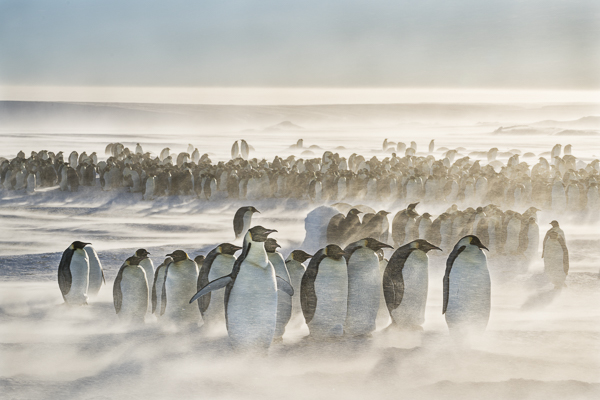
 Like other penguin species, emperors spend their summer months next to the sea, fishing in the rich, cold waters of Antarctica. Starting in March, their behavior becomes different than that of other penguins: males and females leave the sea and walk between 70 and 100 kilometers over the ice until reaching the colony in which they were born. There, they will start their annual reproduction cycle.
 These colonies are located in extremely cold and windy places, with no sources of food. However, since they are far from the sea, the risk of predators for chicks is reduced. Once they reach the colony, males and females start the pairing process: they will sing a special cry that will lead them to the penguin who will be their mate for the next year. Two months later, each female lays and egg and transfers it very carefully to her mate. The females have consumed too much energy and must now start the long walk back to the sea to feed. Meanwhile, the males will incubate the eggs, protecting them against the harshest winter conditions: temperatures of -70 Celsius, and winds of more than 150 km/h.
 Chicks are born between late August and early September, still under their fathers care. A few days later, mothers come back, bringing valuable food for their young. It is now their turn to take care of the chicks, while the males walk to the sea to regain the weight they lost. During the following three months, males and females will take turns caring for the chicks and walking to the sea to bring back food.
 It is very difficult to visit emperor penguins in the wild. The areas in the sea where they spend the summers are surrounded by ice and inaccessible to most ships that visit Antarctica. Their colonies are far from the sea and can only be reached by flying in specially adapted planes.
 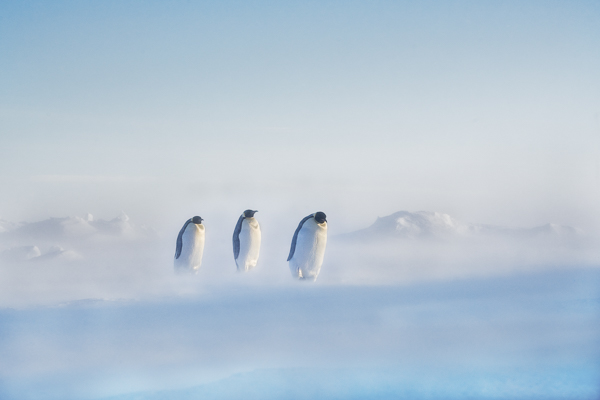 The point of departure for our expedition was Punta Arenas, a city located in the extreme south of Chile. There, we waited for six days until the wind in Antarctica was adequate to fly. We reached our base camp in a Russian Ilyushin jet originally designed to fly to Siberia. After a four-and-a-half-hour flight, we landed on an ice runway in an area known as Union Glacier, which is nearly 80 degrees south.
 There, we utilised a large camp that is used as the starting point for different types of expeditions in Antarctica: skiers trying to reach the South Pole, climbers after the conquest of the tallest mountain in the continent, runners ready for the most extreme marathon of their lives. Also, those of us who wish to live up close with the largest and most fascinating penguin species: the emperors. The logistics required to operate this camp are astounding.
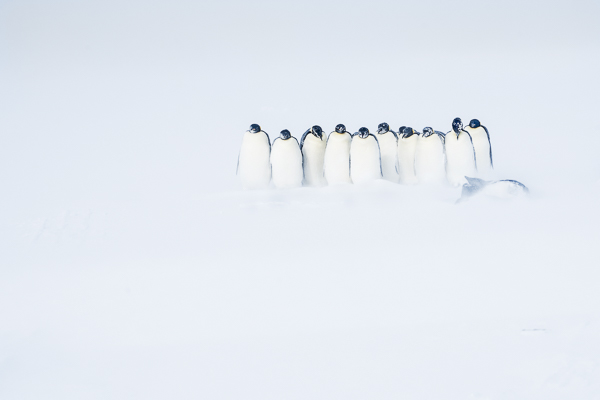 At Union Glacier, we waited for two days before flying to our final destination: Gould Bay, a large expanse of frozen sea ice in the Weddell Sea. We flew in a Twin Otter plane conditioned with skis. There, a small camp was waiting for us. This camp had high mountaineering tents and special condition sleeping bags. All of this was essential, because during the three days we spent there, the wind was never lower than 25 knots (45 km/h).
 Living conditions are not the most comfortable, and the wind and cold are very harsh, but all of it is justified by the purity of the air, the absence of artificial sounds and the direct contact with nature.
 At that time of the year, the sun never sets in Antarctica, allowing us to choose the best time to walk to the colony and photograph the penguins: after dinner, at around 8pm, when the low lying sun created excellent light conditions. The penguin colony was located 1.5 km away from our camp. The walk is not too long, but when the wind is blowing against you, every step feels like an accomplishment.
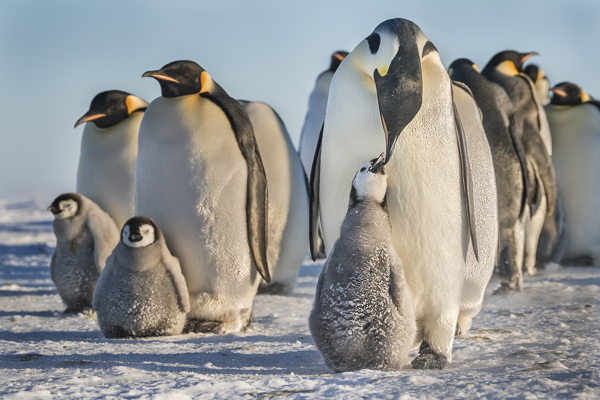
It is impossible to transmit in words one´s feelings at the first encounter with those 8,000 fascinating birds. When we arrived for our first visit, the evening light projected long shadows and the wind made the snow flakes fly, covering everything with a golden layer. I can think of no better introduction to this species. I spent a while sitting, enjoying the curiosity of the penguins, who were not timid about approaching us. Then came the moment to take out my camera and walk next to the colony to start making photographs. Soon, I saw the eight-week old chicks. Some were sheltered inside their parents´ brood pouches; others were standing at the feet of the adults, asking for food with a special cry; others were discovering how to walk, taking tentative steps away from parental protection. Parents were always close to their chicks, ready to step in and protect them at the first sign of danger. It is fascinating to witness how the colony´s entire life flows around the protection and growth of chicks.
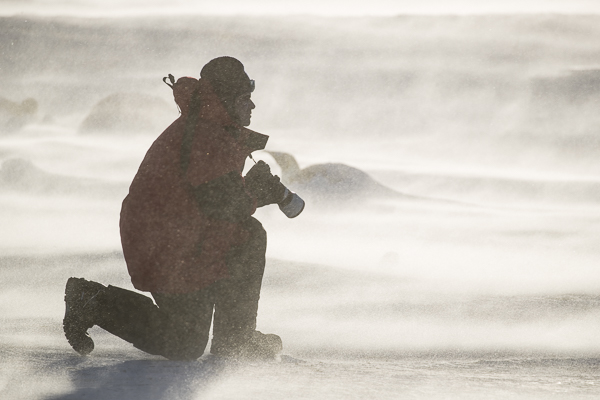 Photography under those conditions is a big challenge: heavy gloves and goggles are essential at all times, but do not allow for operating the camera or looking through the viewfinder. I had to take them off to make a photograph, but could only do it for very short moments, because the weather seemed to guess when I was uncovered to throw snow in my face or freeze my hands. That first day, after four hours out in the cold, I could no longer feel my hands and decided to return.
During the next two days, we repeated our evening walks to the colony and received several visits of emperors in our camp. Ours cameras froze and became frozen bricks, the snow buried the entrance to our tents several times a day, and the visibility disappeared for long stretches. All of this was part of a unique experience, the best I have enjoyed in direct contact with nature.
Trips like this renew my appreciation of the need to keep spaces apart from all human activity, where our fellow species in the planet can live without threats. The worldwide population of emperor penguins has remained stable during the past few years, at 500,000 individuals. However, several studies have confirmed that the species might become endangered due the effects of climate change and overfishing in Antarctic waters. It would be a huge pity if that magnificent species becomes one more victim of our activity on earth.
More of Jose’s Photography can be found at www.joseantoniorosas.com



 www.WILDNATUREPHOTOTRAVEL.com