
I have just published episode #103 of my Wild Nature Photography Podcast. In this episode I discuss the noise reduction pre-sets I have just released for the Canon EOS R5MK2 as well as my first outing and experience with the camera in the field. Now that the dust has settled on the official announcement of the Canon EOS R1 and the Canon EOS R5MKII, I want to take a few moments to discuss the differences between these two cameras, their key features and who they are intended for. There has been much misinformation and scuttlebutt on the internet (predominantly from the usual YouTubers who will say just about anything for likes, clicks and views). ‘Don’t forget to like and subscribe’ Anyway, before I digress any further, these are my thoughts as an actual pro photographer who shoots with these cameras in the field more than 200 days a year.
Shared technologies between the Canon EOS R1 and Canon EOS R5 MKII
Both cameras share many core technologies and features between them such as:
• DIGIC X processor AND a new DIGIC Accelerator – which enable ‘next gen’ AI tracking and focussing (more on that later).
• Back illuminated stacked CMOS sensor – which have faster readout and less rolling shutter than previous sensors.
• In camera noise reduction for RAW images.
• 2X-4X image upscaling & cropping in camera (to JPG).
• AF Eye Control.
• Pre-burst mode for stills & video.
• Very high electronic shutter speeds (R5II 1/32,000 electronic / R1 1/64,000 electronic).
• 8.5 Stops of IBIS at the lens centre (7.7stops at peripheral).
• Action Sports Tracking Priority Modes: Soccer, Basketball, Volleyball.
• Ability to ‘face register’ up to 10 people to AF track.
• Multi-function Hot Shoe – camera can power microphones, use new gen speed lights as well as legacy speed lights.
• Dual Shooting (HD video & JPG stills).
• Close to cinema range video quality.
• 12 bit RAW video recording + 4 channel audio.
• LUTS in camera.
• Log3 + Log2 with 16 stops of dynamic range.
• 4K 120p + HD 240p.
• Proxy RAW footage (to seperate cards) for manageable video editing.
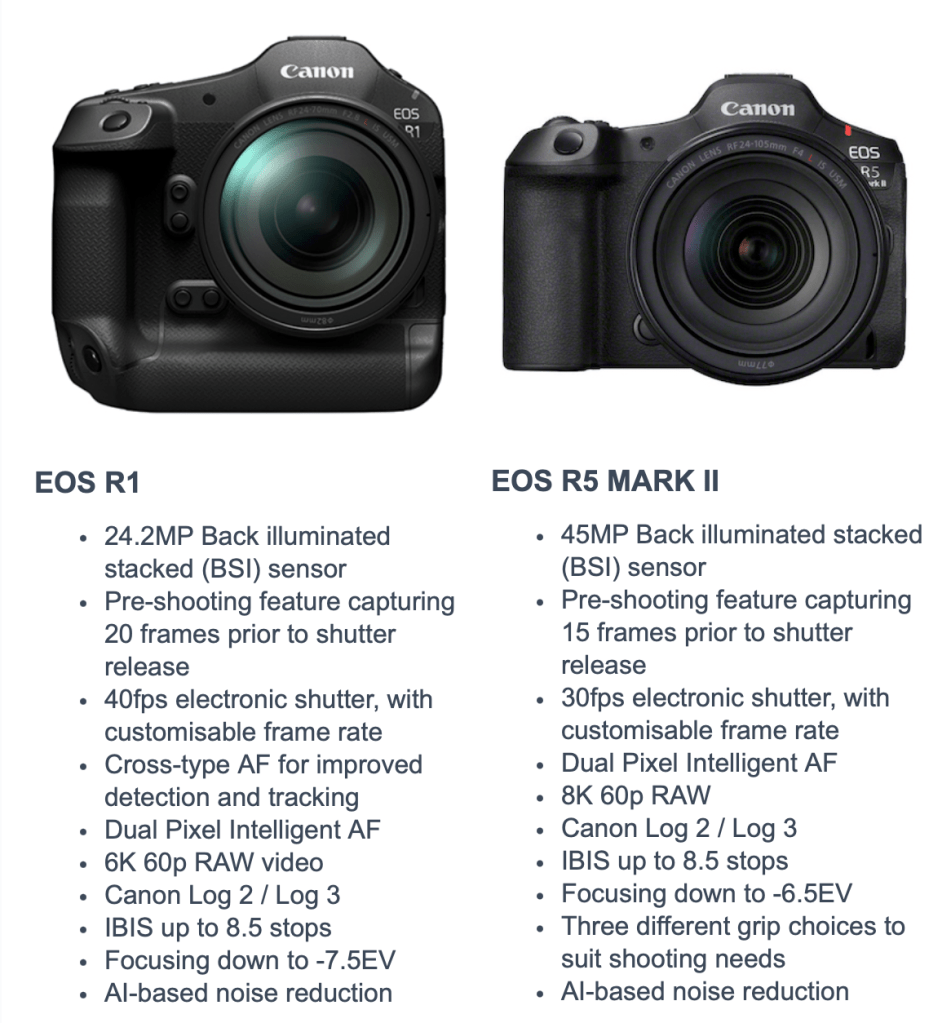
So while these cameras do share core technologies, the R5mkII is classed by Canon as “aspirational, brand-defining and accessible”; while the R1 is classed as “refined, luxury and niche”. Canon representatives also talked about slightly different markets with the R5mkII being for commercial photographers wanting higher mobility and high pixel count; while the R1 is about reliability, high speed, high ISO suited for sports, wildlife, documentary and government use. While most people might consider the R1 the flagship model, Canon representatives referred to both cameras as flagships. This is because the original R5 and its predecessors—the EOS DSLR 5D series—have been industry workhorse cameras that vastly outsell the ‘1’ series by more than 10 to 1. If the R1 is the jewel in Canon’s crown, the crown is mainly made of R5’s.
The big party trick
Apart from the before mentioned technologies shared with the R5MkII, what are the big ticket advantages over the R3 and R5mkII? Apart from a blistering 40 fps in electronic shutter mode, you have a new ‘Cross-type AF’ which ensures the best focussing accuracy in probably any camera on the market. Traditionally with duel-pixel autofocusing, the camera looks for vertical lines (to focus on) in an image when shooting in landscape mode. If you shoot in vertical / portrait mode, many cameras find focus to be more difficult. Cross-type AF solves this issue and increases accuracy in situations that may have many horizontal lines, or subjects are small in size, or the subject has low contrast in low light (something that should significantly benefit many wildlife photographers).
Ultimately, which camera is right for you really comes down to your in the field needs and output needs (as it always has). If high ISO performance, world leading autofocus, 40 frames per second with RAW pre-capture up to 20 frames is important to you (and it is to me as a wildlife photographer) then the Canon EOS R1 is the best tool for the job. If you dont need those things, then the EOS R5 MKII punches very hard for a camera that packs 45 mega pixels. Of course, ergonomics also plays a large part in the equation. Personally, I decided to order one of each and will use the R5MK2 as a light weight landscape camera and the EOS R1 for my wildlife work. This gives me an uncompromising too for wildlife (the EOS R1) and a light weight camera for landscape – the best of both worlds.

 www.WILDNATUREPHOTOTRAVEL.com
Thank you, Josh.
MORE TO PONDER!!!
Aloha, John
LikeLiked by 1 person