Iceland ‘Where to Go and What to Photograph’ 2nd Print Edition Map : Review

In December last year I reviewed a map produced by French Photographer Michael Levy titled ‘ Where to Go and What to See‘ in Iceland. This map was produced specifically for photographers and Michael was selling limited edition copies (limited to 1000) via his website. Curious for all things Iceland and photography related I contacted Michael via email and after some brief correspondence he kindly offered to send me a copy of the map for review.

Michael has subsequently released a new and revised 2nd print edition of his Iceland map for photographers, titled ‘Where to Go, What to Photograph’. The first edition of the map reportedly took two years of work from concept to printing and was created entirely by hand  (not from a database). This new edition is now the culmination of three years of work. From the International Photographer website: The map shows essential route information, detailed descriptions of all areas of interest (volcanoes, waterfalls, lighthouses, monuments, fauna, flora and curiosities) as well as national parks and nature reserves. Not only can you now prepare your trip in detail, thanks to this handy map, but there’s no chance of missing anything exciting once you get there!The first, most noticeable and immediate improvement in the 2nd edition is that it is now printed on a tear proof, waterproof substrate. This is a big improvement and advantage over the original map in that it is now far less likely to be irreparably damaged in the field (especially in Iceland, where it rains a lot). Michael has also fixed a small number of typos and inaccuracies that emerged from the first edition and there are various other improvements and additions. From Michaels website:

We have kept all the elements that made the first edition so successful, while adding innovative improvements based on your many comments:

• 50% more information and sights to see, thanks to the expeditions we undertook to Iceland in 2012 and 2013.

• Travel times for the main routes on road and track, by car and by boat.

• Increased legibility through greater visual contrast and the use of high quality paper and inks.

• Map key now in four languages: English / German / Spanish / French.

• Road network updated and improved.

• Tearproof and waterproof paper.

This map is the ultimate tool. It has been created entirely by hand (not from a database), and will be updated regularly. At a glance, you can see all of the areas to explore and photograph in ICELAND. The map shows essential route information, detailed descriptions of all areas of interest (volcanoes, waterfalls, lighthouses, monuments,fauna, flora, and curiosities), as well as national parks and nature reserves.

Conclusion:

The 2nd Edition is a significant improvement over the 1st edition map. The use of a tearproof and waterproof substrate alone makes the upgrade worthwhile if you already own the 1st edition and plan to return to Iceland. If you had been waiting for a revised edition then now is the time to purchase. My original grip remains in that there is still currently no digital version (especially given the Iceland e-roadbook Michael offers is available as a digital download). I would like to see a digital download version for photographers who do not wish to carry a traditional map with them into the field. As I wrote back in December, photographers are some of the fastest adopters of digital technology and I don’t think there is a serious photographer out there who does not own a tablet device (or phone) of some description that cannot store and display digital map files in the field. I would also like to see GPS co-ordinates added to the map in a future digital edition for photographers who prefer to work with a digital map and a set of co-ordinates for finding a given location. Geo-tagged maps are starting to become quite popular with photographers and there are now a number of photographers producing (and selling) geo-tagged maps of iconic locations in America as an example.

With that said, this remains a hand crafted labour of love and it is important to remember that this map is printed in limited quantities (2000 in the 2nd edition) in the photographers home country of France. It is to my knowledge a unique effort to provide a single map of photographic locations in Iceland and should be considered as such when deciding whether to purchase.

For the photographer travelling to Iceland for the first time this 2nd edition map will likely prove invaluable as it provides sufficient information to plan a self drive tour and covers virtually all of the major iconic locations you are likely to want to visit as well as ensuring you don’t miss the ones that are somewhat harder to find. In combination with something like the Lonely Planet Guide to Iceland and Michael’s e-roadbook to Iceland it will provide a great launching pad for an exciting photographic tour of discovery. It is worth noting that no map can replace local knowledge when it comes to reading the weather and light so I suspect even photographers travelling in groups or with guides will find this map useful as it provides an easy to read and follow reference as you drive around the island. I have personally carried and used it on my own workshops and expeditions so that I can easily illustrate where we are in Iceland to those in the group.

Producing a map for photographers of a country so rich in photographic locations and subjects is a daunting challenge and Michael is to be commended for his hard work and dedication in continuging to upgrade and produce new versions.

For all the international-photographer content visit the International Photographer

Gura Gear Et Cetera Range

It is no secret that I have been a big fan and long time supporter of the Gura Gear range of camera bags. In fact, Gura Gears chief founder Andy Biggs has become a close friend over the last few years and we recently ran two workshops in Iceland together during winter for the Aurora Borealis. We will also be travelling to Namibia together next year to co-lead two back-to-back landscape workshops (there are now only a few places remaining on these trips before they will be sold out). We will also shortly be announcing a new expedition to South Georgia Island (more to come on this soon). I have trusted and utilised my Gura Gear bags to carry my camera equipment to places including Antarctica, France, Tasmania, New Zealand, Iceland, China, Italy, Australia and more. The Gura Gear Kiboko and Bataflae 32L have been my number one camera bags of choice for quite some time now. In fact, I was actively involved in the beta testing of the Bataflae 32L during my travels to Europe last year and put a prototype of this bag through its paces in the field. Gura Gear have been slowly expanding their product range with new bags and new accessories to better help and serve photographers in the field and recently launched their new website. One of the new products that I am finding significant use for is the new Et Cetera range. This range of small satchels and containers is perfect for storing the myriad of chargers, cables, card readers and all manner of accessories that are so often left to float loosely in carry on luggage. I used a number of them during my recent trip to Xinjiang in China and they have already become an indispensable component of my travel kit. So often when travelling it is the little things that make a difference between being disorganised and organised and this clever range of small containers helps me keep my accessories handy at all times. If you are in the market for a new camera bag or you want to better organise your accessories I recommend checking them out.

Canon 200-400mm F4L IS Pre-Production Sample Lens Review

Late in 2012 I wrote a short op ed. blog piece about the pending release of Canon’s new 200-400mm F4L IS lens with inbuilt 1.4 teleconverter. At the time of my post there were only a few prototypes of this lens in existence and they were all at the London Olympics (I was somewhere between Paris and Chamonix at the time) for testing by a lucky few sports photographers. Initial feedback on the grapevine from those fortunate few was that this lens (even in prototype form) was an oustanding performer and lived up to Canon’s claims of Unsurpassed combination of versatility, first-class optical performance and an enhanced weather-proof construction.

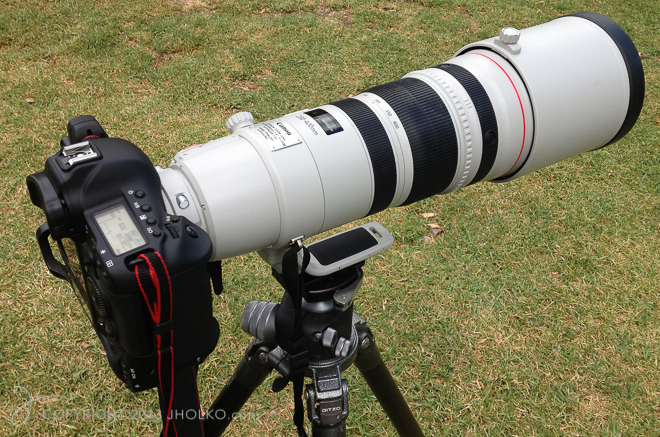
Fast forward to today and I recently finished (in February this year) three days shooting with the new Canon 200-400mm F4L IS lens (in prototype form). To my knowledge this is the first online pre-production review of this lens anywhere in the world. During the test I was fortunate to also have on hand the Nikon 200-400 equivalent and a D800E for comparison and this may also be the first time these lenses have been used side by side. In terms of size the two lenses are almost identical although the Canon is wider in girth and does feel lighter than the Nikon. Once a 1.4 teleconverter is added the Nikon does become a longer lens than the Canon.The Nikon design is now more than a decade old and does not include an inbuilt 1.4 teleconverter although it has had some optical and vibration reduction upgrades over the years. For those looking for a direct comparison of these lenses in terms of image quality I am sorry but you are going to have to look elsewhere. It is just too hard to account for differences in lenses when they are shot on different mega pixel cameras. What I can say is that after shooting side by side with the Canon and Nikon for three days is that both are excellent lenses and that the end result has as much to do with the camera and photographer as the lens itself. Shooting dressage with the 1DX and Canon 200-400 I was able to capture images that the D800E simply could not because its frame rate is literally half that of the 1DX. Twelve frames a second makes a difference when you are photographing a charging horse or wildlife on the move. In terms of autofocus it is again to hard to account for any differences between the lenses as so much depends on the camera and the photographer so we confined ourselves to simply comparing the physical attributes of the lenses. What was universally agreed however is that having an inbuilt 1.4 teleconverter is a significant advantage. The teleconverter can be activated in less than a second in the Canon where as it takes at least ten seconds to take the lens off the Nikon and install a converter. This difference is huge and is not to be underestimated when it comes to wildlife and sports photography. The Canon can continue shooting and tracking the subject whilst the converter is slide into place. The Nikon requires taking the camera away from the eye to fit the converter and then reframing the subject and reacquiring focus. This time delay can be the difference between getting the shot and missing the shot. Included below is a short video with my thoughts and impressions on this new and very impressive lens from Canon.I know the Canon lens looks quite a lot bigger than the Nikon in this photograph however that is a function of the lens and camera used to take this photograph. The Canon is also closer to the camera and thus appears larger in the frame.

Teleconverter Functionality

The Canon 200-400mm F4L IS is only the second lens from Canon to ever employ an inbuilt 1.4 teleconverter that could be optionally switched on or off with the flick of a switch. The first lens to do so was the extremely rare Canon FD 1200mm f/5.6 L Lens (picture on PBase.com). I have personally never seen one of these lenses in the flesh although I have briefly shot with its replacement, the discontinued and ultra expensive EF 1200mm f/5.6 L USM Lens; which did not have an inbuilt teleconverter.

The teleconverter in the Canon 200-400mm F4 L IS lens offers a magnification factor of 1.4x the lens focal length. This turns the Canon 200-400mm lens into a 280mm – 560mm lens with the flick of a switch. The switch can be locked to prevent accidental operation. After three days of shooting with the lens I never felt the need to use the lock switch as the teleconverter switch does require a fairly dedicated press to move into position.

Image Quality

I need to put a caveat on my comments about image quality as the lens I tested from Canon was a prototype and not a finished production model. Whilst I do not expect there to be any significant optical differences between the unit I tested and finished samples it is important to clarify that my comments relate strictly to the prototype and not finished production units (which are currently unavailable).

Getting right down to brass tacks the image quality of Canon’s new 200-400mm F4L IS lens is superb. My own testing shows it to be fully the equal of Canon’s mighty 300mm F2.8L IS lens both in the centre and in the corners. This is phenomenal performance in a zoom lens and goes to show how much development and engineering work has gone into the design of this new optic. During the three days I was able to shoot with the lens I shot over a thousand frames at a local open range zoo not far from my house and at a dressage training event. I also spent a good deal of time shooting test charts so that I could make direct comparisons against the 300mm F2.8L IS. I tested the lens at varying focal lengths both with and without the 1.4 teleconverter in place and have found it to offer superb image quality regardless of focal length. It is necessary to go 300% magnification in Adobe Lightroom to see any difference between a file shot with the 300mm F2.8L IS and the 200-400 F4L IS. The most noticeable difference at 300% is the significant lack of chromatic aberration in the 200-400 lens. Any resolution differences are a quibble and it could be argued that the 200-400mm lens actually has better contrast. This confirms what I have heard from other photographers who tested this lens at both the London Olympics and the Australian Open tennis early this year and have claimed it is as good as Canon’s 400mm F2.8L IS lens.

Image Quality with Teleconverter

The addition of an inbuilt teleconverter makes a good deal of optical sense since it can be specifically designed and tuned to the lens in which it is being employed. Traditional teleconverters are a compromise because they are designed to work with multiple lenses across a range of focal lengths. They are not tuned to a specific set of optics and employ more elements than they may otherwise need to in order to ensure operability between lenses. For this reason an inbuilt converter will always outperform and out-resolve a stand alone converter. In my own testing I found the in built converter in the 200-400 to offer improved image quality over the stand alone Mark III 1.4 Teleconverter.

To clear up the internet scuttlebutt I can clarify that it is possible to use a 2X teleconverter with the 200-400mm lens; which turns it into a 400-800mm F8 lens that will autofocus on the 1DX camera. Image quality with the 2X teleconverter in place is at least equal in quality to what you would expect to see using the converter on a prime telephoto lens.  It is also possible to flick the 1.4 teleconverter into place and go to 1120mm although autofocus is lost and image quality takes a nose dive as you would expect with stacked converters.

Autofocus

The prototype 200-400mm lens I tested on the Canon 1DX camera has the best autofocus I have ever experienced with any camera – period.  It is blisteringly fast and deadly accurate. This lens and camera combination never miss focused during the nearly 700 frames shot on high speed 12 frames per second AI servo at the dressage training event I was invited to photograph. The camera and lens were able to successfully track the rapidly moving dark horses irrespective of erratic and unpredictable movement. All of the files are sharp and well within what I would deem critical focus.

Image Stabilisation

The new 200-400mm lens employs 4 stop image stabilisation that is virtually completely silent. Whilst I can hear the IS in my 300mm F2.8L IS when shooting with the lens in this mode I could not hear it at all on the 200-400mm lens. My tests show that the IS in the 200-400 is significantly better than that in the original 300mm F2.8L IS lens and I would have no hesitation in hand holding this lens in poor light and shooting at shutter speeds that would normally require a tripod for these focal lengths. The lens has three different modes for either hand held shooting, panning or utilisation on a tripod.Who is it for?

For Photographers who need a super-telephoto zoom in the 200mm – 560mm range with superb optics this lens is likely to be worth every cent. After spending time shooting from the deck of ships I have come to the realisation that there is no substitute for a high quality super telephoto zoom lens. For shooting wildlife such as penguins, seals, polar bears, walrus and birds from the deck of a ship where the required focal length is always different I expect this lens will likely prove the ultimate no compromise choice for ‘getting the shot’. It is the lens I have decided to take with me on the expeditions I am running to the Arctic and Antarctic in August and November this year.

With a focal length of 200mm – 400mm or 280mm – 560mm with the 1.4 TC in place this lens will also be very popular with sports photographers simply because of the extreme versatility it will provide. It is not quite as fast as a 300mm or 400mm F2.8 but I expect this small sacrifice in speed will be a small price to pay for the added flexibility this lens will bring to many sports shooters. I expect this lens to be in hot demand with sports and wildlife photographers when it is released in June this year; even with its high price tag. Despite the long lead time from initial announcement of its development to working field prototypes this lens remains likely the most hotly anticipated lens for sports and wildlife photographers in recent memory.

Capture Magazine – Hues in Control?

Australia’s top selling Pro Photography magazine ‘Capture’ has an interesting article on colour management titled ‘Hues in Control’ in their latest March / April 2013 issue.  I was invited to participate in a phone interview to discuss the role of colour management in my own photography and workflow and have been quoted at various points in the article. One of my photographs from Námafjall in Iceland (‘Highway to Hell’) of geothermal features belching sulphur at dawn was chosen as the lead image for the article. A high resolution version of this photograph can be seen on my website.

Whats in Josh’s Gura Gear Bataflae 32L?

In part two of the new Gura Gear Bataflae series of videos we have a look at just what I pack in my camera bag for both international travel and local landscape photography. Depending on where I am travelling and what I am shooting I occasionally swap lenses in and out of this collection. As you will see, you can fit quite a bit of gear in a  Bataflae 32L! I actually discovered another tele-converter in the bag on top of all the other equipment when I was repacking the bag after we finished filming. Just click on the image to watch the video via You Tube. I hope you enjoy. You can order the Gura Gear Bataflae cameras bags directly from Gura Gear.