ANTARCTICA PACKING LIST PART TWO – CLOTHING : 66 NORTH IS HEADED SOUTH

For the regular readers of my blog it will come as no surprise that I am a big fan of the 66 North brand of clothing from Iceland. It is therefore a fait accompli that 66 North is high on my packing list for Antarctica in November this year. For those of you who may be new to my site or have not yet become aware of this Icelandic brand of clothing allow me a moment to bring you up to speed. If you have spent any serious amount of time outdoors you will no doubt be well aware of brands such as The North Face, Patagonia, Mamut etc. These are staple brands amongst anyone who spends any time out in natures elements and many serious outdoor types (myself included) rely upon them. Well, 66 North fits right into this category; indeed in many ways (and certainly in my opinion) its better and in some areas a lot better.

I was quite excited when I first discovered 66 North clothing just over a year ago in Iceland. I new the moment I first picked up and slipped on one of their technical jackets that this was exceptionally well designed and manufactured clothing. I immediately purchased that Glymur Event jacket and it became my ‘go-to’ jacket during my Iceland trip. It has subsequently kept me warm and dry in the South Island of New Zealand in the dead of winter, Tasmania and the Victorian High Country. Everything about the brand exudes quality; from the choice of quality materials to the stitching to the embroided logo – this is extremely high quality clothing that many other manufacturers of outdoor clothing would do very well to pay attention to.

With my preferred brand of clothing established my  specific outdoor clothing of choice for this trip to Antarctica consists of a base layer of 66 North 100% Marino Wool. This is then layered with a soft shell Polartec® Power Shield® jacket and pant with a 66 North eVENT® 3 Layer waterproof shell jacket and pant. This combination provides plenty of warmth as well as an extreme level of protection against wind and rain. It should see me warm and dry no matter what the weather in Antarctica. This combination of clothing will be suitable for standing on a ship deck at sea in inclement weather, to shooting amongst icebergs from zodiac to walking the shorelines of the Antarctic peninsula photographing penguins and leopard seals.

Packing List Base Layer

Packing List Mid Layer

Packing List Outer Layer

Other
  • Xtra-Hand Khumbu Photo Vest (customised)
  • Cap
  • Sunscreen
  • toiletries and misc.

66 North is definitely at the top end of the price bracket in outdoor clothing and the above clothing represents a considerable investment. Especially when purchased here in Australia where we pay in Euro dollars when purchased online from 66 North’s own website. However, when you are standing in freezing weather, wind, rain or snow the price becomes irrelevant and all that matters is wether you can keep photographing despite the elements.

On top of the above Quark Expeditions (who are the expedition operator) will be supplying me with their own custom made fleece lined waterproof jacket and waterproof boots. I expect to use only the boots and will keep their jacket as a back up in case my own gear gets wet.

All of the above may not sound like much in the way of clothing for a three week expedition; however, the ship on which I am travelling (the Ocean Nova) has full laundry facilities; which means I can pack light on clothes (and heavy on camera gear).

ANTARCTICA 2011 PACKING LIST – PART ONE: CAMERA GEAR

I started a blog post about my packing list for the Antarctica expedition in November this year and quickly realised that it was going to be a very long list indeed. So, rather than try and squeeze it into a single post I am breaking up the list into different components to make it a bit more manageable. These lists are as much for my own reference as potential advise on what other polar travellers might consider taking. They are not completely exhaustive and I will continue to add to them as things occur to me or are otherwise suggested.

I am choosing to take both a Canon 1DS MKIII and a Canon 1D MKIV as my primary cameras for this trip. This gives me both a full frame 21.1 mega-pixel camera and 1.3 crop 16.1 mega-pixel camera capable of a blazing ten frames a second (for wildlife). Both of these cameras utilise the same battery system; which means I only need to take multiple of the same batteries; rather than multiples of different types. It also means I only need to take the one charger. Worst case scenario if my charger packs up I can always share with my room mate who also shoots a 1DS MKIII. Both these cameras are also all but waterproof and virtually indestructable. They should be right at home in Antarctica.

At first blush this is going to seem like quite a lot of gear (and indeed it is); but I don’t want to travel all the way to Antarctica and not have the lens I want to hand. So, I am taking pretty much everything except the proverbial kitchen sink. After much pondering I have decided not to take my High Definition Canon video camera. The mind and skill set required to shoot video is very different to still photography and experience has shown me that I struggle to shift gears into video mode when working in the field and I prefer to focus my efforts on my still photography first and foremost. The Canon S90 I am taking does have limited video capability and of course the 1D MKIV has amazing video capabilities should I change my mind or find myself in a situation where video is just a ‘must’.

I may not take the 35mm F1.4L even though it is included below as I can attain almost this focal length by putting the 24mm on the 1D MKIV with its 1.3 crop factor. If space and weight is becoming too much of an issue this will probably be the first lens I choose to leave behind. Likewise the 85mm F1.2L MKII’s focal range is already well covered in the 70-200mm F2.8L IS lens. The 85mm however has a creamy bokeh that I dearly love and it will be struggle not to take this lens with me. I have a few penguin portraits in mind and I think this lens would fit the bill nicely.

Amazingly all of this camera gear (except the tripod, laptop and accessories) fits into just my Gura Gear Kiboko Camera Bag and all of it will be taken as carry on luggage (except the tripod). If by chance you are not familiar with the Gura Gear line of camera bags then be sure to check them out – they are the best camera bags I have ever used and there are several previous posts on my Blog about them.

  • Gura Gear Kiboko 30L Camera Bag
  • Canon EOS 1DS MKIII 21.1 Mega-Pixel Full Frame Camera Body
  • Canon EOS 1D MKIV 16.1 Mega-Pixel 1.3 Crop Camera Body
  • Canon Back-Up Batteries for 1DS MKIII and a 1D MKIV x 3 (5 Batteries in total including those in the cameras)
  • Really Right Stuff L Bracket for Canon 1DS MKIII
  • Canon S90 Point and Shoot (For Happy Snaps)
  • Canon 14mm F2.8L MKII Wide Angle Lens
  • Canon 17mm F4L Tilt Shift Lens
  • Canon 24mm F1.4L MKII Wide Angle
  • Canon 35mm F1.4L Wide Angle Lens (From Borrow Lenses http://www.borrowlenses.com)
  • Canon 50mm F1.2L
  • Canon 85mm F1.2L MKII
  • Canon 70-200mm F2.8L IS
  • Canon 300mm F2.8L IS
  • Canon 1.4X MKII Tele-Converter
  • Canon Macro Extension Tube
  • Canon Cable Release
  • Bubble Levels x 2
  • Waterproof Camera Covers x 2
  • LEE Grad Filter Holder and Step-Up / Step-Down Rings
  • LEE Grad Filter Pack with 1 / 2 /3 Stop Hard and Soft ND Grads
  • Sing Ray 3 Stop Reverse ND Grad Filter
  • Polarisers x 2
  • Rocket Blower / Lens Tissue and Lens Cleaning Fluid / Sterile Wipes / Micro Fibre Cloth
  • Zip Lock Bags (To protect cameras from rapid changes in temperature when coming in out of the cold)
  • Gigabyes of Sandisk CF and SD cards *
Amazingly all of this gear fits into the standard Gura Gear Kiboko Camera Bag.
  • Gura Gear Chobe 24L Laptop / Camera Bag **
  • MacBook Pro 17″ Laptop with Adobe Lightroom and Adobe Photoshop CS5
  • Sandisk High Speed Card Reader
  • 1 Terrabyte External FireWire 800  LACIE rugged Hard Drives x 2 for dual back-up
  • 500 Gigabyte External FireWire 800 LACIE rugged Hard Drive for Time Machine
  • Battery Charger for Canon 1DS MKIII and a 1D MKIV
  • Battery Charger for Canon S90
  • Laptop Power Power Plug Pack
  • Iphone and Headset
  • Arctic Butterfly and Sensor Loupe [EDIT ADDITION]
  • Gitzo Tripod Bag
  • Gitzo GT3530LSV 6 x Carbon Fibre Tripod
  • Really Right Stuff BH-55 Full Size Ball Head with Quick Release Lever
* Both the Canon 1DS MKIII and a 1D MKIV have the capability to shoot simultaneously to both CF and SD cards. This is my preferred method for recording my RAW files in the field as it provides an inbuilt redundancy should a card go bad or fail.  Both cameras will therefore be dual loaded with either 16 or 32 gigabyte CF and SD cards for storage and redundancy. The 1DS MKIII will store around 1200 frames on a 32 gig card. I could double this to 2400 by setting the cards to record sequentially; but as above I prefer to have more cards and record simultaneously to the second SD card. Its inbuilt RAID protection and another level of redundancy. Once I dump the files down to the two hard drives at the end of each shoot I will erase them and re-use the cards.
** This is Gura Gears brand new Laptop / Camera bag which I am ordering this month
The gear heads amongst you will probably notice that there is no flash amongst my gear list. Although I own a Canon 580 Flash I rarely if ever use it (I actually cant remember the last time I even got it out of the cupboard). I prefer to shoot with available light wherever possible. I do envisage some low light shooting during this trip from the deck of the ship; but the low light performance of the 1D MKIV is so amazing I have no concerns about bumping up the ISO as required. You also probably noticed that there is only one zoom lens amongst my whole line up (excluding the S90 of course). I just prefer prime lenses for the better image quality they offer and am prepared to shoulder the extra weight. Part of the reason I am taking a second camera body (as well as back-up) is so that I can shoot with two cameras with different lenses side by side.
Well thats about it for the camera gear list – Part two of this article will focus on clothing and miscellaneous accessories.

ANTARCTICA – T MINUS 3 MONTHS : WILL I BE TAKING A NEW CANON PRO DSLR?

I realised this morning it is now only three months until I leave for Antarctica with Quark Expeditions; which means it is definitely time to get a wriggle on in terms of a packing list and preperation. I have a pretty good idea already on what I plan to take with me but I still need to buy a few things to round out my ‘kit’ for the trip. I need additional memory cards, more thermal clothes and just possibly another lens or two to round out my available focal lengths. The big question is what do I take with me as a second camera body to supplement the 1DS MKIII?

I have been hanging off purchasing another camera body pending either the announcement of a 1DS MKIV or a 1D MKV. The rumour mill has been really spinning up over the last few weeks that an announcement would soon be forthcoming. Specification lists are appearing all over the internet for both the 1DS MKIV and 1D MKV; most of them are clearly no more than wish lists by keen fan boys eager to fuel the rapidly spreading rumour fires. A few of them seem to have some real credibility to them, but it is hard to sort the wheat from the chaff. Of course those who actually know are under strict NDA agreement and can’t say.

Without a desire to add fuel to the now raging fires here is my revised and considered take on what is probably (emphasis on probably) going to happen with both the 1DS MKIV and the 1D MKV cameras in the next few months. As to when it happens; well in my opinion it may well happen sooner rather than later. Especially if Nikon do announce their new big gun pro DSLR’s later this month or early September. A Nikon announcement of a D3S or D3X replacement will more than likely force Canon’s hand to avoid loss of early sales.

Canon will announce a 1D MKV before a 1DS MKIV. The 1D MKV will be a replacement for the 1D MKIV and the 1DS MKIII. It will in effect be a merging of the two cameras as has long been rumoured. The camera will be full frame high mega pixel (probably low 30 mega pixels) and will use the current 1 series body. It will be squarely aimed at sports, photojournalist and outdoor photographers. It will undoubtedly shoot 1080p video and include several new technologies as well as amazing high ISO performance.

A 1DS MKIV will come to market early to mid next year; but it will come under a new name in a new body and will be squarely aimed at studio only shooters. It will most likely use a larger than 35mm sensor (perhaps similar in size to the Leica S2) and will be designed to compete with Medium Format Digital Backs. It will not be weather sealed and may or may not include video capability.

For those clamouring for the 5D MKIII; you won’t see it this year. It will likely come to market in March or April next year and will be a cut down version of the new 1D MKV. Most likely sporting the same mega pixel sensor as the 1D MKV without the rugged body, blazing fast frames per second and auto focus capabilities of the 1D MKV.

I stress again that these are just my current thoughts on what is going to happen with Canon’s Pro DSLR range of cameras – Don’t take them to the bank!

History has shown that it is very difficult to get a hold of a new Canon product soon after its announced, so irrespective of what happens with the 1DS MKIV and 1D MKV if there has not be an announcement by the end of September I will almost certainly be taking an additional 1D MKIV body with me to Antarctica.

ANTARCTICA – LAPTOPS AND THE FILE BACK UP PLAN

Last year I schlepped my 17″ Macbook Pro, power pack and accessories all the way from Australia to Iceland (along with 25+ kilograms of camera equipment). I learnt an important lesson from this exercise: I should not have purchased a 17″ laptop for field work (international or otherwise); a 15″ would have been more than sufficient and saved considerable weight and space. I will not make the same mistake again of selecting such a large laptop. I was seduced by the increased real estate of a 17″ screen and the proposition that I could actually do some image processing in the field. The reality however, is that laptop screens are a very poor substitute for my wide gamut 26″ professsional image editing monitor in my studio. Even calibrated with a high end colorimeter the colour on laptop screens just sucks – period.

Given the price of a fully loaded 17″ Macbook Pro with 8 gigabytes of RAM and a 256 Gigabyte Solid State Drive is a dime or two more than chump change I am resigned to living it with until it reaches the end of its useful life and is subsequently replaced with a 15″ (or smaller) model. Unfortunately, (or forutnately for my bank manager) my 17″ MacBook Pro is going to still be well within its useable life cycle when I leave for Antarctica in November this year and I cant justify ditching it early just to save a bit of travel discomfort.

Unlike Iceland, New Zealand or Tasmania (or pretty much any of the other trips I have done) this time I will be based on a ship with only short zodiac excursions and the occasional shore landing.  This means that once housed in my ship quarters I can pretty much set-up the laptop and leave it that way for the duration of the trip – a very appealing proposition instead of carting it from location to location.  Yes, I am going to have to haul it all the way from Melbourne Australia to Ushuaia South America; through quite a few airports with lots of security checks with all the annoyances that comes with the pleasures of airline travel these days. But, at least on boarding of the ship it will become a static operation.

So, armed with my 17″ laptop for the trip I will have several advantages over small back-up devices such as the Hyper Drive. Firstly, a much larger screen for reviewing files and second the power to run Adobe Lightroom and Photoshop on location. Since space is really not an issue on this trip there is little to no advantage to additional and somewhat expensive devices such as Hyper Drives. These kind of devices are really space and weight saving options and are ideal for hikes or trips where its just totally impractical to carry a full size laptop. I can do all of my key-wording in Lightroom on location at the end of each days shooting on my laptop and even some initial image selection (should I find enough time). I won’t be doing any actual processing of my RAW files since as I mentioned above I find the quality of the screen not up to scratch for this purpose.

In terms of back-up I plan to take a couple of Lacie external rugged  firewire drives; which I will use to back up my files on a daily basis. One drive lives permanently in my laptop bag and the second drive will stay with my person for the duration of the trip. In the unfortunate event (touch wood) that I loose one drive I still have the second back up plus my laptop. Its the belt, suspenders and a piece of string mentality.

I will be taking a large number of 8, 16 and 32 gigabyte compact flash and mini SD cards with me – more than enough for a couple of day’s heavy shooting (and I am envisaging major giggage on this trip!); and after backing up the cards at the end of each day will erase and re-use them. I don’t advocate taking enough cards to never have to erase and re-use; since I want to import and key-word my files at the end of the day in Lightroom anyway and back them up to multiple hard drives. Plus I find it too easy to forget which cards have been used and which have not.

This approach and methodology has worked well for me over the last few years. The only real downside is the size and weight of my 17″ Macbook Pro – a situation I will remedy when my laptop next comes up for refresh sometime next year. In the meantime, if anyone wants a pre loved, fully loaded 17″ Macbook Pro at a discount please drop me a line!

CARRYING AND TRANSPORTING PHOTOGRAPHIC GEAR IN THE WILDERNESS – PART TWO

In Part One of this article I talked about the problem of wildnerness photography in relation to how to comfortably carry equipment into the field on extended hikes and some of the problems I have encountered over the years. I also talked some more about the Gura Gear Kiboko camera bag now that I have been using one for a year in the field. At the risk of repetition the Gura Gear Kiboko is I believe the best camera bag on the market that I have tried for my style of photography.

In Part Two of this article I am going to talk about how the custom Khumbu Xtra-Hand Vest performed for me in the field over a couple of days shooting up at Mount Buffalo in Victoria in the middle of winter. I was very keen to get out into the wilderness with my new vest from Vested Interest to see if it would live up to my hopes and expectations. I was relatively fortunate with the weather over the weekend as it was mostly fine; although a little overcast on Sunday. It was quite cold up at Buffalo with temperatures well below zero for the sunrise shoots and hovering around zero during most of the day before plummeting again at sunset. It did not rain or snow over the weekend although the occasional wind blasts were very cold and quite damp.

Xtra-Hand Vest at the Cathedral

I did several long hikes with the vest including a single hike of approximately ten kilometres through quite deep snow loaded up with a Canon EOS 1DS MKIII with a Really Right Stuff L Bracket, a 70-200mm F2.8L IS lens, a 24mm F1.4L MKII lens, a 17mm F4 TSE lens, a Canon S90 Point and Shoot, my Lee Filter Pack and Filter Holders, Polarising filters, spare battery, spare memory case and cable release, my full size Gitzo Tripod and Really Right Stuff Ballhead and of course my small thermos of coffee as well as all the normal personal items like car keys, mobile phone etc.. This is not an inconsiderable amount of equipment and although I did not weigh it I would estimate it to be in excess of ten kilograms and possibly quite a bit more. I wore a marino wool long sleeve thermal top, my 66 North Eldja mid layer jacket with a 66 North Glymur waterproof jacket over the top. The Xtra-Hand vest went over the top of all this without issue. Because the side straps of the vest are adjustable it is very easy to wear this vest in both the height of summer and dead of winter. I would rate this adjustability among the vests strongest attributes as it means this is an all year accessory; and not season specific. Synching the vest up is a snap with the side straps and its very quick and easy to make adjustments.

Shooting Mahomet's Tomb at Sunset Mount Buffalo

A few thoughts on how this vest performed in the field: I can easily reach my hand over my shoulder and pull out my tripod from the large back pocket to set up a take a photograph without having to remove the vest. This is very convenient when one needs to work quickly. It means I can stop anywhere and access everything I need without having to take off the vest. Putting the tripod back is difficult without taking off the vest and really requires either removing the vest (which only takes a moment) or having an assistant or nearby photographer drop it back in the pocket. I should stress that I use a full size Gitzo GT3530 LSV Carbon Fibre Tripod. This is a very large 3-section tripod and it is a testament to the excellent design of this vest that it can be carried on the back securely, without flopping around and lifted out without the need to remove the vest. Every back pack that I have ever tried that claims it can carry a tripod on side straps fails to adequately support the large Gitzo. Incidentally, I made comment in Part One of this article that I can fit my 300mm F2.8L IS lens in the back pocket of this vest. In point of fact, the pocket is actually large enough to store up to a 600mm F4L lens with the lens hood reversed mounted to Canon 1D MKIV. That should go a long way toward giving you and idea of the storage capacity of this pocket. Of course, there is no way you could remove a 600mm lens and attached camera without first removing the vest. The pocket has a velcro lid and also a drain hole should water get in – another solid plus in the design.

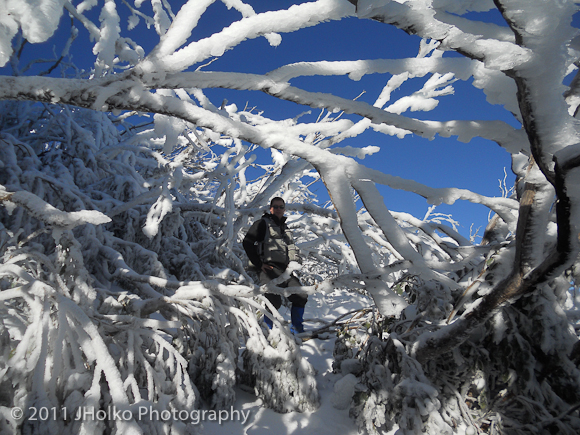
Hoar Frost Forest

I found the side pockets of the vest a great location for storing lenses up to the size of the Canon 70-200mm F2.8L IS. I can reach around and take a lens in and out of these pockets with relative ease without having to remove the vest. The 70-200mm F2.8L IS lens is somewhat of a tight fit in these pockets and if I was ordering this vest again would have the circumference of one of the pockets increased slightly to more easily accommodate this lens. As it stands its acceptable with the 70-200 F2.8L IS and easy with anything smaller. The ability to retrieve and stow a lens or thermos in the side pocket is a real boon as I found it very convenient when I wanted a cup of coffee on a hike or wanted to access a lens quickly.

The padded hip belt was I feel a significant factor in the comfort this vest provided over long hikes. During a three and a half hour hike through relatively deep snow I never felt any back or neck discomfort. I only removed the vest once during a snack break and only then to climb a nearby boulder more freely for a better view of the surroundings. The vest does an outstanding job of spreading the weight of the equipment much better than a traditional back-pack that loads the shoulders and tends to make you somewhat unbalanced. By loading up the front pockets of the vest as a counterweight to the large rear pocket weight is more evenly distributed and makes hiking much easier. The padded hip belt just helps spread the weight and transfer some of it to the waist. Because of the nature of this product being a vest everything is easily accessible in pockets; which is extremely convenient and makes working in the field with a backpack seem very primitive.

Waiting for Sunset at The Monolith

Overall I am very impressed with how this vest performed in its first field test. It has met my expectations and actually proved more comfortable on long hikes than I had envisaged it would be. As I mentioned in Part One, these vests are custom made for the photographer. They are about function and convenience and not style and looks. I am certainly not going to win any fashion awards in the field with this accessory; but it is going to make my hikes more comfortable and my equipment more accessible and that makes it a well designed product in my book.