Exhibition on Moab Somerset Museum Rag

Moab have added a brief blog post to their website on my upcoming exhibition – printed entirely on my favourite new paper – Somerset Museum Rag paper.

Somerset Museum Rag is the newest paper by the acclaimed St Cuthberts Mill in England, who over a decade ago helped create an entire industry when it launched Somerset Enhanced Velvet – one of the first papers used for fine art digital imaging.

Somerset Museum Rag is a pioneer in its own right while remaining true to its history.  It combines an archival 100% cotton heavyweight paper with a smooth surface, sensuous to the touch while durable to everyday handling, with the latest in coating technologies to produce deep, rich blacks with an unparalleled color gamut to make a vibrant image pop to life.

In addition to the inkjet-coated version, the original, uncoated Somerset papers continue to be one of the top papers used by artists worldwide for nearly every form of printmaking.


Scotland’s Mountains by Joe Cornish

During some recent email correspondence with my friend from Iceland Daniel Bergmann; he recommended a book by Photographer Joe Cornish titled ‘Scotland’s Mountains’ with the sub title ‘A Landscape Photographers View’. I subsequently purchased the hard-back book from Amazon on his recommendation and have to say that it has been one of the most enjoyable and wonderful photographic books I have owned.

Scotland’s Mountains follows on from Joe’s previous book ‘Scotland’s Coast’; which I ordered immediately upon receiving his ‘Mountains’ book from Amazon. It has not as yet arrived; but I am eagerly looking forward to spending some time going through the photographs when it does. I particularly enjoyed reading the included ‘field notes’ at the end of the book. As a landscape photographer its always interesting to read how another photographer composed, metered, exposed and dealt with the environmental conditions at the time the photograph was made.

I knew of Joe Cornish’s work through the internet but it took the medium of the printed page to really bring home to me how much I enjoy his photography – Another timely reminder that photography really is all about the print. Photographed almost exclusively on a 5×4 camera with film (yes film – although there are a few digital captures amongst the images) the quality of the photographs and printing are superb. So often I feel a sense of deflation upon seeing beautiful photography printed really badly by the book publisher – it unfortunately happens all to often. Thankfully in this case Aurum press have done a wonderful job.

I do not intend for my blog post to be a review of Joe’s book or work. His photography is wonderful and no more need be said in this regard. Instead this post is more of a ‘shout-out’ to check out his work and in particular his book/s if you have not done so. If you have an interest in photography or even just in Scotland I highly recommend Joe’s Book.

THE QUESTION OF HDR AND POST PRODUCTION

From time to time (and with increasing frequency) I get emails asking ‘how many, if any, of my photographs are HDR or High Dynamic Range?’

The answer is: None.

For any reader who may be unaware: HDR photography is the art of capturing several (usually two or three) different exposures of the same scene. Each exposure will be optimised at the time of capture for either the highlights, shadows or mid tones of the scene. The multiple frames are then composited in Photoshop or alternative program and tone mapped. The final output is a single photograph that captures a dynamic range wider than what the cameras sensor was capable of recording in a single exposure. Usually, but not always, the results are unnatural and somewhat ‘odd’ (at least to my eyes).

All of the photographs on my Portfolio website and on my blog are single exposures that were captured that way in the field. I may well have taken multiple exposures (bracketing) at the time of capture; but this was simply to give me choice of picking the best overall exposure to work with back in my studio – Never for the act of combining for a HDR image. Not that there is anything wrong with HDR photography; but it just isn’t something that interests me, or frankly that I even particularly like.

I am also often asked “if the colours in my photographs are real?”

The answer is: Yes.

I actually do very little post processing work to my photographs in the vast majority of cases. Probably 99% of my photographs never even make it to Photoshop – receiving only basic post processing corrections in Adobe Lightroom. These corrections include adjustments such as white balance, setting white and black points, burning and dodging etc. I am a strong advocate for ‘getting it right in the field’. I use graduated neutral density filters extensively to tame the high dynamic range found in nature and these allow me to capture scenes with a single exposure without resorting to post processing techniques such as HDR tone mapping. I spend many many hours in the field waiting for the right light for my photography and frequently revisit locations for better light.

My shooting style is pretty simple – I like to arrive at my location with plenty of time before the light is at its best. Usually, this means at least an hour before sunrise or sunset (I generally prefer sunrise – the best light being just before the sun crests the horizon). Almost always, if possible I will have scouted the location earlier in the day to ascertain what I wanted to photograph. However, I am always ready to go with the flow, and if I see something happening nearby (maybe the light is reflecting off a pool of water, or whatever) will change my plans accordingly. I shoot with a tripod, mirror lock-up and a cable release. I like to take my time to compose my photographs thoughtfully; I use ‘live-view’ to assist with composition and focusing.

Once I am ready to take the photograph I may make several different exposures so that I can later on choose which is best for my purposes. I will also usually do a number of different compositions and again later in my studio choose which I prefer. During post processing I will endevour to draw out any subtle tones and colours that were captured by the cameras sensor at time of exposure. These adjustments or enhancements if you prefer are usually no more than corrections for the inherent flatness of a RAW file compared to a jpeg; which has already and automatically had post production performed in camera.



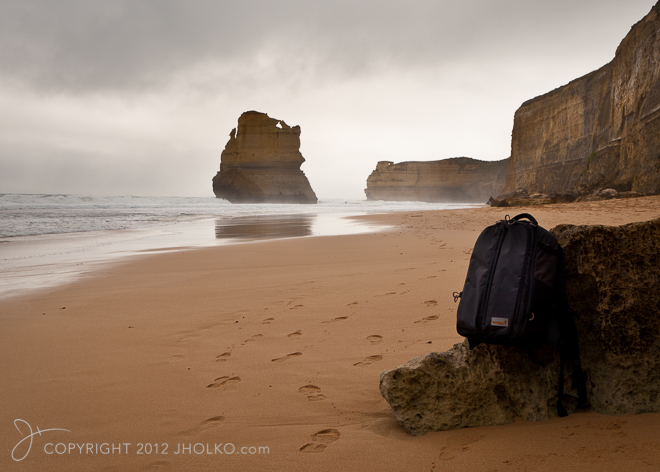
Lorne – Outgoing Tide and Gura Gear at the Twelve Apostles

After spending so much time photographing icebergs in Iceland on the black sand beaches in July and August this year it was really wonderful to get back onto some golden Australian sand for some local photography. It was really enjoyable to just spend a couple of days driving down the Great Ocean road again through Lorne, Apollo Bay and on past the Twelve Apostles, Gibsons Steps, London Bridge, the Grotto, Loch Ard Gorge and Port Campbell. This part of Victoria is simply beautiful and is a wonderful world class location for landscape photography. If you are considering a photographic trip to Australia then this part of Victoria is a must. This first photograph was taken along the beach on an outgoing tide at dawn just before the drive into Lorne. You can just see the Lorne pier in the top right hand corner on the horizon.This short trip was also the first good opportunity I have had since returning from Iceland to put my new Gura Gear Kiboko camera bag through its paces in the field.  This is going to be old news to those of you who already own the fabulous Gura Gear Kiboko camera bag; but thats ok. If you are fortunate enough to own one of these camera bags you need read no further and are summarily excused to go out and do some photography. If, you do not yet own a Kiboko then before you grab your current bag and head out the door take a few minutes and read on because I really do not know how I managed all these years without the Kiboko for carrying all my equipment in the field.

I recently blogged about the Gura Gear Kiboko on my return from three weeks photography in Iceland after I realised how dissatisfied I had become with my current Lowe Pro Nature Trekker back pack. As my photography equipment has grown over the years it had become increasingly difficult to fit it all into the Nature Trekker and inevitably something got left behind – and thanks to ‘Murphy’ that ‘something’ was usually what I needed in the field. Don’t get me wrong; the Nature Trekker is a great camera bag – its well made, virtually waterproof and is one of the toughest bags on the market; but its simply rendered obsolete by the Kiboko.

Physically, the Kiboko is almost the same size as the Nature Trekker; but that is where the similarities end. The Kiboko weighs less than four pounds – yes, less than four pounds. The Nature Trekker on the other hand weighs in at more than double that. And that is with the optional daypack removed! But the weight saving isnt even half the story. The real genius of the Kiboko becomes clear when you start to pack it with equipment. The Kiboko holds significantly more on the inside than its appearance would have you believe. In fact it will swallow a huge amount of equipment and give you easy access to it in the field.

Here is what I have in my Kiboko: (and the Kiboko meets airline carry on size restrictions with all of the below!)

  • 1 x Canon EOS1DS MKIII
  • Spare Battery for EOS 1DS MKIII
  • Canon EOS1DS MKIII Battery Charger
  • 1 x Canon S90 Point and Shoot
  • 1 x Canon 17mm F4L TSE
  • 1 x Canon 24mm F1.4L MKII
  • 1 x Canon 35mm F1.4L
  • 1 x Canon 50mm F12L
  • 1 x Canon 85mm F1.2L MKII
  • 1 x Canon 70-200mm F2.8L IS
  • 1 x Canon 300mm F2.8L IS
  • 1 x Canon 1.4 TC Extender MKII
  • 1 x Canon Macro Extension Tube
  • 1 x Canon Cable Release
  • 1 x Bubble Level
  • 2 x Polarisers
  • 1 x UV Filter
  • 1 x Lee Pro Filter Holder and 3 x Adapter Rings in LEE Pouch
  • 6 LEE Grad Filters in LEE Pouch
  • 2 x Micro Fibre Cleaning Clothes
  • Packet of Lens Tissue
  • All my CF and SD Cards in SanDisk Pouch
  • All of the lens hoods for the included lenses

Oh.. and on top of that I still have room for at least another lens!

Canon Elaborates on New Super Telephotos and Extenders

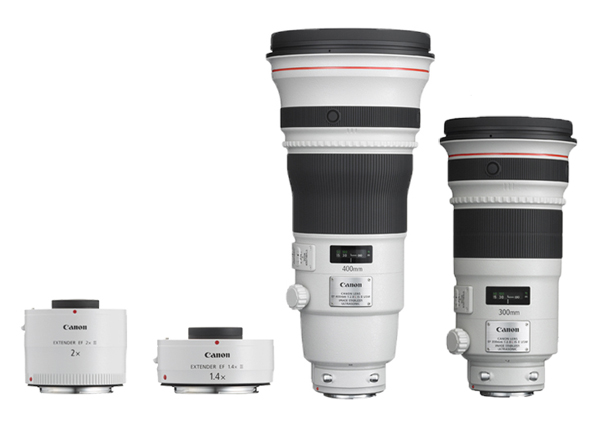
Canon has posted more information on the new 300mm F2.8L IS II USM and 400mm F2.8L IS II USM super telephoto lenses as well as the new 1.4x TC MKIII and 2x TC MKIII tel-extenders on their Digital Learning website.

In August 2010, Canon introduces two improved supertelephotos and companion extenders (from L to R): Extender EF 2X III, Extender EF 1.4X III, EF 400mm f/2.8L IS II USM, and the EF 300mm f/2.8L IS II USM (note that extenders are not shown to scale with lenses)

It may be hard to believe that it’s been more than a decade since Canon introduced its first generation of image-stabilized super-telephoto lenses, but it’s true. The EF 300mm f/2.8L IS USM, EF 400mm f/2.8L IS USM, EF 500mm f/4L IS USM and EF 600mm f/4L IS USM, along with the Series II EF Extenders, were introduced in 1999. Even now, most photographers would agree that those products have been and continue to be state-of-the-art in terms of quality and performance.

However, there is always room for improvement. During the past 11 years, Canon has listened carefully to feedback from professional photographers, visiting various shooting locations around the world and making firsthand observations of the issues that are encountered by actual users. At the same time, the company has continued to invest significant funds in research and development, resulting in technology advancements that have made higher performance products possible.

Against this backdrop, Canon is proud to introduce its second generation of IS super-telephoto lenses, beginning with the EF 300mm f/2.8L IS II USM and the EF 400mm f/2.8L IS II USM. Along with the new lenses, Canon is introducing the Extenders EF 1.4X III and EF 2X III. All of these products are scheduled for initial shipments by the end of 2010. Canon has also issued an announcement that the EF 500mm f/4L IS II USM and EF 600mm f/4L IS II USM are currently being developed, with delivery planned in 2011.

Please see the Canon Digital Learning website for the complete story.