Canon officially announce Development of EOS 1DX MKIII

Hot on the heels of my recent Canon EOS 1DX MK3 post, Canon has today officially made its development announcement for the new camera. Not all of the final specifications have been revealed (for example, we do not has yet know how many mega pixels it will include, (you can expect it will be between 22 and 28) but there is some very big news in the announced capabilities. 4k Video recording in RAW format at 60p is massive news for video shooters. Dual CFexpress cards as predicted and an increase in shooting speed to 16 FPS with the optical viewfinder, or 20 FPS with live-view. What caught my eye and what I am really looking forward to is the increased auto focus capability out near the corners of the frame, improved AF in low light, improved AF algorithms with deep learning and improved capability to move focus points and continue tracking the subject (all features I have been asking for). Slated for April 2020 delivery I already ordered two of them (at 2am here in the USA and suffering from jet lag).

Canon Inc. announced today that development is underway on the EOS-1D X Mark III, the newest entry in the EOS-1 series highly trusted by professional photographers for its high performance and reliability. The new model will deliver enhanced image quality, continuous shooting and operability over its predecessor, the EOS-1D X Mark II (released in April 2016).


This year marks the 30th anniversary of the birth of the EOS-1 Series flagship model of Canon cameras, which began in 1989 with the release of the EOS-1. Based on the original EOS concept of delivering automated performance in accordance with the will of the user the EOS-1 was designed to meet the most demanding professional needs with state-of-the-art technology, top-class functionality, durability, strength and reliability.

Canon is planning to implement the following features in the currently under-development EOS-1D X Mark III:

1.         Newly developed CMOS sensor and image processor for higher image quality and faster continuous shooting speeds.

I.          Canon’s in-development proprietary CMOS sensor and image processor will realise higher sensitivity for stills shooting compared with predecessor models. Saving of still-image 10-bit HEIF* files will be supported. In addition, the camera will support internal recording of 4K / 60p / YCbCr 4:2:2 / 10-bit / Canon Log and RAW format video.

II.         AF and AE tracking supported whether shooting with the optical viewfinder (OVF) or live view and improved continuous shooting speeds compared with previous models. With AF and AE tracking, the camera realises up to approximately 16 frames-per-second shooting using the OVF and 20 with live view. What’s more, when shooting with live view, photographers can choose to shoot using either the mechanical shutter or electronic shutter.

III.        5x increase in maximum number of images captured when performing continuous RAW shooting compared with predecessor models.

2.         More precise autofocus thanks to newly developed AF sensor and AF algorithm

I.          A new AF sensor will be employed, which increased the number of effective pixels in the centre pixel area by approximately 28x compared with predecessor models. High-resolution signals obtained by the AF sensor will enable high focus accuracy when shooting through the OVF. In addition, an expanded AF brightness range will be available for both OVF and live view shooting.

II.         When using either the OVF or live view, the new AF algorithm, which features more stable performance, will utilise deep learning technology to further improve it tracking capabilities.

III.        In live view, the AF offers an expanded focus area of approximately 100% (vertical) and approximately 90% (horizontal). In addition, up to 525 measurement points can be used for AF when using automatic selection.

3.         Serving professional needs with enhanced data transmission functionality

I.          The currently in-development Wireless File Transmitter WFT-E9 (regulatory approval pending), when used with the EOS-1D X Mark III, realises more than twice the wireless image data transmission speed** as its predecessor model, the WFT-E8 (released in April 2016). What’s more, the WFT-E9 can also be used with the EOS C500 Mark II cinema camera (on sale in Australia from January 2020).

II.         Serves as a connection to smartphones and other mobile devices via Wi-Fi and Bluetooth®†. Also enables recording of GPS information at the location of image capture.

III.        When using a wired LAN connection, the WFT-E9 achieves more than twice the image data transmission speed** of its predecessor model.

IV.        Improved UI for establishing network connections.

V.         Expanded link functionality with various equipment. Compatible with the in-development Remote Control Pan-Tilt System which enables remote camera operation.

4.         Trusted by professional photographers on the front lines

I.          Strong magnesium-alloy body provides high reliability.

II.         Rear-side buttons important for operation are back-lit to enable menu operation in dark conditions.

III.        The camera’s memory card format has been changed from CFast 2.0 to CFexpress, enabling faster data writing. In addition, the camera will include two memory card slots.

IV.        AF Start button features a new internal device that enables fast AF tracking setting without users having to release their finger.

V.         Battery Pack LP-E19 and a newly designed power management system provide a greater number of shots per charge compared with predecessor models.

*High Efficiency Image File format. Realizes wider dynamic range and color representation compared with JPEG.

**Transfer speeds may be adversely affected depending on the usage environment.

†Supports Bluetooth Low Energy technology.

Canon EOS 1DX MKIII – Feature Set and Wish List

It is no secret that Canon will soon be announcing the new Canon EOS 1DX MKIII professional DSLR camera body (I expect we will see a February announcement with an April / May 2020 delivery – in time for the Japan 2020 Olympics). The current 1DX MKII has been my go-to workhorse (I own two of them) for the last four years. It has been (and remains) an incredible camera for working and photographing in the worlds polar regions. The 1DX MKII has never let me down in the field and has continued to operate reliably in temperatures as low as -50ºCelsius; even when all of the buttons are literally frozen in place. I have had these cameras so wet they may as well have been underwater. I have dropped them repeatedly, banged them into ship railings, left them buried in snow and ice for hours and otherwise abused them in the pursuit of the image. They are quite literally the most reliable digital cameras I have ever used. So how does Canon improve performance further in the soon to be announced EOS 1DX MKIII?

Here is my best guess (and wish list) for the Canon EOS 1DX MKIII in terms of new and improved features. I am going to refrain from discussing the low level consumer orientated features such as built in HDR, Focus stacking etc. and confine my comments to the features and capabilities that I see as most important. Some these I know for fact and some are my best guess. You will have to surmise which is which.

1 – The 1DX MKIII camera body will be identical or very similar to the EOS 1DX MKII. It will be an EF mount (not RF  -see footnote). Expect built in GPS (as per 1DX MKII) and the inclusion of WiFi. We may see a very slight reduction in overall weight with the use of some new high tech composite materials. I do not envisage huge weight savings since professional photographers working with these cameras greatly value their rugged build quality and the cameras ability to take severe and repeated knocks. The extensive use of light weight materials would by definition compromise some of this build quality. A small weight saving would be appreciated, but is far from mandatory. The EOS 1DX MKIII will ship with an all new battery, but will still be backward compatible with batteries from the original 1DX and 1DX MKII with some reduced functionality.

2 – The EOS 1DX MKIII will have an optical viewfinder – not an EVF. However, we should expect many of the EVF benefits (such as live histogram) when using the rear LCD in live-view mode. It is my hope the 1DX MKIII will  include ‘zebras’ and ‘focus peaking’ when using Live-view. Focus peaking is an absolute god send when working with tilt shift lenses and is one of the primary reasons I purchased an EOS R RF for my landscape photography. Whilst there has been some talk of a ‘hybrid’ EVF / Optical viewfinder I do not believe we will see such a system in an EOS 1DX MKIII. The 1DX MKII was revolutionary for the display capability it offered with its optical viewfinder. I expect the 1DX MKIII to offer similar advantages.

3 – The EOS 1DX MKII with have an all new sensor with between 24 and 28 mega pixels. There is just no reason for Canon to try and stuff more than 28 mega pixels into this professional body. Even Sony realises that professionals just don’t need or want super high mega pixel cameras (witness the release of the Sony A9 MKII with the same 24 mega pixel sensor as its predecessor). Professional photographers understand that it is the quality of the pixels that counts – not the number of them.

4 – Improved high ISO performance. I will comfortably shoot my EOS 1DX MKII in low light situations at ISO6400 if that is what is required to capture the image. However, once you exceed ISO6400 the file is best described as sub optimal and things start to deteriorate rather quickly from there. I expect that EOS 1DX MKIIII will offer better high ISO performance by approximately one or two stops. Sensor technology has more or less plateaued in the last twelve months and I think it highly unlikely we will see huge ISO improvements. Sony’s release of the A9 MKII with a two plus year old sensor (with no update) is living proof that sensor technology (at least high ISO capability) has more or less plateaued.

5 – The EOS 1DX MKIII may, or may not have IBIS. If I was a betting man I would give the inclusion of IBIS no better than even odds.  Whilst the inclusion of IBIS would be ‘nice’, I don’t believe it mandatory; especially given recent  improvements in lens image stabilisation.

6 – Canon will drop the CFast format and move to dual CF Express card slots.  Whilst I will greatly appreciate the inclusion of dual CF Express slots (rather than one CFast and on CF) it does unfortunately necessitate another round of new cards and a new card reader (and that is not a cheap investment for high speed cards). Hopefully Canon Australia helps ease this transition with the inclusion of a reader and CF Express card with the purchase of the new camera (they did this with  CFast and the 1DX MKII). Lets hope for all our sake that the world finally standardises on CF Express as the preferred format of choice.

7 – Improved high speed frame rate: Probably up to 30 frames per second with the mirror locked up. I doubt we will see more than 16 frames per second with the mirror moving up and down as there is just too much mechanical movement required to make a mirror move this fast on a reliable basis. Whilst 30 frames per second with the mirror locked up sounds impressive, I am not sure how useful this will actually be in the field since locking up the mirror blanks out the optical viewfinder and would necessitate using the rear LCD screen (not ideal in most shooting situations). The use of a pellicle mirror would enable a 1DX MKIII to shoot at 30 frames per second without having to lock up the mirror (since a pellicle mirror is fixed), thus enabling the photographer to utilise the optical viewfinder without blackout. However, we have not seen Canon employ this technology since the Canon EOS 1NRS 35mm sports film camera (if memory serves this was around 1995). There are compromises to a pellicle mirror system, but such compromises are more or less easily mitigated with todays technology. Personally, I would be extremely happy if Canon decided to employ a pellicle mirror system in the 1DX MKIII, but I think the odds of this technology reappearing out of the blue at this point are slim at best.

8 – Additional auto focus points closer to the edges of the frame: Quite honestly, this is my biggest wish for the EOS 1DX MKIII. Ideally, I would like auto focus points (cross type and phase detect) right out near the edges of the frame. This would remove the need to focus and recompose when shooting wildlife (which I often have to do). Focusing and recomposing is extremely difficult with fast moving subjects and focus points out closer to the edges of the frame would be of huge assistance in my own wildlife photography (I know sports photographers would also hugely appreciate this feature). Typically I like to compose with my subjects (wildlife) toward the edges of the frame and the only way I can currently do this is to focus and recompose. When the wildlife is moving this becomes extremely difficult. If I could only choose one improvement for the EOS 1DX MKIII it would be additional focus points closer to the corners of the frame.

9 – Improved Rear LCD Screen: The rear LCD screen on the EOS 1DX MKII is already outstanding and fit for purpose so any improvement in the 1DX MKIII is likely to be small. I expect the screen will be either identical to the 1DX MKII, or  ever so slightly larger with slightly improved resolution. Any improvement is likely to be small and an evolution rather than a revolution.

10 – Expect increased frame rate for 4K movie recording – probably up to 120 frames per second. I do not expect Canon to include 8K Video recording in the 1DX MKIII (if they do it will only be at a very low frame rate).

Expect the rumour mill to continue to ramp up as we get closer to an actual camera announcement. Most of what will emerge across the internet over the next few months will be nothing more than hearsay and nonsense and any actual real facts are likely to be concealed beneath layers of miss-information. There is a possibility Canon will make a development announcement toward the end of this year (2019), but I think it more likely that silence and rumours will reign until the official announcement early next year. In the meantime, life goes on with the EOS 1DX MKII and speaking frankly,  it has a great many images left in it.

Footnotes

  • There are over one million EF lenses in the field today. Professional photographers the world over have serious and large investments in EF glass. Canon is not about to abandon its professional users and force them to purchase all new RF mount glass on the eve of the Japan olympics. That just isn’t going to happen. Additionally, Canon has already publicly announced that they are continuing development of EF mounted lenses alongside the new RF mirrorless mount.

Moab Masters Power of the Print Video Release 2019

Moab and Legion paper have just released a new Power of the Print Video as part of the Moab Masters series. I have been working with Moab as one of their Master Printers for more than eight years now and I am still just as passionate about printing today as I was back in the film days – actually even more so.  Moab still produce my favourite paper for printing – Moab Somerset Museum Rag. An absolutely gorgeous rag paper with a wonderful surface stipple that reproduces the texture and tone of snow and ice with a majesty and tactility that I find unmatched by any other paper I have tried. If you are not printing your photographs you really are missing out on what is probably the most satisfying and enjoyable aspect of the entire photographic process. My sincere thanks to Tony Knight and This is My Life for the video production.

Canon EOS R Mirrorless Camera Field Tested

Those of you who followed my recent landscape workshops to the Great Ocean Road and Tasmania (Read the Trip Report) will already be aware that I took the plunge and purchased a Canon EOS R mirrorless camera body to test in the field. It was not a decision I took lightly and I thought long and hard on the implications before I bought into this new RF mount system (more on RF below). I was quite prepared to take the gamble and sell the camera if I decided it did not work for me and the style in which I like to photograph. As it turned out, I am keeping the camera and it will serve as my dedicated landscape camera going forward. By way of some back story, I have been looking for a light weight landscape camera for some time now and was keen for it to be a mirrorless camera. Although the 5D MKIV has many appealing properties I really wanted something smaller and lighter with an EVF. I specifically wanted an EVF for my landscape camera for the focus peaking feature which is an absolute god send when using tilt and shift lenses. I have tried previous generations of the Sony A7 series; but frankly those cameras are not for me. They left me frustrated at their ridiculous ergonomics and scratching my head at their confused menu structure.

Unlike the vast majority of You Tube camera video reviews (does anyone actually use these videos to make buying decisions?) I wanted to actually spend a good amount of time in the field with the camera to really get my head around it before I made up my mind on what I like and what I did not like. Two weeks of intensive use in Victoria at the Great Ocean Road and in Tasmania gave me a great opportunity to come to grips with the camera and really see how it performs in the field  for my style of photography (specifications are really useless for anything other than armchair evaluation and armchair evaluation is about as useless as it gets for assessing the tool during real field work).

My impressions of the Canon EOS R are based on the application I intend to use the camera for – Landscape photography where I am primarily based on a tripod. My thought process for choosing the EOS R was fairly simple: I wanted a camera that was light weight for hiking and one with which I could utilise my existing Canon tilt-shift lenses (with or without adapter). I did seriously consider the Fuji 50 Medium Format but ultimately decided the lack of tilt shift lenses was a deal breaker for me (I have no interest in focus stacking in post).  I was also less than thrilled at the wallet breaking concept of purchasing into an entirely new lens system (I did try the Fuji camera on several occasions and found it an outstanding camera). Packing the same sensor as the Canon EOS 5D MKIV, the EOS R was perhaps the obvious choice. So how did it perform as a dedicated landscape camera?

In short, the Canon EOS R performed exceptionally well in the field and far better than I had thought it might have as a dedicated landscape camera. I very much appreciated its light weight form factor (especially on hikes) and surprisingly to me I also very much enjoyed the cameras ergonomics (although I have not as yet made up my mind about the touch bar). The buttons more or less fall naturally under my fingers (except for the AF button which is a little too close to the side of the camera for me – but I have big hands). I found the Electronic Viewfinder to be amongst the very best I have tried and although it is not as good as a high quality optical prism I did find it acceptable in most situations. Like all EVF’s, the display in the EOS R tends to fall apart in near darkness and is horrible for high speed capture (more on this below).

When it comes to battery life we need to be crystal clear.  Compared to something like a Canon EOS 1DX MKII battery life in the EOS R (and indeed all mirrorless cameras) is abysmal. I can get thousands of shots on a single charge with a 1DX MKII (even in sub zero temperatures). With the Canon EOS R I was lucky to get 100 shots. For landscape photography where I am utilising a tripod this really isn’t too much of an issue for me and it just means I need to carry a spare battery (no big deal as the batteries are small and light). Even a heavy days landscape photography is usually less than 100 images anyway so battery life is really close to irrelevant. Nonetheless I find the need to carry a 2nd battery an annoyance and the need to change it frequently even more so.

I know the arm chair experts out there are at this point brandishing pitchforks and fire brands with cries of ‘Dynamic Range!’  So, let’s clear up the DR issue right now: Yes, the EOS R has the same sensor as the 5D MKIV and yes it does not have the 14+ stop Dynamic Range of the Sony Sensors. But who cares? Im yet to see a single photograph that is worth the paper it is printed on that actually uses even close to 14 stops of Dynamic Range. Call me old school, but I want to make photographs in soft light with a limited dynamic range and if the sky falls outside of the sensors capability to record it I am more than happy to use a graduated ND filter to tame the Dynamic Range. The new range of high quality optical glass filters on the market are superb and have no negative impact on image quality.

As a wildlife camera and for the sort, type and style of wildlife imagery I pursue I am afraid the EOS R is all but useless. Its frame rate is just far too slow for subjects such as birds, its auto focus is not a patch on the EOS 1DX MKII in the field and the EVF is simply sub optimal with fast moving subjects. The time may come when a mirrorless camera is the weapon of choice for wildlife, but until that time the 1DX MKII and its replacement the 1DX MKIII will be my tools of choice for serious wildlife work.

Canon had a number of solid engineering reasons to develop the new RF mount for its mirrorless system. Frankly, none of those reasons offer me anything I don’t already have in my current EF mount so I think it highly unlikely at this point that I will be purchasing any dedicated RF lenses. The new Canon EOS 1DX MKIII when its officially announced will be EF mount. Working Pros such as myself are fully geared for EF mount and we are not about to dump tens of thousands of dollars of glass when the tools we currently have are more than sufficient for our needs. Canon know this and are not about to abandon their core high end market just because they have a new mount in two different mirrorless bodies. We will get a professional mirrorless camera from Canon with an RF mount, but don’t expect to see it until after the 1DX MKIII is announced.

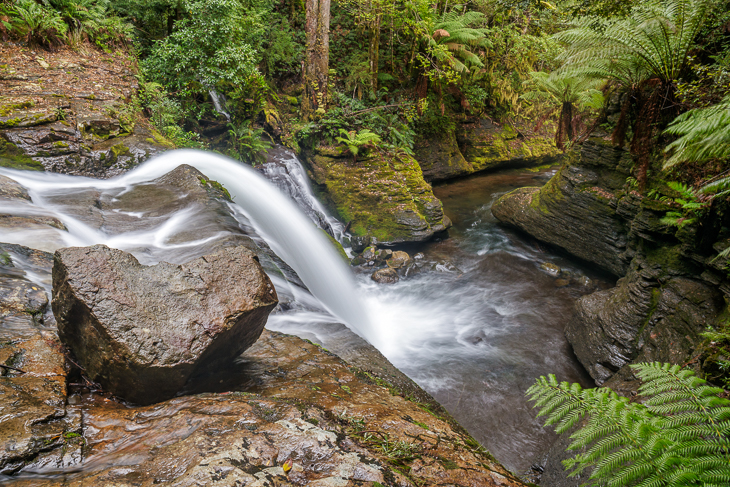
During my testing of the EOS R I also inadvertently tested its weather sealing when I slipped on moss covered rocks at Hopetoun falls in Victoria and temporarily submerged both myself and the camera in the river – whoops! I managed to kill a 24-70mm F4L IS lens in the process, but the camera was absolutely fine. It not only survived the short dunking, but it didn’t skip a beat in the process. Once I extracted myself from the river I simply dried off the camera and kept shooting. Whilst I wouldn’t recommend you try this (I may have just been lucky) it is pretty solid evidence that the EOS R is quite a tough little camera with more than decent weather sealing.

In conclusion, I found the EOS R to be a fantastic tool for serious landscape photography and have decided to keep the camera for just this purpose. I love the focus peaking feature with tilt shift lenses and I really like the light weight form factor. I will definitely not be using it to photograph wildlife though. The cameras slow frame rate, EVF and focus tracking make it sub optimal for my wildlife work. The EOS R would likely also make a very nice walk around camera or travel camera for those looking for a light weight alternative to a traditional DSLR. If I were looking to use it for this purpose I would probably consider one of the new RF lenses so I could do away with the RF to EF converter. For landscape photography on a tripod though the converter is a small price to pay for the convenience of tilt shift lenses. I am looking forward to using the EOS R later this year on my landscape workshop in the Faroe Islands. I will also be taking an EOS 1DX MKII with a 400mm f2.8L IS MKIII for the Puffins.

The photograph below was taken at Freycinet Peninsula on the East Coast of Tasmania with the Canon EOS R with the RF to EF adapter, a 1.4 TC MKIII and the 24mm F3.5 MKII TSE lens (giving me an RF mounted 35mm f3.5 TSE equivalent).  Obtaining infinite depth of field with focus peaking with this setup in the field is an absolute joy and a pleasure. Exposure time was two minutes with a 3 stop Medium NISI Graduated Optical Glass Filter.

Tasmania II Workshop Departure and Packing List 2019

A week of R&R has quickly rolled past and tomorrow I am starting the second of two back-to-back landscape workshops to the Great Ocean road in Victoria and World Heritage Forests and Wild Coasts of Tasmania. Although I have been to Tasmania countless times in the course of my life I never tire of returning to this wonderfully quiet corner of the world. Smattered with primordial old growth forest, pristine rivers and wild and rocky coastlines the landscape opportunities are as fantastic as they are varied. Perhaps best of all, there are still many opportunities to create strong and unique photographs that transcend those captured in the many over touristed locations found around the world today – it is in many ways virgin ground. I have been so taken with the untapped potential on offer in Tasmania that I have decided to return in May next year 2020 and offer one more landscape workshop to Van Diemens land and its primordial forests and coastlines. I will have full details soon, but you can pre-register your interest by dropping me an email at info@jholko.com

Shifting gears somewhat, and hot on the heels of my recent (and somewhat controversial as it turns out) post on ‘Why the DSLR is here for many years to Come *’ are some more thoughts on where mirrorless cameras actually fall into action for the working professional (and serious amateur). Despite what some might believe, I am not against mirrorless cameras (I actually just purchased one – A Canon EOS R). I believe mirrorless cameras hold some significant advantages over traditional DSLR cameras for certain applications and in certain situations. Firstly, mirrorless cameras (the bodies anyway – For some reason mirrorless lenses are often bigger and heavier than their mirrored cousins) are generally much smaller and lighter than their traditional DSLR counterparts. This makes them ideal for hiking and travel. EVF’s (Electronic View Finders) also offer some added additional capability not found in a traditional SLR Mirror camera. Features such as a live histogram in the viewfinder, zebras (for blown out areas) and focus peaking are all really useful features.  The problem with EVF’s to date is their tendency to simply shut down and stop working once they are exposed to temperatures below -10º Celsius for extended periods. Granted, this isn’t going to be an issue for most people, but if you plan to photograph in the world’s Polar Regions at any stage it bears serious consideration. Battery life is also a serious problem in cold weather. The extra current draw required for EVF’s results in dramatically shorter battery time in sub zero temperatures. I have watched photographers struggle with mirrorless battery life on recent cold weather workshops in the Arctic and the necessity to swap batteries in and out on a regular basis is a royal pain in the rear end. By comparison I can get multiple days out a Canon EOS 1DX MKII battery in temperatures as low as -35º Celsius and shoot thousands of frames. No mirrorless camera can do that (yet). Nor, can any mirrorless camera match the focus speed and accuracy of a 1DX MKII in the sort of conditions in which I frequently find myself shooting. I know much of the mirrorless hype would have you believe otherwise, but actual real world experience in the field has shown me it simply is not the case. Nor can any mirrorless camera yet match the rugged build and reliability of a 1DX MKII. That time may come, but today the weapon of choice for serious wildlife work in inclement conditions has to be the Canon EOS 1DX MKII (and its Nikon equivalent).  That said, mirrorless cameras most definitely offer some significant advantages for landscape photography (in all but the harshest of conditions) and that is why I decided to add a Canon EOS R mirrorless to my arsenal.  I did seriously consider the Fuji GFX50 (and its new big brother the GFX100), but ultimately decided the lack of native tilt shift lenses was a deal breaker for me. Especially since the larger sensor in the Fuji results in even shallower depth of field.

For my second Great Ocean Road and Tasmania workshop I am packing the following:

  • 1 x Canon EOS R Mirrorless w/ Really Right Stuff L Bracket (with spare batteries)
  • 1 x Canon 17mm F4L TSE Lens
  • 1 x Canon 24-70mm F4L IS Lens
  • 1 x Canon 24mm F3.5L TSE Lens
  • 1 x Canon 100-400mm F3.5-5.6L MKII Lens
  • 1 x Canon 1.4 TC MKIII
  • 1 x Gitzo GT3533S Carbon Fibre Tripod with an Arca Swiss D4 Geared Head
  • 1 x Set of Nisi Graduated Filters w/ V6. Holder and Polariser
  • 1 x Set of Lee Neutral Density Filters

This will be my first foray into serious landscape photography with my own personal mirrorless camera and I am really looking forward to seeing how it performs in the field. I decided to opt for the EF adapter with the added functionality of the control ring (which I have left at its default setting for Aperture control). Since I primarily plan to use this camera for tripod landscape photography I decided not to purchase any native RF lenses, but rather adapt my current EF lenses (especially my TSE lenses). The addition of the 1.4 TC MKIII is mostly for use on the 24mm TSE lens (turning it into a 35mm TSE Lens).  The keen eyed amongst you might also note the addition of a suite of Nisi Filters. Yes, I recently upgraded from my rather scratched, much loved, but well and truly worn out ‘LEE resin filters’. See you in Tasmania!

* Addendum – It seems Ricoh agrees with me. The DSLR is here for many years to come.