Outdoor Photographer magazine are running a multi-issue (six + issues) feature on the expedition I am leading this November to South Georgia Island and Antarctica with Andy Biggs. This series of feature articles is sponsored by my good friends and manufactures of my preffered camera bags – Gura Gear. The fourth part of the new series is featured in the brand new October 2014 issue. Subsequent issues will include what leads on from South Georgia and Antactica and then at the conclusion of the expedition there will be an issue reporting on our experiences along with a number of photographs taken during the expedition. You can click on the image below to Download a Larger Version of the second article. Be sure to Subscribe to Outdoor Photographer magazine for the follow up issues. Subscriptions are available in single issue or multi-issue in Print, iPad, Zinio and more. Just choose your favourite reading medium, subscribe and enjoy. The South Georgia and Antarctica expedition is now sold out, but I will soon be announcing a future expedition to both the Weddell Sea and South Georgia Island. If you are interested in joining us please Contact Me with your expression of interest.
Category: Media
Media news including interviews, awards, print publications and articles
APPA 2014: Overall Winner Science, Environment & Nature Photographer of the Year and Awarded Australian Institute of Professional Photography Master Photographer Honour
This weekend saw the running of the annual AIPP (Australian Institute of Professional Photography) APPA (Australian Professional Photography Awards) awards in Sydney. These awards are the highlight of the calendar year in Australia in competition terms and are eagerly looked forward to by many (myself included). In fact, they are widely regarded as being at the very top of the pyramid in professional photographic circles. There is something very special about the APPA awards and it’s more than just the kudos that comes with receiving an award – its the incredible standard of work across all categories every year that never ceases to impress and amaze. If you have never checked out one of the annual APPA award books I encourage you to do so (they can be ordered online from the AIPP). They are are a wonderful source of inspirational photography. There is a palpable buzz that comes with the opening of the first days judging at APPA and a drum beat that rises to fever pitch as each day progresses. There are moments of incredible elation and moments of crushing defeat. It can be an emotional roller coaster and whilst its not healthy to become too emotionally invested one can’t help but ride the roller coaster of ups and downs.
If you want to see where the bar is set for world class photographic images and prints you need look no further than APPA. Every year the bar is continually raised that much higher in terms of the standard of work entered. I admit to being a bit of a nervous wreck during the APPA judging. The spine-tingling anticipation of having my work scrutinised for any minutia by my peers gets my heart racing. It’s not even the fear of scoring poorly that puts me on edge; its something far less tangible that I can’t quite put my finger on. If you have never entered or attended the APPA awards that probably sounds a little strange, but for those of you who have entered before you will know exactly what I am talking about. Its a special competition and quite honestly its not for the faint of heart. It’s never wise to take these things too seriously, but on the other hand, APPA is the standard by which professional photographers are judged against each other and is considered to showcase the highest level of photography so one can’t help but become emotionally involved.
This was a massive year for me as I entered APPA after winning multiple categories in the Victorian State Awards including Creative Photographer of the Year, Science Environment and Nature Photographer of the Year, Highest Scoring Print of the Year and overall title of Victorian Professional Photographer of the Year. There is a hefty weight of expectation (even if it is self imposed) that comes with those awards that carries over into APPA so I felt even more nervous than usual when my first print turned around for judging.
For those of you unfamiliar with APPA you can read my previous blog post HERE about how the system operates. The four prints (the maximum you are allowed to enter) I chose to enter this year were my highest scoring prints at state level and I entered them into the Science, Environment and Nature Category. At state level they scored 2 Gold Awards and 2 Gold with Distinctions and thats about as good as one could ever hope to score. So, I was ecstatic to receive a Silver Award, a Silver with Distinction and two Gold Awards for my four entries this year at APPA. All four entries were printed on my favourite fine art paper – Moab Somerset Museum Rag. You can watch a video of the judging of the three highest scoring prints online by clicking on the image below. The culmination of these four awards provided more than the necessary points to also receive the coveted and highly sought after ‘Master of Photography’ ribbon from the AIPP. This award requires the accumulation of not less than ten points in no more than five years after receiving an Associateship Award and its no easy feat to achieve. I had set myself a goal of achieving this in four years and I am pleased to say I managed it in just three years. In fact, I already have several excess points in the bank toward my first Master of Photography Gold Bar. You can read about the honours and points system on the APPA website.
I was even more ecstatic to subsequently learn at the awards dinner last night (which unfortunately I could not attend in person due to print workshop commitments) that not only did I receive multiple Gold and Silver award scores for my prints at National level as well being awarded a Master of Photography by the AIPP but that I also won the overall category and award for 2014 AIPP Canon Professional Science, Environment and Nature Photographer of the Year. This was only the second time I have ever entered this category and taking out the overall title is a huge thrill and honour. It was also a great honour to learn that I took out the highest scoring print in this category – an honour that resonates deeply with my love of the craft of photographic print making. 
 APPA – Silver with Distinction Award ‘Bear Reflections’

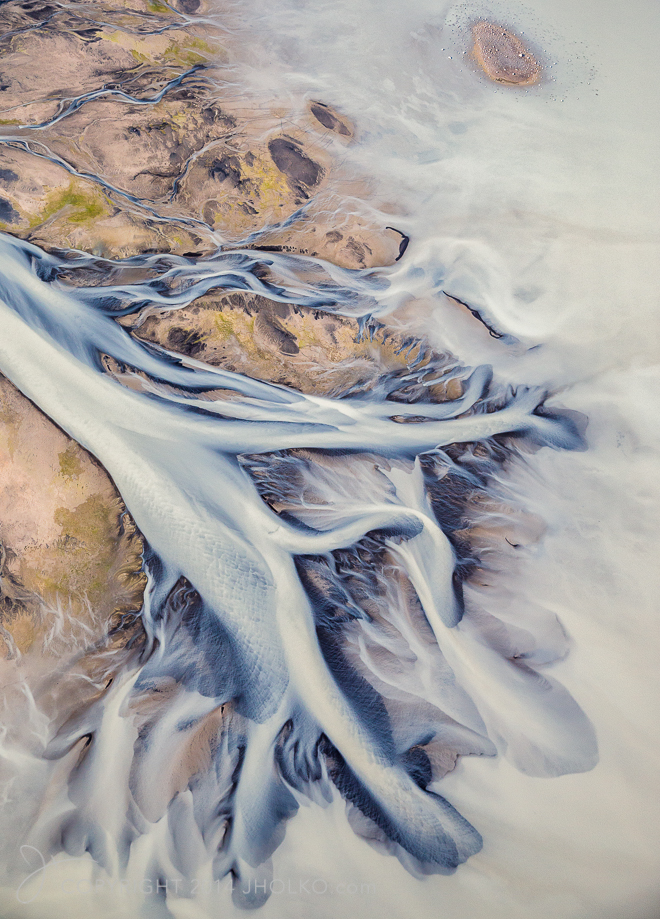
APPA – Gold Award ‘Epic Sense of Scale’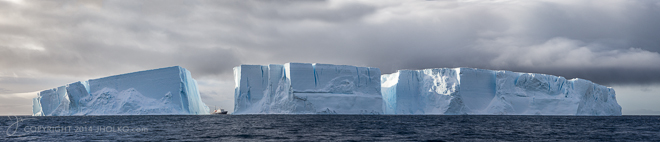 APPA – Silver Award ‘Glacial Delta’
 APPA – Gold Award ‘March of the Penguins’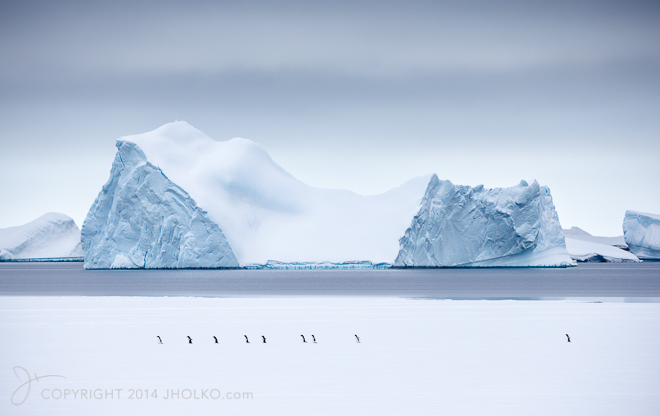
With APPA done and dusted for 2014 and my goal of achieving Master of Photography completed, along with being the overall winner of the Canon 2014 Professional Science, Environment and Nature Photographer of the Year as well as highest scoring print in the category I am now planning to take a short term hiatus from competitions and focus on my book projects that are currently overdue for completion. I hope to have more to say about the first of these over the coming weeks.
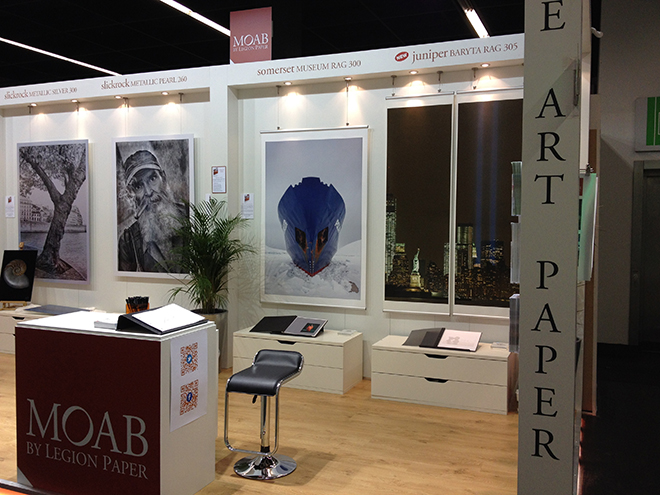
Photokina 2014 – Moab and Legion Paper Stand
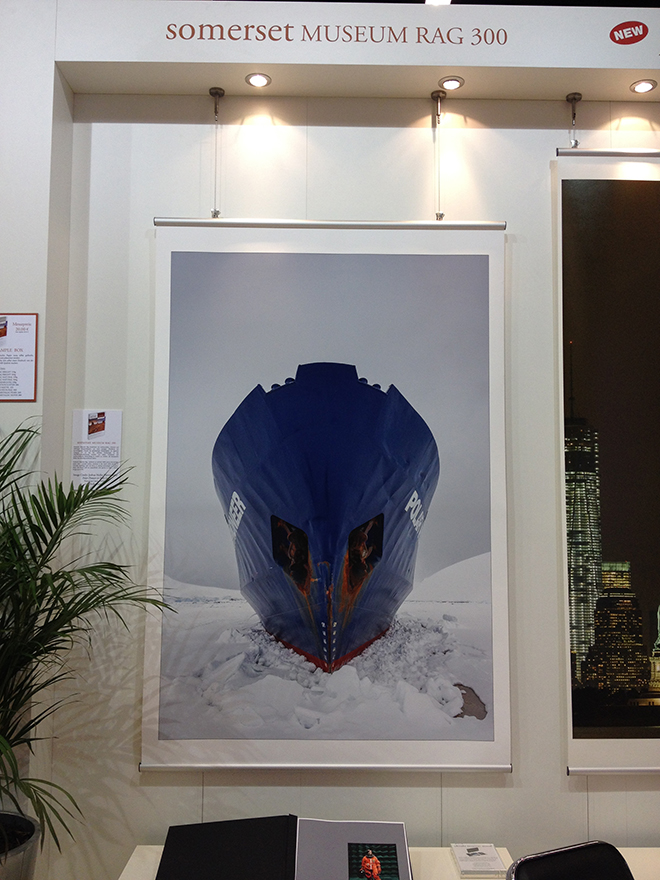
If you are visiting Photokina this year be sure to stop past the Moab and Legion paper stand where one of my images of the ice hardened expedition ship ‘Polar Pioneer’ parked in the pack ice in Antarctica is on display. Printed on my personal favourite paper – Moab Somerset Museum Rag at a whopping 40″ x 60″ inches.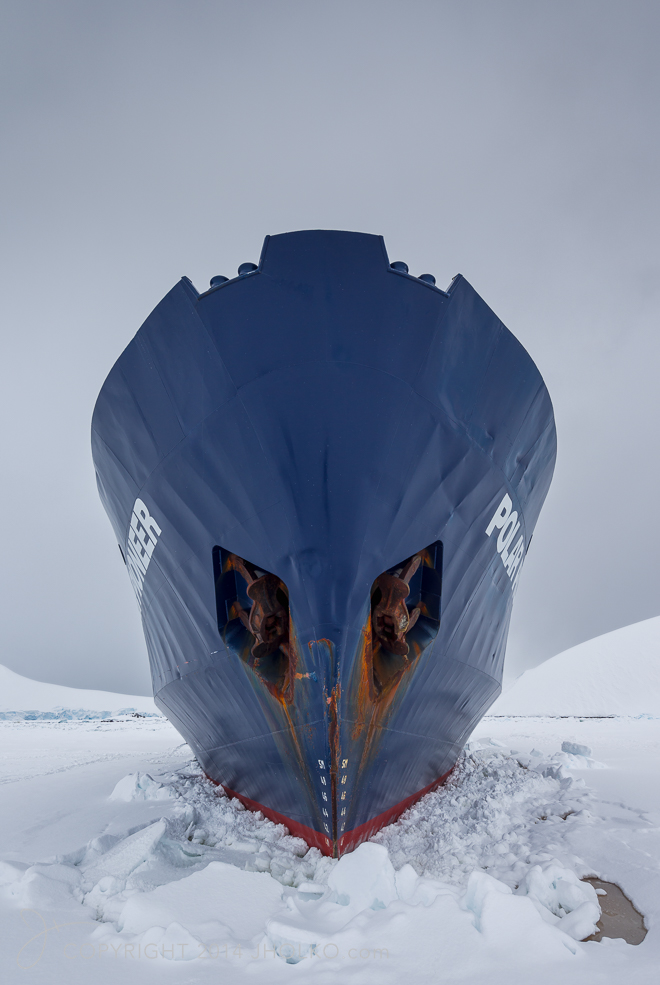
Nature’s Best Photography Semi-Finalist 2014 – A Polar Passion
It is the season for photography competition news so following on from yesterday’s post about the Epson International Pano Awards I was very pleased to learn a few days ago that one of my photographs has made it to the semi-finals in Natures Best Photography this year. This is the third year in a row I have had photographs in the semi-finals or finals of Nature’s Best Photography and I feel very honoured to have been included yet again. Unfortunately I cannot yet divulge which photograph is in the semi-finals – suffice to say the category of choice for me was ‘Polar Passion’.
Nature’s Best Photography is one of the premiere and most respected Nature photography competitions in the market place today (along with BBC Wildlife Photographer of the Year). Importantly (for me) Nature’s Best consider the art of photography the photographers ability to capture an incredible image in the field at time of capture and not just create one on their computer. This is a really important distinction for me as it is in lock step with my own Ethics for Image Capture and post production. As such the submission of RAW files is mandatory to validate them against the high resolution TIFF file at point of entry. Of equal importance to me that the image be captured in the field is that Nature’s Best Photography also place significant emphasis on the print even though the initial round of judging is done digitally. With over 25,000 entries this year it would just be impossible to judge the initial round on the printed page. Kudos to Nature’s Best however for taking the print into consideration in the semi-finals and finals. This is a stance I feel more photography competitions would do well to follow.
It is worth taking a moment to reiterate my thoughts on post production as I am seeing a multitude of over processed, over saturated, and frankly over cooked images across a range of social media and competitions of late as photographers strive to outdo each other (saturation slider goes to +11) and stand out from the crowd. I recently judged several photography competitions for magazines here in Australia and the overall trend was overcooked and over saturated images to my eye. This is of course a personal aesthetic and personal judgement, but its certainly a rising trend. But then this is also a subjective medium and there are as many opinions as there are photographers and frankly none are less valid than another. Along with this trend is an increase in heavily manipulated photographs that include dropped in skies, multiple image composites etc. This is not surprising really as the tools to create such work have become easier to use and more accessible. Suffice to say, from my own ethical perspective I strive to create my photographs at time of capture and not create something that did not exist in Nature. Is this a distinction between a Nature photographer and a Landscape photographer? Possibly… and it could be argued that this is the case, but I certainly hope not. Certainly there are competitions out there touting themselves as ‘the’ landscape competition of choice that have an anything goes approach to post production. I avoid these type of competitions as I feel they are more about creating digital art than about real photography. It certainly shows in the those images that get awarded that the skill of the retoucher is far more heavily weighted than the photographers ability to actually capture a great shot. This is not to say that there isn’t a time and place for this type of post production – I just feel it isn’t in Nature or landscape photography. Categories such as ‘Illustrative’ are far more suitable for anything goes post production. That is my personal judgement however and too each their own.
All of this is good and well of course and it is important to note that standing on an iceberg for forty days, or camping out in the desert for a month does not guarantee a good photograph – because it certainly doesn’t. Time in the field in itself does not guarantee a great capture, or even a mediocre one for that matter; but it certainly stacks the odds in your favour to encounter great subject and great light. Then its up to the skill of the photographer to capture and craft the image at time of capture. Post production should then be used to enhance what was captured – not create something that did not exist. That said, turning a sours ear into a silk purse in Photoshop really does not require much photographic skill – just solid retouching skills. Personally, when I am wowed by a new photograph and I later learn that the photographer dropped in a different sky, or moved an island, or otherwise heavily manipulated the image I feel somewhat cheated. It is my assumption (sometimes incorrectly) that the image was found in Nature and I am left deflated and often disappointed to learn it was a digital creation in post production. I have blogged (ok, ranted) about this on several other occasions but I feel compelled to restate my feelings and opinion for what they are worth in the face of some of the images I am seeing surface across competitions and social media of late. The flip side of this coin is that I am also seeing some really incredible photography emerge across the internet that seems to just drift by quietly and largely unnoticed in the face of the overwhelming noise. The good news is these photographs and photographers are out there producing really incredible work. You just have to filter through the white noise to find and enjoy them. Ill have a list together soon that includes a range of contemporary photographers whose work I believe is being largely missed or ignored outside of their home countries. Watch this space as I think you will very much enjoy the art of great photography.
In other competition news this weekend will see the opening of the 2014 Australian Professional Photography Awards in Sydney. The APPA awards are eagerly looked forward to by all who enter (myself included) and it will, as always be interesting watch the live-stream of the judging. The Landscape category remains an ‘anything goes’ post production fiesta so I have avoided this category entirely again this year and instead chosen a category more in lock step with my own thoughts on post production. – ‘Next Print Please….’
International Pano Awards 2014: Epic Sense of Scale Silver Award
I broke one of my rules for 2014 earlier this year when I decided to enter one of my photographs into a ‘Digital Only’ photography competition. It wasn’t that long ago that I concluded I was really only interested in competitions that judged the finished fine art print rather than the digital jpeg. Nevertheless something went ‘twang’ inside me and in a moment of weakness (or possibly vanity) I entered one image (and one image only) into the 2014 Epson International Pano Awards. The photograph I chose to enter – ‘An Epic Sense of Scale‘ – subsequently scored a Silver Award. Earlier this year at the 2014 Victorian Professional Photographer of the Year Awards it scored a Gold Award and was my third highest scoring print after the two Gold with Distinctions. It also contributed to my overall wins in the Science, Environment and Nature Category, Creative Photographer of the Year Category and Overall Victorian Professional Photographer of the Year. The print was also a finalist in the 2014 Nillumbik Art Award. I mention this because this discrepancy in judging is a very good indicator that photography competitions are subjective and very much a lucky dip at times – You just never know what you are going to get.
Although this photograph scored a very solid silver at the Pano Awards it still fell short of what the judges had to say about the print at the State Awards. Personally, I am not displeased with the result in the Pano Awards as I really feel the jpeg fails to do justice to the printed image – in fact its nothing more than a poor facsimile and the jpeg file probably scored what it deserved. It was a valuable moment for me to receive back my score from the Pano Awards as it reminded me why I prefer to look at prints in lieu of digital files and why I choose to enter print only competitions these days. Am I done with digital only competitions? The answer is probably. There are a few competitions out there that are judging digital files in the initial round of judging but then shift to printed images for the semi-finals and finals and I will continue to enter some of these as time and motivation permits.
In the meantime, I just returned two days ago from more than two months in the Arctic which included two back-to-back workshops in Iceland as well as an expedition to Greenland and Svalbard. I shot over 5000 images during these trips and its time to start the editing and sorting process as well as share some trip reports and feedback. 
 www.WILDNATUREPHOTOTRAVEL.com