Time has snuck up on me and in less than a week I will be flying to the South Island of New Zealand for my 2015 Masterclass workshop. Quite honestly, it feels like only yesterday I walked in my front door after two months on the road in Yellowstone, Iceland and Svalbard and it is quite a surreal feeling to be heading overseas again so soon. It has been a whirlwind time at home split between my family and the office and I feel like I have really only just started to catch up on my backlog of office work. I have no regrets about pushing the office paperwork to one side, but I had hoped to get a few more images processed from my recent travels before I ran out of time.
I am however, really excited about this new Masterclass workshop to the South Island of New Zealand. We have extensive use of helicopters during this workshop for accessing very remote areas and they should provide us some really unique and fantastic opportunities for photography. Early May is my favourite time of the year to visit New Zealand. The Autumn colour will be in full swing and the weather is often ideal with cold, crisp mornings and beautiful sunrises.
I have run out of time for a dedicated packing list post for this trip, but our emphasis is on landscape and as such I will be leaving my longer lenses at home this time. I plan to take my two Canon EOS 1DX cameras along with the 16-35mm F4L IS, 24mm F3.5L TSE MKII, 24-70mm F2.8L MKII and 70-200mm F2.8L IS MKII lenses. I also plan to take a 1.4 TC with me just in case I need a little more reach. I had hoped the new Canon 5DSR would be available by now but unfortunately a thorough and rigorous test of the new high resolution 50 mega pixel camera will have to wait until my Iceland Highlands Expedition in August this year. I am also packing my graduated neutral density filters and my tripod.
Before I leave for New Zealand I will be attending the Epson Victorian Professional Photography Awards that kick off this coming Tuesday the 28th of April and run for two full days at 1140 Studio in Malvern. I was fortunate to win both the Creative Photographer of the Year and Science Nature and Environment Photographer of the Year categories as well the Highest Scoring Print Award and overall grand prize and title of Epson Victorian Professional Photographer of the Year last year; which was a pretty comprehensive sweep and an incredible thrill and honour. I have put aside any expectations on my entries this year and entered solely for the sheer joy and pleasure of the print making process. The craft of fine art printing is really at the core of why I enter both the VPPY Awards and the APPA Awards and its a wonderful experience to watch prints being judged and to be able to view the prints in person. If you are outside Melbourne the VPPY awards this year are being live-streamed and can be watched online:
Room 1 – http://livestream.com/professionalphotography/2015-AIPP-VIC-Epson-Awards-Room1
Room 2 – http://livestream.com/professionalphotography/2015-AIPP-VIC-Epson-Awards-Room2 However, if you are in Melbourne I encourage to come down to the judging in person so that you can view all of the award winning prints as they are judged and displayed. Entry is free and there is an espresso machine on site if that adds any motivation!
 There is an awards cocktail party being held on the Thursday evening and I will then be leaving for New Zealand first thing on Friday morning. As always, I hope to post an update or two from our workshop as we travel through the South Island.
At the conclusion of the Masterclass workshop I will be staying on in New Zealand for an additional couple of weeks of personal photography with my good friend Martyn before I return home.
If you are interested in travelling to the South Island of New Zealand and photographing in this spectacular country I will soon be announcing my 2016 schedule. Please email me to express your interest. There is no obligation at this point. Please just be aware that some places are already spoken for and I do recommend registering interest early to avoid disappointment.
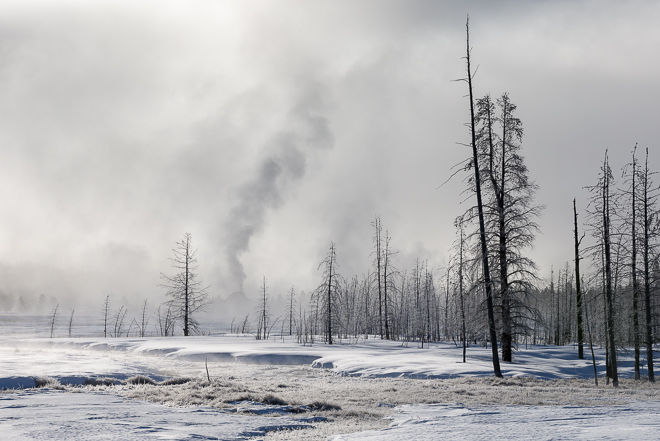 Our plan was to photograph both the landscape and wildlife found in the park and take advantage of the winter snowfall. When visiting Yellowstone in winter there is a sense that you have almost crossed to another planet. The landscape is hushed by a thick blanket of snow. The trees are wreathed in frost and loom like wraiths against the ominous winter clouds. The crisp, icy air enhances the effect of the geothermal features. There is an exotic combination of mist-shrouded hot pools, bubbling paint pots and steaming fumaroles that is the ideal setting for winter landscape photography.
 During this trip we explored the northern part of Yellowstone in the Lamar Valley as well as Mammoth Hot Springs, Old Faithful, Madison Valley and the Firehole River Basin. We also journeyed into the Grand Teton National Park. We had planned to also visit the national Elk Refuge, however the lack of snow this particular season worked against us and we decided to give this a miss and focus on areas with better snowfall instead.
 During our time in Yellowstone we spent several days in the Lamar Valley area photographing both the landscape and wildlife. We were fortunate to see and photograph the Lamar Valley wolf pack on several different occasions as well as Big Horn Sheep, Red Fox, Coyote and Moose. Although the wolves kept a respectful distance it was still a wonderful experience to watch wild wolves in the snow covered landscape. Just as an aside, It was almost as interesting to observe the cult of wolf watchers with their spotting scopes that prowl the Lamar Valley road in the hope of even a glimpse of these elusive animals. I am still sorting through the images I captured of the wolves and I hope to share a few in a future post.
 During the workshop we also spent several days in the Old Faithful area visiting and photographing many of the geothermal features. Geothermal features photograph extremely well with snow and ice. There is a wonderful contrast between rising steam and a snow covered landscape that adds that magic element and wonderful contrast to a photograph.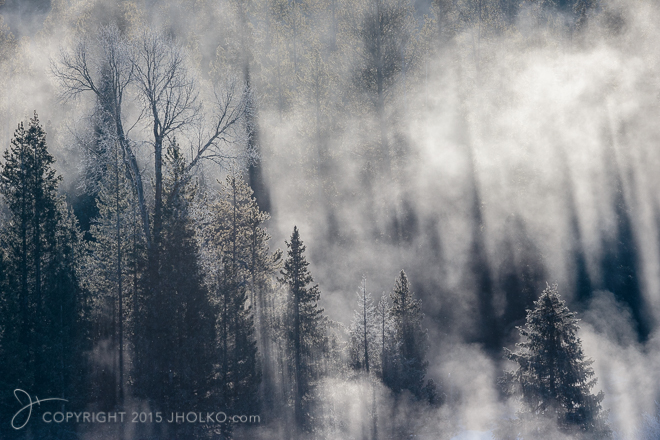

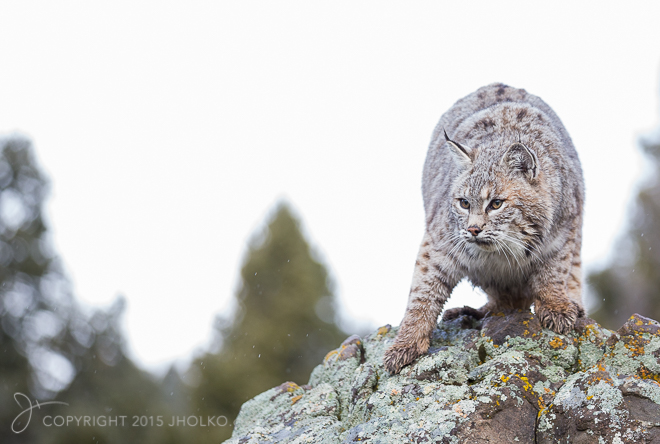 Yellowstone in winter was a fantastic experience and is a truly remarkable place that offers limitless possibilities for photography of both wildlife and landscape in winter. I will be leading a future workshop to Yellowstone for a small group of people in Winter in January of 2017. This workshop will also include an extension into the Grand Teton area that will also take us to the spectacular and iconic Mount Moran area. If you would like to get the drop on the option of securing a place when details are finalised then please just drop me an
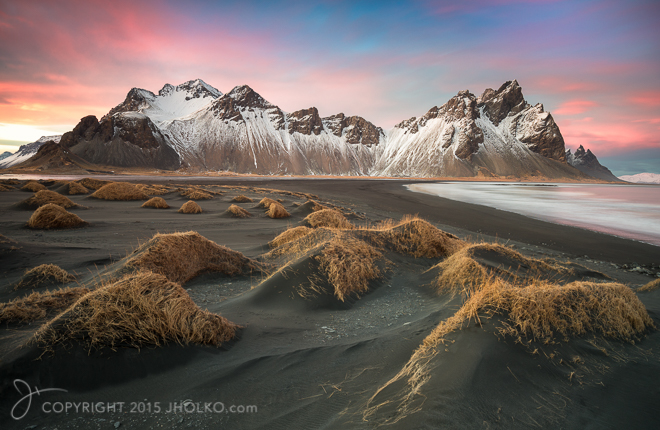 Take the photograph above as an example. If I apply a gradient filter to this sky in Lightroom 5.x and pull it down over the mountains it very quickly destroys the image as the tops of the mountain peaks are darkened along with the sky. This creates a very unnatural effect. Up until now you had to accept the darkened peaks and then create a local adjustment and paint back in exposure compensation where the peaks had been darkened – it was a real pain. Now in Lightroom 6 / Creative Cloud Adobe has given us the option to paint out areas of the graduated filter and solve this problem of unnaturally darkened peaks without a kludgy work around. Landscape photographers rejoice. Our workflows just got simpler. The technique is quite well illustrated in the video below that outlines some of the new features in Lightroom 6 / CC.


