
The latest September issue of the Australian Institute of Professional Photography (AIPP) Journal features an article I recently penned titled ‘The Toughest Print’. The article was also recently featured on the Luminous Landscape website. You can download a copy of the article by clicking on the image below (you do need to be a full AIPP member to download the complete issue).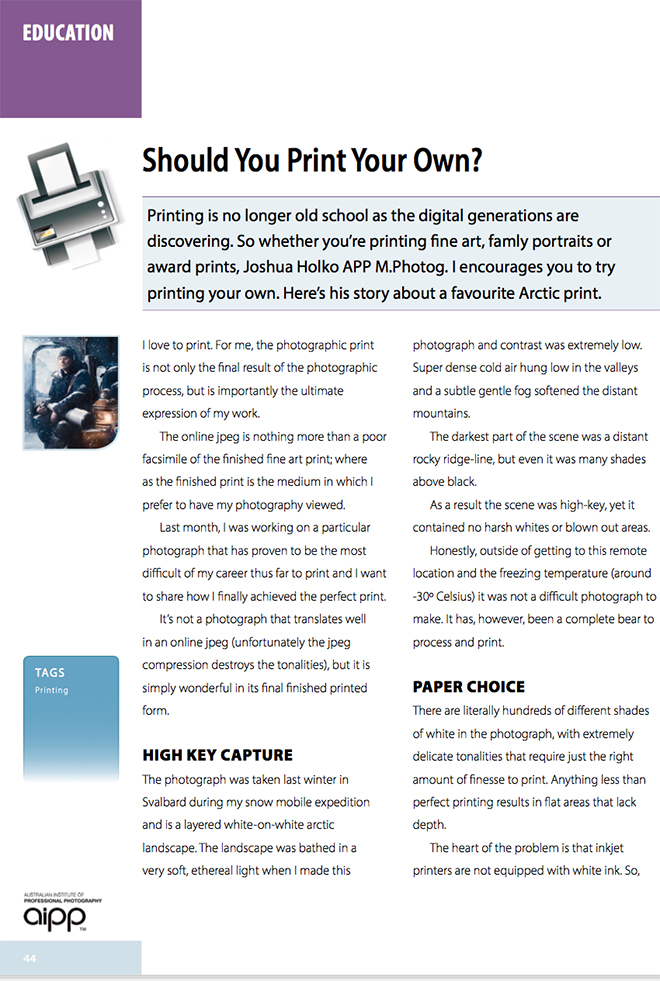
Category: News and Updates
JHolko Photography Latest News and Updates
Departing for Greenland Expeditions 2017
Time has rolled around all too quickly (I feel as though my feet have not touched the ground in Australia) and as soon as I finish this post I am heading back to the airport to start to the long trek to Iceland and then onto Greenland for my two back-to-back expeditions to the east coast and the spectacular Scoresby Sund fjord system. I have been looking forward to returning to the east coast as it has been a few years now since I last visited Greenland. It will be interesting to see how the area has changed and in what sort of state of disrepair the glaciers are now in. With more water melting off the Greenland icecap in a day than France uses in an entire year I am expecting to see some significant change.
As is my custom I like to do a packing list of what photographic equipment I am taking with me. Although these are primarily landscape expeditions we will also be doing quite a lot of photography from zodiac (the east coast of Greenland is home to some of the worlds most dramatic icebergs) and as such I am taking equipment for both the tripod and hand-held work. I am packing my Really Right Stuff Tripod with the new Arca Swiss D4 geared head as well as a full set of LEE filters for land-based work and a couple of Canon EOS 1DX MKII cameras for zodiac work. I am also packing my 300mm F2.8L IS MKII lens in case of any wildlife encounters.
Lightroom Roller (Carry on Luggage)
– 2 x Canon EOS 1DX bodies
– 1 x Canon EOS 5DSR body
– 1 x Canon 11-24mm F4L Lens
– 1 x Canon 16-35mm F4L IS Lens
– 1 x Canon 24-70mm F4L IS Lens
– 1 x Canon 100-400mm F4-F5.6L IS MK II Lens
– 1 x Canon 300mm F2.8L IS MKII Lens
– 1 x Canon 1.4TC MKIII
– 1 x Sigma 15mm Fish Eye
–
Gura Gear Chobe (Carry on Luggage)
– 1 x Apple MacBook Pro 15″ Retina
– 1 x Apple laptop charger
– 1 x 1 TB external portable SSD hard drive
– 1 x USB CF card reader
– 1 x Sunglasses and sunglasses case
– 1 x Leica Ultra-vid 10×42 HD Binoculars
–
Etcetera Case #1 (Inside Chobe)
– 1 x Canon 1-Series camera charger
– 2 x Power Adapters for on board ship
– 2 x Canon 1DX spare Batteries
– 2 x Canon 5DSR spare Batteries
–
Etcetera Case #2 (Inside North Face Duffle)
– 1 x Arctic Butterfly Sensor Cleaner
– 1 x Filter Wrench
– 1 x Zeiss Cleaning Fluid and Lens Cleaning Tissue
– 1 x Micro Fibre Lens Cloth
– 1 x Rocket Blower with Hepa-Filter
–
There is one other important piece of documentation I will be taking with me on this expedition and that is an Australian Customs Declaration form. If you are travelling internationally from Australia you can read about the benefit arming yourself with this documentation HERE.
I am fortunate to meet and travel with some fabulous people who are not only talented photographers in their own right but also a source of continual inspiration. Many of these participants have become friends (and there are quite a few across these two Greenland expeditions) and I just want to take a moment to acknowledge their photography and thank them for their participation and input.
See you in Greenland!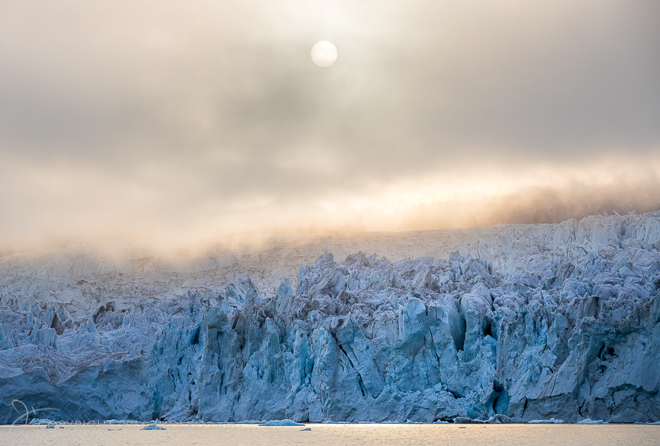 P.S For those of you who have contacted me asking if I will be running a future expedition to the East Coast of Greenland: The answer is not in 2018 – but I have now confirmed a charter for 2019 and will have more details later this year.
Australian Geographic Feature Awarded APPA 2017 Photographs
Australian Geographic Magazine has just featured nine of their favourite photographs from the recent 2017 AIPP Australian Professional Photography Awards. The Australian Institute of Professional Photography (AIPP) has announced the 2017 winners of its prestigious annual photography awards. Both Australian and international photographers competed across 24 categories, including travel, landscape, animals, science and people. Here are our favourites of the stunning award-winning shots.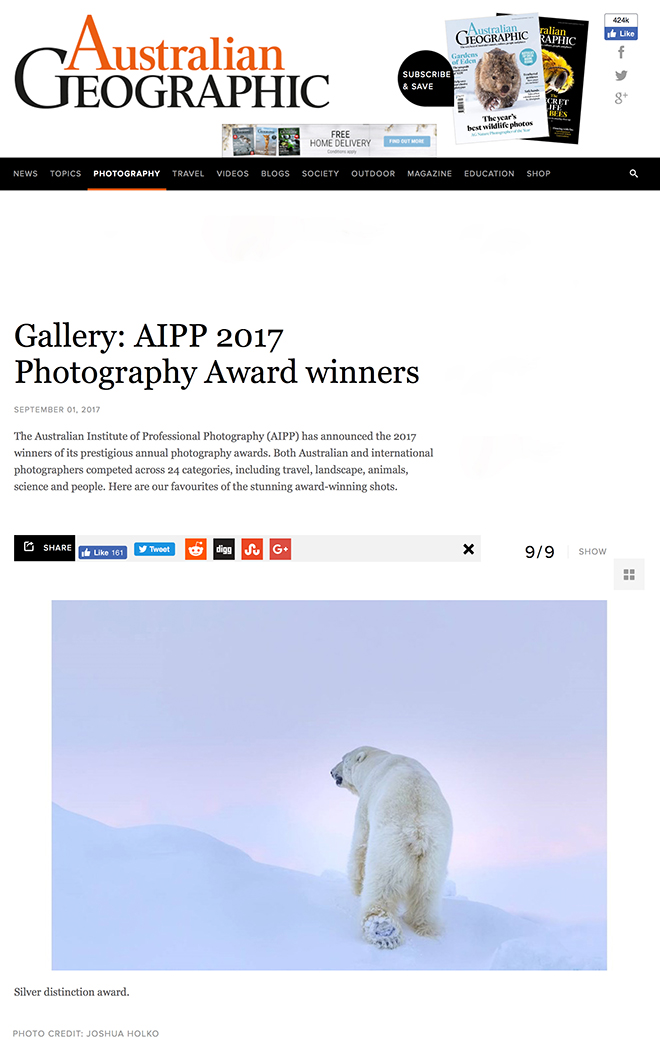
Journey Weaver Magazine August 2017 Feature – The Ice Whisperer
International magazine, Journey Weaver, has just published new interview “The Ice Whisperer” in their latest issue (catchy title!). “Multi-award winning Arctic photographer Joshua Holko knows a thing or two about shooting captivating images of rare wildlife in extreme conditions. He speaks with Crystal Leung about the shot that won him Global Arctic Photographer of the Year, polar travel essentials and his love affair for the world’s coolest destinations.” Just click on the image below to download the full PDF. 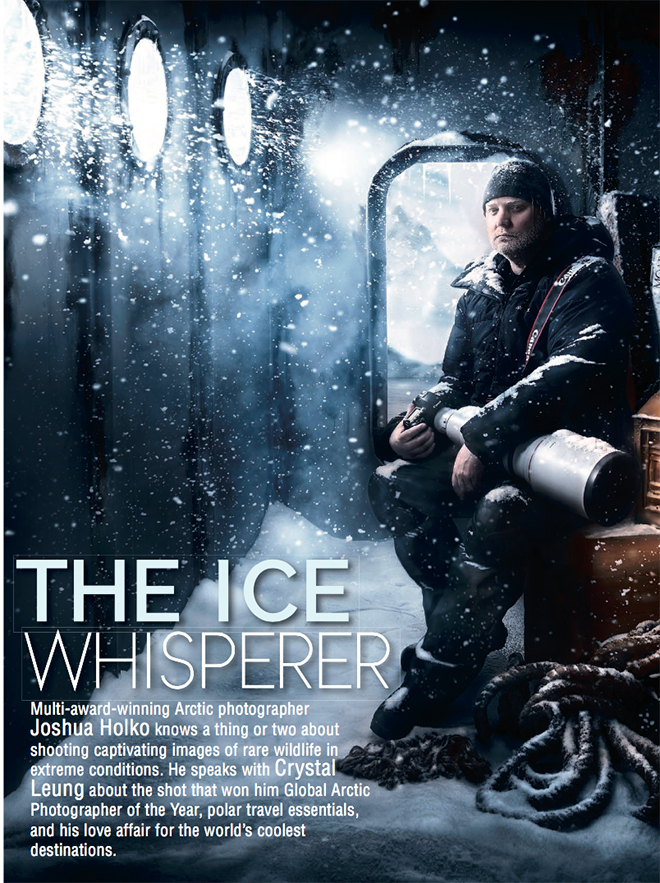
APPA 2017 – Analysis of the Print Score
Yesterday I received a number of very supportive messages in response to my WR-APPA post where I summarised my 2017 APPA results and very gingerly dipped my toe into the murky waters of the APPA scoring ‘game’. In response to those messages, which were universal in they’re questioning of why two of my prints did not score Gold awards I have decided to wade further into those dangerous APPA waters with a more in-depth analysis of one of my print scores. In particular, this photograph of a Polar bear which seems to be the one most people have singled out as being short changed of a Gold award.
Before we analyse the reasons behind the prints final Silver Distinction award lets agree that this exercise is purely for the benefit of those who want to better understand why a print scores what it does. As previously noted, I am comfortable with the final score and at the risk of repeating myself I do feel that the panel of five judges did, on the whole, do justice to all of my prints. With that caveat crystal clear lets begin.
Firstly, lets look at the overall scoring process so that everyone has a good understanding of the overall APPA mechanics. In brief, the panel of five judges are scoring prints out of 100 under strictly controlled lighting conditions. The judges scores are then averaged to give a final overall score out of 100. Prints of a professional standard that score between 75 and 79 points are not considered of award standard but are considered to be a good example of solid professional practice. Prints between 80 and 84 are considered examples of photographs above professional practice and worthy of recognition and are subsequently classed as a Silver Award. Prints between 85 and 89 are of exceptional standard and are awarded with a Silver with Distinction. Prints judged 90 – 94 and 95 – 100 are Gold and Gold with Distinction awards respectively that are reserved for prints that are considered to be of the highest calibre. Judges are often heard to wax lyrical about a Gold award print needing to be one that is never forgotten. It takes a print of exceptional quality to be awarded with a Silver or Gold award.
In this instance the panel of five judges scored the print 83, 84, 87, 87 and 87. One of the judges was in the solid silver range on 83, whilst another was on the fence of Silver or Silver Distinction at 84 and the remaining three judges were all on 87 or a solid Silver with Distinction. The scores are added together and then divided by five to give us a final average of 86 – A silver with Distinction.
Now, had one of the judges been five or more points away from the average score of 86 they could have elected to challenge (see footnote 1) the print score and a short debate would have ensued whereby a number of judges would be invited by the panel chair to present their thoughts and arguments on why the print should either score more, or remain the same (it is very rare for a print to be talked down in score). Likewise, if one of the judges had scored it 90 or more (or if one of the judges had been more than ten points away from the average) there would have been an automatic challenge and the debate would have ensued as above. After the debate the print would have been re-scored. Had this occurred the print may have moved up in points and possibly into a Gold Award. Or, it may have remained at 86, a Silver with Distinction.
Now, as it stands none of the judges scored the print 90+ and we can only second guess ourselves as to why (speculating on a judges motives would be a very slippery slope). Additionally, none of the judges were five points or more away from the average and thus there was no opportunity to challenge to improve the score. If, as in this case, the judges are all within five points of the average, the initial average score of 86 will stand with no further option to re-score (the only exception to this is a print on the cusp of the next award level that will then go for review at the end of the judging session). As an entrant, that is the pitfall of consistent judge scoring at APPA; you loose the possibility of a challenge.
Now, one could argue that consistent scoring at APPA is a good thing and this is a perfectly rational and logical position to adopt. Such scoring shows consistency across the judging panel and ‘perhaps’ indicates that the judges are very close to the ‘right’ score. In reality, the only thing it represents for certain is that the judges more or less subjectively agree with each other. The problem with consistent scoring is it does rob the entrant of any chance of real debate and the chance for the print to be re-scored. And that is where a ‘spike’ judge can really benefit an entrant. A ‘spike’ judge is quite literally a judge who tends to score five points or more outside of the average more often than would be considered ‘normal’. The ‘spike’ benefits the entrant by potentially creating a five point difference and triggering a challenge and subsequent debate and re-score. This did not occur in my case. Nor did it occur for my print that scored an average of 88 (another Silver with Distinction with all judges within five points of each other). In fact, the judges were within five points of each other across all four of my prints!
In situations where there is no option to challenge (as in this case) one of the judges is invited to comment on the print by the panel chairperson for the benefit of the entrant. In this case the comment was as follows:
“ Yeah… very interesting picture. It’s not the sort of thing you often see. And the caption describes it perfectly too; the dragging of the foot. I was just drawn to the contrast between the chunkiness and the detail on the foot and then this little bit facial expression. Lovely subtle tones as well. Well done to the photographer.”
What you choose to individually read into the judges comment above is totally subjective. For me, it was quite gratifying as the judge in question acknowledged exactly what this print is about. When I chose this print for my APPA entries I did so because I felt it presented a very unique view of a Polar bear very few people would have ever seen. I also felt the soft and subtle pastel tones of winter light perfectly complimented the fur of the bear and that the overall gesture of the bear carried both a power and delicacy that had strong emotional impact. Whilst the language used in the judges comment is a little clumsy they did at least ‘get it’ and thus it is clear the intention behind the comment was very positive.
With the comment made and the average score of 86 locked in the print was awarded its Silver with Distinction before the next print was turned around and judged with fresh eyes. And that is exactly how a print that you might feel worthy of a Gold Award ends up with a Silver with Distinction. Without that trigger of a challenge there is no possibility of a debate and the subsequent re-score that would follow. You are instead locked into the first and only averaged score. It happens all the time and it is just a fact of life in the APPA game.
__
Footnote 1: Challenges are issued when one of the judges (who is either in Gold on 90 or above; or is more than five points away from the average) wants to see the print finish with a higher score. This is known as “championing the print”. A great many prints finish in the Gold scoring range through this process. Very few prints score Gold outright without a challenge; although it does happen on occasion.
 www.WILDNATUREPHOTOTRAVEL.com