Mystical Faroe Islands Workshop Report 2019

In August of 2019 I led my first landscape workshop to the Faroe Islands; a series of remote islands south of Iceland (north of Scotland) that offer some of the most rugged and beautiful sea cliffs I have been fortunate to experience and photograph. The Faroe islands archipelago is actually an autonomous country of the kingdom of Denmark. The islands cover a total area of approximately 1,400 square kilometres with a population of just 52,000 people. The climate is sub polar oceanic and such the weather is renowned as wet, windy, cloudy and cool (not what we experienced). Temperatures average above freezing because of the islands location in the Gulf Stream.

The landscape (specifically the sea cliffs) of the Faroe Islands is about as spectacular as one can imagine. Dramatic and plunging cliffs that rise sharply (at some points greater than 800 feet) out of the ocean make for a very dramatic back drop for photography.

Prospective photographic suiters should arm themselves with the knowledge that the Faroe Islands is ripe with locations and vistas you cant simply drive up to and photograph. You absolutely must be prepared to walk and/or hike; and often over some fairly uneven terrain at distances that can exceed ten or more kilometres. Additionally, many of the local land owners have now gated (due to the recent and steep rise in tourism) their properties and are charging admission to hikers and photographers. This currently unregulated practice means that there is quite a variation in entrance fees depending on where you choose to visit. Some locations are now closed to the public without a local guide. We had pre-scouted all of the locations for our workshop and as such avoided any nasty access surprises.

We had planned to schedule our daily activities around the often highly variable weather that the Faroe Islands is known for. As it turned out we experienced weather that could perhaps be said to be ‘too good’ with many warm sunny rain free days that were also mercifully low on wind. In fact, the only rain we experienced during our entire stay was our last morning as we made our way to the airport to say our farewells. I never touched my cold weather clothing the entire trip and lived in a light base layer with the occasional mid layer and light weight wind proof jacket.

Our daily itinerary for this workshop took us across several of the islands and included quite a bit of hiking to reach the best vantage points. The longest of these hikes was out to Drangarnir Arch and Tindholmur; a fairly arduous hike with a superb and highly rewarding vista. If you are planning to visit the Faroes please be aware that access to this location is now closed without a local guide.

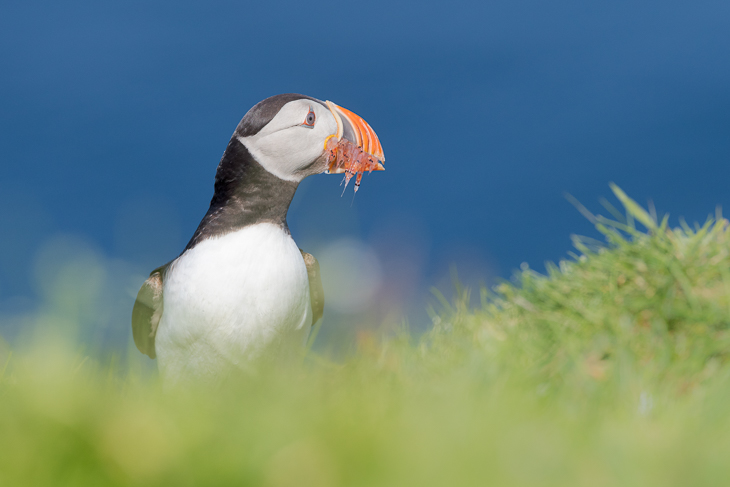
We also visited the island of Mykines where we photographed the Atlantic Puffins that nest on the sea cliffs. I have been fortunate to photograph Atlantic Puffins at two of the best locations in the world in Iceland and was pleasantly surprised to find Mykines was just about as good as any of them. The Puffins are very approachable and one can sit quietly near the cliff edge and photograph them as they come into land with food in their mouths for their chicks. Some of us also took an option hike out to the lighthouse. Although the Puffins are quite approachable the island of Mykines is a tourist hot spot and you do have to contend with a great many day trippers also keen to attempt to photograph the puffins with their smart phones (an unfortunate reality of life these days).
Some of the other locations we visited during our workshop included Traelanipan Cliffs and Bosdalafossur Waterfall and Sørvágsvatn Lake. We also visited and photographed the iconic sea stack Trollkonufingur as well as Gasadalur and Mulafossur waterfall. We also took the ferry to the island of Kalsoy for a walk and scenic photograph of the lighthouse as well as the seal lady at Mikladur. We also visited the Islands of Kunoy, Bordoy and Vidoy and hiked the hillside for amazing views over the fjord and photographed the the Risin & Kellingin sea stacks.

Generally speaking the distances between locations in the Faroe Islands are short and the road conditions mostly excellent (although the roads are very narrow in parts). Tunnels connect some islands whereas others require ferry or car ferry access. In the case of ferry access, you absolutely must either pre-book or arrive very early (in cases where booking is not possible) to avoid disappointment. The Faroes has become very popular in recent years as a photographic destination and as such it is rare to have any of the iconic locations to yourself.

Due to my travel commitments I have not as yet had the time to process many of the landscape photographs I made during our time in the Faroes (and I am leaving for Greenland and Finland in just a few days), but I hope to share more of these beautiful islands over the coming months as time allows. 
Greenland East Coast 2019 & 2020 Expeditions Sold Out!

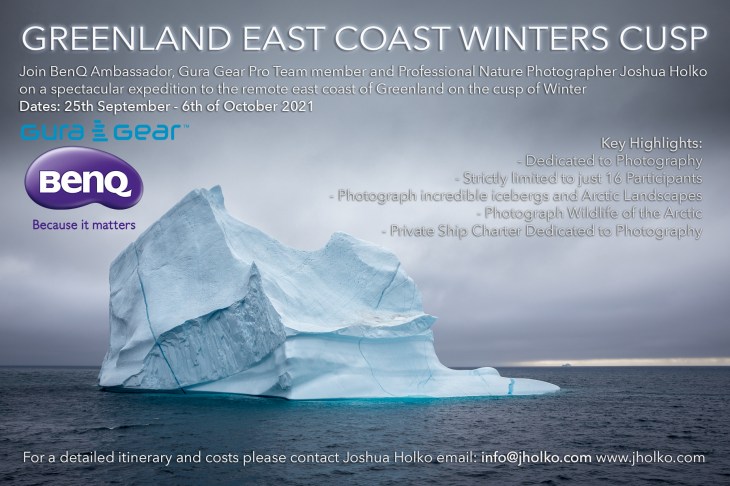
Both my back-to-back 2019 and 2020 expeditions to the remote East Coast of Greenland on the cusp of Winter are now SOLD OUT.  If you have not travelled to and photographed the Scoresby Sund region of Greenland then you absolutely must put it on your bucket list. The East coast of Greenland is one of the most spectacular locations on our planet. Speaking candidly, if I could only photograph one place for the rest of my life it would be Scoresby Sund and the East Coast of Greenland.  It is absolutely miraculous on every level.

If you missed out on a place on the 2019 and 2020 expeditions but would like to travel to the East Coast of Greenland to photograph this amazing region then I will be repeating this very special ‘Winters Cusp’ expedition in September of 2021 (some places and cabins already spoken for). Full details are now available for download from my website at www.jholko.com including a complete PDF itinerary. Dont forget to also check out  the Adobe Spark Greenland Presentation.

Faroe Islands Workshop 2019 Packing List

With time marching ever onward my brief respite at home in Australia after my recent Svalbard High Arctic expedition (Read the Trip Report) has already come to an end and early tomorrow morning I am heading back to the airport to start the trek back north (via London and Copenhagen) for my 2019 workshop to the Faroe Islands with good friend Martyn Lucas.

Packing for the Faroe Islands is a bit of a compromise for me. Although the primary emphasis on this workshop is definitely landscape, we will also be taking the opportunity to photograph Atlantic Puffins and the many sea birds found along the Islands precipitous sea cliffs. As such, I need to pack some wildlife kit as well as my usual landscape equipment. Although I could probably get by with just my 100-400mm lens for the Puffins the reality is that I know I will miss the 400mm 2.8L IS MK3 and as such this lens is a must take for me. With that in mind, my equipment for this workshop as follows:

– Canon EOS R Mirrorless Camera with RRS L Bracket (and spare batteries)

– Canon EOS RF to EF Adapter

– Canon 16-35mm F4L

– Canon 24-70mm F4L IS

– Canon 100-400mm F3.5 – 5.6 IS MKII

– Canon EOS 1DX MKII (with spare battery)

– Canon 400mm F2.8L IS MKIII

– Nisi Filter Kit including Graduated ND Filters, ND Filters and Circular Polariser

– Gitzo Carbon Fibre Tripod with Arca Swiss D4 Geared Head

– Cable Release

The Faroe Islands have long been on my list to photograph as part of a workshop and I am really excited to get underway with a small group of passionate attendees. See you in the Faroes in a few days! The below photograph courtesy Martyn Lucas.

Winner 2019 AIPP Epson Victorian Professional Nature Photographer of the Year

Over the last few days The AIPP Australian Institute of Professional Photography Victorian State awards (VPPY) were held here in my home town of Melbourne at Melbourne Polytechnic Fairfield Campus. The AIPP Annual state and national awards are my two absolute favourite photographic competitions to participate in because all entries (in the categories I choose to enter) are judged in print and not digitally. Those of you who follow my blog regularly are already well aware that I am a huge advocate of the print as the finished medium of choice for my own photography – enough said. The AIPP National and State awards remain two of the few remaining competitions to actually judge the finished print and they do so using a panel of judges all deemed experts in their respective genres and accredited as Masters of Photography through their years of success in this arena.

About the Print Judging: In case you are unfamiliar with either of these competitions the prints are judged in a controlled lighting environment and assessed for their content, originality as well as technical craftsmanship. The judging is enthralling to watch (it was live-streamed to the internet this year) and can be quite nerve wracking if you are a first time entrant as the standard of work is incredibly high. In brief, prints are scored out of 100 with images judged less than 70 being deemed not of professional standard. Prints judged between 71 and 79 are considered strong professional practice and entrants receiving scores in this area are considered to be producing professional quality prints. Images judged 80-84 are awarded a Silver and are considered strong professional practice of an award standard that demonstrate skill beyond strong professional practice. Scores of 85-89 are given a Silver with Distinction and demonstrate superior imagination, craft and skill that elevates the print far above professional practice. Prints judged 90-94 exhibit excellence in visual communication, craft and skill and are considered stunning and exceptional in every way. This level of print far exceeds professional practice and is reserved for only the highest quality prints. And finally those rare few images that reach 96-100 are considered to have exceptional vision, creativity, innovation, master craftsmanship and skill. Very, very few prints ever score Gold awards in these competitions.  Out of the hundreds and hundreds of print entries this year (over 700 prints) fewer than two dozen received Gold awards and only two Gold Distinctions were awarded.

This year I entered the Nature, Documentary and Landscape categories, entering the maximum allowable twelve prints spread across the three categories. I wanted to put what I felt were my strongest four prints into the Nature category, but also wanted to test the other eight prints and see how they performed in different categories. This turned out to be the right approach for me and I was absolutely thrilled to take overall first place in the Nature Category as well as being a finalist in both the Landscape and Documentary categories. The Nature category is very near and dear to my heart and winning it is a huge honour. On top of winning my chosen category I also took out the Highest Scoring Print award for the Nature category. As someone who is so passionate about the ‘print’ and the craft of fine art printing this was an incredible honour.

Below are the winning prints. All of the prints were printed on Moab Somerset Museum Rag. This wonderfully sublime paper has continued to remain my stock of choice for all my fine art photography prints. If you love printing and are not familiar with this paper I urge you to check it out and get a sample pack.

To help provide some insight into the judging I captured and uploaded the live-stream video of the judging of my four photographs in the Nature category. I did not bother with the Documentary and Landscape categories as these were more or less my ‘seconds’ and it was really the Nature category that I was interested in. If you are keen to check out the judging of my Landscape and Documentary prints you can find the full livestream on You Tube. It is both insightful and  interesting to hear the judges thoughts, comments and perspectives. Keep in mind, you are listening to individual opinions – hence a panel of five judges.

Face-Off in a Blizzard –  GOLD Award Nature Category

Lost in a Blizzard –  GOLD Award Nature Category

Family Reunited –  Silver with Distinction Award Nature Category


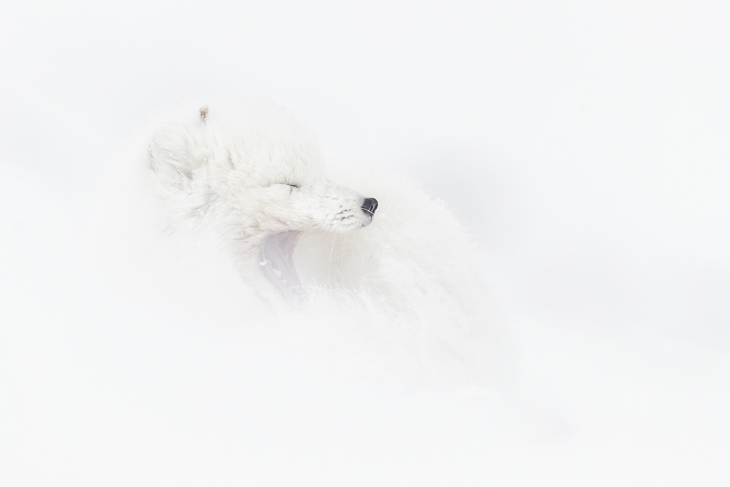
Arctic Fox Snow Storm –  Silver with Distinction Award Nature Category

Sinuous –  GOLD Award Landscape Category

Mars –  SILVER Award Landscape Category

Hanging Glacier –  SILVER Award Landscape Category

Greenland –  SILVER Award Landscape Category

Top of the World –  SILVER with Distinction Award Documentary Category

Wolverine –  SILVER Award Documentary Category

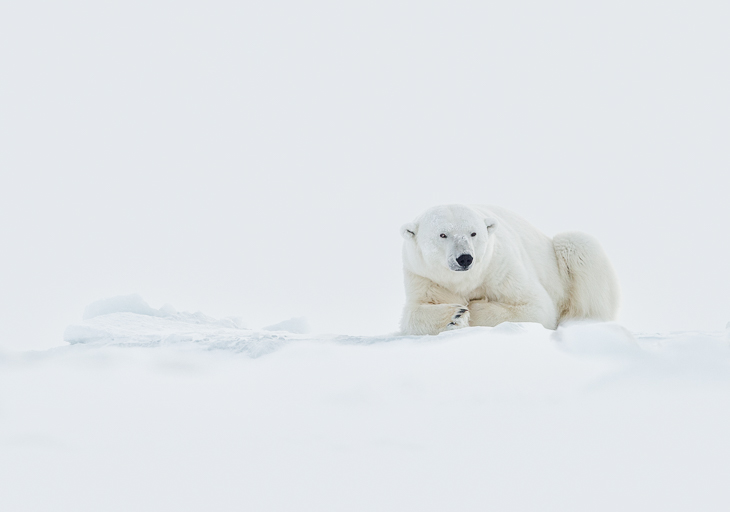
Polar Bear –  SILVER Award Documentary Category

Lone Hunter –  SILVER Award Documentary Category

Great Ocean Road and Tasmania Workshop Reports 2019

In May and June of 2019 I lead two back-to-back landscape workshops to the Great Ocean road region of Victoria and both the East and West coasts of Tasmania with my co-leader and friend Phillip Bartlett. Both of these workshops were structured to provide outstanding and varied opportunities for landscape photography as well as the opportunity to see and experience the wild coastal region of the Great Ocean Road and World Heritage Wilderness areas of Tasmania. Both of these locations offer world class landscape opportunities, yet both remain relatively unknown on the world stage (at least for now). We planned to not only photograph the fantastically varied landscape of these two locations, but also enjoy the fantastic fresh food and produce both of these locations are well known for.

In May and early June in southern Australia we are in the transitional phase from Autumn to Winter and the weather is often varied and unsettled. It can be quite cold, occasionally wet, but also extremely beautiful. Sunrises and sunsets are often intermixed with dramatic cloud and when the wind is up it can result in wild weather as storms and squalls roll in from Antarctica to smash into the coastline. As it turned out and as expected, we experienced a little bit of everything weather wise during both workshops. Our workshops were deliberately timed in the hopes of some dramatic weather and light and we encountered both during the two workshops. As also expected we lost a day, or part thereof on each trip due to intermittent rain, but we more than made up for it with beautiful light on several occasions.

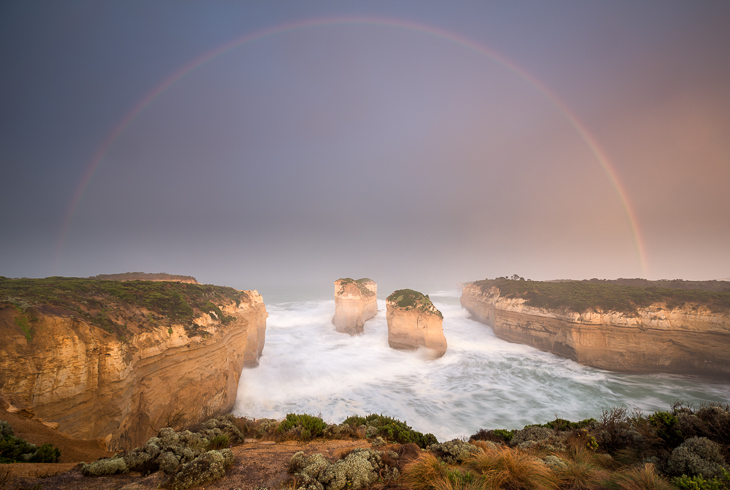
We began our workshops with three days of intensive landscape photography along the spectacular Great Ocean Road and Otway forest region of Victoria. I have been travelling and photographing this part of Victoria for many, many years now and over this period of time have discovered many wonderful locations to photograph and learned a lot about the ideal time to visit these locations. Contrary to popular thought, many of the more obvious locations for sunset actually work much better at sunrise with the massive sandstone sea stacks picking up their own equivalent of an alpine glow before the sun crests the horizon. Sunset is in many ways too obvious for the westward facing sea stacks and experience has shown me sunrise usually provides better light and better opportunities. Typically, there also fewer photographers around and one almost always has the location to themselves – as we frequently did. Knowing where and when to photograph is key to getting great results along the Great Ocean road and there is simply no substitute for local knowledge in this regard. This time I decided to include a fellow participant for scale to show just how gigantic some of these sea stacks truly are.

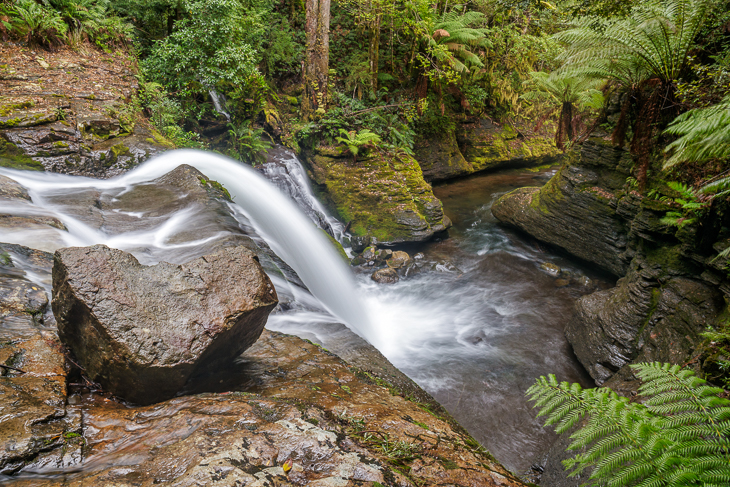
During our time in Victoria we also made several stops at some of the Otway Ranges waterfalls. On both workshops we were blessed with ideal shooting conditions that included low cloud and mist – perfect conditions for this sort of forest photography. Despite Victoria being somewhat unknown for its waterfalls we do actually have several fantastic places that offer superb opportunities when the conditions are optimal. My own preference is always overcast light with low cloud for the soft box light effect. The addition of mist or light rain also adds a further element to really add mood to the photographs. Recent rains ensure the waterfalls are in full flow and at their best for making photographs.

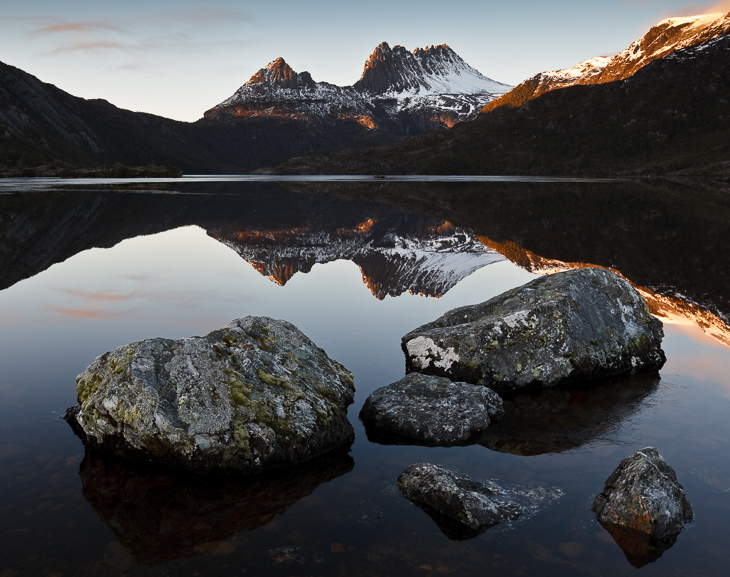
After we finished in Victoria we returned to Melbourne and made the short flight down to Tasmania where we spent the next few days exploring and photographing the world heritage region at Cradle Mountain and Lake St. Claire National parks. Cradle Mountain is without doubt the jewel in the crown and heart of Tasmania. This rugged and wild region of the island offers an opportunity for mountain and forest photography that is as unique as it is impressive. Cradle mountain itself forms an ideal photographic back drop to Dove Lake (the large alpine lake that rests in front of the mountains), whilst the surrounding old growth forest adds a primordial feel that gives the whole place that fantastical ‘Tolkien’ look. The opportunities for dramatic and unique imagery in this area are as expansive as they are untapped and we explored and photographed quite extensively during our time in the area. With our luxury accomodation just outside the park we were perfectly positioned to maximise our time in this area. Some of us even took the opportunity to hike to Marions look-out and walk many of the forest trails. For those that were keen there was also wildlife opportunities with Wombats and Wallabys in abundance.

From Cradle Mountain we travelled south to the small seaside town of Strahan on the wild West Coast where we were based for two nights. During our time in Strahan we took a day cruise out to Hells Gates (the narrow entrance to the harbour) and then on up the Gordon river – an extremely scenic journey into the pristine old growth world heritage forest. Our cruise included a stop at Sarah Island on our return. Overcast light with low cloud and mist is again ideal for this sort of forest photography and we made the most of the opportunities provided to us. We were also fortunate to get fantastic reflections on the river. On our first trip we also tried to find and photograph the Fairy penguins (now known as the Little Penguin) at Bonnet Island but had only marginal success with only a couple of penguins arriving on the island well after dark. The population of Fairy penguins has been in decline at Bonnet Island in recent times and my feeling is this is now pretty much a dead end for penguin photography.  In lieu of the penguins we took an opportunity to photograph Tasmanian Devils on the second workshop at the sanctuary near Cradle Mountain which proved productive and worthwhile.

From Strahan we travelled East to Coles Bay in Freycinet National Park where we spent several more days exploring and photographing this rugged and exposed peninsula. The Freycinet peninsula possess some of the most amazing granite boulders to be found anywhere on earth. Pink and orange granite boulders adorn both sides of the rocky peninsula and offer limitless opportunities for landscape photography. Perhaps best of all, this hidden gem is virtually untouched and un-photographed by world standards. During the many hours we spent photographing in this region at both sunrise and sunset we did not encounter a single other photographer – a rare treat these days.

From Freycinet we travelled South to Hobart where we wrapped up with a final sunrise photography session atop the rock riddled, Mount Wellington. The days are short this time of year in Tasmania; with sunrise around 7:30am and sunset around 5pm. This timeline is absolutely perfect for this type of workshop and meant we could get in a full days photography from sunrise to sunset before ending our day with a fantastic locally produced meal in one of the nearby restaurants. With many of the towns in Tasmania located on or near the coast the fresh seafood on offer is amazing with some of the best fish, oysters and scallops to be found anywhere.

Landscape photography in Tasmania is an absolute joy. Free from the crowds of tourists and photographers that have inundated many other corners of the world, Tasmania remains a quiet back water, mercifully blessed with fantastic food and wine, and world class landscape for the travelling photographer. Although I have been to Tasmania many times in my life, I never tire of returning to this small Island just a short stones throw from my home in Melbourne. The landscape is as irresistible as the fresh seafood and as such I will return again next year for one more workshop to the Apple Isle. You can drop me an email to register your interest.

Footnote: On the second workshop I decided to take a Canon EOS R mirrorless camera with me. This was the first time I had spent with the camera in the field and I was quite surprised with my findings. I will have some more detailed thoughts in another post in the next few days. My conclusions might surprise you.