Tasmania II Workshop Departure and Packing List 2019

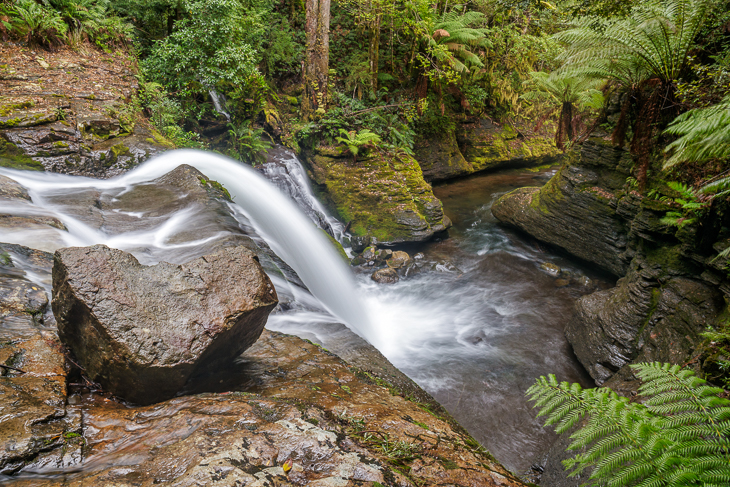
A week of R&R has quickly rolled past and tomorrow I am starting the second of two back-to-back landscape workshops to the Great Ocean road in Victoria and World Heritage Forests and Wild Coasts of Tasmania. Although I have been to Tasmania countless times in the course of my life I never tire of returning to this wonderfully quiet corner of the world. Smattered with primordial old growth forest, pristine rivers and wild and rocky coastlines the landscape opportunities are as fantastic as they are varied. Perhaps best of all, there are still many opportunities to create strong and unique photographs that transcend those captured in the many over touristed locations found around the world today – it is in many ways virgin ground. I have been so taken with the untapped potential on offer in Tasmania that I have decided to return in May next year 2020 and offer one more landscape workshop to Van Diemens land and its primordial forests and coastlines. I will have full details soon, but you can pre-register your interest by dropping me an email at info@jholko.com
Shifting gears somewhat, and hot on the heels of my recent (and somewhat controversial as it turns out) post on ‘Why the DSLR is here for many years to Come *’ are some more thoughts on where mirrorless cameras actually fall into action for the working professional (and serious amateur). Despite what some might believe, I am not against mirrorless cameras (I actually just purchased one – A Canon EOS R). I believe mirrorless cameras hold some significant advantages over traditional DSLR cameras for certain applications and in certain situations. Firstly, mirrorless cameras (the bodies anyway – For some reason mirrorless lenses are often bigger and heavier than their mirrored cousins) are generally much smaller and lighter than their traditional DSLR counterparts. This makes them ideal for hiking and travel. EVF’s (Electronic View Finders) also offer some added additional capability not found in a traditional SLR Mirror camera. Features such as a live histogram in the viewfinder, zebras (for blown out areas) and focus peaking are all really useful features.  The problem with EVF’s to date is their tendency to simply shut down and stop working once they are exposed to temperatures below -10º Celsius for extended periods. Granted, this isn’t going to be an issue for most people, but if you plan to photograph in the world’s Polar Regions at any stage it bears serious consideration. Battery life is also a serious problem in cold weather. The extra current draw required for EVF’s results in dramatically shorter battery time in sub zero temperatures. I have watched photographers struggle with mirrorless battery life on recent cold weather workshops in the Arctic and the necessity to swap batteries in and out on a regular basis is a royal pain in the rear end. By comparison I can get multiple days out a Canon EOS 1DX MKII battery in temperatures as low as -35º Celsius and shoot thousands of frames. No mirrorless camera can do that (yet). Nor, can any mirrorless camera match the focus speed and accuracy of a 1DX MKII in the sort of conditions in which I frequently find myself shooting. I know much of the mirrorless hype would have you believe otherwise, but actual real world experience in the field has shown me it simply is not the case. Nor can any mirrorless camera yet match the rugged build and reliability of a 1DX MKII. That time may come, but today the weapon of choice for serious wildlife work in inclement conditions has to be the Canon EOS 1DX MKII (and its Nikon equivalent).  That said, mirrorless cameras most definitely offer some significant advantages for landscape photography (in all but the harshest of conditions) and that is why I decided to add a Canon EOS R mirrorless to my arsenal.  I did seriously consider the Fuji GFX50 (and its new big brother the GFX100), but ultimately decided the lack of native tilt shift lenses was a deal breaker for me. Especially since the larger sensor in the Fuji results in even shallower depth of field.

For my second Great Ocean Road and Tasmania workshop I am packing the following:

  • 1 x Canon EOS R Mirrorless w/ Really Right Stuff L Bracket (with spare batteries)
  • 1 x Canon 17mm F4L TSE Lens
  • 1 x Canon 24-70mm F4L IS Lens
  • 1 x Canon 24mm F3.5L TSE Lens
  • 1 x Canon 100-400mm F3.5-5.6L MKII Lens
  • 1 x Canon 1.4 TC MKIII
  • 1 x Gitzo GT3533S Carbon Fibre Tripod with an Arca Swiss D4 Geared Head
  • 1 x Set of Nisi Graduated Filters w/ V6. Holder and Polariser
  • 1 x Set of Lee Neutral Density Filters

This will be my first foray into serious landscape photography with my own personal mirrorless camera and I am really looking forward to seeing how it performs in the field. I decided to opt for the EF adapter with the added functionality of the control ring (which I have left at its default setting for Aperture control). Since I primarily plan to use this camera for tripod landscape photography I decided not to purchase any native RF lenses, but rather adapt my current EF lenses (especially my TSE lenses). The addition of the 1.4 TC MKIII is mostly for use on the 24mm TSE lens (turning it into a 35mm TSE Lens).  The keen eyed amongst you might also note the addition of a suite of Nisi Filters. Yes, I recently upgraded from my rather scratched, much loved, but well and truly worn out ‘LEE resin filters’. See you in Tasmania!

* Addendum – It seems Ricoh agrees with me. The DSLR is here for many years to come.
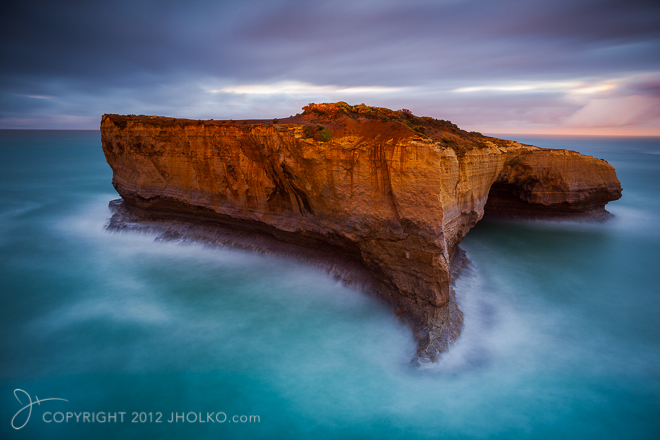
Great Ocean Road & Van Diemens Land Workshop Departure

My new workshop to the Great Ocean Road and Van Diemens Land (Tasmania) has quickly rolled around and tomorrow morning my co-leader Phillip and I will be getting underway on our two week adventure with our small group of participants. This is the first of two sold out back-to-back workshops and I am really looking forward to getting underway. These workshops are primarily landscape based and as such my choice of lenses is quite different to the usual long lens wildlife work I have specialised in over recent years. I will still be shooting with the Canon EOS 1DX MKII as my main camera, but have substituted my long telephoto lenses for my wide angle tilt shift lenses (and will very much enjoy the reduction in weight!). I am also packing my Sachtler tripod and a selection of neutral density and graduated ND Filters. The addition of the 1.4 Teleconverter is specifically for the 24mm TSE lens as I frequently find a need for a 35mm TSE in my landscape work. If time permits I will try and post a few updates from the field. See you along the Great Ocean Road and in the wilds of Tasmania!

  • Canon EOS 1DX MKII Camera Body

  • Canon 17mm F4L TSE Lens

  • Canon 24mm F3.5L MKII TSE Lens

  • Canon 1.4 TC MKIII

  • Canon 24-70mm F4L IS Lens

  • Canon 100-400mm F4-5.6L MKII Lens


Svalbard Winter Ship 2019 Expedition Report

In March and early April of 2019 I lead my annual winter expedition by ship in the Svalbard archipelago in search of wildlife and frozen landscapes. As I have written recently before, Winter has become my favourite time of year to visit Svalbard.  The low angle of sun, snow and ice covered landscape draped with stunning ethereal light make for wonderful photographic opportunities and unlimited potential. Of course, winter also brings with it an increased chance in inclement weather which can present a different set of challenges to summer expeditions when the weather is typically more stable. For those that are willing to brave the elements of a winter trip the rewards can be truly outstanding.

Unlike my snowmobile expeditions (Read the Trip Report), the 2019 ship expedition proved a challenging year for weather with repeated days of high winds and often poor visibility. Strong winds over the entire archipelago prevented us from heading to the edge of the permanent pack ice north of Spitzbergen. Instead, we made the decision to search many of the fjord systems still partially frozen with sea ice. We played cat and mouse with the high winds, seeking shelter in the fjords wherever possible.  This strategy proved fruitful with some great landscape opportunities that we might otherwise have missed. We also had some really great wildlife encounters whilst we sheltered from the weather.

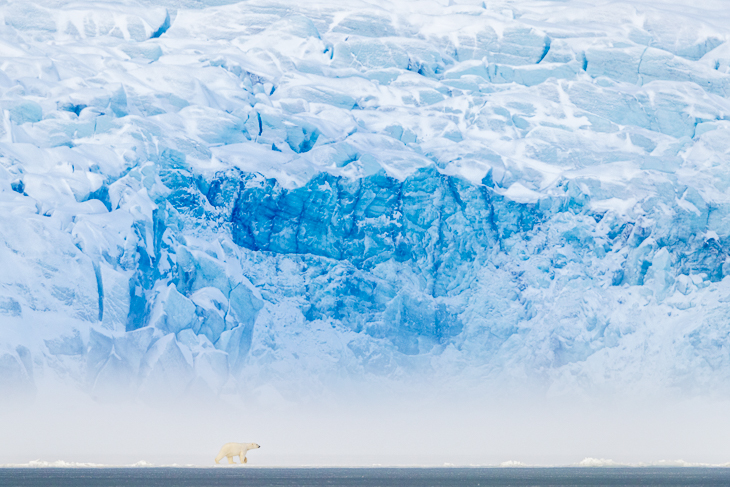
This year we encountered just two Polar Bears during the expedition. Thankfully, both encounters proved extremely profitable with fantastic photographs of both the  bear in front of one of Svalbard’s many glacier fronts as well as the playful teenage bear that put on a wonderful show for us on our last full day of the expedition. As I have frequently lamented – its not the number of bears one encounters during an expedition; its the chance for a ‘photo-friendly’ bear encounter that really counts. I would trade ten bear sightings for one good ‘photo bear’. This year we had two wonderful bears and all aboard made fantastic photographs.

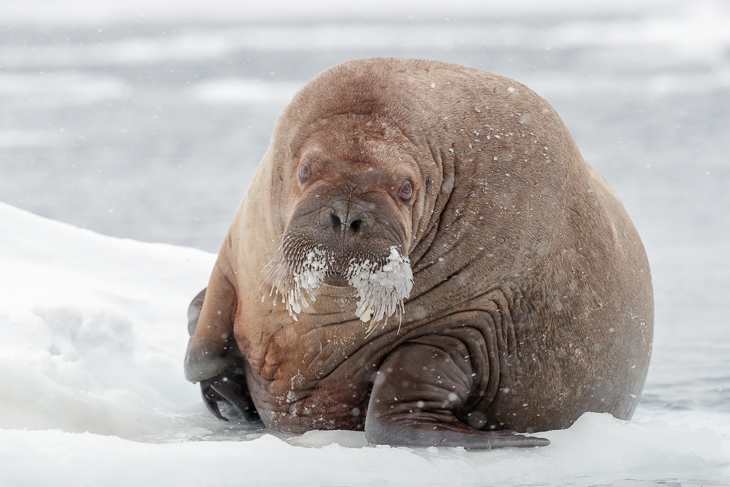
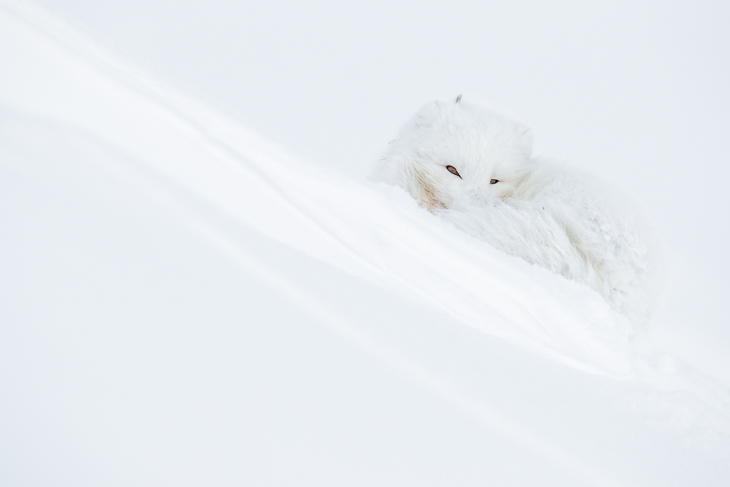
Although Polar Bears were quite thin pickings this year we did have some absolutely superb Walrus encounters on ice flows that more than made up for the lack of bears. Walrus are fantastic to photograph and vastly underrated as a subject. In addition we also had multiple encounters with both white and blue Arctic Fox, Harp Seals, Ivory Gulls and more.

My 2020 expedition to Svalbard in Winter is already almost sold out with just a few places remaining. If you are keen to photograph in this amazing archipelago in the beauty of winter then just drop me an email to express your interest. The remaining places are filled on a first come, first served basis.  If you want to get an idea of what to expect check out the Article – The Art of Polar Bear Photography.

Svalbard in Winter by Snow Mobile 2019 Expedition Report

In March of 2019 I lead two back-to-back small group expeditions via snowmobile in Svalbard in search of winter landscapes, Arctic Fox, Reindeer and the mighty Polar Bear. I have been exploring Svalbard by snowmobile in winter for quite a few years now and have to come to absolutely love both the intimacy and solitude of being out in the freezing winter and at one with Nature and the incredible wildlife that survives in this hostile environment. The Arctic in winter is truly another world and for those that are willing to make the effort, and brave the elements the rewards are simply life-changing. 


The weather during our expeditions was generally superb with cold clear days that were on the whole predominantly wind free. Only on few occasions did we experience true white out conditions whilst crossing some of the glaciers of Svalbard. Conditions can vary wildly and quickly in the Arctic in Winter. It is almost a given that one will loose a day or two to bad weather during any winter expedition. I am pleased to say though that at no time did we loose any time to weather during either of the two expeditions. In fact, we were able on several occasions to take advantage of weather to really enhance the mood and drama of our photographs. Blowing snow is a wonderful addition to any winter wildlife photograph and we took advantage of it whenever the prevailing conditions allowed. The white on white canvas of the Arctic in winter in near white-out conditions is highly fertile material for simple, powerful and emotive photography.

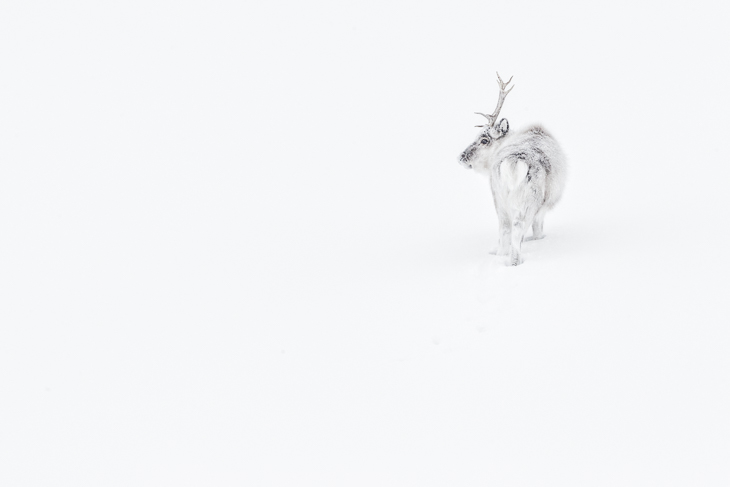
During both expeditions we had fantastic encounters with Polar Bear, Reindeer and Arctic Fox. In total I counted fifteen Polar Bear sightings this year that included several photo bears that provided outstanding opportunities on the frozen sea ice. Encounters with Polar Bears are rare (even in the summer months) so it was fantastic to have such wonderful opportunities during these expeditions. Our encounters with Arctic Fox and Reindeer were no less exciting with some wonderful close up encounters that provided outstanding opportunities.

Svalbard in winter by snowmobile is not for the faint of heart. The distances required to travel are long (upwards of 200km plus per day) and the terrain (glacier crossings and sea ice) is often bumpy and challenging. Temperatures can be extremely cold with many hours of exposure in the field. The rewards for those who are willing to push themselves though can be truly exceptional. The possibility of close encounters with Polar Bears, Reindeer and Arctic Fox make this an expedition where truly unique and powerful photographs can be captured.

I will be returning to Svalbard in early March of 2021 to lead another winter snow mobile expedition for no more than two photographers.  I am not quite ready to start taking bookings as yet but expressions of interest are welcome via email. Prior snow mobile experience is preferred, but not essential. What is essential is a strong desire to spend time in Nature with a willingness to be out in the field in Winter elements. Expect long days, cold weather and best of all incredible rewards that fill the soul as well as your memory cards.


Finlands Frozen North 2019 Wildlife Safari Workshop Report

In early February of 2019 I lead a new winter wildlife and landscape safari to the North of Finland in search of both its amazing wildlife and spectacular snow and ice covered landscapes. Finland is well known for both its amazing winter trees and fantastic wildlife that includes Wolves, Wolverine, Eagles, Owls, Reindeer and a great many Arctic and sub-sub-arctic bird species. It should also be said that winter in Finland whilst cold, is absolutely incredible and well worth the frozen fingers and toes.

Our intention on this safari was to try and photograph winter wildlife as well as take advantage of the snow and ice  covered landscape . Northern Finland is blanketed in snow more than six months of the year which means the forests are draped in a wonderful layer of frozen snow and ice. It is truly other worldly and makes for beautiful and surreal photographs.

On our first and second day in Northern Finland we spent our time in some of the private photography hides just on the edge of no mans land on the Russian border. It was our hope to try and photograph both Wolverine and Wolves in a winter setting. Whilst conditions were ideal, the Wolverine and wolves eluded us this time, although we did have excellent opportunities to photograph Siberian Jay, Eurasian Jay, Great Spotted Woodpecker and even Golden Eagles.

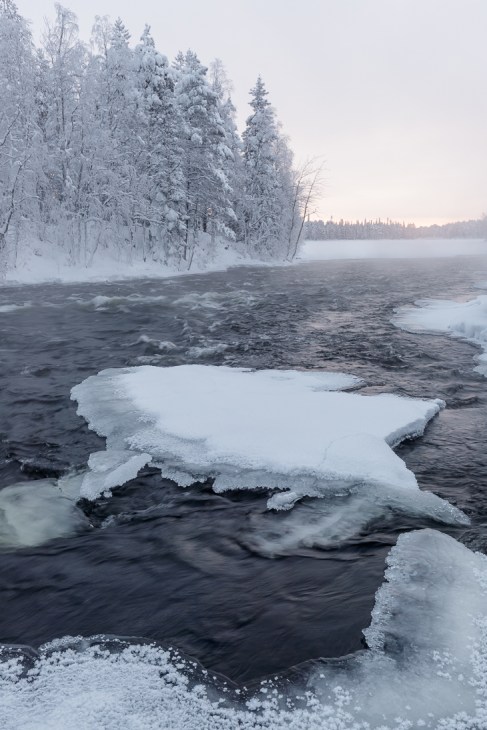
Our third day took us to the Kuusamo region where we spent time searching for otters whilst photographing Dippers and the frozen river landscape.

On day four and day five we headed up to one of the private hides frequented by  a pair of Golden Eagles. One of the largest eagles in the world, the Golden Eagle is splendid and magnificent; its golden feathers a stunning contrast to the white snow. We had many hours with the eagles as well as Black Woodpecker, Great Spotted Woodpecker, Grey headed woodpecker, Siberian Jays, Siberian and Crested Tits and more. These were highly productive days that produced some fabulous images.

On Day six we spent the majority of our time photographing playful otters during frequent snow showers on the banks of one of the many frozen lakes. Otters are fantastic critters to photograph as they play in the snow and water. We also took some time to look for both Hawk Owl and Great Gray Owls but were unsuccessful in our search. Owls can be elusive and this time we were not able to find or photograph them (despite having access to many spotters in the field).

On Day seven we photographed both the landscape area of Kuusamo including the wonderful U-bend river as well as returning for the otters.

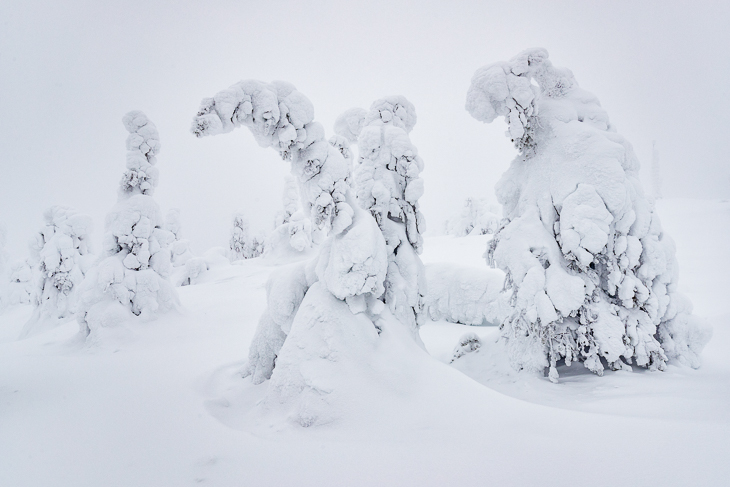
On our final day we took snow mobiles on a 65km return journey up to the Russian border on top of one of the regions hills to photograph the incredible frozen trees. We were not blessed with great light unfortunately and the heavily overcast conditions meant contrast was extremely low. The alien like forms of the frozen trees are are extremely photogenic however and there were good opportunities despite the low cloud and lack of contrast.

Winter is simply a wonderful time to visit Northern Finland. And as such I will be returning to this region again in February of 2021 to lead another Winter safari to both the Kajaani and Kuusamo regions. If you would like to join me, or would like any more information please just drop me an email at info@jholko.com No obligation at this point.