It has been almost a year since I was in Iceland on my photographic expedition in July and August 2010. Since I have been back I have been on many other photographic trips and shoots – some local and some further afield. Yet, it is the many thousands of frames I took in Iceland that consistently draw me back for further editing and processing. It is this further editing and processing of photographs that has made me realise the importance of what I am calling ‘staring time’. That is, the importance of time to do nothing more than visually stare at a photograph so as to give both the conscious and sub conscious mind the chance to fully absorb and understand all of the subtleties and nuances of the photograph. It is not until the mind (at least my mind) has spent a significant amount of time staring at a photograph (often over multiple evenings and even weeks) that I feel I have fully understood what the photograph might need to truly ‘sing’ form a processing perspective. Subtle burning and dodging in just the right area, a slight colour temperature tweak or a different crop can often be the difference between a great photograph and one that truly shines. Staring time gives my mind the clarity in relation to the photograph to try and make those adjustments. It doesn’t always work and occasionally I find myself being unable to see the wood for the trees. In such circumstances I often find it useful to put the photograph away and revisit it at a later date.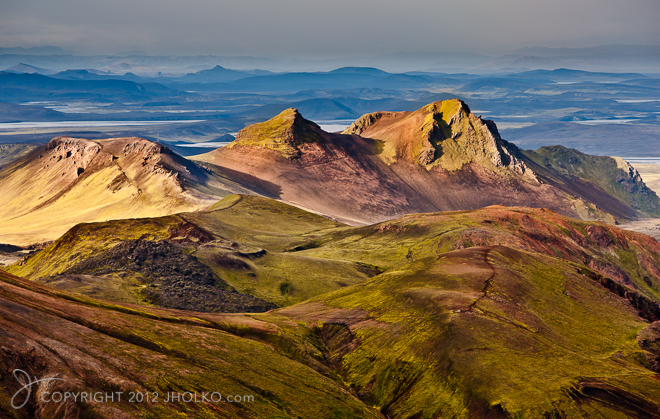 There is no hard and fast rule for staring time. Sometimes (rarely) I find there is quite literally no staring time required. The photograph comes into Lightroom off the CF card, is cropped, processed and exported as a Tiff in its completed iteration. This can be a process that takes no more than a few minutes. Alternatively it can be a long, slow and iterative process that might take any where from an hour to a few weeks (as is usually the case for me).
I want to use this photograph below from Landmannalaugar as an example of what I am driving at. This photograph has resided in my Lightroom library since I returned from Iceland in August 2010. It sat, unnoticed, unloved and unprocessed until a week or so ago when I was casually reviewing files from various shoots late one evening before bed. Something just clicked for me when this file came up and I realised I had a potential gem – a proverbial diamond in the rough. It was late however, and I was tired so I added the image to a quick collection for easier reference later and went to bed.
The next day I eagerly sat down in front of my computer and began to process the image. As is usual for me the first thing I like to do is to set both the white and black point correctly (to restore a lot of the contrast that is in the photograph – but not displayed on screen when the RAW file is imported. This gives me a pretty good indication right off the bat what I am dealing with in terms of how the final image will look. Many images never make it past this point for me. After setting the white and black point I tweak the color temperature and tint before setting the crop for the image. I will clean up any dust spots and then start to fiddle with the tone curve and other controls. This is where staring time enters the processing equation. I find it necessary to often make an adjustment and then just stop and stare for a while; perhaps even leaving the image and coming back to it later – sometimes after a cup of coffee or sometimes another day. This staring time gives me a greater sense of clarity about wether the change I made produced the desired result. Its a back and forth process that may sound somewhat counter intuitive; but it works for me. This photograph from Landmannalaugar is one such photograph that has absorbed significant staring time. Throughout the processing of this photograph I just stopped and stared more than I perhaps care to accurately recall. In short, I spent a lot of time staring at this photograph, making small subtle changes to really make it sing to me. In the end if I look at the history tab in Lightroom what I find is a list of many changes that were made, unmade, sometimes remade in another form before I ended up at the final photograph. What this tells me is that me (the photographer) had to go on a unknown journey to get to my final destination. I could not simply plot a direct course from point A to point B to arrive at my final photograph. I was forced (ok forced is a little too strong a word) to find my way there by trying varying paths. At the risk of being somewhat controversial this is perhaps one of the key difference between producing a photojournalistic style record of an event (a snapshot) and Art.
Now; if staring time is so important during processing of the photograph it must therefore be equally important during the actual taking of the photograph – it stands to reason. I believe this photograph also illustrates this point. This photograph was taken after spending three hours at the top of one of Landmannalaugar’s highest mountains in the freezing arctic winds waiting for light. I have blogged about this days shoot before so wont repeat the story, but I had a lot of time to stare at the scene during this time; which ultimately lead me to my final composition. Perhaps if I had arrived just as the light was turning magical I would not have been able to make this photograph? The importance of staring time in my photography is considerable and it is a timely reminder for me of its importance on the eve of my trip to New Zealand’s South Island and Antarctica later this year.
A higher resolution version of this photograph is also on my Portfolio website under Iceland at www.jholko.com