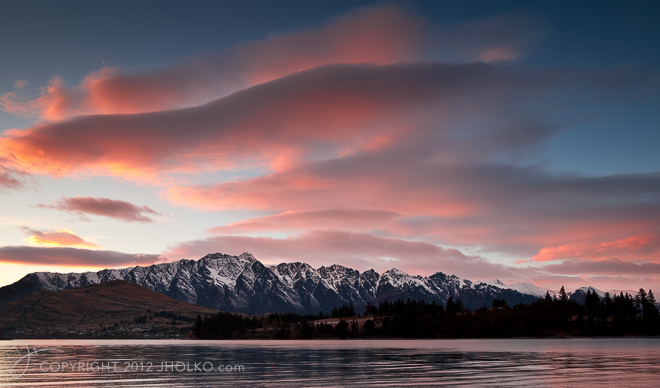
During my two weeks in the South Island of New Zealand last year I had several opportunities to photograph The Remarkables on the foreshore of Lake Wakatipu in Queenstown. This is a wonderful location for landscape photography – not to mention convenient. One can simply wander down from one of the many restaurants before or after dinner, set up, get the shot and then wander back for an evening night cap – pretty civilised stuff and a pleasant change from hours of driving and hiking.
The Remarkables make a stunning back drop to the view across the Lake and the whole scene comes alive with evening light and soft cloud. I was fortunate to get one really good sunset with some lovely soft lenticular clouds to offset the jagged peaks of the Remarkables themselves. Photographed with the Canon EOS 1DS MKIII and 24mm F1.4L MKII at F11 ISO 100 with a 3 stop hard graduated neutral density filter exposure time was still only a quarter of a second (the setting sun is just out of frame on the left). This was pretty much F11 and be there.
As time ticks past and the volcanic eruption in Iceland continues I am becoming ever so slightly more confident that I just might get my chance to photograph this spectacular natural event when I arrive in late July this year – all fingers are still crossed. Irish photographer Peter Cox has recently returned from the eruption site and has written a short essay on how best to photograph the eruption – available on the Luminous Landscape. Thanks Peter! Your essay is very timely and appreciated.
This is the third and final photograph I am going to post from the recent trip to the Pinnacles at Cape Woolamai in Victoria. I rarely do black and white images; I just see the world in colour and its colour that usually catches my eye and appeals to me in a photograph. It’s not that I don’t appreciate a really good black and white image – because I certainly do; and I am very glad there are photographers out there who specialise in this classic medium (and very glad of publications such as LensWork). That said, I new this image would be black and white before I even released the shutter. I was clambering over the boulders waiting for the light to improve when I spied one boulder that was much lighter in colour than all of those around it – the odd one out. It just screamed black and white to me and as I have learned it is usually best to go with my first instinct for a photograph. So, I framed it, shot it and converted it to greyscale in Lightroom and set about some minimal dodging and burning. I have also applied a very subtle tint to the final photograph. The shot works in colour as well, but its the black and white tones that simplify and enhance this photograph for me.
I had a chance today with the Anzac day public holiday to get out and do some photography. I had been itching to try out the new LEE ‘Big Stopper‘ 10 stop Neutral Density filter I purchased a few days ago and today was my first opportunity. I set my alarm for 5:00am, crawled out of bed, grabbed my gear and headed out to the Yarra Valley in the hopes of a good sunrise and some Autumn/Fall colour. The golden colours in the leaves are just starting to peak in certain parts of the Yarra Valley at the moment (in particular in the many vineyards) and I was hoping to be able to capture a little bit of it.
There was a thick fog as dawn broke and unfortunately no sign of colour in the sky. Normally, I get quite excited when we have a fog as the photographic opportunities are usually wonderful. However, this time the fog was thick and was obscuring the colour I was looking for. I have not been able to crack a really good Autumn sunrise recently despite several attempts (I will just have to keep trying, and it gives me a reason to go back). Thankfully, the dawn fog quickly burned off in the morning sun whilst I enjoyed a cafe lat’e in one of the many Yarra Glenn Cafe’s. With the fog gone the morning had developed into a glorious sunny day with some lovely high cloud that was very photogenic.
These two photographs were shot about an hour and a half after sunrise at the Yarrawood winery (actually its the same photograph with a different crop as I could not decide which I prefer?). I scouted this location more than a year ago and had kept it in the back of my mind for its beautiful lake with the old rowing boat set against the vine yards. I used my 24mm lens in combination with the LEE Big Stopper to give me a 13.0 second exposure in bright sunlight at F8/ ISO 100. Contrary to how it might appear I did not use a polariser. The long exposure has captured the clouds streaking across the sky and has added a good deal of drama to the image. Metering with this new filter is quite easy in the field. Just meter the scene as normal without the Big Stopper in place, then slide the filter into place and consult the handy LEE exposure chart to determine the corrected exposure. Switch the camera to Manual or Bulb, set the exposure accordingly and the exposure will be correct. Its a little more fiddly than just pressing the shutter, but after a half dozen frames or so I pretty much had it nailed and could do it quite quickly. The soft mount system of the Big Stopper is very effective in keeping out extraneous light and the fit is firm and feels good in the filter holder.
Cloud WarpCloud Warp
One of the first tests I did with the new filter was to shoot exactly the same scene with and without the Big Stopper in place so that I could compare them side by side in Lightroom for any noticeable flaws such as a colour cast. I am happy to report as expected that there is no noticeable colour cast with this filter in place (as is the case with all of LEE’s ND and Grad ND filters). Overall I am very pleased with this new ‘Big Stopper’ filter. It provides the ability to keep shooting long after sunrise and still create dramatic photographs in the right conditions. This filter is now a permanent addition to my photographic kit and I suspect will see quite a bit of use in shoots to come.
This was one of my final frames during the sunset shoot at the Pinnacles. Although I prefer the photograph below for the lovely bit of warm light in the foreground this shot does actually show the Pinnacles in all their glory – they truly are remarkable. Technically, it was a very difficult photograph to make because the sun was setting directly behind the rock formations silhouetting the Pinnacles. There was very little in the way of overhead cloud to reflect light back onto the rocks; which meant deep dark shadows. I used a 3-stop soft graduated neutral density filter to pull back the sky and exposed the scene for the secondary highlights allowing the shadows to fall where they may. I let the very brightest part of the setting sun clip and then pulled it back in Lightroom with the recovery slider. I new I would be able to get away with this as it would only clip in the red channel making recovery a cinch. This approach allowed me to capture pretty much the entire dynamic range on the Canon 1DS MK3. I used a cable release with mirror lock-up and timed my shots to the incoming waves. Post processing in Lightroom allowed me to add some fill light and tone curve adjustments to brighten up the dark shadows and otherwise correct the image. The end result is a photograph I am very pleased with. A higher resolution version is on my website at www.jholko.com in the Australian Portfolio.