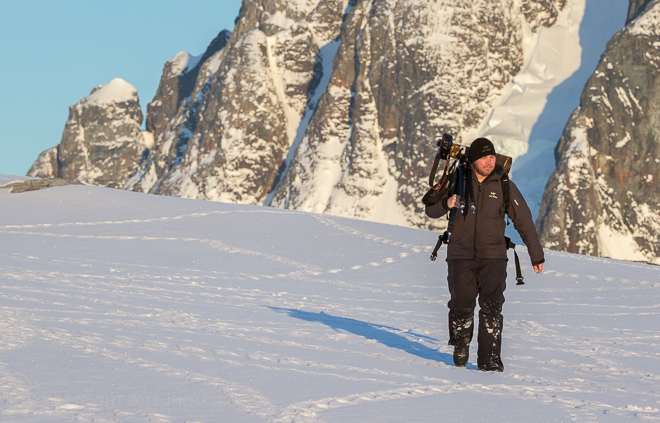
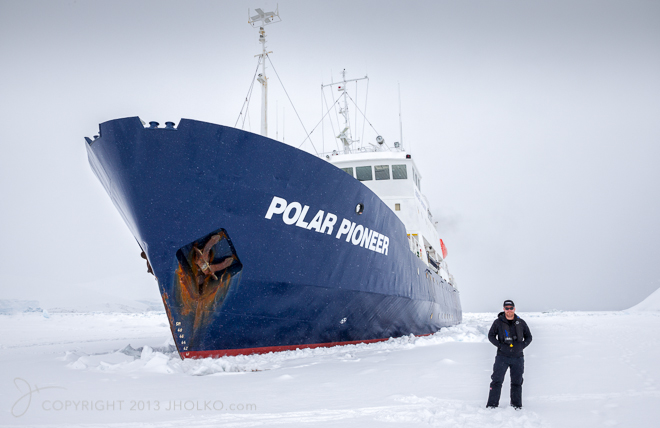
In November this year I lead a dedicated photographic expedition to Antarctica with my good friend Daniel Bergmann. This expedition had been more than twelve months in the planning and utilised the ice hardened expedition class ship ‘Polar Pioneer’. Polar Pioneer is an ex Russian survey ship that has been refitted for polar expeditions to both Antarctica and the Arctic. It’s ice hardened hull and low decks make it the ideal vessel for polar photography. The expedition was for a strictly limited number of 50 participants plus leaders and expedition guide and offered an extended period in Antarctica (15 Day / 14 night Expedition). Whilst most trips to Antarctica take 100+ tourists this expedition was capped at a maximum of 50 dedicated photographers in order to ensure the best possible experience for all aboard. As it turned out we ended up with just under 50 due to a last minute cancellation which worked in our favour with a smaller number of photographers per zodiac. Many first time Antarctic travellers are unaware of the benefits of travelling in small groups such as this. It is worth noting that many of the locations in Antarctica forbid landing more than 100 people at a time. That means that if you are part of a much larger group you have to draw lots and wait your turn to go ashore and likely miss out on opportunities and great light. We had no such restrictions on this expedition and were able to land all of those photographers who wished to go ashore at each of our chosen landing points. The expedition included special access into areas normally restricted to scientific research (including the Polish Station ‘Arctowski’), as well as taking in amazing locations such as the breathtaking Lemaire Channel, the Gerlache Strait and the surreal geothermal Deception Island, to name but a few. At the conclusion of the expedition we sailed across to the Falkland Islands; which avoided the worst of the Drake Passage and gave those of us who wished an opportunity to stay on in the Falklands for more photography. As it turned out we ended up experiencing bigger seas on our return journey to the Falklands than we did on our journey across the Drake – c’est la vie. I chose to spend a week after the Antarctica expedition on the Chile side of Patagonia and will have more to say about my experiences in Patagonia in a future post.
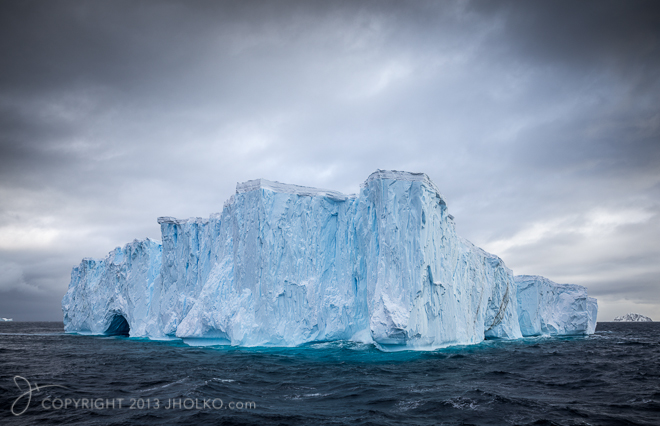
 For those of you reading this who have not been to Antarctica before it is impossible to put into words what this continent is truly like. Antarctica is nothing short of miraculous – A continent of stark and beautiful desolation. I know of no other place on the planet that is so remote and so difficult to reach, yet so hauntingly beautiful. It is a landscape of precipitous mountains and glaciers that is bathed in soft polar light. There are deep iridescent blues and aquamarine colours to be found in the myriad of icebergs that drift through the straits, seas and oceans that surround the continent that fall far outside what one would expect from Nature’s box of crayons. The sky frequently displays incredible cloud formations including some of the largest and most impressive lenticular cloud formations I have ever seen. Antarctica is the definition of a pristine wilderness – ice, icebergs, mountains, glaciers, birds, penguins, whales, seals and a myriad of other wildlife. Mother Nature is truly a mad scientist and Antarctica is her greatest achievement.
 Travelling to Antarctica is always an adventure and we began our adventure in the small town of Ushuaia at the bottom of South America where we boarded Polar Pioneer and sailed across the notorious Drake Passage. The Drake Passage is always somewhat of a gamble. On my first trip to Antarctica I experienced huge seas with 25+ foot waves that caused the boat to pitch and roll relentlessly during our crossing. I recall not less than half the ship hiding in their cabins suffering from seasickness during this crossing. On this this expedition we were exceptionally fortunate and experienced the ‘Drake Lake’. Our crossing was smooth and calm by ‘Drake standards’ and we made good time arriving in Antarctica a few hours earlier than expected. Congratulations to my friend Martyn Lucas for winning the prize of spotting the first iceberg during our crossing.
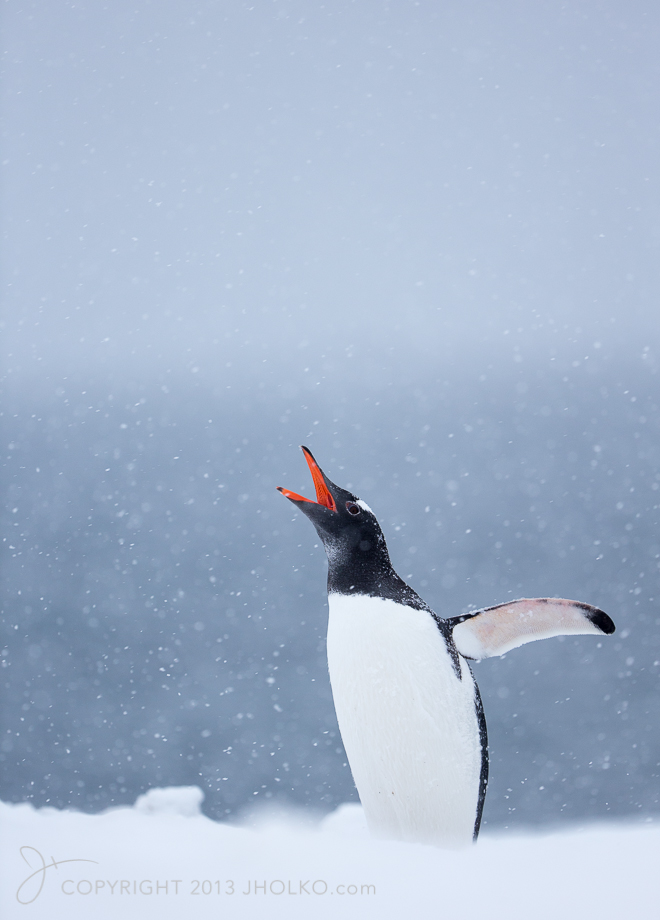
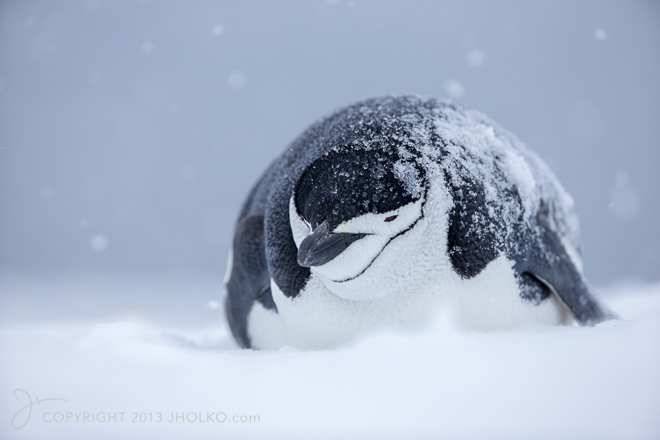 We experienced a broad range of weather and conditions during our expedition that included everything from brilliant sunshine to driving snow and freezing katabatic winds. Thankfully we only experienced one day of blazing sunshine during our time in Antarctica and even then we had sporadic cloud cover. Antarctica is brilliant with deep blue skies and glistening ice when the sun is shinning but these conditions prove extremely problematic for photography with extreme contrast ranges that are impossible to capture in a single frame. Overcast conditions and dark and ominous skies are by far my preferred shooting conditions and my wish for these conditions was fulfilled in spades. Overcast conditions really bring out the blue in the ice and we enjoyed some fantastic polar light during our time in Antarctica. This particular photograph of penguins marching across the sea ice under soft polar light is one my personal favourites from this expedition.
  During the expedition we landed at multiple locations along the peninsula, cruised for icebergs and wildlife in zodiacs and navigated narrows passages such as the Lemaire Channel in our ship Polar Pioneer. Over the course of our time in Antarctica we visited and landed at Brown Bluff and Brown Station, Cuverville and Halfmoon Island, Hydrurga Rocks and Neko Harbor, Whalers Bay (Deception Island), Petermann Island, Port Lockroy at Goudier Island and Point Wild on the North coast of Elephant Island (click on each of these links for a detailed PDF containing information about each location). We also cruised through the Lemaire Channel which proved not only the highlight of this expedition, but also one of the photographic highlights of many participants careers (myself included). It was a remarkable experience. We had arrived at the entrance to Lemaire Channel around 3am in the morning just as the first pangs of light were signalling the breaking dawn. The skies were heavily overcast and grey and the channel was clagged in with low cloud and fog – it was looking anything but promising. Another ship (the Ocean Nova) had been hanging around for two days prior to our arrival unsure of wether to attempt the passage. I was having serious doubts myself about our ability to navigate the channel so early in the season and about the photographic possibilities in the grotty weather. Undaunted we began our journey into the Lemaire and as if someone flicked a light switch the skies cleared and we experienced and enjoyed incredible mountain reflections in the still black Antarctic waters. I recall putting my cameras down for only a few moments during our passage through the Lemaire and only then to pause for breath and take in the sheer beauty of this location and the sheer delight of sharing it with so many passionate photographers. Our passage through the Lemaire proved doubly special as we were the first ship of the season to navigate through the channel. This day also proved our longest shooting day with an afternoon and evening landing at Petermann Island that saw us photographing in perfect light conditions until well after midnight. Those of us who still had some energy stayed up and photographed our return journey through the Lemaire under a full moon. Had we not shot a single frame for the rest of the trip the entire journey would have been worth the Lemaire Channel and Petermann Island experience. Kevin Raber at the Luminous Landscape who was a participant on this expedition (and also has written his own Trip Report) as a representative of medium format camera manufacturer Phase One called it ‘One of the finest days of his life‘. I would have to agree with him.

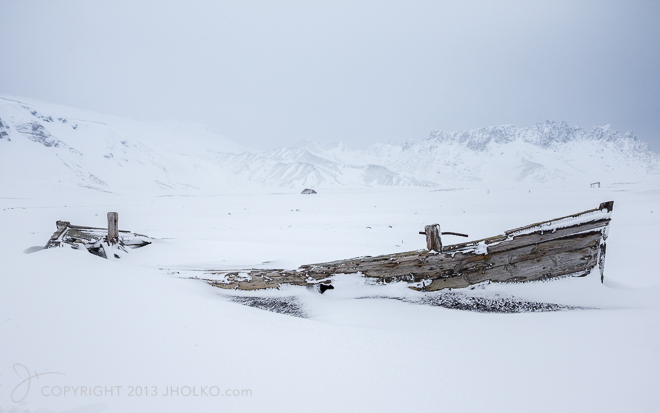
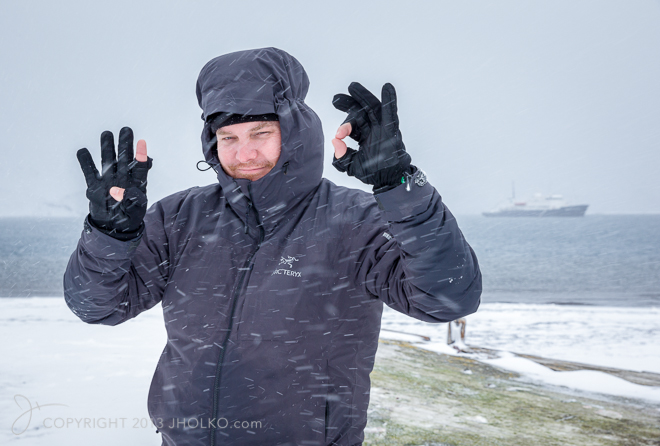
 One of the other key highlights of this expedition was our landing at Whalers Bay at Deception Island. We arrived at the entrance to Neptune’s Bellows at sunrise and made our way slowly into the bay where we made anchor. We were blessed with some wonderful golden light as we entered the bay that saw everyone up on deck making the most of the opportunity. The entrance into Whaler’s Bay is incredibly impressive. Navigating through the craggy outcrops of ‘Neptune’s Bellows’ is a very surreal experience. Once anchored and we had made our way ashore it began to snow heavily. Snow blanketed the black beach, ruined whalers station remnants and geothermal areas and provided us with some really unique photographic opportunities. This was the first time I have experienced Deception Island covered in snow and it is not a scene I will quickly forget. We spent over four hours ashore photographing the landscape and remnants of the whaling station in conditions that can only be described as challenging. We experienced a lot of snow fall during this expedition but Deception Island was the heaviest I can recall shooting in.
 One of the other unique experiences we had during this expedition was to park our 72 metre ship in the sea ice at Port Lockroy and disembark for a stroll on the ice. Port Lockroy is located in a natural bay at Goudier Island and is flanked by a glacier that rings half the bay. The glacier makes for really interesting photography on top of the experience of walking on the pack ice. I spent an hour or so photographing this glacier before I realised that what it really needed was the inclusion of the human element for scale – so selfie to the rescue! During our time at Port Lockroy we also visited the Antarctic base and local Penguin colony.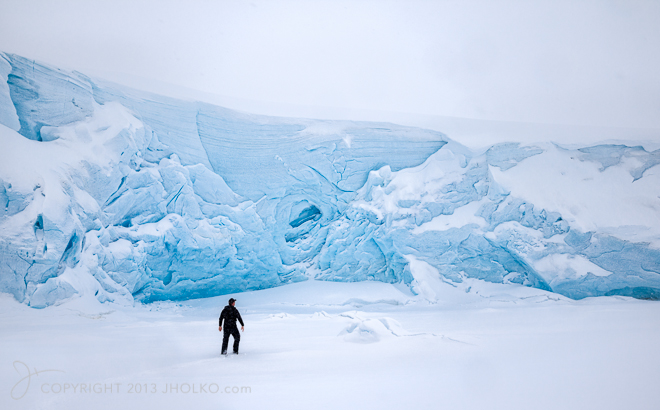
 During this expedition I shot more than 7000 images and since returning home have only just begun the editing and processing process. The few images I have posted here are just the ones that jumped out at me from a first pass. Much like my previous trips to Antarctica, I feel it will be many months (possibly years) before I have mined all the jewels from this expedition. Many of the participants on this trip shot well in excess of 7000 images and have already begun to share their work through their websites and social media. Some fabulous photography has already emerged and I am very much looking forward to seeing more photographs over the coming weeks and months.
 This was an extremely successful expedition to Antarctica with a broad cross section of participants that included some very talented, well known and respected photographers. It was a real pleasure to share this experience with all aboard and I want to thank them again for their input into the collective group. These expeditions require an incredible amount of logistical organisation along with a good dose of planning, timing, weather and luck to be so successful. They also require participants who are dedicated and passionate about their photography and it would be remiss of me not to thank all of them greatly for their contributions towards this expedition. It could not have been successful without them. I was fortunate to also celebrate my 40th Birthday in Antarctica and I could not have wished for a better ground of photographers to share in the experience.
 You can view the GPS tracking of this expedition online HERE. High resolution versions of many of these photographs can be seen on my website at www.jholko.com in the Antarctica Portfolios. I will be posting more photographs from this expedition both here on my blog and on my primary website over the coming weeks and months as time permits. Wildlife Biologist and Photographer Chris Gamel joined me on this expedition and has also posted a gallery of his favourite images on his website at www.chrisgamel.com. You can also see photographs from this expedition from Nature photographer Clemens Van Der Werf at www.clemensvanderwerf.com. If you have never travelled on this sort of photography expedition and you would like to get an idea of what it is like be sure to watch the video below.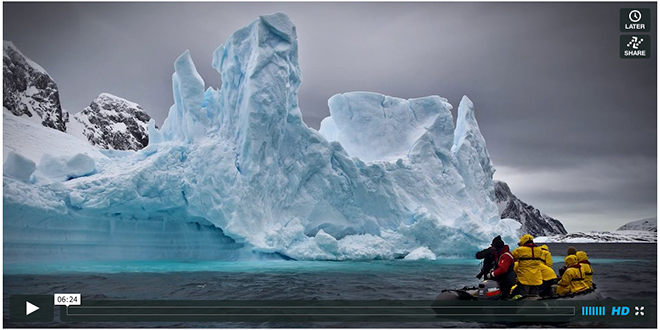
If you are interested in travelling to Antarctica I will be leading a new expedition to South Georgia Island and Antarctica in November 2014 aboard Polar Pioneer with my friend Andy Biggs. This expedition departs Ushuaia in South America on the 3rd of November and docks back in Ushuaia on the 22nd of November 2014. The expedition is dedicated to photography (both landscape and wildlife) and there are limited places remaining. You can read details of this trip HERE or email me if you would like additional information.

 Speaking of gear: I have been receiving sporadic emails since my pre-release video review of the 200-400 lens last year asking me if I know when Canon is going to release its new high end, high mega pixel camera. I know gear talk (and particularly rumours) is the focus of many photography websites, forums and blogs as it creates more website traffic than any other topic in photography. However, I have made a concerted effort to avoid spurious gear talk here on my blog as a general rule and prefer to focus on images rather than equipment. Canon Rumours is probably the best source on the release of new cameras from Canon and they do a good job of reporting the news and rumours. The truth is I actually have no idea when Canon will release a new high mega pixel camera and can offer nothing more than an educated guess at this point. Even if I did know Canon would likely have me under a non-disclosure agreement in any case which would prevent me from discussing it. For those of you who may be into guesses; my best guess would be an announcement by the end of March with a delivery date of sometime later in the year (but don’t take that to the bank). As to how many mega pixels the camera will have and how much it will cost I wold guess somewhere around 40 mega pixels and likely somewhere around $8000 USD provided it ships in a 1-Series body. If it ships in a 5 series body I would expect the price to be closer to $5000 USD. Quite honestly I no longer pine for such a camera and have stopped paying attention to most of the rumours surrounding its release. I am very happy shooting with the 18 mega pixel 1DX at present. It is quite simply the best DSLR I have ever used. 18 mega pixels is more than enough for most of my application needs and the high ISO and auto focus performance are blisteringly good. The Canon 1DX will remain my primary camera for 2014 along with my 1DSMKIII as a back up. The only other planned addition I will be making to my camera and lens arsenal early this year is to invest in Canon’s 600mm F4L IS MKII lens and a pair of Leica UltraVid HD binoculars for spotting wildlife.