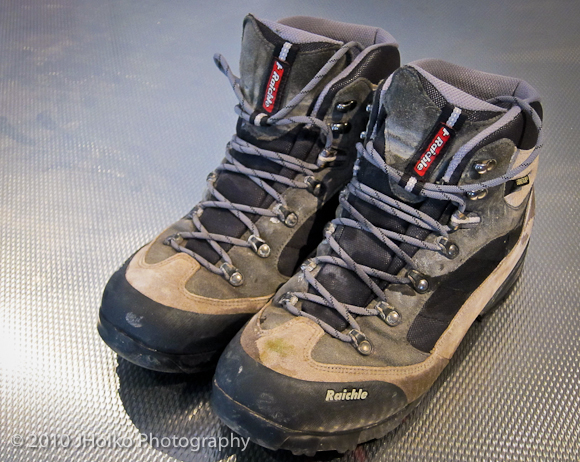
Upsetting customs officials when you first enter a foreign country is never a good idea. Yet, this is something I almost achieved last year in the South Island of New Zealand when I got pinged for packing my favourite trekking boots in a rather dirty state. Lesson learned – Never pack a pair of dirty or muddy trekking boots in your baggage without giving them a good scrub and clean before you leave home. Customs in many countries have strict quarantine procedures to protect their individual and often unique eco systems and can either confiscate or fine you accordingly for either not declaring muddy boots and/or not cleaning them before entering a foreign country. Always better to be safe and clean them before leaving home.
For the travelling Landscape, Nature and Wilderness photographer there are some significant international travel hurdles to overcome. Not the least of which is the ‘light weight’ carry on restrictions enforced by pretty much all the airlines nowadays (I don’t know anyone who is willing to check their expensive camera gear in general baggage). To this end I have spent the better part of this evening balancing out my photographic equipment between my two camera bags to meet the individual ‘carry-on’ bag weight limits, but yet maintain a reasonable sense of order for working in the field. A task that is not as easy as it might first sound, but I pretty much have it sorted now. I posted a full equipment list in an earlier post HERE. My Canon 1DSMK3 is in my Lowe Pro Nature Trekker bag with the 24mm F1.4L MKII lens attached. This bag also holds the 17mm TSE F4 lens, the 50mm F1.2L lens, a 1.4 MKII Tele-extender, a macro extension tube, the Canon S90 Point and Shoot, all of my graduated filters, adapters and polarisers, spare battery, lens hoods, rocket blower and other accessories such as memory cards and bubble level. It tips the scales right on the 8 kilogram limit. The second smaller Lowe Pro bag has my 70-200 F2.8L IS and 300mm F2.8L IS lens along with my RRS Ball-head. The Canon 85mm F1.2L MKII lens is staying at home. My tripod is going inside my main luggage suitcase. Worst case, if the airlines loose my luggage I can always buy another tripod in Iceland and use my RRS ball-head which I carried on board.
Continuing the ‘avian’ theme this Pelican at Healesville seemed more than content to pose for what was probably the easiest animal portrait I have yet taken in this series.
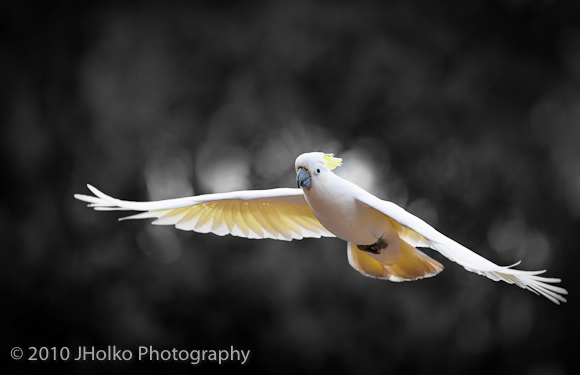
Another from the same photo shoot as the Emu photograph ‘Eye-to-Eye‘. This time of the Australian Cockatoo in flight at Healesville. I shot this with the Canon 300mm F2.8L IS wide open at F2.8 ISO400 1/2000th of a second to freeze the action. Tracking birds in flight is not easy – this was one of only a few good sharp frames where I was also very happy with the pose. In order to make the Cockatoo better stand out from the background I created a second layer in Photoshop, converted it to Black and White and then masked off the Cockatoo. This effect dramatically helps in isolating the bird and creating a clear point of focus.
I am starting to wind down my Wildlife Portraits project as its only a week now until I leave for Iceland and I have a seemingly never ending list of things I need to complete before I can leave. The plan was to run the project up until I left for Iceland. However, I have subsequently shot a lot more frames than I initially thought I would have and still have images to sort through and process. So, rather than finalise a project that feels somewhat incomplete I am simply going to put it on hold until I get back and have a chance to pick up where I am leaving off. I will then see the project through until the end of the year. The additional time should give me greater opportunity to expand the portfolio into a more complete form. I hope to still post a couple more images (including this photograph) before next week when the project will officially go on hold.